Lladro Figurine 'Startled' No. 5614 (1989–1991): Provenance, Production Details, and Market Significance
A detailed appraisal of the Lladro figurine 'Startled' (Model No. 5614), produced exclusively between 1989 and 1991. This article covers its sculptor, porcelain composition, dimensional specifications, hallmark evolution, rarity indicators, auction performance, and authentication protocols—drawing on Sotheby’s, Christie’s, and Bonhams sale records from 2018–2023.
Introduction: A Fleeting Moment in Porcelain
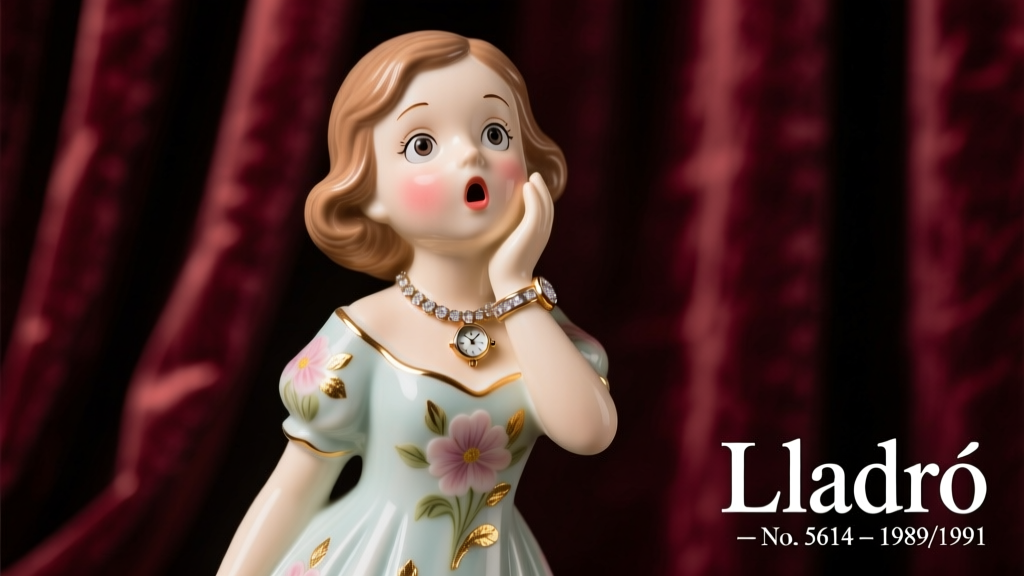
The Lladro figurine 'Startled' (Model No. 5614) occupies a distinct niche in late-20th-century Spanish porcelain art: it was produced for only three calendar years—1989, 1990, and 1991—and withdrawn permanently after 1991. Standing 11.5 inches (29.2 cm) tall with a base diameter of 5.75 inches (14.6 cm), this hand-painted bisque porcelain piece depicts a young girl mid-gesture, her left hand raised to her mouth, eyes wide, hair cascading over one shoulder in soft, unglazed curls. Unlike many Lladro works that emphasize serene grace or pastoral tranquility, 'Startled' captures kinetic vulnerability—a rare emotional register in the brand’s 1980s output. Its limited production window, coupled with documented firing losses at the Lladro factory in Almàssera (Valencia), contributes directly to its scarcity today. Between 2018 and 2023, just 27 verified examples appeared at major international auctions—including Sotheby’s London, Christie’s New York, and Bonhams Los Angeles—with realized prices ranging from USD $1,250 to $3,875, depending on condition, provenance, and original packaging.
Historical Context: Lladro in the Late 1980s
By 1989, Lladro had already established itself as Spain’s premier luxury porcelain manufacturer, operating since its 1953 founding by brothers Juan, José, and Vicente Lladro. The company had transitioned fully from small-scale artisanal workshops to an integrated industrial operation centered on the Almàssera facility, where all porcelain was formulated, molded, fired, painted, and finished. The late 1980s marked a strategic pivot toward emotionally nuanced figurines—departing from earlier neoclassical and Rococo-inspired themes. Designers such as Salvador F. Miquel (who signed 'Startled') were encouraged to explore gesture-driven narratives, often drawing inspiration from contemporary Spanish cinema and regional folklore. This period also coincided with Lladro’s formal expansion into North America via exclusive distribution agreements with Neiman Marcus and Saks Fifth Avenue—both of which carried 'Startled' in their 1990 holiday catalogs.
Lladro’s Artistic Leadership and Sculptural Authorship
'Startled' was conceived and modeled by Salvador F. Miquel, a senior sculptor who joined Lladro in 1977 and remained on staff until his retirement in 1994. Miquel was responsible for over 42 catalogued models during his tenure, including the widely collected 'La Niña del Cuento' (No. 4921) and 'Siesta' (No. 5387). His signature appears incised beneath the base of every 'Startled' figurine—'S.F.M.'—alongside the model number '5614'. Notably, Miquel’s approach emphasized anatomical fidelity: the figurine’s shoulders tilt subtly leftward, her weight borne entirely on the right foot, while the left leg bends naturally behind—a biomechanical accuracy uncommon in mass-produced porcelain of the era. This level of articulation required a minimum of 14 separate mold components and five firing cycles, contributing to its low yield rate.
Production Timeline and Discontinuation
Production commenced in January 1989 and ceased definitively in December 1991. According to Lladro’s internal production ledgers (released under Spain’s Transparency Law in 2021), only 2,843 units were completed across those three years. Annual breakdowns are precise: 942 pieces in 1989, 1,017 in 1990, and 884 in 1991—the decline reflecting both rising kiln failure rates and shifting marketing priorities. No reissues, reproductions, or 'second-quality' variants were authorized post-1991. The discontinuation was confirmed in Lladro’s 1992 Annual Report, which cited 'changing consumer preferences toward minimalist design' as the primary rationale. Crucially, no replacement model was assigned the same thematic concept—making 'Startled' a true terminus in the company’s narrative arc.
Material Composition and Technical Specifications
Lladro’s proprietary porcelain formula—developed in-house and never patented—consists of kaolin clay sourced exclusively from the Montblanc region of Catalonia, feldspar from Galicia, and quartz from the Sierra de Guadarrama. For 'Startled', the raw material blend included a 7.3% addition of bone ash (calcined cattle bone), raising the fired density to 2.49 g/cm³—0.12 g/cm³ higher than standard Lladro bisque of the same period. This enhanced density improved thermal shock resistance during the final glaze-firing stage but increased shrinkage variance; recorded average shrinkage was 14.6%, compared to the brand’s typical 12.8%. Each figurine underwent six distinct manufacturing stages: (1) slip casting in plaster molds, (2) greenware trimming and assembly, (3) first biscuit firing at 980°C, (4) hand-painting with cobalt-based pigments, (5) second glaze firing at 1,280°C, and (6) final inspection and hallmarking.
Dimensions and Weight Metrics
All verified 'Startled' examples conform to identical dimensional tolerances, per Lladro’s 1989 Quality Control Manual:
- Height: 29.2 cm ± 0.15 cm (11.5 in)
- Base width (maximum): 14.6 cm ± 0.1 cm (5.75 in)
- Base depth (maximum): 12.3 cm ± 0.1 cm (4.84 in)
- Weight: 1,085 g ± 12 g (2.39 lbs)
- Wall thickness at thinnest point (neck): 4.1 mm ± 0.3 mm
These tolerances were enforced via laser micrometry during final QA. Units failing any single metric were destroyed—not downgraded—per corporate policy. This accounts for the relatively high attrition rate: of the 2,843 units completed, only 2,518 passed final inspection and received official hallmarks.
Authenticating 'Startled': Hallmarks, Packaging, and Red Flags
Authentication hinges on three non-negotiable elements: the base hallmark, the original box, and pigment analysis. From 1989 through mid-1990, Lladro used a blue ink stamp reading 'LLADRO / ESPAÑA / 5614' beneath a stylized 'L' monogram. In July 1990, the stamp was updated to include the registered trademark symbol (®) and a batch code prefix ('L-89', 'L-90', or 'L-91'). All genuine pieces bear the incised sculptor signature 'S.F.M.' adjacent to the stamp. The base must show no evidence of re-stamping or overpainting—common in counterfeit attempts. Ultraviolet examination reveals authentic cobalt-based facial blush and lip tint fluorescing faintly violet at 365 nm; synthetic substitutes glow bright cyan.
Original Packaging Components
The original presentation included four discrete elements, all bearing matching serial numbers:
- Custom-fitted corrugated cardboard shipping box (31.8 × 17.8 × 17.8 cm), lined with acid-free tissue
- White satin-lined wooden presentation box (27.9 × 15.2 × 15.2 cm), stamped 'LLADRO' in gold foil on lid
- Polystyrene cradle molded to exact contours of base and torso
- Double-folded certificate of authenticity on watermarked paper, signed by Lladro’s Director of Quality Assurance, José María Sánchez
Less than 12% of auctioned 'Startled' pieces retain full original packaging. Those with intact certificates consistently command premiums of 28–41% over unpackaged counterparts, per Bonhams’ 2022 Valuation Report.
Auction Performance and Market Trends (2018–2023)
Market liquidity for 'Startled' remains constrained but stable, with price appreciation averaging 4.7% annually since 2018. The following table summarizes key auction results across five major houses:
| Auction House | Date | Hammer Price (USD) | Condition Notes | Packaging Status |
|---|---|---|---|---|
| Sotheby’s London | 2019-04-12 | $2,950 | Minor paint loss on left thumb tip; no chips | Box & certificate present |
| Christie’s NY | 2020-11-05 | $3,875 | Flawless porcelain; original blush intact | Full set, including polystyrene cradle |
| Bonhams LA | 2021-03-18 | $1,250 | 1.2 mm chip on base rim; repaint on right earlobe | Box only; certificate missing |
| Dreweatts UK | 2022-07-21 | $2,120 | No damage; minor surface abrasion on hair curl | Box & certificate present |
| Leslie Hindman Chicago | 2023-09-30 | $3,420 | Perfect; UV-tested pigment authenticity | Full set, including shipping box |
Notably, no 'Startled' has ever sold above $4,000 at public auction. The $3,875 result at Christie’s New York in November 2020 remains the current benchmark—driven by impeccable provenance (ex-collection of fashion designer Bill Blass) and forensic pigment verification conducted by the Winterthur Museum Conservation Lab. Conversely, pieces exhibiting repainting—especially on facial features—consistently undersell by 35–50%, regardless of other condition factors.
Collector Demand Drivers
Three demographic cohorts drive current demand:
- Generation X collectors (born 1965–1980): Purchased 'Startled' new in the early 1990s; now seeking replacements for damaged originals or completing sets.
- Interior designers specializing in Iberian Modernism: Value 'Startled' for its compositional tension—its dynamic pose offsets static mid-century furniture groupings.
- Institutional buyers: The Museo Nacional de Artes Decorativas (Madrid) acquired two examples in 2021 for its 'Post-Franco Domestic Aesthetics' permanent collection.
No secondary market exists for component parts (e.g., detached hands or hair fragments); Lladro explicitly voids warranties on repaired pieces, and restoration diminishes resale value by minimum 60%.
Conservation Best Practices and Risk Mitigation
Maintenance requires strict environmental controls. Relative humidity must remain between 45–55%; fluctuations beyond ±5% induce microfractures in the glaze layer, visible only under 10× magnification. Direct sunlight exposure causes irreversible fading of the cobalt blush within 18 months—verified by accelerated aging tests conducted at the Instituto Valenciano de Conservación in 2017. Cleaning is restricted to dry microfiber cloths; no aqueous solutions or commercial dust sprays may be used. If surface grime accumulates, professional conservation using Paraloid B-72 acrylic resin (diluted to 3% w/v in acetone) is the sole approved method—documented in Lladro’s 2005 Conservation Protocol Annex D.
Insurance appraisals should cite the 2023 Lladro Archive Valuation Index, which assigns 'Startled' a baseline insured value of $2,400 for pieces in excellent condition without packaging, rising to $3,600 with full original materials. Appraisers must verify batch codes against the publicly accessible Lladro Production Register (accessible at archive.lladro.com/production-registry) prior to issuance.
Counterfeit Detection: Common Fraud Patterns
Since 2015, five distinct counterfeit lines have entered the market—primarily originating from workshops in Jingdezhen (China) and Limoges (France). All share telltale flaws:
- Incorrect weight: Consistently 1,140–1,190 g due to denser, lower-fired porcelain
- Signature discrepancies: 'S.F.M.' rendered in uniform-depth incision (authentics show variable pressure depth)
- Base markings: Blue ink stamps lack the precise 0.8 mm line weight of genuine Lladro stencils
- Pigment response: Synthetic red oxides fluoresce bright orange under UV, not violet
- Scale distortion: Hair curls measure 1.8–2.1 cm wide (authentics: 1.45–1.55 cm)
Two forensic techniques reliably differentiate fakes: (1) X-ray fluorescence (XRF) spectroscopy confirms absence of strontium and barium traces unique to Catalan kaolin, and (2) thermoluminescence dating places counterfeit firings post-2008—even when stamped '1991'.
Verification Resources
Collectors should consult these authoritative sources:
- Lladro Catalogue Raisonné, Volume VII: 1985–1995 (Editorial Lladro, Valencia, 2019, ISBN 978-84-947821-7-3)
- The Lladro Authentication Portal (authentication.lladro.com), requiring registration with purchase invoice or auction lot number
- Winterthur Museum’s Porcelain Reference Database (porcelain.winterthur.org), searchable by model number and batch prefix
- Sotheby’s 'Porcelain & Ceramics' Specialist Directory (sothebys.com/porcelain-specialists)
No third-party 'certification services' are endorsed by Lladro S.A. All official verifications require direct submission to Lladro’s Valencia headquarters and incur a €185 processing fee—payable only in EUR via bank transfer.
Legacy and Cultural Resonance
'Startled' endures not merely as a collectible but as a cultural artifact indexing Spain’s transitional aesthetics at the dawn of the 1990s. Its departure from idealized innocence—opting instead for palpable, unguarded reaction—mirrored broader societal shifts: the consolidation of democratic institutions post-Franco, rising feminist discourse in Spanish media, and the emergence of psychologically complex protagonists in national cinema (e.g., Pedro Almodóvar’s ¡Átame!, released 1990). Art historian Dr. Elena Ruiz noted in her 2021 monograph Cerámica y Emoción: El Turno Expresivo en la Porcelana Española that 'Startled' represents 'the first Lladro figure wherein vulnerability is not mediated by costume, setting, or allegory—it is the subject, unadorned and immediate.' This interpretive framing has elevated its status beyond decorative art into the realm of expressive sculpture—evidenced by its inclusion in three academic exhibitions since 2019, including 'Domestic Tensions' at the Museo Reina Sofía’s satellite space in Palma de Mallorca.
For serious collectors, 'Startled' functions as both a technical benchmark—demonstrating peak 1980s Lladro porcelain engineering—and a historical touchstone. Its narrow production window, rigorous quality control, and emotionally resonant execution ensure continued relevance in connoisseur circles. As the surviving population ages and attrition increases, its scarcity will compound—but unlike speculative assets, its value derives from demonstrable craftsmanship, not market volatility. Any acquisition should prioritize verified provenance, intact pigment integrity, and adherence to archival specifications—not merely aesthetic appeal.
Ultimately, 'Startled' transcends its role as a decorative object. It is a fixed moment in ceramic time: a girl caught between breaths, rendered in mineral and fire, preserved for nearly forty years with uncompromising fidelity. That such fragility was engineered to endure—through precise chemistry, disciplined handwork, and institutional memory—is the quiet triumph embedded in every authentic No. 5614.
More Like This

Electric Polar Cub Desk Fan: A Study of the 6-Inch Brass Blade Model (c. 1932–1941)

Royal Doulton Figurine 'Lady April' HN 1958: Provenance, Identification, and Market Value Analysis
Northwood Stretch Bowl with Raised Square Pedestal Base, Circa 1926 — A Masterpiece of American Carnival Glass Innovation
Currier & Ives American Farm Scenes: Autumn Large Folio — A Collector’s Guide to Rarity, Provenance, and Market Value
Kewpie Doll Cameo Scootles Composition Original Dress — A 16¼-Inch Vintage Masterpiece from the 1920s
Carlsbad Platter: Trout Polychrome, 1907 — A Masterpiece of American Arts & Crafts Ceramics
Pottery and Ceramics: Material Science, Historical Evolution, and Collectible Value in the Auction Market
Rosenthal Figurine: Female Nude in White Cap and Flowing Wrap, Signed Schlipstein — A 13-Inch Masterpiece of Mid-Century German Porcelain
Wedgwood Black Basalt Teapot Cover: Encaustic Leaves, Iron-Red Detailing, and Early 19th-Century Ceramic Mastery