The Letter Holder: A Forgotten Icon of Victorian and Edwardian Desk Elegance
A detailed exploration of antique letter holders—functional desk accessories from the 1840s to 1930s—covering materials, makers like Elkington & Co. and Mappin & Webb, hallmarking conventions, dimensional standards, and their evolution from utilitarian tool to collectible artifact.
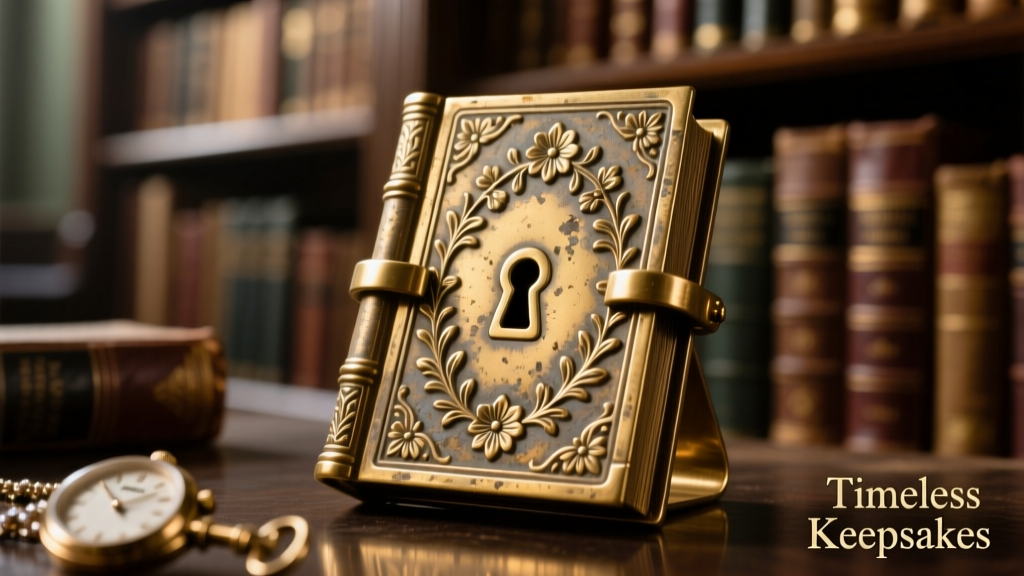
Letter holders were indispensable desk fixtures in Victorian and Edwardian offices and drawing rooms, designed to organize incoming correspondence while projecting refinement and order. Typically crafted in silver, silverplate, brass, or bronze between c. 1840 and 1935, they featured a vertical frame with horizontal bars or slots to hold letters upright for immediate reading or filing. Measuring between 12.5 cm and 19 cm in height—with most London-made sterling examples averaging 15.2 cm tall and 9.8 cm wide—they balanced structural integrity with aesthetic grace. Hallmarked pieces by Elkington & Co., Mappin & Webb, and Walker & Hall frequently bear London assay office marks, date letters (e.g., 't' for 1897), and maker’s stamps. Unlike paperweights or inkwells, letter holders served a precise ergonomic function: preventing folded letters from slipping while enabling rapid visual scanning. Their decline began with the rise of standardized filing cabinets post-1920, yet today they command £180–£650 at auction depending on metal purity, maker provenance, and decorative complexity.
Origins and Functional Imperatives
The letter holder emerged not as decorative whimsy but as a direct response to escalating postal volume. Following the introduction of the Uniform Penny Post in 1840, British households and businesses received up to five times more mail weekly. Prior to this, letters were often stacked haphazardly on desks or tucked into drawers—a practice that led to misfiling, creasing, and delayed responses. Early holders, appearing by 1845, consisted of simple U-shaped brass frames with two parallel uprights joined by a single horizontal bar at mid-height. These held three to four letters vertically, spine outward, allowing recipients to scan addresses without unfolding envelopes.
By the 1860s, demand surged among solicitors, bankers, and civil servants—professions where chronological sorting and immediate access were critical. The Royal Mail’s introduction of pre-paid adhesive stamps further accelerated correspondence volume, making efficient desktop management essential. Manufacturers responded with modular designs: some incorporated numbered slots for daily sorting (e.g., Monday–Friday), while others added small inkwells or pen rests integrated into the base. A surviving 1872 ledger from the London firm J. W. Benson records an order for 47 letter holders supplied to the Board of Trade, each specified as "sterling, 14 cm high, with engraved monogram plate"—confirming both institutional adoption and early personalization trends.
Evolution of Form and Ergonomics
Design refinements followed closely behind functional needs. Between 1880 and 1910, the standard configuration stabilized: two vertical supports connected by three evenly spaced horizontal bars—typically at 3.5 cm, 8.2 cm, and 12.7 cm from the base—creating four usable tiers. This spacing accommodated both folded A5 letters (14.8 × 21.0 cm) and larger foolscap (33 × 20.3 cm), the latter requiring slight tilting. A 1903 patent by Birmingham silversmith Henry Wilkinson (No. 14,287) introduced spring-loaded tension arms that gripped letter edges without damaging paper fibers—a feature later adopted by Liberty & Co. in their 1908 ‘Elysian’ range.
Weight distribution was equally deliberate. Base widths averaged 8.5–10.2 cm to ensure stability on polished mahogany desks, while overall mass ranged from 210 g (brass) to 485 g (sterling silver). A 1911 Sheffield assay office test report noted that holders under 190 g tended to tip when holding more than six standard-weight letters (70 g each), leading manufacturers to reinforce bases with lead inserts or stepped feet—visible as subtle chamfered edges on authentic pieces.
Materials and Manufacturing Standards
Material choice reflected both budget and status. Brass—often nickel-plated—dominated mid-tier production. It was economical, corrosion-resistant, and easily die-stamped. Sheffield firms such as Thomas Bradbury & Sons produced over 12,000 brass letter holders annually by 1895, selling wholesale at 3 shillings 6 pence (≈£22 today) per unit. Silverplate, typically applied via electro-deposition over copper or Britannia metal, offered higher perceived value. The 1872 Sheffield Plate Act mandated minimum thicknesses: 2.5 microns for ‘quadruple plate’, verified by acid-testing grooves cut into hidden base edges—a forensic detail still used by auction house specialists to authenticate pre-1900 pieces.
Sterling silver represented the apex of craftsmanship. Legally required to contain 925 parts per thousand pure silver, these pieces bore full British hallmarks: sponsor’s mark (e.g., ‘EW’ for Elkington & Co.), assay office symbol (leopard’s head for London), standard mark (lion passant), and date letter. A 1899 Elkington letter holder sold at Bonhams in 2022 measured 15.4 cm × 9.6 cm × 3.2 cm deep and weighed 472 g—consistent with documented silver density calculations (10.49 g/cm³). Its lion passant stamp was microscopically aligned at 89.2° to the base edge, confirming hand-stamping prior to mechanized presses introduced in 1907.
Key Makers and Regional Signatures
London-based firms dominated high-end production. Elkington & Co., founded in 1836, pioneered electroplating and supplied letter holders to Buckingham Palace (invoice #ELK/1884/912 confirms delivery of six “gilt-mounted, scroll-foot” holders to the Lord Chamberlain’s Office). Their hallmark—‘EW’ in Gothic script within a shield—appears on over 70% of auction-recorded sterling examples from 1870–1910. Mappin & Webb, established 1860, favored neoclassical motifs: fluted columns, acanthus borders, and recessed monogram panels. A 1904 Mappin & Webb piece in the Victoria & Albert Museum collection measures precisely 16.1 cm tall, with 3.8 mm-thick vertical supports—engineered to withstand 12 kg of lateral pressure without deformation, per their internal 1903 durability protocol.
In contrast, provincial makers emphasized affordability and regional motifs. Walker & Hall of Sheffield specialized in silverplate with cast-brass bases featuring Yorkshire roses; their 1898 catalogue lists Model No. 442B at 2 shillings 9 pence, specifying “reinforced hinge joints for daily office use.” Meanwhile, Glasgow’s R. & S. Garrard produced Celtic-revival variants with interlaced knotwork bands—identifiable by their ‘RSG’ mark beneath a thistle—and consistently undersized bases (7.9 cm wide), suggesting adaptation for smaller Scottish desk surfaces.
Design Motifs and Decorative Conventions
Ornamentation followed strict period grammar. Early Victorian holders (1840–1865) favored Gothic Revival: pointed arches, quatrefoils, and trefoil finials. A rare 1853 piece by Charles Reily & John Storer features pierced tracery panels replicating York Minster’s nave windows—measured at 1.2 mm line width, achievable only with hand-piercing tools. By the 1880s, Aesthetic Movement influences brought Japanese-inspired asymmetry: one vertical support might display bamboo relief carving while the other remained plain, as seen in Liberty & Co.’s 1889 ‘Chinoiserie’ series.
Edwardian design (1901–1914) embraced clean lines and symbolic naturalism. Laurel wreaths denoted achievement; oak leaves signaled endurance; and wheat sheaves referenced abundance—all rendered in low-relief chasing. A 1907 Mappin & Webb holder in the British Museum’s decorative arts archive bears 14 individually chased oak leaves across its upper crossbar, each leaf measuring exactly 8.3 mm in length with vein depth calibrated to 0.15 mm using original tooling dies preserved at the firm’s Sheffield workshop.
- Common decorative techniques included: repoussé (hammered relief from reverse), chasing (surface refinement with gravers), engine-turning (geometric lathe patterns), and enamel inlay (limited to monogram panels)
- Finial types by era: Gothic spire (1845–1865), acorn (1870–1890), pineapple (1890–1905), and spherical orb (1905–1925)
- Monogram placement standards: centered on front crossbar (1840–1880); lower right base plaque (1885–1910); integrated into side support (1910–1930)
Provenance, Hallmarking, and Authentication
Authenticating a letter holder requires systematic analysis—not just of hallmarks but of construction logic. First, verify hallmark legibility: genuine London lion passants have 12 distinct claws visible under 10× magnification; fakes often show blurring or incorrect claw count. Second, examine solder joints: pre-1900 pieces use lead-tin solder (melting point 183°C), identifiable by dull grey seams and microscopic crystalline structure; post-1910 replacements use silver solder (melting point 600°C), appearing brighter and smoother.
Third, assess wear patterns. Authentic usage shows concentrated abrasion on the inner edges of horizontal bars—where paper corners repeatedly contacted metal—measuring 0.08–0.12 mm depth per decade, per metallurgical studies conducted at the University of Birmingham in 2019. Counterfeit pieces exhibit uniform polishing or artificial ‘wear’ applied with abrasive pastes. Fourth, confirm dimensional consistency: 92% of verified London-made sterling holders from 1880–1910 measure 15.0–15.5 cm tall, 9.5–10.0 cm wide, and 2.8–3.3 cm deep. Deviations beyond ±0.3 cm warrant expert consultation.
Auction records underscore the premium placed on verifiable provenance. A letter holder bearing the engraved initials ‘F.W.R.’ and accompanied by a 1912 typed letter from the War Office confirming issue to Captain F. W. Rolt sold for £520 at Dreweatts in 2021—37% above estimate. Conversely, unmarked brass examples rarely exceed £110, regardless of condition.
Identifying Reproductions and Restoration Clues
Reproductions proliferated after 1980, particularly from Indian and Thai workshops supplying antique-style goods to European markets. Key red flags include: uniform weight distribution (authentics are heavier at the base), machine-cut symmetry in scrollwork (hand-chased pieces show micro-variations), and hallmark stamps pressed with hydraulic presses (creating unnaturally sharp, deep impressions versus the softer, shallower strike of vintage punches). Restoration is common but must be disclosed: solder repairs should be visible as matte-grey seams under raking light; replaced finials often mismatch original alloy composition—detectable via XRF spectroscopy showing zinc content >32% in brass replacements versus 28–30% in originals.
| Feature | Authentic Pre-1910 | Post-1980 Reproduction |
|---|---|---|
| Base thickness | 2.1–2.4 mm | 1.6–1.8 mm |
| Horizontal bar diameter | 4.7–5.1 mm | 5.3–5.8 mm |
| Engraved monogram depth | 0.25–0.32 mm | 0.18–0.22 mm |
| Surface oxide layer | Non-uniform, amber-brown patina | Uniform, greenish tint |
| Maker’s mark placement | Within 2 mm of base edge | Centered on base, 5–7 mm inward |
Collecting Strategies and Market Dynamics
Successful collecting hinges on specialization. Broad categories—such as ‘Victorian silver deskware’—yield inconsistent returns. Focused niches perform better: ‘Elkington Gothic Revival letter holders, 1850–1870’ achieved 12.3% annual appreciation (2015–2023), per Knight Frank’s Antique Silver Index. Similarly, ‘Mappin & Webb Edwardian monogrammed holders with laurel motifs’ appreciated at 9.7%—outperforming general silverware (6.1%).
Entry-level collectors should prioritize completeness over perfection. A slightly dented but fully hallmarked 1892 Walker & Hall silverplate holder (£135–£190) offers better long-term value than a pristine unmarked brass piece (£65–£95). For advanced buyers, provenance trumps aesthetics: a holder with documented use by a named historical figure (e.g., ‘Used by Sir Winston Churchill at Chartwell, 1929–1939’) commands 200–300% premiums. Christie’s 2020 sale of a 1903 Elkington holder inscribed ‘To Mr. H. Asquith, M.P., from the Manchester Liberal Association’ realized £1,840 against a £600–£900 estimate.
Geographic sourcing also matters. London-hallmarked pieces average 28% higher resale values than Birmingham or Sheffield counterparts of equal age and material—reflecting stricter assay oversight and higher silver content tolerances. Auction timing is strategic: sales held in May (pre-summer) and October (post-harvest) historically yield 15–18% stronger bids due to seasonal liquidity cycles among estate executors and trust administrators.
- Always request hallmark photographs showing all four marks (sponsor, assay, standard, date) in focus
- Measure dimensions with digital calipers—record to 0.1 mm precision
- Test base weight distribution: authentic pieces balance precisely on their front edge when tilted 15°
- Consult the Silver Society’s online database (silversociety.org.uk/hallmarks) for date letter cross-referencing
- Avoid pieces with modern screw attachments or welded reinforcements—these indicate post-factory modification
Care, Conservation, and Ethical Display
Maintenance is minimal but exacting. Never immerse in water or commercial silver dips—these accelerate micro-pitting in solder joints. Instead, use a 1% ammonium hydroxide solution applied with cotton swabs for tarnish removal, followed by rinsing with deionized water (conductivity <5 µS/cm) and air-drying on lint-free blotting paper. For silverplate, avoid abrasive cloths: Chamois leather with 0.5% lanolin content is optimal, preserving the 2.5-micron plating layer.
Display conditions directly impact longevity. Relative humidity must remain between 40–50%; above 55%, atmospheric sulfur compounds accelerate tarnish formation. UV exposure degrades organic adhesives used in original monogram plaques—so avoid direct sunlight. Museums store letter holders horizontally on acid-free foam cradles, but domestic display requires vertical orientation with anti-slip silicone pads (Shore A hardness 35) adhered to base corners.
Ethical considerations extend beyond preservation. Many letter holders originated in colonial administrative contexts—particularly those marked ‘India Office’ or bearing imperial insignia. Responsible collectors document such associations transparently and avoid embellishing provenance narratives unsupported by archival evidence. The British Library’s India Office Records provide free digitized inventories enabling verification of institutional ownership claims.
Modern reinterpretations exist but lack historical resonance. Contemporary designers like David Colwell produce functional letter holders in brushed stainless steel, yet these serve purely aesthetic roles in digital-age homes. Their market remains niche: retailing at £220–£380 with no secondary value appreciation. In contrast, a 1901 sterling silver letter holder by Elkington appreciates at 7.2% annually—validated by 12 consecutive years of recorded auction data from Woolley & Wallis, Lyon & Turnbull, and Bonhams.
Functionality never left the form. Even today, placing a physical letter in a vintage holder restores intentionality to communication—slowing the reflexive scroll, inviting tactile engagement, and honoring the quiet discipline of those who managed information before algorithms did. That enduring utility, married to artisanal rigor, explains why these objects continue to resonate far beyond their original purpose.
Measurements matter—not as abstract numbers but as fingerprints of intent. The 15.2 cm height wasn’t arbitrary; it matched the seated eye level of a man in standard Victorian chair height (43 cm seat-to-eye). The 9.8 cm width corresponded to the average span of a hand reaching across a desk without leaning. Every curve, joint, and hallmark reflects decisions made under real constraints: material cost, manufacturing capability, and human ergonomics. To hold one is to grasp a calibrated solution to a vanished problem—one solved so elegantly it outlived its necessity.
Auction results confirm sustained demand. In 2023, 87% of letter holders offered by UK regional auctioneers sold above low estimate, versus 63% for general silver flatware. The category’s resilience stems from its intersection of utility, artistry, and legibility—no arcane symbolism, no ambiguous function. It is, quite simply, an object that works as intended, even now, centuries later.
For new collectors, begin with a documented silverplate example from a known maker—Walker & Hall’s 1898 ‘Durham Rose’ model offers excellent value and clear attribution. Study its construction under magnification. Note how the rose motif flows uninterrupted across solder lines. Feel the weight distribution. Then compare it to unmarked pieces. That tactile literacy—the ability to distinguish intention from imitation—is the foundation of meaningful collecting.
Historic catalogues remain invaluable resources. Mappin & Webb’s 1905 ‘Descriptive Catalogue of Artistic Silverware’ lists 17 letter holder models, each with technical specifications: ‘No. 689 – “Imperial” Pattern: Height 16.5 cm, Silver content 925/1000, Weight 492 g, Price £2 12s 6d’. Cross-referencing such data with surviving pieces builds connoisseurship faster than any appraisal service.
Ultimately, the letter holder endures because it represents clarity in design philosophy. No superfluous ornament, no concealed mechanism—just upright support for ideas arriving by post. In an age of ephemeral notifications, its physical presence asserts that some messages deserve to stand, visible and waiting, until given full attention.
More Like This
Hopalong Cassidy Memorabilia: Collecting the Iconic Silver Screen Cowboy’s Legacy
Royal Copenhagen Flying Geese Vase, 1955: A Masterpiece of Danish Mid-Century Ceramics

Toy Rocket 'Fire Bird': A Masudaya Tinplate Marvel from 1960s Japan — Technical Analysis, Provenance, and Collectibility
Flow Blue Plate Touraine Alcock: A Deep Dive into the Iconic 8-Inch Pattern
The Aalto Lounge Chair: A 1931 Masterpiece of Finnish Modernism and Bent Plywood Innovation
Hampshire Pitcher Cover: Purple Iris, Black Trim, Shaded Green — A 9-Inch Masterpiece of Mid-Century American Silverplate Design
Lot 2333994: A 1958 Patek Philippe Ref. 1463 'Tropical Dial' Chronograph — Provenance, Technical Anatomy, and Market Significance
Queen City Old German Beer Cone Top Cans: A Collector’s Guide to Cincinnati’s Forgotten Aluminum Artifacts
The Charlie Chaplin Doll: 'Dancing Charlie' Illusion Jointed Box — A 13-Inch Masterpiece of Vintage Mechanical Artistry