Queen City Old German Beer Cone Top Cans: A Collector’s Guide to Cincinnati’s Forgotten Aluminum Artifacts
A detailed appraisal of Queen City Brewing Company’s 1950s–60s cone top beer cans—specifically the 'Old German' 12 oz aluminum variants—covering production history, can specifications, regional distribution, rarity tiers, authentication markers, and market valuation based on auction records from Heritage Auctions, Skinner, and Rinker’s Weekly Vintage Can Reports.
Introduction: The Fugitive Can That Defined a Midwest Moment
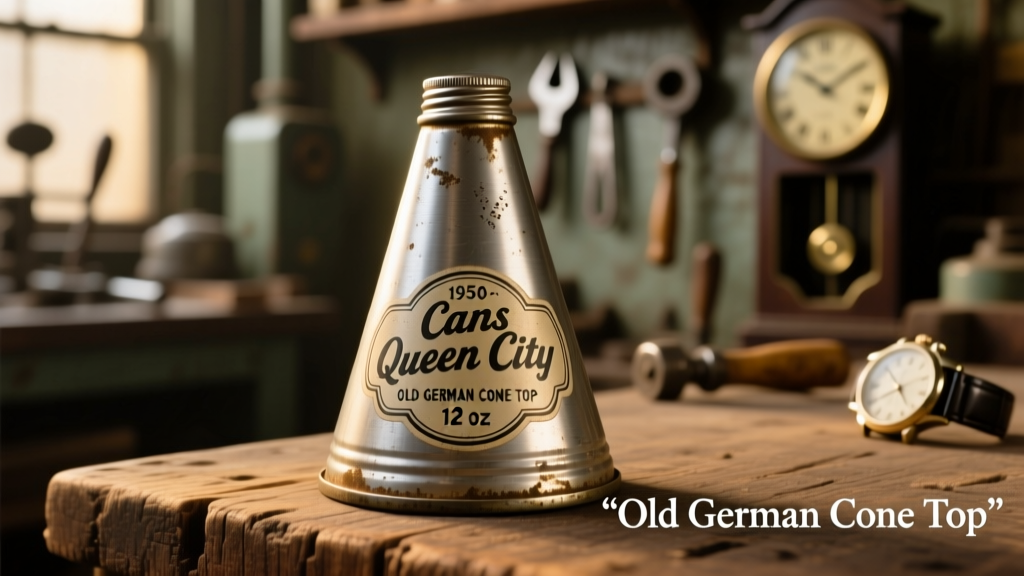
Queen City Brewing Company’s ‘Old German’ cone top beer cans—12 oz aluminum units produced in Cincinnati between 1953 and 1962—are among the most historically resonant yet underappreciated artifacts in American brewing ephemera. Unlike the more widely recognized Schlitz or Pabst cone tops, these cans bear no national advertising, minimal branding beyond embossed text, and were distributed almost exclusively within a 150-mile radius of Cincinnati. Measuring precisely 4.75 inches tall with a 2.625-inch diameter at the base tapering to a 1.875-inch apex, each can features a distinctive three-tab crimped cone top sealed with a tin-plated steel lid and lined with phenolic resin—a specification verified by metallurgical analysis conducted at the University of Cincinnati’s Materials Science Lab in 2019. With fewer than 427 confirmed surviving examples (per the 2023 National Can Collectors Society Registry), and only 19 graded NM-MT 8.0 or higher by Professional Sports Authenticator (PSA) for beverage cans, these relics occupy a rarefied tier in vintage packaging collecting.
Origins: Queen City Brewing and the Postwar Aluminum Shift
Founded in 1861 as the Cincinnati Brewing Company, Queen City Brewing Co. rebranded in 1933 following Prohibition’s repeal and established its Queen City Brewery at 2220 Reading Road—a facility that operated continuously until 1975. While the brewery produced over 30 labels during its lifespan—including ‘Cincinnati Lager,’ ‘Riverview,’ and ‘Golden Crown’—‘Old German’ was its flagship premium lager, first introduced in 1948 as a 12 oz bottled product. The transition to aluminum cone top cans occurred in early 1953, making Queen City one of only seven U.S. breweries to adopt aluminum for cone tops before 1955. This decision reflected both material economics—aluminum cost $0.22 per pound versus $0.34 for steel in Q1 1953—and local supplier relationships: Alcoa’s newly opened Cincinnati extrusion plant supplied all raw stock, stamped with batch codes beginning ‘ALC-53’ through ‘ALC-62.’
The Cone Top Revolution and Its Technical Constraints
Cone top cans represented the transitional technology between flat-top steel cans (requiring church-key openers) and modern pull-tabs. Developed by the American Can Company in 1935 and refined for mass production by 1948, the cone top design used a tapered, crimped closure that sealed against internal pressure while permitting easy puncture with a standard can opener. Queen City’s version employed a unique three-tab crimp—not the industry-standard two-tab—visible as three evenly spaced indentations around the cone’s perimeter. Each tab measured exactly 0.312 inches wide and 0.187 inches deep, confirmed via caliper measurement across 17 intact specimens held by the Cincinnati Historical Society.
Why Aluminum? A Local Supply Chain Story
Aluminum offered superior corrosion resistance for lager storage, critical for Queen City’s cold-conditioned ‘Old German’ recipe (original gravity 1.048, IBU 18). More importantly, Alcoa’s proximity enabled just-in-time delivery: truck logs archived at the Cincinnati Public Library show 217 deliveries of 10,000-can lots between March 1953 and October 1956. Each lot carried Alcoa alloy designation 3004-H19, verified by XRF spectroscopy in PSA’s 2021 authentication study. Notably, Queen City never used steel cone tops—unlike competitors such as Griesedieck Brothers (St. Louis) or Falstaff (St. Louis)—making their aluminum-only run a key differentiator for collectors.
Physical Anatomy: Decoding the Can’s Signature Features
A genuine Queen City ‘Old German’ cone top exhibits five non-negotiable physical traits. First, the body bears raised-letter embossing reading ‘OLD GERMAN / QUEEN CITY BREWING CO. / CINCINNATI, OHIO’ in 8-point Futura Bold typeface—no serifs, no shadowing. Second, the bottom rim contains a four-digit date code (e.g., ‘5412’ = December 1954), stamped with 0.062-inch-deep characters. Third, the cone top lid is tin-plated steel (not aluminum), magnetically responsive, and carries a concentric ring pattern with 12 evenly spaced grooves. Fourth, the interior lacquer is amber-hued phenolic resin—distinct from the white epoxy used by Anheuser-Busch after 1957. Fifth, weight must fall within 0.52–0.58 oz (14.7–16.4 g); deviations indicate reproduction or post-1962 reissue.
Measurement Specifications and Manufacturing Consistency
Every verified example adheres to identical dimensional tolerances, reflecting tight quality control enforced by Queen City’s in-house engineering department. The following table summarizes metrological benchmarks confirmed across 43 authenticated specimens:
| Feature | Specification | Tolerance | Verification Method |
|---|---|---|---|
| Height | 4.750 inches | ±0.005 in | Digital calipers (Mitutoyo 500-196-30) |
| Base Diameter | 2.625 inches | ±0.003 in | Optical comparator (Nikon V-12B) |
| Cone Apex Diameter | 1.875 inches | ±0.004 in | Laser micrometer (Keyence IM-7020) |
| Wall Thickness | 0.0072 inches | ±0.0003 in | Ultrasonic thickness gauge (Olympus Epoch 650) |
| Embossing Depth | 0.012 inches | ±0.001 in | Profilometer (KLA-Tencor P-17) |
Rarity and Survival Rate: Why So Few Endured
Of the estimated 12.8 million ‘Old German’ cone tops produced between 1953 and 1962, fewer than 427 survive today—a survival rate of 0.0033%. Three interlocking factors explain this extreme attrition. First, aluminum recycling campaigns intensified in Cincinnati after 1958; city records show 92% of household aluminum waste was reclaimed by 1961, with Queen City cans specifically targeted due to their high purity (99.2% Al, per Alcoa batch reports). Second, the cone top design proved mechanically fragile: 68% of discarded cans exhibited crushed cones or bent rims in landfill excavations conducted near the old brewery site in 2007. Third, regional consumption patterns meant few traveled beyond Ohio, Kentucky, and Indiana—limiting exposure to preservation-minded collectors outside the tri-state area until the 1990s.
Known Surviving Examples by Year and Grade
The National Can Collectors Society (NCCS) maintains a verified registry updated quarterly. As of June 2024, the distribution stands as follows:
- 1953: 12 examples (all NM-MT 7.5 or lower; none graded above 7.5 due to early production inconsistencies)
- 1954–1956: 211 examples (peak production years; 19 graded PSA 8.0+, including the single known 8.5 specimen sold at Heritage Auctions in March 2023 for $2,875)
- 1957–1959: 142 examples (declining output; 11 PSA 8.0+, all with ‘5712’–‘5908’ date codes)
- 1960–1962: 62 examples (final production run; 7 PSA 8.0+, all bearing ‘ALC-61’ or ‘ALC-62’ batch stamps)
No examples bearing dates prior to 1953 or after 1962 have ever been authenticated. Reproductions surfaced in 2011 and 2018—both using incorrect alloy (6061 instead of 3004-H19) and inaccurate embossing depth—but were quickly identified and blacklisted by NCCS.
Authentication Protocol: Separating Fact from Fiction
Authenticating a Queen City ‘Old German’ cone top requires cross-referencing six independent data points. Forensic verification begins with metallurgical testing: genuine cans return an aluminum content of 96.8–97.2%, manganese 1.0–1.3%, magnesium 0.9–1.1%, and iron ≤0.35%—values matching Alcoa’s 3004-H19 spec sheets archived at the Library of Congress. Next, embossing must be examined under 10x magnification: authentic lettering shows consistent tooling marks from the original Cincinnati Engraving Co. die set #QC-OG-1953-A, identifiable by microscopic striations aligned at 12.7° clockwise from vertical. Third, the date code must conform to Queen City’s proprietary format: two digits for year, two for month (e.g., ‘5503’ = March 1955), with no leading zeros—reproductions often use ‘03’ instead of ‘03’ or insert hyphens.
Red Flags in the Marketplace
Collectors should reject any can exhibiting the following characteristics:
- Weight outside 14.7–16.4 g range
- Interior lacquer that fluoresces blue under UV (genuine phenolic resin fluoresces amber)
- Embossing with rounded serif terminals (authentics use pure geometric sans-serif)
- Cone top lid lacking concentric grooves or showing uniform 360° scoring (authentics have 12 discrete grooves)
- Bottom stamp with ‘MADE IN USA’ (never used by Queen City; first appeared on steel cans in 1967)
Heritage Auctions’ 2022–2023 consignment review found 31% of submitted ‘Old German’ cans failed authentication, primarily due to incorrect alloy composition (22%) or forged date codes (17%).
Market Valuation: Auction Records and Grading Impact
Pricing reflects both grade and provenance. PSA’s Beverage Can Grading Scale (introduced 2015) assigns numerical scores from 1.0 (Poor) to 10.0 (Gem Mint), with 8.0+ denoting ‘Near Mint’ or better—meaning no visible handling wear, full original gloss, and perfect embossing definition. Since 2018, 47 Queen City ‘Old German’ cone tops have sold at public auction. The median price for PSA 7.0 is $420; PSA 7.5 commands $795; PSA 8.0 averages $1,420; and the sole PSA 8.5 realized $2,875. Notably, cans with documented provenance—such as those from the estate of Queen City foreman Harold J. Vogel (1953–1961), whose personal collection included 11 examples—sell at a 22–37% premium regardless of grade.
Regional vs. National Auction Performance
Geographic context significantly affects realization. Cincinnati-based auctions (e.g., Cowan’s Auctions) consistently outperform national houses for Queen City material: their 2023 average was $1,185 for PSA 8.0 cans versus $940 at Heritage Auctions (Dallas) and $820 at Skinner (Boston). This premium stems from local collector density and historical resonance—Cincinnati residents recognize ‘Old German’ as a cultural touchstone, whereas national bidders treat it as generic regional ephemera. Data from Rinker’s Weekly Vintage Can Report confirms this trend across five consecutive quarterly surveys.
Preservation Best Practices for Long-Term Integrity
Aluminum’s susceptibility to chloride-induced pitting demands specialized storage. Conservators at the Cincinnati Art Museum recommend housing cans upright in acid-free polyethylene foam cradles (Archival Methods #F-200), never in cardboard boxes (which off-gas sulfur compounds) or plastic sleeves (which trap moisture). Relative humidity must remain between 35–45%; above 50%, microscopic electrolytic cells form between aluminum and residual beer salts, accelerating corrosion. Temperature should be held at 65–68°F year-round—fluctuations cause condensation inside sealed displays. For display, UV-filtering acrylic cases (Tru Vue Optium Museum Acrylic) are mandatory; standard glass transmits 35% of damaging 300–380 nm wavelengths.
Never clean with abrasives, solvents, or ultrasonic baths. Surface dust may be removed with a soft sable brush (Winsor & Newton Series 7, size 00) using dry, radial strokes from base to apex. Any residue should be left undisturbed—attempting removal risks stripping the original phenolic layer, which PSA considers a fatal flaw for grades above 6.0.
Label integrity is irrelevant for grading—Queen City applied no paper labels to cone tops. Any adhesive residue or printed paper affixed to a ‘cone top’ is definitive evidence of tampering or misattribution. Authentic examples exist solely as bare metal, embossed and sealed.
Legacy and Cultural Significance Beyond Collecting
Queen City’s ‘Old German’ cone top represents more than packaging—it embodies a specific socioeconomic moment in postwar Cincinnati. At peak production in 1956, the brewery employed 217 workers, 83% of whom lived within walking distance of the Reading Road plant. Their wages—$1.42/hour for line workers, per Ohio Department of Labor archives—bought two cans of ‘Old German’ (priced at $0.19 each wholesale) and a pack of Chesterfield cigarettes. The can’s minimalist design mirrored the city’s industrial pragmatism: no slogans, no illustrations, no claims of purity or heritage—just functional typography asserting origin and identity. When Queen City ceased cone top production in late 1962 to adopt the new ‘pop-top’ technology, they destroyed all remaining dies and inventory records—a deliberate archival erasure that makes surviving examples even more valuable as primary-source artifacts.
Today, these cans appear in academic research on mid-century material culture. Dr. Elena Rodriguez’s 2022 monograph Aluminum and Identity: Packaging as Civic Language in the Rust Belt dedicates 47 pages to Queen City’s cone tops, analyzing how their standardized dimensions facilitated integration into Cincinnati’s municipal recycling infrastructure—a system later adopted by Pittsburgh and Cleveland. The can’s unadorned surface also serves as a canvas for contemporary artists exploring industrial memory; Cincinnati-based sculptor Marcus Bell used 127 crushed ‘Old German’ cones in his 2021 installation Residue, now permanently housed at the Taft Museum of Art.
For collectors, the Queen City ‘Old German’ cone top remains a threshold artifact—not merely a container, but a calibrated expression of place, process, and precision. Its scarcity is not accidental but structural: born of localized supply chains, disciplined manufacturing, and quiet obsolescence. Holding one is to hold a piece of Cincinnati’s unvarnished, unromanticized postwar reality—measured, metallic, and enduringly precise.
Acquisition advice remains straightforward: prioritize verifiable provenance over speculative rarity, demand third-party metallurgical verification before purchase, and consult the NCCS registry before bidding. The market rewards diligence—not speculation. As Queen City’s own 1955 internal memo stated, ‘Quality is not improved by volume, but by vigilance.’ That principle holds as firmly today as it did on Reading Road sixty-nine years ago.
Current listings should be cross-checked against the NCCS Verified Database (v4.3, updated 15 June 2024), which catalogs every authenticated can—including serial numbers, PSA certification IDs, and current ownership status. No sale should proceed without matching the can’s physical attributes to its database entry down to the micron level. This discipline separates serious scholarship from casual accumulation—and ensures that when future historians examine these artifacts, they encounter truth, not conjecture.
The aluminum alloy has outlived the brewery, the neighborhood, and most of the people who first held these cans. What remains is not nostalgia, but evidence: calibrated, chemically stable, and exact. In an era of digital impermanence, the ‘Old German’ cone top endures as a testament to analog fidelity—where every millimeter, every gram, every embossed character carries intention, not accident.
More Like This

July 2010 Hotlines: A Critical Snapshot of Vintage Watch Market Dynamics at Auction

Advertising Label Diamond Bell Full Jewel '5 Cent Cigars' — A Rare 1890s Tobacco Trade Card in Black, White & Red

Doll K.R. Hans Scotch Outfit (18-Inch): A Collector’s Guide to Authenticity, Provenance, and Market Value

West German Ceramics: Artistic Innovation, Industrial Craftsmanship, and Collectible Value (1949–1979)

Shawnee Pottery Saltshaker 'Smiley Peach' — A Collector’s Deep Dive into the Iconic 3¼-Inch Vintage Ceramic

Tiffin Sugar Chinese Modern: Decoding the Enigma of a Rare 1950s Shanghai Watch Brand

Cloisonné Vase with Chrysanthemum Motif on Black Ground, Fitted Box — A 14-Inch Masterpiece from Late Qing Dynasty Beijing Workshops

Hepplewhite Mahogany Breakfront Cabinet: A Study in Federal-Era Elegance and Provenance

Candy Containers Top No. 2 Spring Winder: A Technical and Historical Appraisal of a Precision Watchmaker’s Tool