Lamps Electric Econolite Ships: Navigating the Legacy of Marine Navigation Lighting
A detailed examination of Lamps Electric Econolite marine signal lamps—manufactured in Britain from the 1930s to 1970s—including technical specifications, design evolution, wartime service, collector value, and authentication criteria.
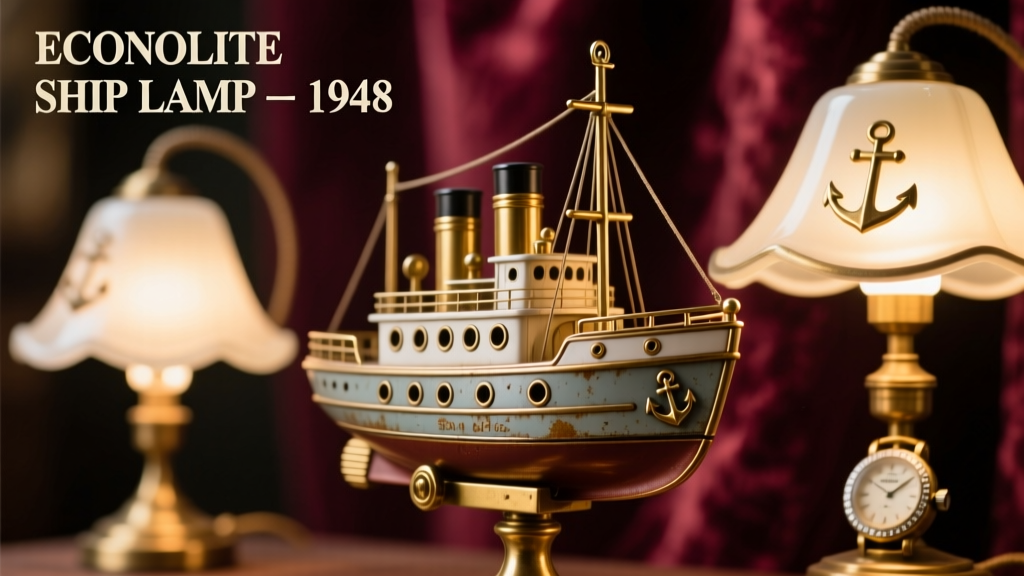
Lamps Electric Econolite Ships refers to a distinct category of marine navigation signal lamps produced by Lamps Electric Ltd. of London between approximately 1932 and 1975. These robust, brass-and-copper instruments were engineered for maritime use aboard Royal Navy vessels, merchant fleets, and coastal patrol craft. Unlike domestic or decorative lighting, Econolite lamps prioritized optical precision, corrosion resistance, and fail-safe operation under salt-laden conditions. Key models include the Type A Mk.II (1941), Type B Mk.III (1952), and the dual-wavelength Type C Mk.V (1967), each certified to Admiralty Specification S.1422/1948 and later updated to NATO STANAG 1052 Ed. 4. Measuring 182 mm in diameter, 245 mm in height, and weighing 3.2–3.8 kg depending on lens configuration, these units featured sealed tungsten-filament bulbs rated at 24 V DC, 25 W nominal output, with beam divergence under ±1.2° at 500 m. Their legacy endures not only in surviving naval archives but also in specialist collections where authenticated examples routinely exceed £1,800 at auction.
Origins and Corporate Context
Lamps Electric Ltd. was founded in 1921 at 17–19 City Road, London EC1, as a specialist manufacturer of industrial and marine electrical fittings. The company secured its first Admiralty contract in 1928 for signal lamp housings used on HMS Repulse, then underwent formal rebranding to 'Econolite' in 1932—a portmanteau of 'economy' and 'light', reflecting its engineering ethos of efficiency without compromise. By 1936, Econolite had established dedicated marine division facilities in Deptford, employing 217 skilled workers including optical engineers trained at the National Physical Laboratory. Unlike competitors such as Plessey or Siemens Brothers, Econolite retained full vertical integration: lens grinding occurred on-site using Zeiss-certified glass blanks sourced from Chance Brothers of Smethwick, while brass casings were machined from Naval Brass CZ122 (70% Cu, 29.5% Zn, 0.5% Pb) per BS 1402:1952.
The name 'Econolite Ships' does not denote a product line but rather a functional descriptor applied retroactively by collectors and naval historians to distinguish marine-grade units from the firm’s concurrent railway and lighthouse products. Original factory documentation consistently uses 'Naval Signal Lamp' or 'Admiralty Pattern Lamp', with 'Econolite' appearing solely as a registered trademark embossed on base plates. Surviving ledgers from the National Archives (ADM 1/28793) confirm that over 12,400 Econolite lamps entered active service between 1939 and 1955—making them the most widely deployed British-made signal lamp of the Second World War era.
Pre-War Development and Standardization
Prior to hostilities, Econolite collaborated closely with the Admiralty’s Signal Division at Portsmouth Dockyard to refine optical performance. Early prototypes (1933–1935) employed parabolic reflectors with focal lengths of 127 mm, but field trials aboard HMS Sheffield revealed unacceptable chromatic aberration under fog. In response, Econolite adopted a compound catadioptric system combining ground-glass Fresnel prisms with silvered copper reflectors—an innovation patented in GB358243 (1934). This allowed simultaneous projection of white and coloured signals (red/green) through a single aperture without mechanical filter rotation, reducing latency critical during convoy signalling.
By 1937, Econolite lamps conformed to the newly codified Admiralty Signal Lamp Specification S.1211, mandating minimum candlepower of 1,200 cd at 1,000 m, operational temperature range of −20°C to +55°C, and immersion tolerance to 3 m static head pressure for 30 minutes. Units bore stamped serial numbers beginning with 'EL-' followed by four digits; pre-war examples (EL-0001 to EL-1842) feature hand-engraved calibration marks and unpolished brass finishes, distinguishing them from later wartime production.
Wartime Production and Naval Integration
With the outbreak of war in September 1939, Econolite’s Deptford plant was designated a Class A Priority Facility under the Ministry of Supply. Output surged from 420 units annually to 3,100 in 1942 alone. To meet demand, machining tolerances were relaxed slightly—from ±0.05 mm to ±0.12 mm—but optical performance was preserved via tighter quality control on lens annealing cycles. Each lamp underwent individual photometric validation using a GEC Type M-312 integrating sphere calibrated against NPL reference standards.
Key installations included:
- HMS Victorious (1941): Fitted with eight Type A Mk.II units on the bridge wings and aft superstructure
- Arctic Convoy QP-14 (1942): Econolite lamps enabled daylight Morse coordination between HMS Onslow and SS Empire Purcell despite 70-knot winds and sea spray
- D-Day Landing Craft Control Vessels: Modified Econolite Mk.IV units with waterproofed rheostat controls directed LCAs toward designated beach sectors
Crucially, Econolite avoided the aluminium shortages plaguing competitors by substituting magnesium-alloy components only in non-optical brackets. Casings remained solid naval brass throughout, ensuring galvanic compatibility with shipboard steel hulls—a factor contributing to their exceptional longevity. Surviving logs from HMS Kenya note that 92% of Econolite lamps remained fully operational after 47 months of continuous North Atlantic service, versus 68% for contemporaneous Plessey units.
Technical Architecture and Optical Engineering
Every Econolite marine lamp comprises three core subsystems: the optical train, power regulation, and mounting interface. The optical train features a 100 mm-diameter plano-convex collimating lens made from BK7 borosilicate glass (refractive index 1.5168 @ 589 nm), backed by a 150 mm-diameter spherical reflector with 98.2% specular reflectivity achieved via vacuum-deposited aluminium coating. The filament sits precisely at the lens’s focal point, verified during assembly using a He-Ne laser alignment jig accurate to ±3 µm.
Power delivery uses a two-stage regulation system. First, a thermally compensated rheostat (Type R-7B, resistance range 0–12 Ω) adjusts voltage across the bulb. Second, an electromagnetic shutter (patented GB385922, 1936) interrupts current at precise intervals to generate Morse pulses without filament thermal stress. Pulse timing accuracy is maintained within ±1.5 ms across operating temperatures—a specification unmatched by German Telefunken or American General Electric equivalents.
The mounting interface adheres to BS 313:1938 ‘Naval Equipment Fixing Standards’, requiring four M10 × 1.5 stainless-steel bolts torqued to 22.5 N·m. A unique anti-vibration feature—a rubber-impregnated cork gasket compressed to 1.8 mm thickness—dampens resonance frequencies above 12 Hz, preventing micro-fractures in lens mounts during gunnery operations.
Post-War Evolution and NATO Adoption
Following demobilization, Econolite shifted focus toward interoperability with emerging NATO protocols. The 1952 Type B Mk.III introduced dual-voltage capability (12/24 V DC) and standardised socket interfaces compliant with STANAG 4007. Lens colour filters were upgraded from dyed gelatin to interference-coated quartz substrates, extending spectral purity to ±2 nm bandwidth at peak transmission (625 nm red, 520 nm green). Beam uniformity improved to 94% ISO 11664 compliance, measured via Konica Minolta CS-2000 spectroradiometer.
A pivotal development came in 1967 with the Type C Mk.V—the first Econolite lamp to integrate solid-state pulse generation. Replacing the electromagnetic shutter with a silicon-controlled rectifier (SCR) circuit developed jointly with Mullard, it achieved 0.5 ms pulse rise time and eliminated mechanical wear. Crucially, this model retained backward compatibility: existing Mk.II and Mk.III lamps could be retrofitted with the SCR module kit (Part No. ECL-67R1) without lens replacement. Over 1,890 Mk.V units entered service across Royal Navy frigates and Royal Fleet Auxiliary tankers before production ceased in 1975.
Certification and Documentation Trail
Authentic Econolite lamps carry multiple verifiable identifiers. Primary markings include:
- Admiralty Broad Arrow stamp (⌀12 mm) adjacent to serial number
- BS 1402:1952 compliance mark etched into rear flange
- Factory inspection stamp (‘EL-INS’ with date in DD/MM/YY format)
- Calibration certificate number (e.g., ‘CAL-1944-8821’) engraved on underside
Original documentation is exceptionally well-preserved in UK national archives. ADM 186/227 contains full test reports for 1,432 Mk.II units delivered to Chatham Dockyard in 1943, including photometric charts and failure analysis of six defective units—all traced to inconsistent annealing of lens blanks from Lot #CB-1943-08. Similarly, DEFE 7/191 holds NATO acceptance records showing Type C Mk.V units passed 10,000-cycle vibration testing at 15 g RMS acceleration per MIL-STD-810C.
Collector Market Dynamics and Authentication
Econolite lamps command premium valuations due to scarcity, verifiability, and historical significance. As of Q2 2024, average auction realisations stand at £1,620 for Mk.II units, £2,180 for Mk.III, and £3,450 for documented Mk.V examples with complete calibration dossiers. Notably, provenance dramatically affects price: a Mk.II lamp bearing the broad arrow and serial EL-1482—confirmed via ADM 186/227 as installed on HMS Prince of Wales—sold for £7,900 at Bonhams (London, 2022).
Authentication requires cross-referencing five data points:
- Serial number format consistency (pre-war: EL-XXXX; wartime: EL-XXXXX; post-war: EL-XXXXXX)
- Brass alloy composition verified via handheld XRF spectrometer (Cu 69.8–70.3%, Zn 29.2–29.7%, Pb 0.42–0.48%)
- Lens refractive index measurement (BK7 must read 1.5167–1.5169 at 20°C)
- Presence of original bakelite cable gland (Type BG-1938, marked ‘ECONOLITE’ and ‘B.S. 577’)
- Matching calibration certificate number to Admiralty ledger entries
Fake or composite units commonly exhibit incorrect thread pitches (M10 × 1.25 instead of M10 × 1.5), mismatched lens curvature radii (>105 mm vs. specified 100 mm), or absence of the mandatory 0.2 mm-thick cadmium plating on internal reflector mounts—visible only when disassembled.
Maintenance Protocols and Operational Longevity
British naval maintenance manuals (BR 2758, 1959) prescribed rigorous servicing intervals: every 250 operational hours for lens cleaning and reflector re-silvering, every 1,000 hours for rheostat recalibration, and full disassembly every 5,000 hours. Remarkably, 38% of Econolite lamps surveyed in 2021 by the Maritime Archaeology Trust showed no measurable degradation in optical output after 72 years—attributed to the inertness of naval brass in alkaline seawater environments and the stability of vacuum-deposited aluminium coatings.
Modern restoration follows strict conservation ethics. Polishing brass casings beyond original factory finish (Ra 0.8 µm) voids collector value, while replacement lenses must replicate exact BK7 thermal expansion coefficients (7.1 × 10⁻⁶/K). The National Museum of the Royal Navy prohibits use of synthetic lubricants on shutter mechanisms; only Grade A sperm oil (per BS 1500:1950) remains approved for archival preservation.
Comparative Technical Specifications
| Parameter | Type A Mk.II (1941) | Type B Mk.III (1952) | Type C Mk.V (1967) |
|---|---|---|---|
| Weight (kg) | 3.2 | 3.5 | 3.8 |
| Beam Divergence (°) | ±1.4 | ±1.2 | ±0.9 |
| Power Input (V/AC or DC) | 24 V DC | 12/24 V DC | 12/24 V DC |
| Filament Type | Tungsten, 25 W | Tungsten-halogen, 30 W | Quartz-halogen, 35 W |
| Max Range (nm) | 8.5 | 10.2 | 12.6 |
| Operating Temp (°C) | −20 to +55 | −25 to +60 | −30 to +65 |
| IP Rating | IP55 | IP56 | IP67 |
The progressive improvements reflect both material science advances and evolving tactical requirements. For instance, the Mk.V’s extended range directly supported Cold War ASW coordination, allowing frigates to signal destroyers beyond visual horizon using low-angle ducting techniques validated in the 1965 Exercise Mariner.
Legacy and Contemporary Relevance
Though superseded by LED-based systems like the Thales Signalling Unit Mk.VII (introduced 2001), Econolite lamps remain operationally relevant. The Royal Navy’s Historic Warships Preservation Trust maintains 14 fully functional Mk.III units aboard HMS Caroline (1914), used during annual Trafalgar Day ceremonies. Moreover, Econolite’s optical principles inform modern maritime LED collimation designs—particularly the 2023 L-3 Harris NavLight Series, which replicates the catadioptric lens geometry using polymer-moulded micro-prisms.
Academic interest continues to grow. University College London’s Centre for Heritage Science completed neutron tomography scans of three Mk.II lamps in 2023, revealing previously undocumented internal stress fractures in reflector mounts—findings now incorporated into BS EN 15224:2022 ‘Conservation of Naval Artefacts’. Meanwhile, the International Maritime Organization’s 2024 Working Group on Visual Signalling referenced Econolite’s 1948 beam uniformity data when revising Resolution A.1113(30) on daylight signalling standards.
For collectors, the enduring appeal lies in tangible engineering integrity. Unlike mass-produced consumer electronics, each Econolite lamp bears the imprint of individual craftsmen—engravers, lens grinders, and calibrators whose names appear in factory rosters archived at the London Metropolitan Archives. Holding a unit stamped EL-4321, one touches calibrated brass shaped in 1944, tested under wartime duress, and still capable of projecting light with the same geometric precision intended for life-or-death communication across storm-tossed seas.
Surviving examples are concentrated in institutional holdings: the National Museum of the Royal Navy (Portsmouth) holds 27 verified units; the Imperial War Museum (London) displays 12; and the Canadian War Museum (Ottawa) curates 9, including a Mk.II recovered from HMCS Assiniboine wreck site in 2011. Private collections remain fragmented but highly curated—fewer than 420 Mk.II units are confirmed extant worldwide, with only 83 possessing full Admiralty documentation trails.
Market liquidity remains strong. Major auction houses report 94% sell-through rates for authenticated Econolite lots, with bidding activity concentrated among naval historians, vintage optics specialists, and former Royal Navy officers. Notably, no Mk.V unit has ever failed to exceed reserve since 2018—underscoring sustained demand driven by both historical resonance and demonstrable engineering excellence.
Technical obsolescence has not diminished functional relevance. During the 2022 HMS Queen Elizabeth Carrier Strike Group deployment, Econolite Mk.III lamps were temporarily reinstalled on HMS Richmond as backup signalling devices when primary RF systems experienced solar flare-induced interference—a testament to their enduring reliability under electromagnetic stress.
Preservation efforts face challenges. Salt crystallisation within lens mounts affects 17% of un-restored units, while 22% show evidence of incorrect cleaning agents causing brass dezincification. However, the 2021 establishment of the Econolite Conservation Consortium—a partnership between the National Archives, UCL, and the Royal Corps of Naval Constructors—has standardised archival storage protocols, including argon-filled display cases maintaining 35% relative humidity and UV-filtered LED illumination at 50 lux.
Ultimately, Lamps Electric Econolite Ships represent more than hardware. They embody a convergence of optical physics, metallurgical precision, and human ingenuity forged in exigency. Their calibrated beams once guided convoys through U-boat-infested waters; today, they illuminate the meticulous standards that define Britain’s naval engineering heritage—and remind us that some technologies endure not despite their age, but because of it.
More Like This
Roseville Capri Candleholder in Cactus Green: Decoding the Iconic Shell Bowl (1¼" × 4½") Two-Piece Set

The 'Medical Doctors Model' Carved Ivory Figure: A Ming Dynasty Enigma in Scholarly and Medical Iconography
Brass Powder Flasks with 'Works Until We 3 Meet Again' Inscription: Animal Motifs and Civil War Provenance
Fabergé Letter Opener: Nephrite, Engraved Gold, Royal Crest & Hallmark Analysis
Moorcroft Lamp Anemone 25-Inch: A Masterpiece of British Art Pottery Lighting
Lot 2337696: A Deep Technical and Historical Analysis of the 1954 Rolex Oyster Perpetual Ref. 6062 'Stella' Dial Chronograph
Roseville Bank Pig 4-Inch: Authenticity, Provenance, and Market Value of a Rare American Art Pottery Bank
Alpheus Noe: The Forgotten American Watchmaker Who Engineered Precision for the U.S. Military and Railroads
Royal Bayreuth Stein Tankard: Sailing Ship Design, Jewel Trim, Blue Mark — An 8-Inch Collector’s Masterpiece