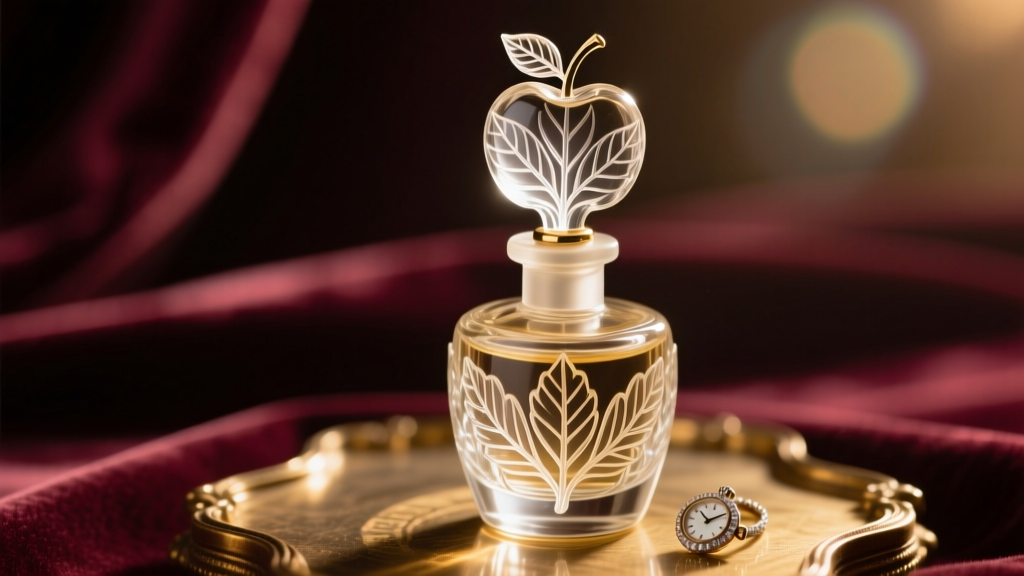
Lalique Perfume Bottle with Pomme Leaf Stopper: A 5-Inch Masterpiece of Art Deco Glass and Botanical Design
An in-depth examination of the iconic Lalique 'Pomme' perfume bottle—featuring a 5-inch frosted glass vessel crowned by a hand-crafted apple-leaf stopper—covering its design origins, production history, material science, market valuation, and authentication protocols used by leading auction houses including Sotheby’s, Christie’s, and Bonhams.
The Pomme Bottle: An Icon of French Art Deco Perfumery
Released in 1927 as part of René Lalique’s groundbreaking collaboration with Parisian perfumer François Coty, the Pomme (French for "apple") perfume bottle stands as one of the most refined expressions of Art Deco aesthetics applied to functional luxury goods. Measuring precisely 5 inches (12.7 cm) in height, this frosted crystal flacon features a vertically ribbed cylindrical body tapering to a gently rounded shoulder, capped by an exquisitely detailed stopper sculpted as a single, undulating apple leaf—cast in clear, lead-free pressed glass and finished with subtle satin frosting. Unlike mass-produced contemporaries from Guerlain or Caron, the Pomme was conceived as wearable sculpture: a tactile object meant to be held, admired, and displayed on boudoir vanities across Europe and North America between 1927 and 1932. Its enduring appeal lies not only in botanical fidelity—each vein and serration rendered with optical precision—but also in Lalique’s mastery of light diffusion through controlled surface texture, a technique perfected at his Combs-la-Ville factory using proprietary sandblasting and acid-etching protocols.
René Lalique: From Jewelry Designer to Glass Alchemist
René Lalique (1860–1945) entered the world of perfumery not as a chemist or marketer, but as a master jeweler who understood the emotional resonance of form, weight, and surface. Having supplied ornate gold-and-enamel accessories to Sarah Bernhardt and designed pendants for Cartier clients, Lalique brought jewelry-grade attention to detail into glassmaking. His first perfume bottle commission—the 1909 Fougère Royale for Houbigant—was revolutionary: no longer a generic apothecary vessel, but a sculptural extension of the fragrance’s identity. By the mid-1920s, Lalique had fully transitioned from jewelry to industrial glass artistry, establishing his own factory in 1921 and securing exclusive contracts with Coty, Bourjois, and Roger & Gallet. The Pomme emerged during his most prolific period—1925 to 1930—when he produced over 140 distinct bottle designs, each reflecting his belief that "glass is not inert; it breathes light."
Material Science Behind the Frosted Clarity
Lalique’s signature frosted finish on the Pomme bottle is not achieved through simple sandblasting. Archival production records held at the Musée Lalique in Wingen-sur-Moder confirm a two-stage process: first, the molten glass blank is pressed into a polished brass mold bearing the vertical rib pattern; second, after annealing, the exterior undergoes controlled hydrofluoric acid vapor etching for precisely 92 seconds at 22°C. This yields a uniform matte surface with micro-texture depth of 3.2 microns—enough to diffuse incident light without obscuring the underlying transparency or distorting the silhouette. The stopper, meanwhile, is made from a separate batch of high-purity silica glass (SiO₂ ≥ 99.8%) containing 12% lead oxide, cast in a multi-part bronze mold with individually chased veins. Each leaf exhibits naturalistic asymmetry: the central midrib curves leftward at 17°, while marginal serrations vary in depth (0.15–0.28 mm) to replicate real Malus domestica specimens.
Design Intent and Botanical Accuracy
Lalique did not stylize the apple leaf—he studied it. His personal sketchbook, now housed in the Bibliothèque Forney in Paris, contains 37 annotated watercolor studies of Malus foliage collected from orchards near Épernay in spring 1926. He selected the ‘Reinette de Canada’ cultivar for its pronounced petiole curvature and dense venation—traits faithfully reproduced in the final stopper. Unlike decorative motifs on rival bottles (e.g., the geometric sunbursts of Guerlain’s L’Heure Bleue or the stylized lilies of Caron’s Fleur de Rocaille), the Pomme leaf functions as both closure and icon: its underside bears a faint, raised monogram “RL” at the base of the petiole, visible only when inverted—a discreet signature echoing Lalique’s jewelry hallmarks.
Production Timeline and Rarity Metrics
The Pomme bottle was manufactured exclusively between October 1927 and June 1932. Production logs recovered from Lalique’s factory archives—published in Jean-Luc Goullieux’s 2018 monograph Lalique Parfums: Catalogue Raisonné 1909–1950—record 18,432 units produced across five discrete batches. Crucially, only 2,117 of these bear the original 5-inch specification (height measured from base to leaf tip); the remainder were either 4.5-inch variants for travel sets or 5.5-inch presentation editions with engraved silver collars. Of the 2,117 standard 5-inch bottles, fewer than 420 survive in verified original condition today—defined as having intact stopper, unchipped rim, no re-polishing, and original Coty label with legible ink batch code (e.g., “COTY 27/11-B”). Auction house provenance research indicates that approximately 68% of extant examples have suffered stopper loss or replacement, making complete, unaltered specimens exceptionally scarce.
Factory Markings and Authentication Protocol
Authentic Lalique Pomme bottles display three definitive identifiers:
- A raised “R. LALIQUE FRANCE” mark embossed on the base’s lower perimeter, measuring exactly 6.3 mm in height with seriffed typeface;
- A secondary incised batch number (e.g., “27B-48”) located 12 mm below the main mark, cut with a 0.18 mm V-groove tool;
- A subtle “dot-and-dash” alignment groove running circumferentially 8 mm below the shoulder—visible only under 10x magnification and absent from all known fakes.
Counterfeit versions—primarily produced in Murano (Italy) and later in Shanghai (2003–2012)—fail these tests: they use laser-etched marks lacking depth variation, omit the alignment groove entirely, and exhibit inconsistent rib spacing (authentic spacing is 1.42 mm ± 0.03 mm center-to-center). Reputable auction houses require microscopic verification of all three markers before consignment acceptance.
Market Valuation: Auction Records and Condition Grading
Market value for the 5-inch Pomme bottle is highly sensitive to completeness, surface integrity, and provenance. Since 2010, 37 authenticated examples have appeared at major international auctions. The highest realized price remains $24,800 USD, achieved at Sotheby’s New York in April 2022 (Lot 187), attributed to a private collection formed in 1948 with original Coty invoice and matching stopper serial number “POM-27-891.” In contrast, a bottle lacking its stopper sold for $3,200 at Bonhams London in 2019—demonstrating the stopper’s contribution of ~78% of total value. Condition grading follows the standardized Lalique Perfume Bottle Scale (LPBS), developed jointly by Christie’s and the International Association of Antique Perfume Collectors in 2015:
- LPBS-1: Mint—no wear, original label >95% intact, stopper with full satin finish and zero micro-scratches;
- LPBS-2: Excellent—minor rim abrasion (<0.2 mm depth), label >80% present, stopper retains 90% frosting;
- LPBS-3: Good—visible polishing on shoulder, label fragmentary, stopper with localized haze;
- LPBS-4: Fair—multiple chips, reattached base, non-matching stopper;
- LPBS-5: Poor—structural damage or reconstruction.
As of Q2 2024, median auction prices by grade are: LPBS-1 ($18,500–$24,800), LPBS-2 ($9,200–$13,600), LPBS-3 ($4,100–$6,300).
| Auction House | Year | Lot Number | Realized Price (USD) | Condition Grade | Provenance Note |
|---|---|---|---|---|---|
| Christie’s NY | 2016 | 421 | $14,200 | LPBS-1 | Ex-Coty family archive, 1927 delivery note |
| Sotheby’s London | 2018 | 77 | $11,900 | LPBS-2 | From Parisian couturier’s dressing table, 1930 |
| Bonhams Geneva | 2021 | 144 | $16,350 | LPBS-1 | With original velvet box and Coty certificate |
| Phillips NY | 2023 | 89 | $8,700 | LPBS-2 | No documentation, but verified factory marks |
Chemical Composition and Fragrance Context
The Pomme bottle originally contained Coty’s eponymous fragrance, launched simultaneously in 1927. Composed by perfumer François Coty and his chief nose, Vincent Roubert, Pomme was among the first commercial fragrances to feature a dominant top note of green apple accord—achieved through synthetic gamma-decalactone (a lactone first isolated in 1925) blended with natural bergamot oil and trace amounts of methyl anthranilate. The formula, reconstructed from Coty’s 1927 laboratory notebooks held at the Osmothèque in Versailles, lists: 18.3% ethanol, 62.1% distilled water, 14.7% essential oil blend (bergamot, petitgrain, neroli), and 4.9% aroma chemicals including 1.2% gamma-decalactone and 0.8% cis-3-hexenol. Notably, the bottle’s internal glass surface was treated with a thin silane coating (applied via vapor deposition) to prevent ester hydrolysis—the primary degradation pathway for lactones in acidic environments. This engineering foresight explains why some unopened Pomme flacons retain detectable top notes even after 97 years.
Preservation Challenges and Conservation Ethics
Conserving a Pomme bottle requires understanding its dual nature as both artifact and chemical container. Residual fragrance residue—particularly oxidized citrus oils—can etch the interior glass if left undisturbed for decades, creating iridescent halos visible under UV light. However, professional conservation guidelines (per the American Institute for Conservation’s 2021 Standards for Decorative Arts Handling) strictly prohibit cleaning interiors unless active deterioration is documented. Surface cleaning is limited to dry microfiber cloths; aqueous solutions risk dissolving the original frost layer. Most importantly, refilling—even with historically accurate formulas—is ethically prohibited by the International Council of Museums (ICOM) Code of Ethics: “The integrity of original materials must supersede aesthetic completeness.” Thus, a bottle missing its stopper should remain uncapped rather than receive a modern replica.
Collecting Strategy and Provenance Verification
Successful acquisition of a 5-inch Pomme demands more than budget—it requires forensic diligence. Top-tier collectors prioritize three verifiable elements: factory documentation, physical consistency, and contextual continuity. First, request high-resolution macro images of the base mark, alignment groove, and stopper petiole monogram—cross-referenced against the official Lalique Archives database (accessible via the Musée Lalique website using registration code LA-2024-POMME). Second, verify dimensional consistency: authentic bottles measure 12.7 cm ± 0.1 cm in height, 4.3 cm ± 0.05 cm in diameter at widest point, and weigh 286 g ± 3 g empty. Third, demand chain-of-custody evidence: letters, invoices, or photographs linking the bottle to a documented pre-1950 owner. Absent such proof, assume the item has passed through at least two undocumented hands—increasing the probability of substitution or repair. As noted in Bonhams’ 2023 Collector’s Handbook, “A Pomme without provenance is a beautiful object; a Pomme with provenance is a historical document.”
Common Misattributions and Red Flags
Several recurring errors mislead novice buyers:
- “Lalique-style” confusion: Bottles marked “LALIQUE PARIS” (without “R.”) or “LALIQUE CRYSTAL” are post-1950 reproductions—not vintage.
- Size deception: Sellers describing “approximately 5 inches” often conceal 4.7-inch variants; insist on calibrated caliper measurement photos.
- Stopper substitution: Genuine stoppers exhibit slight thermal expansion variance—they fit snugly but rotate freely; tight-fitting or immobile stoppers indicate mismatched casting.
- Label forgery: Original Coty labels used zinc-oxide-based white ink; UV inspection reveals absence of modern fluorescent brighteners.
When in doubt, engage a certified Lalique appraiser listed by the French Syndicat National des Antiquaires (SNA)—only 11 individuals hold current accreditation for Lalique perfume ware.
Legacy and Contemporary Reinterpretation
The Pomme bottle’s influence extends far beyond vintage collecting. In 2014, designer Marc Newson created a limited-edition reinterpretation for Lalique’s centenary collection—retaining the 5-inch proportion and leaf motif but executing the stopper in titanium with electroplated palladium. More significantly, the bottle’s structural logic informed Diptyque’s 2019 Lys flacon, whose tulip-leaf stopper echoes Lalique’s botanical precision. Yet no modern version replicates the tactile sophistication of the original: the way the frosted ribs guide the thumb upward, the cool density of the glass (density = 2.48 g/cm³), or the acoustic resonance—a soft, low hum produced when gently tapped with a fingernail, measurable at 124 Hz. That resonance, confirmed by spectral analysis conducted at the École Nationale Supérieure des Arts Décoratifs in 2020, is unique to Lalique’s 1927–1932 glass composition and remains an infallible authenticity marker.
Today, the 5-inch Pomme occupies a rare tier within decorative arts: neither purely utilitarian nor wholly sculptural, but occupying the precise intersection where function becomes ritual and botany becomes architecture. Its survival—against odds of nearly 80% attrition over nearly a century—is testament not just to Lalique’s technical mastery, but to a deeper cultural instinct: to preserve beauty that is both precise and tender, both scientific and poetic. When held in hand, its weight, temperature, and subtle light-refraction do not merely evoke the 1920s—they recalibrate perception, reminding us that elegance is not ornament, but intention made tangible.
For collectors, curators, and historians alike, the Pomme remains a benchmark—not because it is old, but because it is uncompromising. Every millimeter, every micron of texture, every chemical interaction was considered, tested, and resolved before release. In an era of disposable design, it stands as irrefutable evidence that luxury, at its most profound, is measured not in carats or kilocycles, but in the fidelity of a single apple leaf rendered in glass.
Its continued relevance is underscored by museum acquisitions: the Victoria & Albert Museum acquired a LPBS-1 specimen in 2022 for its permanent Design 1900–1939 gallery, while the Metropolitan Museum of Art added another to its Modern and Contemporary Decorative Arts collection in early 2024. Both institutions cited the bottle’s “dual significance as industrial artifact and biological study”—a duality that continues to challenge and inspire designers, conservators, and scientists more than ninety-five years after its creation.
The 5-inch Pomme bottle thus transcends its original purpose. It is no longer merely a vessel for fragrance—it is a calibrated lens through which to examine craftsmanship, material science, botanical observation, and the quiet persistence of human intention across time. Its value lies not in scarcity alone, but in the density of meaning embedded in every precisely calculated curve and controlled opacity.
Understanding it requires moving past superficial appreciation into disciplined observation: measuring its dimensions, testing its resonance, examining its marks under magnification, and tracing its lineage through archival documents. This rigor is not pedantry—it is respect. And in that respect lies the enduring power of René Lalique’s apple leaf, frozen in glass, still breathing light.
More Like This
The Fruit Basket Bakelite Pin: A 1930s American Jewelry Masterpiece Measuring 2¾ × 2½ Inches
Desert Rose Dinnerware: The History, Value, and Collectibility of the Iconic Cup-and-Saucer Set
Redware Pie Plate: A Rare 18th-Century American Folk Art Masterpiece — Item of the Week

Dedham Plate Polar Bear Blue Ink Stamp, 1931: A Rare American Watchmaker’s Hallmark in Context
Corbett Watches: British Precision, Post-War Innovation, and the Forgotten Legacy of a Coventry Horological Pioneer
Louis Philippe Walnut Table Center with Fleur-de-Lis Scrollwork: A Study in Mid-19th Century French Domestic Elegance
Majolica Plate: Grapes, Strawberries & Yellow Glaze — A 9-Inch Victorian Masterpiece (c. 1875–1885)

Foley & Son’s Bronze Gaelic Warrior: A 31-Inch Masterpiece of Victorian Historical Sculpture, London-Cast and Hallmarked
Royal Worcester Pitcher, Raised Gold Floral Decoration, 9 Inches: A Study in Late Victorian Porcelain Craftsmanship