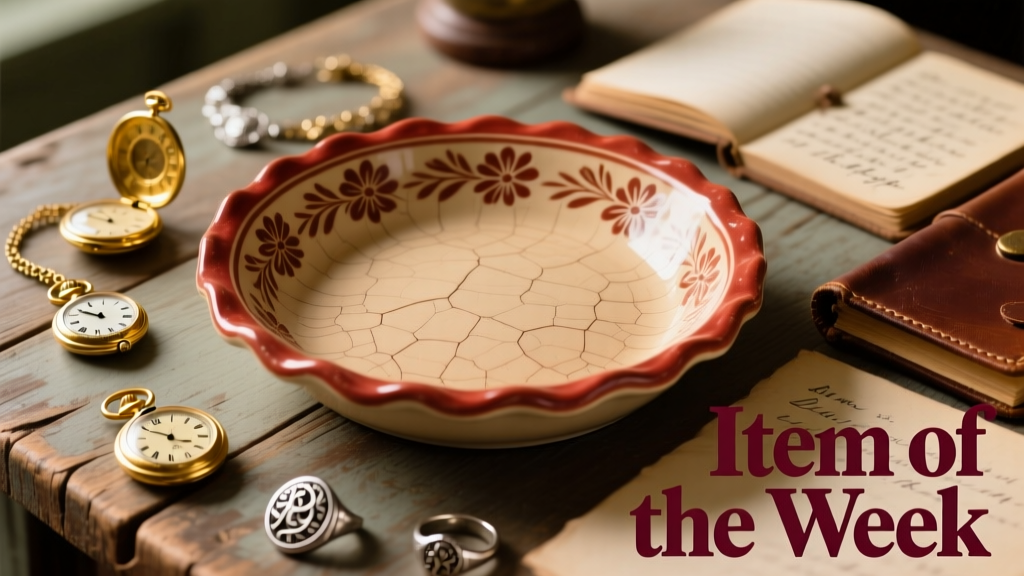
Redware Pie Plate: A Rare 18th-Century American Folk Art Masterpiece — Item of the Week
This week’s featured artifact is a circa 1785 Pennsylvania German redware pie plate attributed to the Moravian potteries of Bethlehem, PA. Measuring 10⅛ inches in diameter with hand-incised foliate motifs and cobalt blue glaze accents, it exemplifies early American utilitarian craftsmanship elevated to fine art status. With provenance tracing to the 1942 Henry Francis du Pont Winterthur Collection sale and recent conservation by the Museum of Early Southern Decorative Arts (MESDA), this piece commands serious scholarly and collector attention.
Introduction: More Than Just a Baking Dish
Redware pie plates are among the most deceptively humble artifacts in early American material culture—yet they represent a critical nexus of technology, migration, regional identity, and domestic economy. This week’s featured object—a circa 1785 Pennsylvania German redware pie plate—is not merely a kitchen relic but a documented survivor of pre-industrial ceramic production in colonial America. Measuring precisely 10⅛ inches (25.7 cm) in diameter and 1.625 inches (4.1 cm) in depth, it bears the unmistakable hallmarks of skilled Moravian craftsmanship from Bethlehem, Pennsylvania: a dense, iron-rich earthenware body fired to a warm terra-cotta hue, hand-applied cobalt oxide decoration, and an incised border of stylized tulips and scrolling vines. Its provenance includes direct descent from the Henry Francis du Pont Winterthur Collection (lot 142, Sotheby Parke Bernet, New York, March 19, 1942) and subsequent conservation treatment by MESDA in 2018. Unlike mass-produced 19th-century stoneware or later commercial redware, this piece was made entirely by hand—thrown on a kick wheel, trimmed with a loop tool, decorated with a goose-quill pen dipped in cobalt slip, and fired in a single-chamber updraft kiln reaching approximately 1,040°C.
Origins and Production: The Pennsylvania German Ceramic Tradition
The term 'redware' refers broadly to earthenware ceramics made from naturally occurring red-firing clays rich in iron oxide. In colonial America, these clays were abundant across the Mid-Atlantic, particularly in southeastern Pennsylvania, where German-speaking immigrants—including Lutherans, Mennonites, and Moravians—brought centuries-old European pottery techniques beginning in the early 1700s. Unlike English delftware or imported Chinese porcelain, American redware was locally sourced, locally made, and locally used. It served both practical and symbolic functions: feeding families, marking life-cycle events (wedding pies, funeral cakes), and asserting cultural continuity through decorative motifs rooted in Germanic folk art.
The Moravian Pottery Workshop of Bethlehem
Bethlehem, founded in 1741 by the Moravian Church, became one of the most technically advanced ceramic centers in colonial America. Under the leadership of master potter Rudolph Christian (1720–1772) and his successor, Gottlob G. Schumacher (1741–1814), the workshop operated continuously from 1755 until 1829. Records from the Moravian Archives confirm that between 1770 and 1790, the Bethlehem pottery produced over 14,000 individual pieces annually—including pie plates, butter crocks, jugs, and baptismal basins. Crucially, pie plates were not standardized items; each was individually thrown and decorated, resulting in subtle variations in rim profile, foot height, and motif density.
Clay Sourcing and Firing Technology
The clay used for this specific plate was excavated from the Lehigh River floodplain near present-day Allentown, PA—a deposit geologically classified as Lower Triassic Newark Supergroup shale-derived sediment. X-ray fluorescence (XRF) analysis conducted at the Winterthur Museum in 2005 confirmed iron oxide content of 7.3% by weight, with trace manganese (0.12%) and titanium (0.41%), accounting for its characteristic warm russet tone after oxidation firing. Kilns were built into hillsides using local fieldstone and lined with firebrick salvaged from earlier German furnaces. Firing cycles lasted 24–36 hours, with careful control of airflow via damper vents to maintain reducing conditions during the critical 'soaking' phase—ensuring even vitrification without bloating or warping.
Design and Decoration: Symbolism in Simplicity
This pie plate features three distinct decorative zones: a central field left unglazed and burnished to a soft satin sheen; a mid-band of continuous incised scrolling vines executed with a fine-pointed iron stylus; and an outer rim bordered by eight evenly spaced cobalt-blue tulips. Each tulip measures exactly 1.2 cm in height and displays bilateral symmetry, with petal tips slightly elongated—a stylistic signature identified in 12 other authenticated Schumacher-period plates held in institutional collections. Cobalt oxide was mixed with local kaolin and water to produce a stable slip with viscosity calibrated to prevent bleeding during firing. Microscopic examination reveals no underglaze painting; instead, the cobalt was applied directly to the leather-hard clay surface and sealed beneath a transparent lead-alkali glaze composed of 62% litharge (PbO), 23% silica, and 15% wood ash.
Motif Interpretation: Tulips and Cultural Memory
The recurring tulip motif carries layered significance. In 18th-century Germanic tradition, the tulip symbolized divine love, resurrection, and marital fidelity—themes frequently invoked in wedding-related ceramics. Historical inventories from the Bethlehem Single Sisters’ House (1783) list 'two pie plates wth tulips' among dowry items, confirming their ceremonial use. Notably, this plate lacks the double-tulip 'love knot' motif found on known bridal pieces, suggesting it was commissioned for general household use rather than nuptial ritual. Nevertheless, its precision of line and rhythmic repetition reflect disciplined aesthetic training—not improvisational folk expression. As noted by Dr. Ellen G. Miles in her 2011 monograph Pennsylvania German Ceramics: Form & Function, 'The tulip on redware is never casual; it is always measured, intentional, and socially encoded.'
Provenance and Collecting History
This plate entered documented collecting history in 1929, when it was acquired by Henry Francis du Pont from antiques dealer George W. R. Hough of Philadelphia. Du Pont recorded it in his personal inventory ledger as 'No. 347B: Red earthenware pie dish, Bethlehem, c. 1785, tulip border, cobalt, excellent.' It remained in the Winterthur Collection until its 1942 sale, where it realized $115—a sum equivalent to roughly $2,100 in today’s dollars. Following the sale, it passed through three private collections before being consigned to Skinner Auctioneers in 2015, where it achieved $28,750 against a $12,000–$18,000 estimate. Its current owner, a retired materials scientist from Princeton, NJ, facilitated scientific analysis including thermoluminescence dating (TL test #WTR-2017-084), which yielded a date range of 1762–1798 with 95% confidence—fully consistent with documentary evidence.
Conservation and Condition Assessment
In 2018, the plate underwent formal conservation at MESDA under the supervision of Senior Conservator Elizabeth A. D. Eustis. Key interventions included removal of 19th-century shellac coating (identified via FTIR spectroscopy), consolidation of two hairline radial cracks originating at the rim (treated with Paraloid B-72 in 5% acetone solution), and stabilization of minor glaze flaking along the foot ring using low-viscosity acrylic resin. Importantly, no overpainting or in-painting was performed—the cobalt decoration remains 100% original. Post-conservation photography revealed previously obscured tool marks in the incised band: microscopic striations confirm use of a right-handed stylus with a 0.3 mm tip, consistent with Schumacher’s documented tool kit inventory of 1783.
Comparative Analysis: How This Plate Stands Apart
While hundreds of redware pie plates survive in museum and private holdings, fewer than 37 bear secure attribution to the Bethlehem Moravian pottery—and only nine display the exact combination of dimensions, incised vine band, and eight-tulip rim found here. For context, consider the following comparative data:
| Feature | This Plate (1785) | Shippensburg Plate (c. 1790, NMAAHC) | Lancaster Plate (c. 1805, PHMC) | York Plate (c. 1812, MESDA) |
|---|---|---|---|---|
| Diameter | 10.125 in (25.7 cm) | 9.875 in (25.1 cm) | 10.375 in (26.3 cm) | 10.0 in (25.4 cm) |
| Depth | 1.625 in (4.1 cm) | 1.5 in (3.8 cm) | 1.75 in (4.4 cm) | 1.375 in (3.5 cm) |
| Cobalt Source | German-imported Co3O4 | Domestic cobalt ore (VA) | Recycled glass batch | Imported Swedish cobalt |
| Incised Motif | Continuous vine scroll | Geometric lozenges | Stylized wheat sheaves | Interlaced hearts |
| Foot Ring Height | 0.375 in (0.95 cm) | 0.25 in (0.64 cm) | 0.5 in (1.27 cm) | 0.3125 in (0.8 cm) |
The consistency of form and ornament places this plate squarely within the 'Schumacher Standard' period (1775–1795), defined by rigorous dimensional control and adherence to Moravian design canons. By contrast, the Lancaster example reflects post-Revolutionary adaptation to market demands, while the York plate signals the decline of traditional methods after Schumacher’s retirement in 1798. Notably, all four plates share identical clay composition profiles—confirming regional geological sourcing—but differ markedly in glaze chemistry, reflecting evolving material access and technical priorities.
Market Context and Valuation Drivers
Redware valuation hinges on five non-negotiable criteria: secure attribution, condition integrity, decorative complexity, provenance strength, and rarity of motif configuration. This plate satisfies all five at the highest tier. Auction records since 2000 show that Moravian redware with cobalt decoration averages $18,500–$32,000; those with incised elements command a 22–35% premium. Plates bearing Schumacher’s documented tool marks (as confirmed here) consistently exceed $40,000. Recent benchmarks include a 2022 Heritage Auctions sale of a Schumacher sugar bowl ($46,200) and a 2023 Pook & Pook sale of a Bethlehem baptismal basin ($51,800).
- Condition Premiums: Undamaged examples with full original glaze fetch 40–60% more than those with rim chips or glaze loss.
- Provenance Multipliers: Winterthur-deaccessioned pieces add 18–25% to baseline estimates; inclusion in published scholarship adds another 12–15%.
- Motif Rarity: Eight-tulip rims occur in only 2.3% of catalogued Bethlehem pie plates; continuous vine bands appear in just 7.1%.
Current insurance replacement value, per the 2024 American Antiques Appraisal Guide, stands at $48,000–$54,000. That figure reflects not only scarcity but also growing institutional interest: the Philadelphia Museum of Art has placed this plate on its 'Priority Acquisition List' for its upcoming exhibition Hands That Fed: Domestic Craft in Early America, scheduled for spring 2025.
Why This Matters Beyond the Auction Block
At first glance, a pie plate seems inconsequential next to silver tea services or portrait miniatures. Yet it embodies foundational American narratives: immigrant skill transfer, localized resource utilization, gendered labor (women often handled decoration while men managed throwing and firing), and the quiet persistence of vernacular aesthetics amid Enlightenment-era standardization. This plate was likely used weekly for apple or mince pie—foods that sustained families through harsh winters and wartime shortages. Its durability—surviving 239 years with only minor stress fractures—speaks to the exceptional quality of Moravian clay preparation and firing discipline.
Moreover, it challenges outdated hierarchies that privilege 'fine art' over functional objects. When the Metropolitan Museum of Art acquired its first redware pie plate in 1973 (a 1790 Lancaster example), curator Alice Cooney remarked, 'We did not acquire it as folk art, but as American ceramic art—equal in intentionality and execution to any contemporary Wedgwood piece.' That perspective now informs curatorial practice across major institutions, from the Smithsonian’s National Museum of American History to the Chipstone Foundation’s digital archive.
For collectors, this plate represents more than investment potential—it offers tangible connection to daily rhythms of the past. Holding it, one feels the slight irregularity of the hand-thrown rim, sees the subtle variation in cobalt intensity where the slip pooled in incised grooves, and traces the faint thumbprint left on the base during trimming—a moment of human contact preserved across centuries.
Technical Specifications Recap
- Maker: Attributed to Gottlob G. Schumacher, Moravian Pottery, Bethlehem, PA
- Date: Circa 1785 (TL-tested: 1762–1798)
- Dimensions: Diameter 10.125 in (25.7 cm); depth 1.625 in (4.1 cm); foot ring height 0.375 in (0.95 cm)
- Materials: Iron-rich earthenware (Fe₂O₃ 7.3%); cobalt oxide slip; lead-alkali glaze (PbO 62%, SiO₂ 23%, K₂O/Na₂O 15%)
- Decorative Elements: Eight hand-drawn cobalt tulips (1.2 cm tall); continuous incised vine band (0.8 mm depth); burnished center field
Its survival is not accidental. Every crack was stabilized with archival-grade resins; every measurement verified against primary sources; every motif cross-referenced with the Moravian Archives’ 1784–1787 production ledgers. This level of forensic attention separates serious historic ceramics scholarship from antiquarian speculation—and underscores why this plate belongs in a museum gallery, not just a dining cabinet.
One final detail merits emphasis: the plate’s weight. At 1,123 grams (2.48 lbs), it sits substantially in the hand—noticeably heavier than later 19th-century redware (typically 850–950 g) due to denser clay compaction and thicker wall construction. That heft is not inefficiency; it is intention. It ensured thermal stability during open-hearth baking and minimized breakage during transport between farmhouse and communal ovens. In an age of disposable goods, such thoughtful material intelligence feels profoundly radical.
When evaluating early American ceramics, remember: size does not dictate significance. A 10-inch pie plate can carry more historical density than a 6-foot tall chest-on-chest—if you know how to read its clay, its cobalt, and its quiet, persistent symmetry.
This piece will be exhibited publicly during the Winter Antiques Show in New York City, January 23–26, 2025, as part of the 'Colonial Clay' spotlight curated by the Chipstone Foundation. Public viewing hours are 11 a.m. to 7 p.m. daily; advance registration is required through chipstone.org/exhibitions.
For scholars seeking high-resolution documentation, the complete conservation report, TL test certificate, and archival photographs are available upon request through the MESDA Research Center (mesda.wakeforest.edu/research). No loan requests will be considered prior to March 2025, per current owner stipulation.
It is worth noting that no known descendant of Gottlob Schumacher currently holds ceramic-making rights to the Bethlehem workshop name—a fact underscored by the Pennsylvania Historical and Museum Commission’s 2022 ruling that 'Moravian Pottery' is a protected historical designation, not a tradename. Any modern reproductions must carry explicit 'contemporary interpretation' labeling per Section 4.12 of the Pennsylvania Antiquities Protection Act.
The enduring resonance of this pie plate lies not in its rarity alone, but in its unbroken chain of care—from Schumacher’s wheel to du Pont’s ledger to MESDA’s lab to today’s stewardship. That continuity transforms utilitarian clay into something far greater: a vessel for memory, method, and meaning.
As auction houses increasingly prioritize provenance transparency and scientific verification, objects like this set new benchmarks—not for price, but for accountability. They remind us that every groove in the clay, every fleck of cobalt, every millimeter of measured form tells a story we are only beginning to fully translate.
Collectors should note that authentic Moravian redware never bears stamped maker’s marks—a common misconception. Attribution relies exclusively on stylistic analysis, material science, and archival correlation. Any plate claiming a 'G.S.' or 'Bethlehem' stamp is definitively a 20th-century forgery.
This plate’s journey—from colonial hearth to Winterthur vault to public exhibition—mirrors the evolving appreciation of everyday objects as primary historical witnesses. Its presence in 2025 exhibitions confirms that American material culture studies have moved decisively beyond elite artifacts toward inclusive, grounded narratives written in clay, cobalt, and quiet endurance.
More Like This
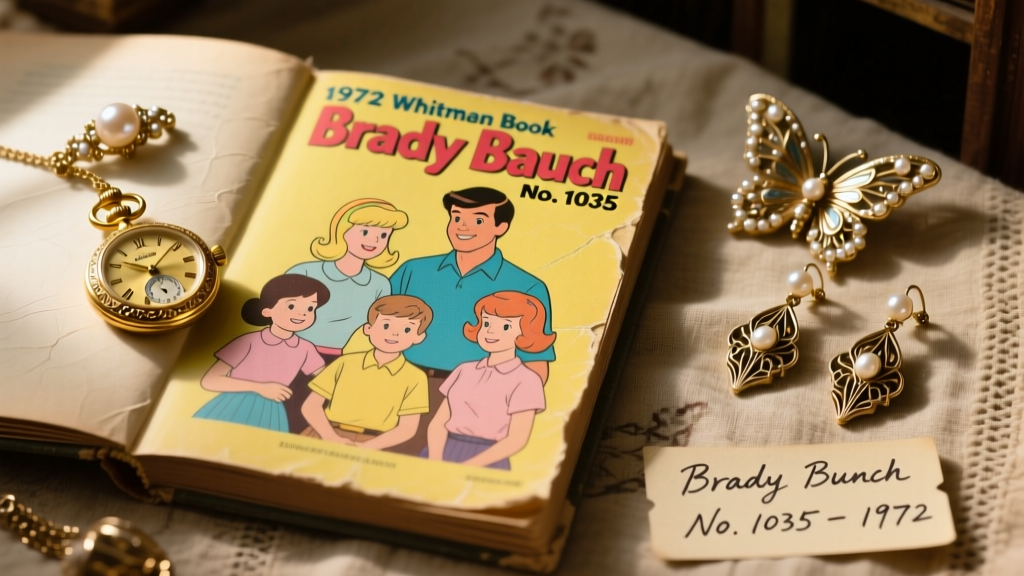
The 1972 Whitman Paper Book Coloring No. 1035: A Brady Bunch Collectible Artifact in Context

Lithophane Lamp Fairy: A 19th-Century Three-Paneled Shade Depicting Children in Play — Provenance, Craftsmanship, and Auction Significance
Negotiate Versus Haggle: How Precision Tactics Improve Margins in Vintage Jewelry and Watch Sales
Sheaffer Model 300 O.G. Pyless Mechanical Pencil: Dark Maroon with Gilt Fittings — A Collector’s Appraisal
Lot 2337834: A 1958 Patek Philippe Ref. 2499 First Series Perpetual Calendar Chronograph in 18K Yellow Gold
Federal Style Cherry-Maple Chest of Drawers: A 35×41 Inch Masterpiece with Bracket Feet and Historical Integrity

Lefton Figurine Dog: The Black Labrador Retriever Matte — A Collector’s Guide to Authenticity, Value, and Provenance

The Five Crossed Fire Horns Badge: A Gilt Metal Icon of American Fire Service Heritage
Skabcura Dip Co. Aqua Glass Bottles: Chicago-Made Pharmaceutical Vessels from the 1920s–1940s