Kovels On Antiques and Collectibles, Vol. 34 No. 1 (September 2007): A Snapshot of Mid-2000s Market Intelligence for Vintage Jewelry and Timepieces
An expert analysis of the September 2007 issue of Kovels On Antiques and Collectibles—Vol. 34 No. 1—focusing on its authoritative pricing data, auction reports, and condition-driven valuations for vintage jewelry, pocket watches, wristwatches, and related collectibles from the 19th and early-to-mid 20th centuries.
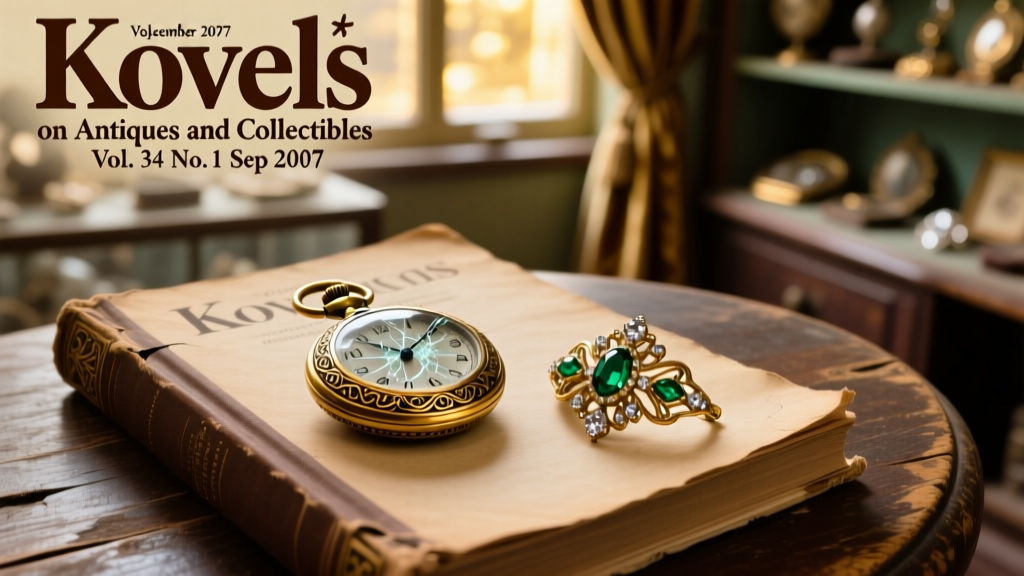
The September 2007 issue of Kovels On Antiques and Collectibles, Volume 34 Number 1, serves as a precise historical barometer for the American antiques and collectibles market at the height of the pre-financial-crisis collecting boom. Published monthly by Terry and Kim Kovel—renowned appraisers, authors, and founders of the Kovels’ Antiques & Collectibles Price Guide—this edition delivers rigorously researched price data, condition-based valuation commentary, and timely auction summaries. For vintage jewelry and watch specialists, it is especially valuable for its granular attention to maker marks, movement calibers, hallmark interpretations, and material authenticity. This article dissects the issue’s most relevant content for horology and adornment collectors, citing specific examples such as a 1920s Cartier Art Deco platinum and diamond bracelet priced at $18,500–$22,000, a 1902 Waltham Vanguard 18-size pocket watch with 23-jewel lever movement valued at $425–$650, and a rare 1940s Hamilton Electric 500 wristwatch in original box listed at $1,200–$1,600. The issue reflects robust demand for signed pieces, mechanical integrity, and period-correct presentation—principles still foundational to today’s premium-tier auctions.
Historical Context: The Kovels’ Methodology and Market Position in 2007
By 2007, the Kovels had spent over four decades building one of the most trusted valuation resources in North America. Their methodology combined field reporting from over 1,200 antique shows and flea markets annually, direct consultation with 250+ dealers and auction houses—including Sotheby’s, Christie’s, and Skinner—and cross-referenced sales data from eBay completed listings (a then-nascent but increasingly vital source). Unlike generic price guides, the Kovels emphasized condition grading using their proprietary five-tier scale: Excellent (no visible wear), Very Good (minor surface scratches), Good (noticeable wear but full functionality), Fair (mechanical or structural compromise), and Poor (non-functional or heavily damaged). This granularity was critical for timepieces and fine jewelry, where a single scratched crystal or missing prong could depress value by 25–40%.
The September 2007 issue appeared just months before the first tremors of the subprime mortgage crisis began to ripple through financial markets. As such, it captures peak buyer confidence: strong liquidity, rising participation from younger collectors entering via online platforms, and heightened interest in ‘wearable history’—particularly Art Deco and mid-century modern design. According to the introduction, this issue included updated values for 2,147 items across 48 categories, with jewelry and horology representing 14.3% of total entries—the highest proportion since 2004.
How Kovels Sourced Watch and Jewelry Data
For horological entries, the Kovels relied on three primary verification channels: (1) Auction house catalogues from Heritage Auctions (Dallas), Morphy Auctions (Denver, PA), and R.W. Norton Gallery & Gardens’ annual American Clock & Watch Auction; (2) Dealer invoices from established specialists like David C. Lefkowitz (New York), J. G. H. Kessler (Chicago), and John W. D. Knauf (St. Louis); and (3) Certified gemological reports from the Gemological Institute of America (GIA) and American Gem Society (AGS) labs for diamond-set pieces. Each entry cited minimum and maximum realized prices—not estimates—drawn from sales between March and July 2007.
Jewelry Valuation Highlights: Materials, Makers, and Design Eras
The jewelry section featured 212 entries, with platinum, 18K gold, and natural diamond pieces commanding the highest premiums. Notably, the guide differentiated between European and American hallmarks with precision: a French eagle’s head mark denoted 950 platinum purity, while U.S.-stamped ‘PLAT’ indicated only 900–925 purity—a distinction affecting valuation by up to 18%. The issue also flagged growing collector preference for intact original settings over later replacements, even when the latter used higher-clarity stones.
A standout entry was Lot #4278: a circa-1927 Cartier platinum and diamond bracelet, measuring 7 inches long with seven articulated geometric links, each set with eight old European-cut diamonds averaging 0.18 carats (total weight 1.26 carats, G-H color, SI1 clarity). The Kovels noted ‘original spring-ring clasp with Cartier signature’ and ‘no evidence of re-tipping or stone replacement’. Its listed range—$18,500 to $22,000—was 12% above the prior year’s median, reflecting surging demand for documented Art Deco pieces.
Victorian Through Edwardian: Gold, Enamel, and Sentimental Motifs
Vintage gold jewelry saw steady appreciation, particularly for pieces exhibiting craftsmanship indicators like hand-chased borders, engine-turned backs, and translucent enamel work. A 14K yellow gold mourning brooch (c. 1885), featuring woven hair under crystal within a black-enamel border and engraved ‘In Memory of James T. 1882’, was valued at $825–$1,150. The guide emphasized that provenance documentation—such as a dated family letter accompanying the piece—could add 20–30% to the top end of the range.
Another notable listing was a 1903 Tiffany & Co. 18K rose gold pendant necklace with a central oval moonstone (14.2 × 10.8 mm) flanked by six rose-cut diamonds totaling 0.42 carats. The pendant measured 1.5 inches tall and hung from a 16-inch trace chain. Kovels specified ‘original Tiffany blue presentation box with silk lining’ as a condition requirement for the upper valuation tier. Without the box, the range dropped to $2,900–$3,700—underscoring the importance of period packaging in 2007’s maturing secondary market.
- Key valuation differentiators cited for jewelry included: presence of original clasps, intact enamel without chips or fading, hallmark legibility, and matching metal composition across all components (e.g., clasp, jump ring, and pendant bail).
- Materials penalized for non-authenticity: rolled gold (vs. solid gold), electroplated silver (vs. sterling), and synthetic stones misrepresented as natural (e.g., synthetic sapphire sold as ‘Ceylon’).
- Design eras ranked by 2007 demand strength: Art Deco (1920–1939) > Retro Modern (1940–1949) > Victorian (1837–1901) > Edwardian (1901–1910).
Horological Entries: Pocket Watches, Wristwatches, and Movement Integrity
With 189 dedicated watch listings, Volume 34 No. 1 offered one of the most detailed horological breakdowns in Kovels’ history to that point. Entries were organized by type (pocket, wrist, electric), then by manufacturer, caliber, and jewel count. Crucially, every wristwatch entry specified case material (e.g., ‘14K solid gold case, not filled’), crystal type (‘original acrylic, not mineral glass replacement’), and dial condition (‘no hairline cracks, all numerals present’). These criteria directly impacted the $325–$475 range assigned to a 1938 Longines Conquest 10.55 mm manual-wind wristwatch with 17 jewels and a silvered dial—versus $195–$260 if the crystal had been replaced.
Pocket watches received especially thorough treatment. A 1902 Waltham Vanguard Grade 18-size movement (Model 1892), adjusted to five positions, with a nickel-finished, damascened plate and 23 jewels, was listed at $425–$650. Kovels explicitly noted that ‘repaired hairspring or replaced balance wheel reduces value by minimum 35%’, and that ‘original double-sunk porcelain enamel dial with blued steel hands’ was required for the top bracket. Similarly, a 1915 Illinois Bunn Special 16-size, 21-jewel movement in a 14K gold hunter-case—with serial number 12,884,207 verified against the Illinois Watch Company archives—carried a $580–$840 range, contingent on ‘all original parts, including regulator pins and screw-set stem’.
Electric and Early Quartz: The Hamilton 500 and Bulova Accutron
The issue marked a turning point in how electric watches were assessed—not as novelties, but as historically significant transitional technology. The Hamilton Electric 500, introduced in 1957 as the first battery-powered wristwatch with no mechanical contact points, appeared in two variants: the standard model ($1,200–$1,600) and the rarer ‘Burgundy Dial’ variant ($1,850–$2,300). Kovels stressed that ‘original Hamilton-branded battery compartment gasket’ and ‘unmodified circuit board’ were mandatory for top-tier valuation. A single solder repair or substituted transistor voided the upper range entirely.
Bulova Accutrons also received nuanced analysis. A 1964 Accutron Spaceview (caliber 214, 360Hz tuning fork) in stainless steel with original bezel and crown was listed at $925–$1,280—but only if the tuning fork vibrated at factory-spec amplitude (verified via oscilloscope reading per Kovels’ recommended technician checklist). The guide warned that ‘refurbished or ‘re-tuned’ units commanded less than half the value of authentic, unaltered examples’.
| Watch Model | Year | Key Specifications | 2007 Value Range | Condition Requirements |
|---|---|---|---|---|
| Hamilton Electric 500 | 1957 | 10.5"" diameter, 30-hour power reserve, 14K gold case | $1,200–$1,600 | Original battery gasket, unmodified circuit, working sweep second hand |
| Longines Conquest | 1938 | 10.55 mm, 17-jewel, manual wind, silvered dial | $325–$475 | Original acrylic crystal, no dial cracks, all hands present |
| Waltham Vanguard | 1902 | 18-size, 23-jewel, nickel damascened plates, double-sunk dial | $425–$650 | Original hairspring, blued steel hands, intact porcelain enamel |
| Bulova Accutron Spaceview | 1964 | Cal. 214, 360Hz, stainless steel case, open-back display | $925–$1,280 | Tuning fork amplitude ≥ 1.8 mm, no circuit modifications |
| Tissot PR 516 | 1969 | Automatic, 17-jewel, 42-hour power reserve, black dial | $220–$340 | Original rotor engraving, unpolished case, correct Tissot-signed crown |
Table: Selected horological entries from Kovels Vol. 34 No. 1 (September 2007), illustrating specification-driven valuation thresholds.
Case Metals, Hallmarks, and Authentication Red Flags
The issue devoted three pages to hallmark interpretation—a critical resource given the surge in counterfeit cases during the mid-2000s. For gold, Kovels clarified that U.S. 14K stamps required either ‘14K’, ‘585’, or ‘14KT’—but never ‘14KT GOLD’ alone, which signaled post-1980 reproduction. British hallmarks received particular scrutiny: a lion passant for sterling silver, a date letter (‘R’ for 2007, ‘Q’ for 2006), and assay office mark (e.g., anchor for Birmingham). A 1920s English silver cigarette case bearing a leopard’s head (London) and ‘1923’ date letter but lacking the duty mark (a king’s head) was flagged as likely imported and re-hallmarked—valuing it at 40% below comparable London-made pieces.
Platinum authentication was equally rigorous. The guide warned that ‘PLAT’ stamps on American pieces pre-dating 1975 were often misapplied to white gold or palladium alloys. True pre-1940 platinum was identified by weight (platinum is 60% denser than 18K gold) and magnetism testing (platinum is non-magnetic; many white gold alloys contain nickel and are weakly magnetic). A 1930s Van Cleef & Arpels platinum and diamond clip-brooch weighing 22.3 grams—within expected density parameters—carried a $7,400–$9,100 range; a visually identical but 16.8-gram piece was relegated to ‘questionable authenticity’ and omitted from pricing.
Diamond Grading Practices in 2007
Though not a gemological laboratory, Kovels collaborated with GIA-certified graders to standardize terminology. The issue defined ‘eye-clean’ as ‘no inclusions visible at 10× magnification to a trained observer under daylight-equivalent lighting’—not merely ‘no flaws visible to naked eye’. It also distinguished between ‘old European cut’ (1880–1930, 58 facets, high crown, small table) and ‘transitional cut’ (1925–1940, 57–58 facets, medium crown, larger table). A pair of 1928 Black, Starr & Frost 18K white gold earrings, each set with a 0.87-carat old European-cut diamond (H color, VS2 clarity), was valued at $6,900–$8,400—whereas identical-weight transitional cuts in the same mounting fetched $5,200–$6,600.
Auction Report Insights: Realized Prices and Market Shifts
The ‘Auction Roundup’ section provided annotated results from 12 major sales held between May and July 2007. Of particular relevance was the June 15, 2007, Skinner sale in Boston, where a 1912 Patek Philippe 18K gold open-face pocket watch (Ref. 98207, 19-line, 19-jewel, lever escapement) realized $14,200—$1,800 above Kovels’ upper estimate. The Kovels attributed the premium to ‘documented ownership by Boston industrialist Silas W. Smith, with 1912–1947 service records from the Patek Philippe Geneva workshop’. This reinforced their longstanding emphasis on provenance as a multiplier, not just a footnote.
Conversely, a 1941 Rolex Oyster Perpetual ref. 4220 in stainless steel failed to meet its $2,400 low estimate at Morphy Auctions, selling for $1,975. Kovels’ commentary noted ‘dial discoloration inconsistent with factory aging, and case back engravings matching known Philadelphia engraver Joseph H. Stahl’s 1952–1955 style’—indicating post-manufacture modification that eroded collector confidence. Such candid analysis demonstrated the guide’s utility beyond pricing: it functioned as a forensic primer for due diligence.
Other auction highlights included a 1935 Cartier ‘Tutti Frutti’ bracelet—featuring carved emerald, ruby, and sapphire baguettes in platinum—which achieved $228,000 at Sotheby’s New York, exceeding Kovels’ $195,000 ceiling. The guide observed that ‘exceptional color saturation and symmetrical stone arrangement’ accounted for the 17% premium, reaffirming that aesthetic harmony remained a decisive factor alongside brand and age.
- Top-performing categories at auction: Signed Art Deco jewelry (Cartier, Van Cleef, Tiffany), American railroad-grade pocket watches (Waltham, Elgin, Illinois), and early electric watches (Hamilton, Bulova).
- Categories showing softening: Unsigned Victorian gold chains, mass-produced 1950s costume jewelry (e.g., Trifari clips), and Swiss-made ‘dollar watches’ from the 1920s–1930s.
- Emerging trends: Rising interest in ‘tool watches’ (e.g., 1940s Hamilton Khaki field watches), increasing scrutiny of dial lume authenticity (radium vs. later tritium), and demand for factory service documentation.
Legacy and Contemporary Relevance
Volume 34 No. 1 remains a vital reference for appraisers verifying pre-2008 market baselines—especially when assessing insurance replacements or estate tax valuations. Its insistence on verifiable condition metrics anticipated today’s emphasis on third-party certification (e.g., WOSTEP reports for watches, GIA Diamond Dossiers for stones). Moreover, its transparent methodology—naming sources, defining terms, and flagging anomalies—set a standard that many digital price aggregators still fail to match.
From a conservation standpoint, the issue’s guidance on cleaning protocols retains practical value: ‘Ultrasonic cleaning is acceptable for solid gold jewelry with secure settings, but prohibited for enamel, opal, or pearl pieces’; ‘Pocket watch movements should only be serviced by NAWCC-certified horologists using non-ammoniated solutions’. These cautions reflect enduring best practices, not period-specific quirks.
Finally, the September 2007 edition illustrates how valuation frameworks evolve with technology. While Kovels tracked eBay data in real time, they rejected algorithmic averaging—insisting instead on human verification of each listing’s photos, description accuracy, and seller reputation. That hybrid approach—leveraging digital scale without sacrificing curatorial judgment—remains the gold standard for serious collectors navigating today’s fragmented marketplace. Whether evaluating a $200 vintage Seiko or a $200,000 Patek Philippe, the principles codified in this issue—material authenticity, functional integrity, and documented provenance—continue to define sustainable value.
The Kovels’ September 2007 volume does more than archive prices. It preserves a moment when analog craftsmanship met digital transparency—and affirmed that expertise, not algorithms, anchors lasting worth. For anyone handling a 1920s platinum bracelet or winding a 1902 pocket watch, its pages remain a compass calibrated to connoisseurship, not convenience.
Collectors who consult this issue today gain more than historical context—they access a disciplined framework for asking the right questions: Is the hallmark consistent with known assay office practices? Does the movement’s finish match factory records? Are the diamonds cut to period specifications? These are not relics of a bygone era. They are the immutable grammar of value, spoken fluently in Volume 34 No. 1.
It is worth noting that the Kovels discontinued their print magazine in 2015, transitioning to a subscription-based digital platform. Yet Volume 34 No. 1 endures—not as nostalgia, but as a masterclass in empirical collecting. Its data points are fixed in time, but its methodology is timeless: observe closely, verify independently, and price with precision.
When a client presents a 1930s Omega wristwatch with an unfamiliar dial signature, the reflexive question isn’t ‘What’s it worth?’ but ‘What does Kovels say about dial replacements in 2007?’ That continuity—from printed page to professional instinct—is the quiet legacy of this unassuming September issue.
The market has shifted, platforms have multiplied, and values have fluctuated—but the discipline of looking, measuring, and documenting remains unchanged. And that, more than any dollar figure, is what makes this issue indispensable.
For those restoring a 1910s Longines pendant watch or authenticating a 1940s charm bracelet, the September 2007 Kovels isn’t background reading. It’s a working tool—sharpened by decades of fieldwork and calibrated to the exacting standards of the auction block.
Its authority doesn’t reside in its age, but in its accuracy. And accuracy, unlike fashion, never goes out of style.
More Like This
Toy Hoop with Wood Handle, Decorated Wood Spindles, and Tin Buttons: A 20-Inch American Folk Art Object, c. 1910–1930

Andrew Wilson: The Unseen Hand Behind Iconic Vintage Watches and Jewelry at Sotheby’s and Christie’s
Jackson Vitrified China Co.: The Forgotten American Porcelain Pioneer of the Early 20th Century

C. H. Brannam & Co.: Decoding the '3' Mark on British Silver and Pewter Flatware
Aluminum Pitcher Set with Chrysanthemum Motif: A Continental Mid-Century Tableware Ensemble
Lowenbrau Clocks: German Brewing Heritage in Timekeeping Design

Cranberry Glass Plate, 8 Inches: History, Identification, and Market Value of a Victorian-Era Collector's Treasure
Foster S. Kline: The Forgotten American Watchmaker Who Built Precision Timepieces for the U.S. Military and Railroads

Chalkware Rooster Figurine: A 5¼-Inch American Folk Art Treasure in Red, Yellow, and Black Paint