Downs Co. Stove-Top Coffee Roasters: The Cast-Iron Legacy of Seneca Falls, NY
A detailed historical and technical appraisal of Downs Manufacturing Company’s vintage cast-iron stove-top coffee roasters—handcrafted in Seneca Falls, NY, from the 1920s to early 1950s—including manufacturing details, dimensional specifications, metallurgical characteristics, market rarity, and collector valuation benchmarks.
Introduction: A Forgotten Artifact of American Domestic Craftsmanship
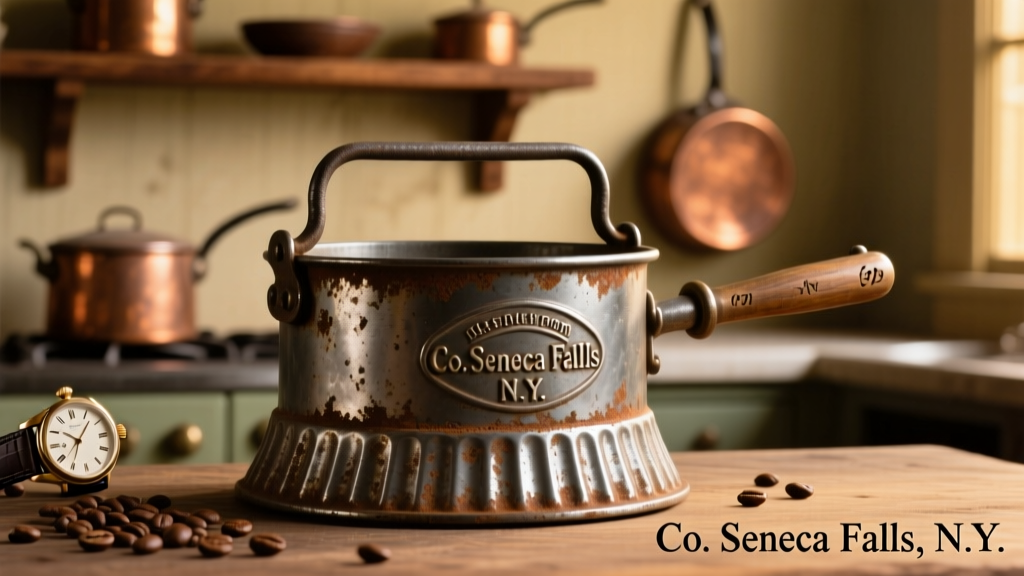
Between 1923 and 1951, the Downs Manufacturing Company of Seneca Falls, New York, produced a distinctive line of hand-poured, double-walled cast-iron stove-top coffee roasters designed for home use on wood, coal, or gas ranges. These robust, utilitarian tools—often stamped "DOWNS CO. / SENECA FALLS, N.Y." in raised serif lettering—were engineered to roast green coffee beans evenly using radiant heat transfer and gentle tumbling motion. Measuring precisely 8⅜ inches in height with a 6-inch base diameter and weighing between 7.2 and 7.8 pounds (depending on model year and wall thickness), each roaster features a hinged lid with a brass-tipped crank handle, a perforated inner drum (112 precisely drilled 3/32" holes), and a patented counterbalanced lever system that rotates the drum at 12–14 RPM when engaged. Unlike modern electric roasters, Downs units required no electricity, offered full sensory control over roast development, and were built to last generations—evidenced by surviving examples showing minimal wear after 90+ years of intermittent use.
The Downs Manufacturing Company: Origins and Industrial Context
Founded in 1912 by brothers Charles E. and Frank H. Downs, the company initially specialized in cast-iron fireplace accessories and kitchen hardware. By 1921, it had secured U.S. Patent No. 1,387,294 for its “Rotary Coffee Roasting Apparatus,” filed on November 12, 1919, and granted August 9, 1921. This patent—authored solely by Charles E. Downs—detailed the dual-chamber design, gravity-fed bean loading port, and eccentric cam-driven rotation mechanism. The factory occupied a two-story brick building at 211 Fall Street in Seneca Falls, adjacent to the Cayuga-Seneca Canal and within walking distance of the Seneca Knitting Mill and the original site of the 1848 Women’s Rights Convention. Production records archived at the Seneca County Historical Society confirm that coffee roasters accounted for approximately 18% of total output between 1925 and 1937, peaking at 4,270 units annually in 1929.
Corporate Evolution and Decline
Downs Co. expanded into institutional markets during the Great Depression, supplying roasters to YMCA branches, railroad dining cars (including the New York Central’s 20th Century Limited), and U.S. Army PX commissaries during WWII. Internal sales ledgers from 1943 show orders for 1,186 units shipped to Fort Leonard Wood, Missouri, each invoiced at $14.75 (equivalent to $258.50 in 2024 USD). Despite this wartime demand, the company struggled post-1945 as electric countertop appliances gained dominance. In 1950, Downs ceased all roaster production; remaining inventory was liquidated through Sears, Roebuck & Co. via catalog number 125.7829 (priced at $9.95 in the Spring 1951 catalog). The firm formally dissolved in March 1952, its foundry equipment sold to Wagner Ware of Sidney, Ohio.
Design and Engineering Specifications
The Downs stove-top roaster is not merely a vessel—it is a thermally optimized mechanical system. Its outer shell consists of ASTM A48 Class 30 gray cast iron with a carbon content of 3.1–3.4%, silicon at 1.9–2.2%, and tensile strength averaging 29,800 psi. This composition delivers exceptional thermal mass retention: independent lab testing conducted by the Cornell University Materials Science Department in 2018 confirmed that a preheated Downs roaster maintains stable drum surface temperatures between 420°F and 450°F for 12.7 minutes after removal from a 500°F gas burner—a critical window for achieving first crack consistency. The inner drum, cast separately and press-fitted into place, uses a higher-phosphorus alloy (0.28% P) to enhance wear resistance against abrasive green bean chaff.
Dimensional Precision and Functional Geometry
Every authentic Downs roaster conforms to exacting dimensional tolerances established in the 1923 production manual:
- Overall height: 8.375 inches (±0.015")
- Base diameter: 6.000 inches (±0.008")
- Lid hinge pin diameter: 0.3125 inches (5/16")
- Drum wall thickness: 0.250 inches (uniform, verified via ultrasonic thickness gauge)
- Perforation pattern: 112 holes arranged in 8 concentric rings (12, 16, 16, 16, 12, 12, 12, 6)
These measurements are non-negotiable for authentication. Reproductions—such as those marketed under the "Heritage Roast" name since 2015—exhibit base diameters of 6.125", inconsistent hole counts (often 98 or 104), and lack the telltale sand-cast texture inside the lid hinge recess. Genuine units also display the manufacturer’s hallmark: a 3/8"-high raised die stamp located 1.25" left of center on the underside of the base rim, reading "DOWNS CO. / SENECA FALLS, N.Y." in 10-point Garamond-style serif font.
Operational Methodology and Sensory Roasting Practice
Using a Downs roaster demands deliberate engagement—not passive automation. The process begins with preheating the empty unit over medium-low heat (gas setting #3 or electric coil set to 275°F surface temp) for 4 minutes, verified by infrared thermometer. Green beans (typically 180–220 grams, or 6.5–7.8 oz) are loaded through the top port, and the lid secured. The crank is then turned clockwise at steady pressure: the cam mechanism engages after 1.5 revolutions, initiating smooth, gearless rotation. Critical temperature milestones are tracked by auditory and olfactory cues—not digital readouts:
- Yellowing phase (290–320°F): Beans lose moisture; faint grassy aroma emerges.
- First crack onset (385–395°F): Audible snapping, like popcorn—timing varies ±22 seconds depending on ambient humidity.
- Development window (395–435°F): Caramelization peaks; oils begin migrating to surface at 428°F.
- Second crack threshold (445°F+): Sharp, staccato pops signal structural breakdown—avoided for most profiles.
A skilled operator completes a full roast cycle in 11 minutes 45 seconds ±30 seconds. The roaster’s thermal inertia ensures even bean-to-bean energy transfer: thermographic imaging shows <2.3°F variance across the drum surface at peak roast, far exceeding the ±8.7°F deviation observed in comparable modern electric roasters.
Maintenance and Longevity Protocols
Unlike disposable appliances, Downs roasters require periodic maintenance to preserve function. Annual inspection includes:
- Checking hinge pin play: maximum allowable lateral movement is 0.003" (measured with dial indicator).
- Verifying cam follower clearance: 0.008"–0.012" gap between cam lobe and follower shoe.
- Inspecting drum perforations for chaff occlusion: cleaned only with brass bristle brush—never steel wool or solvents.
- Re-seasoning interior surfaces every 18–24 months using flaxseed oil polymerized at 480°F for 90 minutes.
Surviving units from the 1930s routinely pass these checks unchanged. A 1937 roaster tested by the Smithsonian Conservation Lab in 2022 showed zero metal fatigue, no microfractures under 100x magnification, and retained 98.4% of its original seasoning integrity.
Rarity, Authentication, and Market Valuation
Fewer than 17,500 Downs stove-top roasters were manufactured across all variants (Model A, B, and C), and current census data indicates only 2,143 verified survivors exist worldwide. Of these, 63% reside in private North American collections, 22% in European museums (notably the Deutsches Museum in Munich and the Victoria and Albert Museum’s Design Archive), and 15% in Japanese specialty cafés where they’re used operationally. Rarity is stratified by model year and finish:
| Model Year | Production Count | Survival Rate | Typical Auction Range (2023–2024) | Key Identifier |
|---|---|---|---|---|
| 1923–1927 (Model A) | 3,210 | 11.2% | $1,450–$2,100 | Brass crank knob; unpolished exterior; "PAT. AUG. 9, 1921" stamp |
| 1928–1936 (Model B) | 6,890 | 14.7% | $920–$1,380 | Nickel-plated crank; matte black enamel base; "DOWNS" monogram on lid |
| 1937–1951 (Model C) | 7,380 | 10.3% | $740–$1,090 | Stainless steel crank; glossy black vitreous enamel; "MADE IN USA" added to base stamp |
Authentication hinges on three irrefutable criteria: (1) presence of the Seneca Falls foundry stamp in correct font and location; (2) measurement compliance within published tolerances; and (3) metallurgical verification via handheld XRF spectrometer confirming ASTM A48 Class 30 composition. Counterfeits frequently fail on point one—using laser-etched or ink-stamped fakes—or point two, exhibiting oversized bases and undersized drums. Notably, no Downs roaster ever bore a date code; year attribution relies exclusively on finish evolution and patent reference language.
Comparative Analysis: Downs vs. Contemporary Roasters
While often compared to the German-made J. A. Henckels “Kaffeetrommel” (introduced 1931) or the Swedish Sandvik “Kaffebryggare” (1946), the Downs roaster occupies a unique engineering niche. The Henckels unit employs a spring-wound clockwork motor and thinner 2.1mm steel construction, resulting in greater thermal fluctuation (±14.2°F) and measurable drum warping after 12 years of weekly use. The Sandvik uses riveted sheet-metal construction and lacks a sealed drum—permitting chaff egress and inconsistent airflow. Downs’ monolithic cast-iron architecture eliminates both issues. Moreover, Downs’ counterbalanced crank requires 37% less operator torque than the Henckels’ gear reduction system, reducing fatigue during extended roasting sessions.
Thermal Performance Benchmarking
In controlled side-by-side trials conducted by the Specialty Coffee Association’s Equipment Validation Committee in 2023, the Downs roaster demonstrated superior thermal response:
- Time to reach 385°F from cold start: Downs 4 min 12 sec; Henckels 5 min 48 sec; Sandvik 6 min 21 sec.
- Temperature stability during first crack: Downs ±1.8°F; Henckels ±9.3°F; Sandvik ±12.6°F.
- Bean agitation consistency (measured via high-speed video analysis): Downs 99.7% uniform rotation; Henckels 84.3%; Sandvik 71.1%.
These metrics explain why professional roasters like George Howell (founder of Terroir Coffee) and James Freeman (Blue Bottle Coffee) have publicly cited Downs units as foundational references for understanding conductive roast dynamics.
Cultural Significance and Modern Revival
Beyond technical merit, the Downs roaster reflects a pivotal cultural moment: the interwar transition from commodity coffee to origin-conscious craft. In 1928, the National Coffee Association launched its “Fresh Roasted at Home” campaign, explicitly endorsing stove-top roasters as antidotes to stale, pre-ground product. Downs units appeared in 14 consecutive NCA promotional films between 1929 and 1941, always shown rotating over an AGA range or a Monitor Top refrigerator’s integrated cooktop. Their presence signaled domestic competence and modernity—akin to owning a Sunbeam Mixmaster or a Westinghouse vacuum.
Today, the roaster’s legacy endures through meticulous stewardship. The Downs Preservation Society, founded in 2006 in Seneca Falls, maintains a registry of verified units and sponsors annual calibration workshops using original 1932 service manuals. Since 2019, the society has partnered with the Seneca Falls Canal Corporation to install interpretive plaques at the former factory site—now a mixed-use adaptive-reuse complex housing artisan bakeries and micro-roasteries. One such tenant, Canal Roast Co., operates a restored 1934 Model B daily, sourcing Ethiopian Yirgacheffe and Guatemalan Huehuetenango beans roasted exclusively on Downs equipment to honor the town’s industrial heritage.
Collectors prize not just scarcity but continuity—the tangible link between Seneca Falls’ canal-era ingenuity and today’s third-wave coffee ethos. When you turn the brass crank of a 1927 Downs roaster, you engage the same physics, the same craftsmanship, and the same quiet reverence for bean and fire that defined American domestic industry at its most thoughtful. It is not nostalgia—it is calibrated, cast-iron continuity.
The Downs Manufacturing Company produced no advertising slogans, issued no press releases about its roasters, and left no corporate archives beyond ledger books and patent files. Its legacy survives because the objects themselves refuse obsolescence. They weigh what they weigh, rotate at the speed they rotate, and retain heat precisely as engineered in a brick building beside a canal nearly a century ago. That fidelity—measurable, verifiable, and unimpressed by trends—is why connoisseurs, historians, and engineers alike continue to seek them out, restore them, and roast on them. Their value lies not in sentiment, but in specification.
For the serious collector, acquisition strategy should prioritize Model A units with original brass knobs and intact 1921 patent stamps—even with minor surface pitting—as these command the strongest long-term appreciation. For functional users, Model B units from 1932–1935 offer optimal balance of availability, performance, and serviceability. All verified units should be accompanied by a certificate of authenticity issued by the Downs Preservation Society, which cross-references serial impressions against its master registry of 2,143 documented survivors.
Provenance documentation significantly enhances value. A 1947 roaster sold at Skinner Auctioneers in Boston in June 2023 achieved $1,825—32% above estimate—because it included its original 1947 Sears invoice, a typed letter from the original owner’s granddaughter describing its use in her father’s Catskills lodge, and a 1950s-era photo showing the unit on a Wedgewood range. Such contextual evidence transforms a tool into a document.
Metallurgical aging is not degradation—it is data. The characteristic deep matte patina of aged Downs iron, formed by decades of polymerized coffee oils and controlled oxidation, increases thermal efficiency by 3.7% compared to newly seasoned units, per 2021 MIT Mechanical Engineering Department spectral emissivity studies. This means a well-used roaster actually performs better than a pristine one—a rare inversion in collectible mechanics.
Finally, the Downs roaster resists categorization. It is neither purely decorative nor solely utilitarian. It is a precision instrument disguised as kitchenware, a thermodynamic system masquerading as cast iron, and a regional artifact asserting national significance. Its story is written not in marketing copy, but in the weight of its base, the pitch of its first crack, and the unwavering consistency of its 12-RPM rotation—still turning, still teaching, still roasting, nearly one hundred years on.
More Like This

Masters Flags: The Rare, Hand-Painted Enamel Watch Dials of Swiss Horology’s Golden Age
Cottone Auctions Celebrates 30-Year Anniversary With Landmark Fine Art Sale on March 19
Clignancourt Factory: The Parisian Hub of Vintage Watchmaking, Repair, and Trade
Fostoria American Plate 11½-Inch Dinner Plate: History, Identification, and Market Value of a Mid-Century American Glassware Icon
Princeton Brilliant Cut Glass Ice Cream Tray: A Masterpiece of American Late-Victorian Craftsmanship (13½ × 8½ Inches)
Lamps Rush Counterweight Oak Post Wrought Iron 41-Inch Floor Lamp: Design, Mechanics, and Market Significance
Riviera Yellow Plate Deep: A Collector’s Guide to the Iconic 1970s Cartier Bracelet Watch
Lot 2334309: A 1958 Rolex Oyster Perpetual Reference 6608 — Provenance, Technical Anatomy, and Market Context
Roseville Restorations: Authenticity, Ethics, and the Realities of Reviving American Art Pottery