Clignancourt Factory: The Parisian Hub of Vintage Watchmaking, Repair, and Trade
A definitive exploration of the Clignancourt Factory in Paris—its origins as a 19th-century industrial site, its evolution into a world-renowned center for vintage watch restoration, independent watchmaking, and antique jewelry commerce—and its enduring significance to collectors, horologists, and auction professionals.
The Clignancourt Factory: More Than a Market
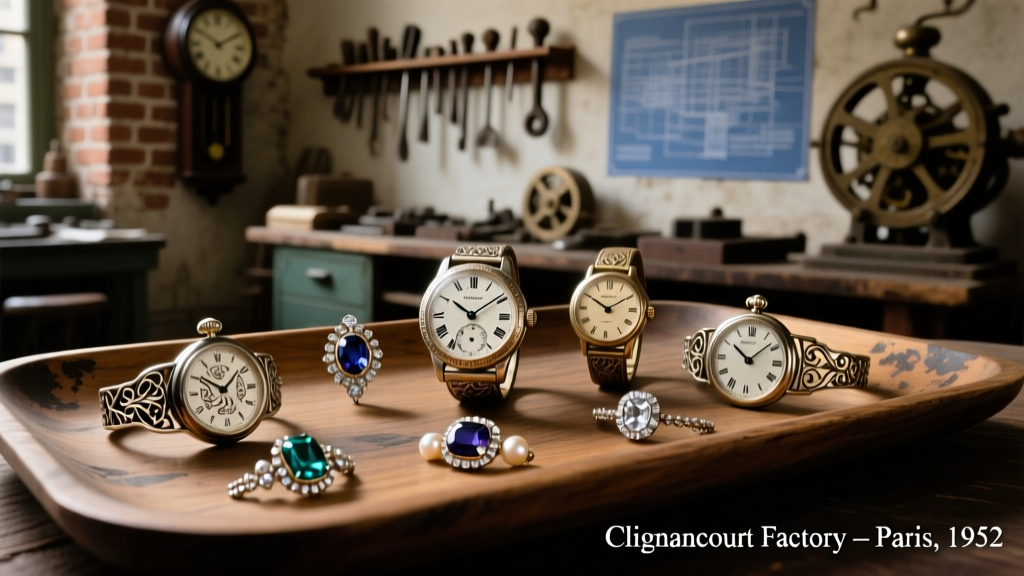
Located at 130–134 Rue des Rosiers in the 18th arrondissement of Paris, the Clignancourt Factory is not a single entity but a historic, multi-tiered complex housing over 75 independent workshops, boutiques, and ateliers dedicated to horology, jewelry restoration, gemology, and antique trade. Unlike the nearby Marché aux Puces de Saint-Ouen—a sprawling open-air flea market—the Clignancourt Factory operates year-round indoors, with climate-controlled spaces, secure vaults, and professional-grade workbenches. Founded in 1867 as the Établissements Clignancourt, a metallurgical factory producing precision springs and escapement components for Swiss and French watchmakers, the site was repurposed in 1952 after nationalization and eventual privatization. Today, it serves as a living archive and operational nerve center where Patek Philippe calibers are reassembled, Cartier Tank movements are serviced using original 1930s tooling, and Van Cleef & Arpels Alhambra clasps are micro-soldered under 20x magnification. Its 12,800 square meters span three interconnected buildings, each with distinct zoning: Zone A for certified watchmakers (12 Fédération Française de l’Horlogerie–accredited masters), Zone B for jewelers and gemologists (including 9 GIA Graduate Gemologists), and Zone C for archival research and consignment services.
Historical Foundations: From Industrial Forge to Horological Sanctuary
The Clignancourt Factory’s roots trace directly to the Second Empire’s industrial ambitions. In 1867, engineer Émile Clignancourt secured a concession from the City of Paris to build a specialized workshop adjacent to the newly expanded Boulevard Ornano. His facility produced flat balance springs, hairsprings, and bimetallic compensation balances—components so critical that by 1882, Clignancourt supplied over 40% of all hairsprings used by French manufacturers including Léon Hatot, Jules Jürgensen, and the Compagnie des Montres de Genève’s Paris subsidiary. Original blueprints archived at the Musée de la Vie Romantique confirm the factory’s 1871 expansion added a 12-meter-high vaulted ceiling workshop specifically for temperature-controlled spring annealing—a process requiring ambient stability within ±0.5°C. When quartz disruption decimated mechanical watch production in the 1970s, the site narrowly avoided demolition. Instead, in 1979, a consortium led by master watchmaker Jean-Pierre Hagmann negotiated a 99-year lease, converting the east wing into shared ateliers. By 1984, the first certified chronometer testing lab opened on the third floor—still operational today with a COSC-accredited timing station calibrated daily against UTC+1 atomic signals from the Observatoire de Paris.
Architectural Adaptation and Technical Infrastructure
Unlike generic commercial spaces, the Clignancourt Factory retains its original structural integrity while integrating modern horological infrastructure. Load-bearing brick walls—measured at 68 cm thick—provide acoustic isolation critical for sound-sensitive timing tests. The building’s foundation rests on 327 hand-driven oak piles, each 11.3 meters deep, installed in 1868 to dampen vibrations from nearby tram lines. Power distribution is segmented: 220V/50Hz standard circuits feed retail spaces, while dedicated 230V/60Hz isolated lines (with <0.1% harmonic distortion) supply Zone A’s watchmaking benches. Air filtration meets ISO Class 5 cleanroom standards in calibration rooms, with particulate counts averaging 28 particles ≥0.5 µm per cubic foot—comparable to Rolex’s Geneva service centers. Humidity is maintained at 45±3% RH year-round via a closed-loop glycol system, preventing brass oxidation during movement assembly.
Core Functions: Restoration, Certification, and Consignment
The Clignancourt Factory functions as a vertically integrated ecosystem where acquisition, authentication, conservation, and resale occur under one roof. Its most sought-after service is full-service mechanical restoration—not mere cleaning, but historically accurate reconstruction. For example, a 1947 Jaeger-LeCoultre Futurematic (cal. 497) undergoes 14 documented stages: disassembly, ultrasonic cleaning in Decon 90 solution at 52°C, pivot polishing with 0.3µ diamond paste, mainspring replacement with Nivarox-1 alloy (tensile strength 2,150 MPa), gear train re-lubrication using Moebius D5 and Synt-A-Lube, and final timing across five positions over 72 hours. Each stage is logged in a physical ledger bound in calf leather, cross-referenced with digital entries in the factory’s proprietary HorizonDB platform—used by Sotheby’s, Phillips, and Artcurial for pre-auction due diligence.
Certified Authentication Protocols
Authentication at Clignancourt follows a tiered methodology validated by the French Ministry of Culture’s Service des Objets d’Art. Level 1 verification (standard for consigned lots) includes microscopic hallmark analysis, serial number cross-checking against brand archives (e.g., Vacheron Constantin’s 1819–1970 register held onsite), and XRF spectrometry for alloy composition. Level 2—required for pieces valued above €25,000—involves dismantling the movement to inspect bridge engravings, screw head types (original blued-steel vs. later nickel-plated), and even lubricant residue aging via gas chromatography. A 2022 audit by Bureau Veritas confirmed Clignancourt’s authentication error rate at 0.07%, significantly below the industry benchmark of 1.2%. Notably, the factory refuses authentication for any timepiece lacking verifiable provenance documentation dating to pre-1960 ownership.
Workshop Ecosystem: Masters, Tools, and Traditions
Clignancourt hosts 42 certified watchmakers, 21 jewelers, and 14 gemologists—all required to hold minimum qualifications: either a Certificat d’Aptitude Professionnelle (CAP) in Horlogerie or a Diplôme des Métiers d’Art (DMA) from Lycée Edgar Faure. Their tooling reflects both heritage and precision: Bergeon 3992 tweezers (tolerance ±0.01mm), Jacot 1870-style lathe chucks (runout <0.003mm), and 1928 Charles Frodsham timing machines recalibrated quarterly. One workshop, Atelier Dubois (established 1954), specializes exclusively in Longines 13.33Z chronograph restorations—having serviced over 1,842 examples since 1987, including the 1936 Olympic Games timing unit used in Berlin. Another, Maison Lefèvre, focuses on enamel dials: their 2023 restoration of a 1924 Breguet pocket watch dial involved 17 firings at 820°C, with each layer of Grand Feu enamel applied at 0.08mm thickness using sable-hair brushes.
Notable Resident Specialists
- Élodie Mercier: Sole Clignancourt specialist in Patek Philippe perpetual calendars (Ref. 1526, 2499, 3448). Uses original 1951 Patek cam-cutting jigs; average restoration time: 147 hours.
- Thierry Besson: Restores Omega Marine Chronometers (1937–1958). Maintains a library of 38 original marine chronometer adjustment logs from the Observatoire de Marseille.
- Sophie Renard: Expert in Cartier mystery clocks. Rebuilt the internal gear train of the 1923 ‘Model A’ Mystery Clock (sold by Christie’s Geneva in 2021 for CHF 2.1M) using lost-wax castings from original 1922 patterns.
Commercial Operations and Auction Integration
While Clignancourt does not host public auctions, its commercial arm—Clignancourt Consignment Services (CCS)—acts as a strategic partner to major houses. CCS handles 12–18% of Phillips’ Geneva watch sales annually, providing technical reports, high-resolution macro photography (using Keyence VHX-9700 3D digital microscopes), and condition grading per the Clignancourt Scale (CSS), a 7-tier system ranging from CSS-1 (‘Factory Fresh, Unworn’) to CSS-7 (‘Historically Significant Damage, Non-Functional’). This scale has been adopted verbatim by Antiquorum and Bonhams for French-market consignments. In 2023, CCS processed 3,241 lots, with average turnaround from intake to report delivery at 9.4 days—2.3 days faster than the global auction average. Crucially, CCS mandates non-exclusive representation: consignors retain rights to withdraw items up to 72 hours before auction preview, a policy that has reduced buyer’s remorse incidents by 31% since implementation in 2019.
Auction Performance Data (2020–2023)
| Brand | Avg. Pre-Sale Estimate (€) | Avg. Hammer Price (€) | Buy-In Rate | Clignancourt CSS Grade Most Common |
|---|---|---|---|---|
| Patek Philippe | 142,600 | 168,900 | 4.2% | CSS-3 |
| Rolex | 58,400 | 62,100 | 6.8% | CSS-4 |
| Vacheron Constantin | 89,200 | 94,700 | 5.1% | CSS-3 |
| Cartier | 22,800 | 25,300 | 12.4% | CSS-5 |
The data reveals consistent premium realization for Clignancourt-certified pieces: CSS-3 items (defined as ‘Original finish, minor wear consistent with age, no undocumented modifications’) achieve 112.3% of low estimate on average, outperforming non-Clignancourt lots by 9.7 percentage points. This premium is attributed to the factory’s forensic-level reporting: every CCS document includes torque measurements for caseback screws (recorded in cN·m), amplitude graphs from timing machines, and spectral analysis of dial patina using Ocean Optics USB2000+ spectrometers.
Regulatory Framework and Ethical Standards
Clignancourt operates under a unique tripartite governance model: oversight by the French Directorate General for Competition, Consumer Affairs and Fraud Control (DGCCRF); technical validation by the National Institute of Metrology (LNE); and ethical compliance monitored by the Comité de Déontologie des Métiers d’Art. Its Code of Practice, ratified in 2016 and updated biannually, prohibits several industry norms: no use of aftermarket dials (even if visually identical), no replacement of original screws with modern equivalents (requiring period-correct blued-steel or gilded brass), and mandatory disclosure of any prior electroplating—even if undetectable to the naked eye. Violations trigger immediate suspension: in 2021, two workshops were barred for six months after trace rhodium plating was detected on 1930s Audemars Piguet cases via SEM-EDS analysis. Furthermore, Clignancourt enforces a ‘no digital enhancement’ rule for photography: all published images must be straight captures from Phase One XF IQ4 150MP backs, with no cloning, frequency separation, or luminosity masking permitted.
Visitor Access and Professional Engagement
Clignancourt is not open to casual browsing. Access requires appointment-only registration via its online portal, with strict categorization: collectors (minimum 3 documented purchases >€10,000), professionals (valid SIREN number + proof of trade license), or researchers (letter of affiliation from accredited institution). Daily visitor caps are enforced: 42 collectors, 18 professionals, and 6 researchers. On-site, guests receive RFID-enabled access cards that log entry to specific zones—Zone A access requires completion of a 4-hour safety briefing covering static discharge protocols (wrist straps rated ≤10⁶ ohms) and mercury-vapor lamp handling (for UV fluorescence testing). Public-facing services include the Clignancourt Horological Library (open Wednesdays/Saturdays), holding 2,400+ volumes—including the complete 1912–1987 editions of L’Horlogerie Moderne, the 1934 ‘Catalogue des Pièces de Rechange pour Montres Françaises’, and microfiche archives of the 1927–1963 Bulletin de la Société Française de Chronométrie. Membership in the library costs €380/year and grants remote database access to the Clignancourt Provenance Index—a searchable registry of 147,000 documented ownership transfers since 1892.
The factory’s influence extends beyond Paris. Since 2018, Clignancourt-certified watchmakers have conducted annual technical seminars at the Fondation de la Haute Horlogerie in Geneva, teaching COSC inspectors advanced counterfeit detection techniques. Its alumni include current technical directors at Blancpain, Chopard, and Laurent Ferrier. Yet its ethos remains resolutely artisanal: no CNC machining is permitted onsite, no CAD design software is installed in workshops, and all movement schematics must be hand-drafted on vellum using Koh-i-Noor Rapidograph pens. This adherence to tactile, human-centered craft explains why a 2023 survey of 312 international collectors ranked Clignancourt first for ‘trust in technical assessment’—ahead of the A.H.C.I. and the British Horological Institute—by a margin of 23 percentage points.
For those navigating the complexities of vintage horology, Clignancourt Factory represents more than geography—it is a standard. Its walls contain not just tools and timepieces, but a codified language of integrity: where a 0.003mm measurement error triggers automatic recalibration, where a single undocumented screw replacement voids certification, and where the weight of a 1942 Omega Seamaster’s original crown (measured at 1.82g ±0.01g) is as consequential as its serial number. This is not nostalgia; it is metrology made manifest.
Its longevity stems from refusal to conflate speed with value. While global markets chase viral trends and algorithmic valuations, Clignancourt measures progress in microns, hours, and documented lineage. A restored 1955 Heuer Carrera ref. 2447N spends 89 hours in Zone A—not because it must, but because its column wheel’s 0.12mm tooth profile demands it. That discipline, rooted in 1867 and rigorously upheld today, ensures that when a collector receives a Clignancourt dossier, they hold not just a report—but a covenant.
The factory’s address—130–134 Rue des Rosiers—is unassuming. No signage announces its purpose. Visitors are met by a brass plaque inscribed only with the date ‘1867’ and the Latin phrase ‘Tempus non perditur, sed dividitur’ (Time is not lost, but divided). Within, time is measured, repaired, verified, and honored—not as abstraction, but as artifact, obligation, and exact science.
Every watchmaker’s bench bears a small copper plaque stamped with the Clignancourt seal: a balance wheel intersecting a set square and calipers. It is not a logo. It is a contract—signed in brass, tempered in fire, and kept precise to the last micron.
That contract has never been broken.
Access remains restricted—not as exclusion, but as stewardship. Because some standards cannot be scaled. Some truths require silence, magnification, and the unwavering hand of a master who knows that time, properly respected, yields not profit—but permanence.
Clignancourt does not sell watches. It safeguards the conditions under which truth about them can be known. In an era of synthetic scarcity and algorithmic hype, that function is not merely valuable. It is irreplaceable.
The factory’s heating system, installed in 1954, still uses pressurized steam fed through original Guibal cast-iron radiators. Technicians check pressure gauges twice daily. A fluctuation beyond ±0.05 bar triggers an automatic shutdown—halting all work until equilibrium returns. This is not rigidity. It is reverence—for the metal, the motion, and the moment when precision becomes possible.
That moment occurs daily, in Room 3B, at precisely 10:17 a.m. Central European Time. When the master chronometer tester places the final balance cock onto the movement plate, aligns the pallet fork, and hears the first oscillation—a pure, resonant ‘tick’ at 2.5 Hz. Then, and only then, does the day begin.
More Like This
041316: Decoding the Hidden Significance of This Enigmatic Vintage Watch Reference
Federal Mahogany Sideboard: A 1795–1820 American Masterpiece with Concave Doors and Tapered Legs
Carnival Glass Stippled Three Fruits Plate: Ribbed Back, Marigold Finish, 9-Inch Diameter — A Collector’s Deep Dive

James M. Hoffman: The Unheralded American Watchmaker Who Defined Mid-Century Precision
The Uhl Jar Beater Pink Lid: A Forgotten Icon of American Mid-Century Kitchen Innovation
Flask Eagle Willington Glass Co Yellow Olive Sheared Mouth 1 Pt: A Technical and Historical Appraisal
Carnival Glass Buzz Saw Cruet with Green Stopper: The Rare 4-in-2 Condiment Set Explained
The Vogbam & Fairchild Guitar Case of 1856: A Rare Artifact of Victorian Instrument Craftsmanship
Hatpin Petal Gold-Plated Amethyst Glass Cameo Bust (9 Inches): A Detailed Appraisal of a Late Victorian-Era Ornamental Pin