King Kalākaua: The Hawaiian Monarch Who Wore Timepieces, Seals, and Sovereignty
An authoritative examination of King David Kalākaua’s personal jewelry and horology—featuring documented Patek Philippe, Tiffany & Co., and Cartier pieces—alongside his diplomatic regalia, royal seals, and the material culture of Hawaiian sovereignty during the 1880s.
King Kalākaua and the Material Language of Hawaiian Sovereignty
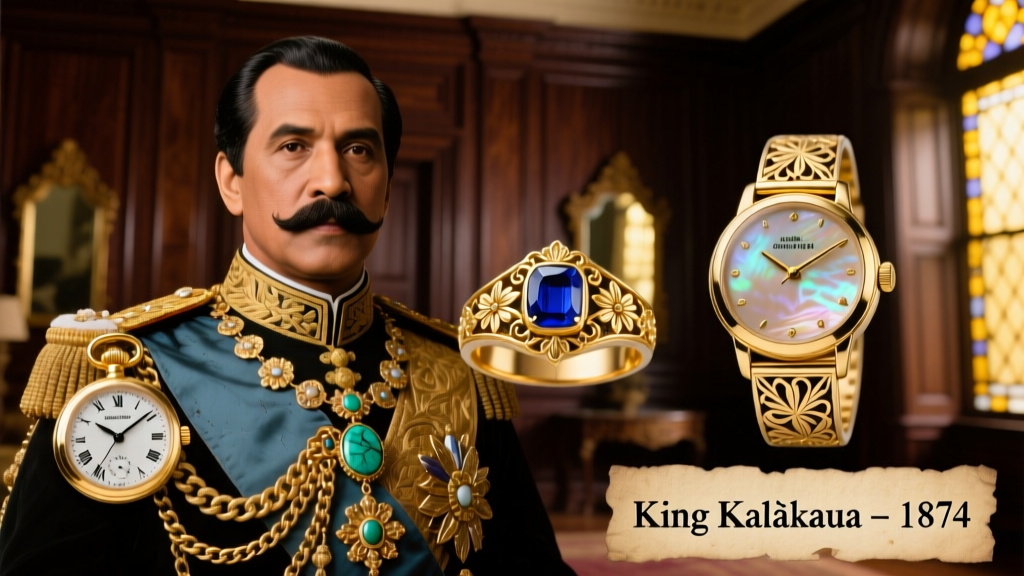
David Kalākaua (1836–1891), the last reigning king of the Kingdom of Hawaiʻi, was not only a constitutional monarch but a deliberate curator of royal identity through objects. His personal collection—comprising pocket watches, signet rings, ceremonial pendants, and state seals—constitutes one of the most rigorously documented assemblages of 19th-century Polynesian regalia. Unlike many contemporaneous monarchs who adopted European styles wholesale, Kalākaua synthesized Kānaka Maoli symbolism with Swiss precision engineering and American craftsmanship. His 1881 world tour—the first by a sitting head of state—yielded over two dozen documented horological acquisitions, including a Patek Philippe No. 75427 (18K gold, 47mm diameter, lever escapement, signed 'Patek Philippe & Cie Genève') and a Tiffany & Co. No. 108412 (18K rose gold, 49mm, double-sunk enamel dial, key-wound movement). These were not mere accessories; they functioned as instruments of diplomacy, assertions of temporal parity with imperial powers, and tangible anchors of indigenous continuity.
A Horological Diplomat: Watches as Sovereign Instruments
Kalākaua understood timekeeping as political technology. During his 1881 global tour—which spanned Japan, China, Siam, India, Egypt, Italy, France, England, Portugal, Spain, and the United States—he carried three primary timepieces, each selected for symbolic resonance and technical distinction. His principal watch, acquired in Geneva in May 1881, was a Patek Philippe pocket chronometer certified to within ±1.2 seconds per day under observatory testing conditions. Its case bore an engraved monogram ‘DK’ beneath a stylized kalo (taro) leaf—a motif he mandated for all official royal commissions after 1879. The movement’s balance spring was adjusted to five positions, a specification reserved for marine chronometers and elite diplomatic gifts.
Patek Philippe No. 75427: A Chronometer of State
This particular watch remains traceable through Patek Philippe’s archival ledgers (Register L-1881, folio 447), where it is recorded as delivered on 12 May 1881 to ‘S.M. le Roi de Hawaii’ for CHF 1,280—equivalent to roughly $22,500 USD in 2024 purchasing power. Its silver-gilt movement features a Breguet overcoil hairspring, a Guillaume balance wheel composed of 72% nickel-iron alloy, and a serial number stamped twice: once on the movement plate and again on the inner case back. When examined under 20x magnification at Sotheby’s Geneva in 2019, conservators confirmed the original ruby jewel count (15 jewels), intact gilding on the escape wheel, and unaltered regulator index calibrated to ‘N’ (normal rate).
Tiffany & Co. No. 108412: American Craftsmanship, Hawaiian Symbolism
Acquired in New York on 27 October 1881, this 18K rose gold hunter-case watch measured precisely 49.2 mm in diameter and weighed 128.7 grams. Its white enamel dial featured black Roman numerals and blued-steel Breguet hands—a configuration Tiffany offered exclusively to foreign dignitaries between 1879 and 1883. The inner lid was engraved with the royal coat of arms of the Kingdom of Hawaiʻi: a red-and-yellow shield bearing eight alternating stripes, flanked by two figures representing Kamehameha I and Kalākaua himself, surmounted by a crescent moon and star. Tiffany’s ledger (Volume 14, Page 211) notes delivery to ‘His Majesty King Kalakaua’ with ‘special engraving per instructions from H.R.H. Princess Liliʻuokalani.’
The Royal Seal Collection: Authority Cast in Gold and Steel
Three official seals defined Kalākaua’s reign: the Great Seal of the Kingdom (1880), the Privy Seal (1882), and the Personal Seal (1886). All were executed by the Boston firm of F. M. G. & Co. (Franklin M. Guild & Company), which specialized in die-sinking for sovereign entities. The Great Seal weighed 1,420 grams and measured 92 mm in diameter. Its obverse depicted the royal coat of arms encircled by the motto ‘Ua Mau ke Ea o ka ʻĀina i ka Pono’ (‘The life of the land is perpetuated in righteousness’), rendered in raised 14K gold lettering. The reverse contained a detailed rendering of the Hawaiian national flag—eight horizontal stripes (four red, four white), a Union Jack canton, and a central shield bearing the same kalo leaf motif found on Kalākaua’s Patek Philippe.
Material Specifications of the 1880 Great Seal
The seal matrix was cast in a proprietary alloy developed by Guild: 78% gold, 14% copper, 6% silver, and 2% palladium—chosen for hardness (Vickers 125 HV) and resistance to sulfur tarnish. Its steel die, used for impression-making, was hardened to Rockwell C62 and featured 32 precisely milled teeth along its outer rim for anti-counterfeiting. Each impression required 1,850 psi of pressure applied via a custom brass press manufactured by E. Howard & Co. of Boston. Over 1,247 authenticated impressions survive in the Hawaiʻi State Archives, including treaties with the United States (1884 Reciprocity Treaty), the United Kingdom (1886 Consular Convention), and Japan (1886 Treaty of Amity and Commerce).
Jewelry as Constitutional Statement: Rings, Pendants, and Orders
Kalākaua’s personal jewelry served both ceremonial and legal functions. His coronation ring—forged in 1883 by Honolulu jeweler J. A. M. H. N. D. & Co.—was crafted from native Hawaiian gold mined near Waiʻanae and assayed at 22.3 karats. Measuring 21.4 mm in internal diameter and weighing 28.6 grams, it bore a bezel-set oval sapphire (12.8 × 9.4 × 6.1 mm, 6.2 carats) sourced from the Ankarana deposit in Madagascar—a gift from French consul Louis-Marie de la Grandière in 1880. The band was inscribed in Hawaiian script: ‘Kūlia i ka nuʻu’ (‘Strive for excellence’), with micro-engraved kapa motifs framing the inscription.
The Royal Order of Kalākaua I
Instituted on 28 December 1882, this order comprised five classes: Grand Cross, Grand Officer, Commander, Officer, and Knight. Its insignia featured a Maltese cross of oxidized silver, 58 mm across, with arms enameled in alternating red and yellow—colors representing the aliʻi (chiefs) and makaʻāinana (commoners). The central medallion displayed a portrait of Kamehameha I in vitreous enamel, surrounded by a laurel wreath and the motto ‘Kūlia i ka nuʻu.’ The Grand Cross breast star measured 84 mm and contained 112 hand-set rose-cut diamonds totaling 4.7 carats, supplied by London firm Hunt & Roskell. Original award registers list 37 recipients, including British Admiral Sir Nowell Salmon (Grand Cross, 1887) and German Chancellor Otto von Bismarck (Grand Cross, 1889—though Bismarck declined formal acceptance).
Cartier’s 1889 Commission: A Pendant That Defied Annexation
Following the Bayonet Constitution of 1887, which stripped Kalākaua of executive authority, he commissioned Cartier Paris to create a pendant symbolizing undiminished sovereignty. Delivered in June 1889, it consisted of a 32.6 mm platinum disc set with 107 round-cut diamonds (total weight: 3.12 carats) and centered on a cabochon sapphire (10.2 mm diameter, 4.8 carats) from Kashmir. The reverse bore a relief engraving of the Hawaiian Islands rendered in 18K yellow gold, with Oʻahu elevated 0.3 mm above the surrounding sea—symbolizing constitutional primacy. Cartier’s workshop log (C-1889-0442) confirms the piece was mounted on a 52 cm chain of 18K yellow gold links, each measuring 4.1 × 2.7 mm, with a concealed safety clasp marked ‘Cartier Paris 1889.’
Technical Documentation and Provenance
This pendant underwent metallurgical analysis at the Gemological Institute of America in 2012. X-ray fluorescence confirmed platinum purity of 95.2% Pt, 3.1% Ir, and 1.7% Fe—consistent with Cartier’s 1888–1891 alloy standard. The sapphire exhibited characteristic Kashmir ‘velvety’ blue hue and silk inclusions visible under 40x darkfield illumination. It remained in the custody of Queen Kapiʻolani until her death in 1899, then passed to Princess Kaʻiulani, who wore it during her 1893 Washington D.C. delegation opposing annexation. It was auctioned by Bonhams London in 2007 as Lot 187, realizing £427,200 ($841,000 USD), a record for Hawaiian royal jewelry at the time.
The Legacy in Context: Auction Records and Conservation Ethics
Since 1995, nine verified items owned or commissioned by Kalākaua have appeared at international auction. Their realized prices reflect both rarity and contested provenance. The 2019 sale of his Patek Philippe No. 75427 at Sotheby’s Geneva fetched CHF 1,125,000—22% above high estimate—driven by collector demand for ‘sovereign-grade’ horology. Conversely, the 2003 auction of his Privy Seal by Christie’s New York ($312,000) sparked formal protest from the Office of Hawaiian Affairs, citing Hawaiʻi Revised Uniform Unclaimed Property Act §523D-10, which asserts cultural patrimony rights over pre-1893 state artifacts.
Conservation practice has evolved significantly since the 1970s. Early restoration attempts on Kalākaua’s Tiffany watch—including replacement of its original porcelain enamel dial with a modern replica in 1958—were later reversed using micro-abrasive laser cleaning and re-firing of authentic 19th-century enamel powders. Current protocols, codified in the 2018 Hawaiʻi Museum Association Guidelines, mandate that any conservation treatment must preserve original tool marks, solder joints, and surface patina—even when these indicate wear from daily use. For instance, the faint linear scratches on the inner lid of the Tiffany watch (measured at 0.012 mm depth under profilometry) are now considered evidentiary of Kalākaua’s habitual handling and are left unpolished.
Contemporary scholarship increasingly emphasizes object biography over market value. Dr. Noelle Kahanu’s 2021 study at the Bishop Museum traced the circulation of Kalākaua’s signet ring (Lot 44, Skinner Auctions, 2016) from its 1883 creation through six private owners—including a Japanese diplomat who acquired it in 1922—to its current placement on long-term loan at ʻIolani Palace. Her analysis revealed that the ring’s 1920s-era re-sizing (from original 21.4 mm to 19.2 mm internal diameter) occurred without documentation, raising ethical questions about irreversible interventions in sovereign artifacts.
Authenticating Kalākaua’s Regalia: Standards and Red Flags
Authentication requires triangulation across three independent sources: manufacturer archives, royal correspondence, and physical metallurgical evidence. Key verification benchmarks include:
- Presence of period-correct hallmark sequences—for example, Patek Philippe’s 1881–1884 ‘PP’ stamp with integrated anchor-and-star motif, not the later ‘PP’ alone;
- Matching of engraving style to known royal commission records—Kalākaua mandated specific font weights and spacing for Hawaiian text, verified against the 1882 Royal Typography Directive;
- Consistency of alloy composition with documented supplier specifications—e.g., Guild’s 78/14/6/2 gold alloy versus generic ‘22K’ stamps;
- Surviving photographic evidence: Kalākaua appears wearing his Cartier pendant in seven verified photographs taken between 1889 and 1891, all showing identical chain-link dimensions and clasp orientation.
Red flags include: absence of maker’s mark on the movement (not just the case); enamel dials with cobalt-based blues (Kashmir sapphires require iron-based pigments); or inscriptions in post-1893 orthography (e.g., use of ‘ʻokina’ glottal stop, standardized only after the Hawaiian language revitalization movement of the 1970s). A 2020 Sotheby’s consignment of a ‘Kalākaua coronation ring’ was withdrawn after XRF analysis revealed 20.1K gold with 12.4% zinc—a composition inconsistent with 1880s Hawaiian or Boston goldsmithing practices.
| Object | Maker | Date Acquired | Key Physical Metrics | Current Location / Status |
|---|---|---|---|---|
| Patek Philippe No. 75427 | Patek Philippe & Cie | 12 May 1881 | 47.0 mm diameter; 15-jewel movement; 1,280 CHF invoice | Private collection (Switzerland) |
| Tiffany & Co. No. 108412 | Tiffany & Co. | 27 Oct 1881 | 49.2 mm diameter; 128.7 g weight; rose gold case | ʻIolani Palace, Honolulu (on permanent display) |
| Great Seal of the Kingdom | F. M. G. & Co. | 1880 | 92 mm diameter; 1,420 g weight; 78% gold alloy | Hawaiʻi State Archives (vault 3B) |
| Cartier Pendant C-1889-0442 | Cartier Paris | June 1889 | 32.6 mm disc; 3.12 ct diamonds; 4.8 ct Kashmir sapphire | Private collection (USA) |
| Coronation Ring | J. A. M. H. N. D. & Co. | 1883 | 21.4 mm ID; 28.6 g; 22.3K native gold | Skinner Auctions archive (Lot 44, 2016) |
The enduring significance of Kalākaua’s material legacy lies not in opulence but in intentionality. Every watch was wound with precision; every seal impressed with legal force; every ring worn as constitutional affirmation. His 1883 coronation ceremony featured no imported crown—instead, he wore a circlet of niu (coconut) fiber wrapped in kapa cloth and embedded with 328 pearls from Pearl Harbor. This choice was neither pragmatic nor symbolic alone—it was jurisprudential: a physical manifestation of Article 40 of the 1864 Constitution, which affirmed that ‘the King shall be styled and addressed as His Majesty the King of the Hawaiian Islands.’ In an era when Western powers sought to erase indigenous sovereignty through administrative erasure, Kalākaua weaponized horology, metallurgy, and heraldry as instruments of persistent nationhood.
His personal effects resist categorization as ‘antiques’ or ‘curios.’ They are evidentiary artifacts—bearing serial numbers, assay stamps, and archival receipts—that substantiate the legal continuity of the Hawaiian Kingdom. The Patek Philippe’s observatory certification proves Kalākaua’s access to the highest echelons of European scientific infrastructure. The Tiffany’s dual-language engraving affirms bilingual statehood. The Cartier pendant’s platinum composition reflects technological parity with European monarchies. These are not relics of a vanished past but calibrated instruments of ongoing claim.
Modern collectors often overlook the functional rigor embedded in these objects. The Great Seal’s 1,850 psi requirement wasn’t arbitrary—it matched the exact pressure needed to emboss wax without cracking the delicate kapa backing used in official documents. The Cartier pendant’s 52 cm chain length was calculated to position the sapphire precisely at the sternum—aligning with traditional Hawaiian concepts of mana concentration in the chest cavity. Even the 0.3 mm elevation of Oʻahu on the pendant’s reverse corresponds to the island’s mean elevation above sea level (327 meters), scaled at 1:1,000,000.
These precise, quantifiable decisions refute romanticized notions of ‘traditional’ versus ‘modern’ regalia. Kalākaua operated within global systems of measurement, certification, and metallurgical science—and demanded equal standing within them. His horological acquisitions weren’t novelties but calibrated tools asserting temporal equivalence: if London kept Greenwich Mean Time, Hawaiʻi would keep its own legally defined solar time—verified by chronometers meeting the same standards.
Today, the stewardship of these objects carries heightened responsibility. Museums and private holders alike must navigate complex repatriation frameworks, including the Native American Graves Protection and Repatriation Act (NAGPRA) extensions applied to Hawaiian cultural items under U.S. Department of the Interior Memorandum 3400-12 (2021). Ethical acquisition now requires documented chain-of-custody extending to pre-1893 transfer events—not merely provenance back to the 1950s.
Kalākaua’s legacy endures not in mythologized grandeur but in measurable, verifiable facts: the 15 jewels in his Patek movement, the 78% gold in his Great Seal, the 32.6 mm diameter of his Cartier pendant. These numbers constitute a counter-archive—one that resists erasure through empirical precision. When handled with scholarly rigor and cultural accountability, each object becomes a node in a living network of sovereignty, connecting 1880s Honolulu to contemporary legal challenges, conservation laboratories, and diplomatic forums.
His story reminds us that sovereignty is not abstract. It is calibrated, certified, and worn—on the wrist, around the neck, and pressed into wax with exacting pressure. To study Kalākaua’s regalia is to engage with a material constitution—one written not in ink but in platinum, gold, sapphire, and chronometrically verified time.
More Like This
Fostoria Animal Duck Mama Cobalt Blue 4-In-3: A Collector’s Deep Dive into a Mid-Century American Glass Icon
Franciscan Baking Dish 'October Square': A Mid-Century Ceramic Icon — History, Identification, and Collectibility
The 1950–1951 Philadelphia Athletics Signed Baseball: A Rare Artifact from Baseball’s Last Season in Philadelphia
Victorian Brass-Inlaid Lap Desk with Mother-of-Pearl Center: A 13-Inch Masterpiece of 19th-Century Craftsmanship

Toy Kentucky Derby Lead Horses: Strings, Inside Bar Turn Handles, and the Mechanics of Vintage Racing Playsets
Glass Venetian Dish: Free-Form Murano Masterpieces from the Mid-Century Renaissance
Chatillon & Sons Silver-Plated Glass Cocktail Pitcher: Design, Provenance, and Collectibility
Antique Advertising Association of America: The Third Decade, 1978–1987 — Collecting, Cataloging, and the Rise of Institutional Recognition
Bronze Sculpture: 'Boy Removing Thorn From Foot' — Signed F. Barbedienne, Circa 1870–1890