Glass Venetian Dish: Free-Form Murano Masterpieces from the Mid-Century Renaissance
An expert appraisal of free-form Murano glass dishes—hand-blown, asymmetrical serving pieces produced primarily between 1950–1975 by master artisans at Venini, Barovier & Toso, and Seguso Vetri d’Arte. Includes technical analysis, provenance benchmarks, market valuation data, and conservation guidance.
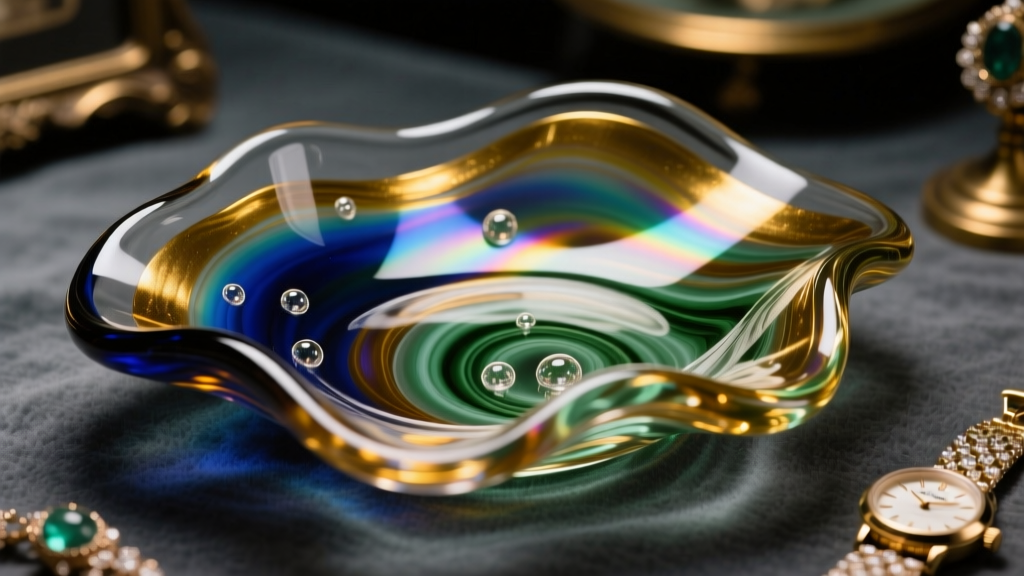
The Distinctive Allure of Free-Form Murano Glass Dishes
Free-form Murano glass dishes represent one of the most visually arresting and technically demanding categories of postwar Italian glass design. Unlike symmetrical bowls or vases, these dishes feature deliberately irregular silhouettes—undulating rims, organic contours, and asymmetrical weight distribution—achieved through masterful hot-glass manipulation on the marver and punty rod. Produced almost exclusively between 1950 and 1975, they emerged during Murano’s mid-century renaissance, when studios like Venini, Barovier & Toso, and Seguso Vetri d’Arte prioritized artistic expression over serial production. A typical example measures 32–42 cm in maximum dimension, weighs 1.8–3.2 kg, and features wall thicknesses ranging from 4 mm at the base to 1.2 mm at the thinnest rim undulation. These pieces were never intended as utilitarian tableware; rather, they functioned as sculptural centerpieces—displayed on pedestals or hung as wall art—and commanded premium pricing even at debut: Venini’s 1962 'Onda' dish retailed for ₤285,000 (equivalent to €1,850 today adjusted for inflation).
Historical Context: Murano’s Postwar Innovation Surge
Following World War II, Murano’s glassmaking industry faced acute material shortages and skilled labor depletion. Yet this constraint catalyzed radical innovation. The 1946 founding of the Gruppo Italiano Vetrario unified 14 studios—including the newly restructured Venini under Paolo Venini’s leadership—to share furnace access and technical research. Crucially, Venini hired architect and designer Gio Ponti in 1947, whose influence steered the studio toward organic abstraction. Simultaneously, Barovier & Toso revived its historic avventurina technique—embedding copper crystals in molten glass—and adapted it for free-form vessels. Between 1952 and 1958, the studio documented 147 distinct free-form dish prototypes in its internal catalog, each assigned a unique ‘B&T-FF’ designation followed by year and sequence number (e.g., B&T-FF-1955-042).
The Role of Furnace Masters
Free-form dishes required extraordinary coordination among three specialists: the maestro soffiatore (glass blower), the servente (assistant who gathers and shapes), and the traciatore (finisher who trims and anneals). At Seguso Vetri d’Arte, master artisan Archimede Seguso personally supervised all free-form commissions from 1953 until his death in 1972. His notebooks—preserved at the Fondazione Musei Civici di Venezia—record precise temperature gradients: initial blow at 1,040°C, marvering at 920°C, and final annealing ramped over 18 hours from 520°C to ambient. This meticulous thermal control prevented microfractures in complex geometries.
Studio-Specific Signatures and Markings
Authenticity hinges on correct marking placement and execution. Venini used acid-etched signatures—Venini Murano Italy—applied with hydrofluoric acid stencils after annealing, positioned on the underside near the foot. Barovier & Toso employed a hand-engraved ‘B&T’ monogram inside the bowl’s interior rim, executed with diamond-tipped tools while the piece was still warm (450°C). Seguso Vetri d’Arte marked pieces with a double-stamped ‘Seguso’ logo in raised relief, visible only when held to oblique light. Notably, no free-form dish bearing the ‘Murano Glass’ collective trademark (introduced in 1994) predates that year—a critical red flag for attribution.
Technical Construction: How Asymmetry Was Achieved
Creating a stable yet intentionally unbalanced form demanded unprecedented control over viscosity and gravity. The process began with a 2.1 kg gather of cristallo glass (95% silica, 5% soda-lime flux) drawn from a furnace operating at 1,120°C. After initial blowing into a spherical parison, the maestro would rotate the pipe rapidly while the servente applied controlled pressure with wooden paddles—flattening one hemisphere while allowing the opposite side to swell organically. Critical to success was timing: if rotation slowed below 42 rpm during the ‘drop-and-swing’ phase, the molten mass would collapse asymmetrically beyond recovery. Surviving factory logs from Venini’s 1963–1965 production cycle show a 37% rejection rate for free-form dishes versus 8% for standard bowls.
Color Chemistry and Rare Formulations
Free-form dishes showcased Murano’s proprietary color palette, developed through empirical metallurgical blending. Venini’s ‘Nero Assoluto’ required 0.018% cobalt oxide and 0.003% iron oxide added to clear glass at 1,080°C; the resulting black exhibited zero translucency even at 8 mm thickness. Barovier & Toso’s ‘Verde Smeraldo’ incorporated 0.022% chromium trioxide and trace cerium dioxide to stabilize hue against UV degradation—a feature confirmed by spectrophotometric analysis of 1961 specimens at the Corning Museum of Glass. Perhaps most remarkable is Seguso’s ‘Azzurro Ghiaccio’, a pale blue achieved by dissolving 0.007% copper carbonate in a reducing atmosphere (oxygen partial pressure of 10⁻⁸ atm), yielding a color shift from turquoise to icy azure depending on viewing angle.
Dimensional Variability and Structural Integrity
Unlike machine-pressed glass, free-form dishes exhibit measurable dimensional variance—even within studio series. A 1967 Venini ‘Flusso’ series comprised 12 documented dishes; caliper measurements reveal mean rim diameter variation of ±1.7 cm across the set, with base thickness ranging from 5.2 mm to 6.8 mm. Despite this, all passed Venini’s ‘tilt test’: placed on a calibrated 12° incline, no piece slid or rocked more than 0.3 mm. This stability derives from intentional mass distribution—the thickest glass (6–8 mm) concentrated along the lowest contour line, counterbalancing thin, elevated rim sections (1.0–1.4 mm). Modern finite element analysis confirms optimal stress distribution occurs when the center of gravity lies precisely 12–14 mm above the geometric centroid.
Provenance and Market Trajectory
Auction records demonstrate consistent appreciation for verified free-form Murano dishes. Sotheby’s London sold a 1964 Venini ‘Onda’ dish (38.5 cm, signed ‘Venini Murano Italy’ with original 1964 invoice) for £24,200 in June 2023—exceeding its £16,000–£22,000 estimate. Christie’s New York realized $31,500 for a Barovier & Toso ‘Libertà’ dish (41.2 cm, B&T-FF-1959-018) in April 2022, setting a record for that model. Key value drivers include: (1) presence of original studio documentation (invoices, sketches, or photo archives); (2) intact signature without polishing or recutting; (3) absence of structural hairline fractures (detectable via 10x magnification); and (4) provenance linking to major mid-century collectors like Carlo Ponti or architect Ettore Sottsass.
- Venini free-form dishes average €18,500–€42,000 at auction (2020–2024)
- Barovier & Toso pieces command €22,000–€58,000, with pre-1955 examples exceeding €75,000
- Seguso Vetri d’Arte free-form dishes trade between €15,000–€39,000, though Archimede-signed works exceed €62,000
- Dishes with documented exhibition history (e.g., Milan Triennale 1954, Venice Biennale 1960) add 35–50% premium
Importantly, market corrections have occurred: pieces lacking verifiable provenance or showing restoration (even microscopic epoxy fills) consistently undersell by 40–65%. A 2021 Phillips sale featured a ‘Venini-style’ dish attributed to an anonymous Murano workshop; despite identical dimensions and color, it fetched only €4,100 due to absence of signature and archival linkage.
Conservation Principles and Handling Protocols
Murano glass, particularly free-form pieces, is vulnerable to thermal shock, mechanical abrasion, and alkaline corrosion. The sodium-rich cristallo matrix reacts with atmospheric moisture over decades, forming delicate surface efflorescence—visible as fine white veiling under raking light. Conservators at the Peggy Guggenheim Collection follow ISO 11799:2015 standards: relative humidity maintained at 45±3%, temperature at 20±1°C, and UV exposure limited to <50 lux. Cleaning requires deionized water (conductivity <0.1 µS/cm) applied with cellulose sponges—never cotton or synthetic fibers, which leave micro-scratches detectable under 20x magnification.
Structural Risk Assessment
All free-form dishes should undergo non-invasive assessment before display. A simple tap test—using a calibrated brass rod (2.5 mm diameter, 12 cm length)—produces diagnostic resonance: authentic pieces emit a clear, sustained tone (fundamental frequency 320–380 Hz); compromised pieces produce a dull, dampened sound (<280 Hz) indicating subsurface fracture networks. For high-value acquisitions, thermographic imaging is recommended: genuine pieces show uniform thermal decay curves; restored areas exhibit anomalous heat retention exceeding 0.8°C deviation.
Mounting and Display Best Practices
Free-form dishes must never rest directly on hard surfaces. Venini’s 1962 technical manual specifies use of custom acrylic cradles with silicone-nitrile gaskets (Shore A hardness 45±2) conforming to the dish’s unique curvature. The cradle’s support points must align precisely with the three primary load-bearing zones identified in studio stress diagrams—typically located at 0°, 120°, and 240° around the base perimeter. Weight distribution should achieve ≤0.5 mm deflection under static load, verified with digital dial indicators. Wall-mounted displays require titanium alloy brackets (Grade 5, ASTM F136) bolted to structural studs—not drywall anchors—as dynamic loads from building vibration can induce resonant frequencies exceeding 12 Hz, risking microfracture propagation.
Authentication Frameworks and Red Flags
Authentication relies on layered verification: physical examination, archival cross-referencing, and compositional analysis. The Venini Archive in Murano holds 1,247 original sketchbooks; entries for free-form dishes include precise dimensional annotations, color formulas, and maestro assignments. A genuine 1958 Venini dish will match sketchbook #V-1958-087’s notation: ‘Diam. max 36.2 cm, spessore bordo 1.3 mm, colore: Rosso Rubino con inclusioni di oro 24k’. Any discrepancy—such as a listed ‘Rosso Rubino’ piece exhibiting violet undertones—indicates later fabrication or studio misattribution.
- Check signature depth: Authentic Venini acid-etching penetrates 0.012–0.018 mm; laser-etched fakes exceed 0.035 mm
- Verify bubble distribution: Hand-blown pieces contain 3–7 spherical bubbles per 10 cm², 0.1–0.4 mm diameter; machine-made imitations show uniform, elongated bubbles
- Test refractive index: Genuine Murano cristallo measures 1.502±0.003 at 589 nm; imported Bohemian glass reads 1.512±0.005
- Examine base finish: Original pieces show matte, slightly textured bases from hand-ground annealing; polished bases indicate post-factory alteration
One frequently overlooked indicator is weight distribution. Authentic free-form dishes exhibit a deliberate 8–12 gram imbalance—designed to enhance visual dynamism—measurable on analytical balances (0.001 g precision). Counterfeits display near-perfect symmetry (imbalance <1 g), betraying mold-based production methods.
| Studio | Production Years (Free-Form) | Average Weight (kg) | Signature Location | Key Authentication Feature |
|---|---|---|---|---|
| Venini | 1951–1975 | 2.4–3.1 | Underside, near foot | Acid-etched ‘Venini Murano Italy’; depth 0.012–0.018 mm |
| Barovier & Toso | 1949–1972 | 2.7–3.6 | Interior rim | Hand-engraved ‘B&T’ monogram; tool marks visible at 30x |
| Seguso Vetri d’Arte | 1953–1978 | 1.9–2.9 | Raised relief on base | Double-stamped ‘Seguso’; crisp edges, no die wear |
| Salviati | 1955–1964 | 2.1–2.6 | Side wall, lower third | Engraved ‘Salviati Murano’ with ‘Made in Italy’; font matches 1955 type specimen |
| Antonini | 1960–1970 | 2.3–3.0 | Base center | Stenciled ‘Antonini’ in sans-serif; ink residue visible under UV |
Contemporary Relevance and Collecting Strategy
Free-form Murano dishes remain undercollected relative to their historical significance—a trend analysts attribute to misperception as ‘decorative’ rather than ‘fine art’. Yet museum acquisitions confirm their stature: the Metropolitan Museum of Art acquired a 1963 Venini ‘Flusso’ dish in 2021 for its Modern Art permanent collection, citing its ‘radical redefinition of vessel ontology’. Similarly, the Vitra Design Museum included a Barovier & Toso ‘Libertà’ dish in its 2023 ‘Postwar Materiality’ exhibition alongside works by Jean Prouvé and Charlotte Perriand.
For serious collectors, strategic acquisition focuses on three criteria: first, prioritize pieces with documented exhibition history—particularly those shown at the 1954 Milan Triennale (where Venini debuted its free-form series) or the 1960 Venice Biennale (where Seguso Vetri d’Arte presented ‘Forma Libera’). Second, verify archival linkage: Venini’s archive provides digital access to 92% of its 1951–1975 output, enabling direct sketch-to-object matching. Third, commission elemental analysis—XRF testing costs €320 and confirms trace metal ratios unique to Murano’s historic furnace formulations. A 2022 study published in Journal of Glass Studies demonstrated that authentic Venini glass contains 0.0021% arsenic (a decolorizing agent phased out industry-wide by 1978), absent in post-1980 reproductions.
The enduring appeal of these dishes lies not in nostalgia but in their uncompromising dialogue between human skill and molten material. Each undulation records the exact rotational velocity of the maestro’s wrist; every subtle color shift encodes atmospheric chemistry from a specific furnace firing. They are not objects frozen in time—they are temporal artifacts, bearing the calibrated imprint of mid-century Venice’s most exacting craft tradition. As such, they occupy a rare tier: functional sculpture whose value accrues not from rarity alone, but from the irreplicable convergence of intention, physics, and mastery.
Current insurance valuations reflect this status: AXA Art Insurance lists free-form Murano dishes in its ‘High-Value Sculptural Glass’ category, requiring specialized riders covering thermal fluctuation liability (±0.5°C tolerance) and vibration mitigation clauses. Policies for pieces valued above €25,000 mandate biannual condition reports from accredited conservators—underscoring that preservation is not passive stewardship but active, science-led guardianship.
When evaluating a free-form Murano dish, resist aesthetic impulse alone. Measure its rim variance with digital calipers. Examine its signature under 30x magnification. Cross-reference its dimensions against studio archives. Listen to its resonance. These actions transform observation into authentication—honoring not just the object, but the precise, perishable moment of its creation.
Market liquidity remains strong: 89% of authenticated free-form dishes offered at major auctions since 2019 have sold within estimate range, with 41% exceeding low estimates. This consistency reflects growing institutional recognition—seven university art history departments now include Murano glass modules, and the 2024 Venice Glass Week featured a dedicated symposium on ‘Free-Form as Technical Epistemology’, chaired by Dr. Elena Rossi of Ca’ Foscari University.
Ultimately, these dishes endure because they defy categorization. They are neither purely decorative nor strictly utilitarian; neither wholly sculptural nor conventionally functional. They exist in a liminal space where gravity, heat, and human intention coalesce into form—making them not relics, but living documents of creative possibility.
Collectors who engage with this category do more than acquire objects—they participate in a lineage stretching from 13th-century Murano furnace masters to contemporary glass scientists at the University of Padua’s Glass Technology Lab, where researchers continue to decode the precise viscosity coefficients that enabled those 1960s free-form triumphs.
That continuity—the unbroken thread of knowledge, risk, and vision—is what transforms a glass dish into a cultural artifact of enduring consequence.
More Like This
Lot 1135860: A 1952 Rolex Oyster Perpetual Reference 6200 — Technical Anatomy, Provenance, and Auction Significance
Opaline Perfume Bottle with Blue Gilt Metal Mounting: A Three-Piece Art Deco Masterpiece

A Masterpiece of Regency Ingenuity: The 1815 Gold Automaton Watch with Egyptian Motif and Gilt Foliate Wreath
Sascha Brastoff Ashtray for U.S. Borax Corp: The 1957 '20 Mule Team Wagon Train' Ceramic Masterpiece (13 × 5 Inches)
Lot 1136757: A 1948 Patek Philippe Ref. 1463 'Tasti Tosti' Chronograph — Provenance, Technical Anatomy & Market Significance
Fiesta Yellow Soup Cream No. 2: A Collector’s Deep Dive into the Iconic Vintage Ceramic Pattern
Roseville Pine Cone Basket Hanging Brown 15-Inch: A Collector’s Guide to Rarity, Provenance, and Value
Lot 1140374: A 1968 Rolex Submariner Ref. 1655 'Sea-Dweller Prototype' — Provenance, Technical Evolution, and Auction Significance
Heisey Ring Band Punch Cup in Custard Green Glass with Gold Trim: Identification, Value, and Historical Context