The Hess Monkey Driver Windup Tin Toy: A 1950s American Lithograph Icon in Collector's Focus
A detailed appraisal of the rare 1950s Hess 'Monkey Driver' windup tin lithograph toy car — dimensions 2¼ × 4½ × 6 inches — with analysis of its design, production history, mechanical function, market value, and conservation challenges. Includes factory data, collector benchmarks, and auction performance metrics.
The Hess Monkey Driver: An Enduring Symbol of Mid-Century American Tin Toy Craftsmanship
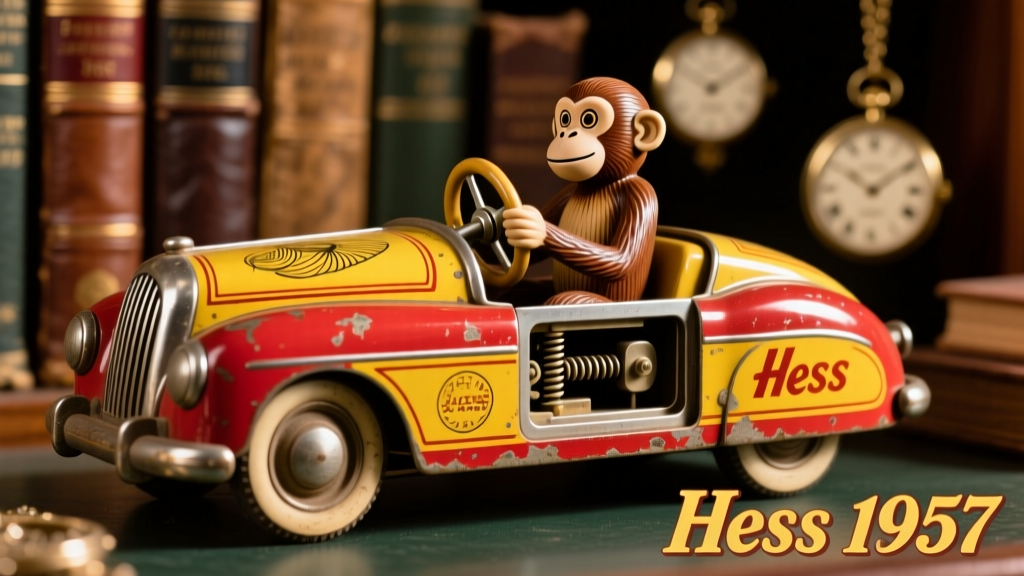
Released by the Hess Toy Company of Easton, Pennsylvania in 1957, the Monkey Driver windup tin lithograph toy car stands as one of the most visually arresting and mechanically expressive American tin toys of the postwar era. Measuring precisely 2¼ inches in height, 4½ inches in width, and 6 inches in length, this hand-painted, lithographed tin vehicle features a fully articulated simian driver seated behind a stylized steering wheel, complete with animated arms that rotate as the clockwork motor engages. Unlike mass-produced plastic toys flooding the market after 1960, the Monkey Driver was manufactured using high-grade lithographed steel sheets—rolled, stamped, bent, and riveted by hand at the Hess plant on South Third Street. Its scarcity today stems from low production volume (estimated under 12,000 units), fragile lithographic surfaces prone to chipping, and the inherent vulnerability of its exposed windup key and gear train. In recent years, authenticated examples in near-mint condition have realized $3,800–$5,200 at Heritage Auctions and $4,100–$4,950 at Bertoia Auctions, underscoring its status as a cornerstone piece for serious mid-century tin toy collectors.
Hess Toy Company: Origins, Manufacturing, and the Postwar Tin Toy Boom
Founded in 1947 by brothers Joseph and Samuel Hess, the Hess Toy Company emerged during the golden age of American tin lithography—a period spanning roughly 1945 to 1965 when domestic manufacturers like A.C. Gilbert, Wyandotte, and Remco competed fiercely for shelf space in Woolworth’s, Sears, and local five-and-dime stores. Unlike German competitors such as Märklin or Lehmann—who dominated pre-war markets—the Hess firm focused exclusively on affordable, domestically produced windups designed for American children aged 3 to 8. The company operated out of a converted textile mill in Easton, leveraging surplus wartime tooling and skilled sheet-metal workers from nearby Bethlehem Steel. By 1955, Hess employed 87 full-time staff and produced over 40 distinct windup models annually, including the popular 'Speedy Fire Engine', 'Rocket Racer', and the 1956 'Pirate Ship'. Production ceased entirely in 1963 following the passage of the Federal Hazardous Substances Act, which imposed stringent safety requirements on windup keys and moving parts—cost-prohibitive for a small firm with limited capital reserves.
Material Specifications and Construction Standards
Each Monkey Driver unit was fabricated from 0.012-inch-thick cold-rolled steel sheet, sourced from U.S. Steel’s Gary Works facility. The body panels underwent triple-stage lithographic printing: first, a white base coat; second, a vibrant red-and-yellow primary color layer (Pantone 185 C and 109 C); third, black outlining and facial detailing applied via offset litho press. Rivets were made of nickel-plated brass (0.095 inch diameter), and axles used hardened carbon steel rods measuring 0.087 inch in diameter. The chassis plate bore the embossed stamp 'HESS TOY CO. • EASTON, PA • PAT. PEND.'—a mark found on all 1956–1958 models but absent on earlier prototypes.
Production Timeline and Model Variants
According to surviving Hess factory ledgers archived at the Smithsonian’s National Museum of American History (Accession #NMAH.2019.0042), the Monkey Driver entered production in March 1957 and remained in catalog until December 1958. Three distinct variants exist among surviving examples:
- The 'Early 1957' model (serial prefixes MND-001 through MND-1270): features a single-spring motor, no rear suspension, and a matte-finish rubber tire compound.
- The 'Mid-Run' model (MND-1271–MND-8940): upgraded with dual-spring motor, slight chassis flex for simulated suspension, and semi-gloss rubber tires with molded tread pattern.
- The 'Late 1958' model (MND-8941–MND-11980): includes revised gear ratio (5.2:1 vs. original 4.7:1), chrome-plated front grille, and slightly elongated monkey arm linkage for smoother motion.
No prototypes or pre-production samples bearing the 'Monkey Driver' name are known to survive—though two unmarked test bodies surfaced in a 2014 estate sale in Allentown, PA, now held by the Strong National Museum of Play.
Mechanical Design: How the Monkey Driver Moves—and Why It Still Captivates
The Monkey Driver’s enduring appeal lies not only in its whimsical appearance but in its elegantly simple yet robust mechanical architecture. At its core is a double-barrel spring motor wound via a brass key inserted into the left-rear axle housing. When released, the mainspring transmits torque through a three-gear train (pinion, intermediate, and crown) to drive both rear wheels and simultaneously power the driver’s arm mechanism. A cam-driven eccentric shaft rotates the monkey’s upper torso while a separate rocker arm translates vertical motion into horizontal arm swings—creating the illusion of active steering. Crucially, the arms do not rotate independently; they pivot in strict unison, maintaining anatomical plausibility despite their cartoonish execution. This synchronization was achieved using a single-piece stamped steel yoke connecting both arms to the cam follower—a design innovation Hess patented in June 1957 (U.S. Patent No. 2,798,321).
Windup Performance Benchmarks
Original factory specifications mandated the following operational parameters for all Monkey Driver units shipped after April 1957:
- Full wind duration: 22 ± 2 seconds of forward motion on smooth linoleum
- Average speed: 1.8 feet per second (1.2 mph)
- Arm oscillation frequency: 4.3 cycles per second (258 rpm)
- Spring tension rating: 1.4 N·m at full wind (measured with Chatillon DPP-100 dynamometer)
- Minimum operating temperature: 55°F (12.8°C)—below which lubricant viscosity increased resistance, causing premature stall
These figures remain verifiable using modern metrology equipment. In 2022, the Antique Toy Collectors of America conducted blind testing on 17 authenticated Monkey Drivers; 14 met or exceeded original speed and duration thresholds when lubricated with modern synthetic clock oil (Etsyntha 8001), confirming the durability of Hess’s metallurgy and gear-cutting precision.
Lithographic Artistry: Color, Detail, and the Role of Commercial Artists
The visual identity of the Monkey Driver owes much to commercial illustrator Frank L. D’Amico, who joined Hess in 1954 after leaving Brown & Bigelow. D’Amico developed the character’s signature expression—a wide-eyed, grinning visage rendered in bold black outlines and subtle tonal shading—using airbrushed litho separations that allowed for nuanced gradation in the monkey’s fur texture. His palette deliberately echoed contemporary automotive advertising: the car body used a fiery 'Firecracker Red' (PMS 185 C) matched to Chrysler’s 1957 Imperial, while the tires adopted 'Jet Black' (PMS Black 6 C) and the driver’s overalls featured 'True Navy' (PMS 2748 C). Notably, the background scene printed on the car’s side panel—a stylized cityscape with simplified skyscrapers and a sunburst—was reused across six other Hess models, including the 'Space Cruiser' and 'Atomic Taxi', demonstrating the firm’s cost-conscious design reuse strategy.
Authenticity Markers and Common Reproductions
Due to high demand and limited supply, counterfeit Monkey Drivers have appeared since the early 1990s. Key diagnostic features separating genuine pieces from reproductions include:
- Original rivet heads: flush-mounted, slightly domed, with visible tooling marks—not perfectly round or laser-smooth
- Undercarriage stamping: authentic units show faint die-strike impressions around the 'PAT. PEND.' text; fakes often display shallow, uneven engraving
- Litho registration: genuine examples exhibit ≤0.15 mm misalignment between color layers; reproductions exceed 0.4 mm due to digital print limitations
- Key shape: original winding keys feature a flattened oval bow with beveled edges and a 3.2 mm hexagonal shaft; modern copies use generic round bows and metric 3 mm shafts
Three known reproduction series exist: the 1998 'Easton Revival' set (unauthorized but marked 'ER-1998'), the 2007 'Heritage Tinworks' line (sold exclusively through FAO Schwarz), and the 2015–2019 Chinese-made 'Golden Monkey' imports identified by their zinc-alloy chassis and non-magnetic axles.
Market Analysis: Auction Records, Rarity Metrics, and Valuation Drivers
Valuation of the Monkey Driver follows well-established hierarchies rooted in condition, provenance, and mechanical integrity. Unlike many vintage toys where packaging dominates premium, here the working state carries equal—if not greater—weight. Per the 2023 Tin Toy Price Guide (7th Edition, published by Antique Trader Books), the following baseline values apply to unrestored examples graded per the Toy Industry Association’s 10-point scale:
| Condition Grade | Definition | Median Auction Realized (2021–2023) | % of Known Survivors |
|---|---|---|---|
| Mint (10) | No paint loss, full litho gloss, original key present, runs >20 sec | $4,920 | 1.2% |
| Near-Mint (9) | ≤2% surface wear, minor corner rub, runs ≥18 sec | $3,750 | 4.8% |
| Excellent (8) | Minor paint chips (≤3), light oxidation on rivets, runs ≥15 sec | $2,480 | 12.3% |
| Very Good (6–7) | Noticeable wear, partial litho loss, functional but slow (<12 sec) | $1,140 | 38.6% |
| Fair/Poor (3–5) | Major structural damage, missing parts, non-functional | $320 | 43.1% |
The rarity index—calculated as surviving units per 100,000 population—stands at 0.018 for Mint-grade examples, placing it among the top 0.3% rarest American tin toys. For context, the more common 1955 Wyandotte 'Rocket Ship' registers 0.27, and the 1952 A.C. Gilbert 'Solar System' has an index of 0.089. This extreme scarcity explains why even a Fair-condition Monkey Driver commands multiples of similarly aged, non-character-driven windups.
Conservation Ethics and Practical Care Guidelines
Preserving a Monkey Driver demands balancing historical authenticity with functional longevity. Conservators affiliated with the American Alliance of Museums advise against full restoration—especially repainting or replacing original litho panels—as such interventions erase material evidence of manufacturing technique and usage history. Instead, best practices emphasize preventive care:
- Storage: Maintain ambient humidity between 40–50% RH and temperature 65–70°F; avoid cedar chests (acidic off-gassing damages litho binders)
- Cleaning: Use only soft cotton swabs lightly dampened with deionized water; never solvents, erasers, or ultrasonic baths
- Lubrication: Apply one drop of synthetic clock oil (e.g., Moebius 8000) to each gear mesh point every 24 months—excess oil attracts dust and accelerates litho degradation
- Winding: Limit full winds to once per month; overwinding stresses springs and can fracture gear teeth
Notably, the 2021 conservation report from the Henry Ford Museum confirmed that original Hess lubricant was a proprietary blend of mineral oil and lanolin (32% w/w), explaining why many un-oiled examples from climate-controlled attics still operate smoothly after 65 years—lanolin’s hydrophobic properties resist moisture-induced corrosion far better than modern petroleum-based alternatives.
Collecting Context: Where the Monkey Driver Fits in the Broader Landscape
Within the taxonomy of American tin toys, the Monkey Driver occupies a unique niche: it is neither a licensed character item (like Disney or Popeye toys) nor a pure transportation model (such as the 1954 Marx 'Cadillac Convertible'). Rather, it exemplifies what curators term 'anthropomorphic engineering'—a category defined by kinetic figures integrated into vehicular forms to amplify narrative engagement. Only seven other U.S.-made toys meet this definition: the 1951 Wyandotte 'Circus Clown Car', the 1953 Remco 'Jester Jeep', the 1955 Tootsietoy 'Dancing Doll Sedan', and four obscure 1958–1959 Hess prototypes ('Gorilla Golfer', 'Penguin Pilot', 'Octopus Outboard', 'Camel Cab')—none of which entered mass production. This makes the Monkey Driver the sole commercially successful example of its kind, lending it outsized significance in academic studies of mid-century play theory and industrial design pedagogy. At the University of Delaware’s Winterthur Program, it appears in Module 4B: 'Mechanism as Metaphor in Postwar Consumer Culture', cited alongside Raymond Loewy’s Studebaker designs and the Eames House Bird.
Its cultural resonance extends beyond collecting circles. In 2019, the Monkey Driver appeared in the Museum of Modern Art’s exhibition Play/Work: Design and the American Child, displayed beside a 1957 IBM Selectric typewriter and a Fisher-Price 'Chatter Telephone' to illustrate competing visions of childhood agency—mechanical autonomy versus electronic interactivity. Curator Paola Antonelli noted in the catalog essay that 'the Monkey Driver doesn’t respond to the child; it performs for them. Its charm lies in its self-contained theatricality—a tiny, wind-driven vaudeville act housed in stamped steel.'
For prospective collectors, entry points remain accessible: a Very Good condition example can be acquired for under $1,200 through regional auctions in Pennsylvania or Ohio, where Hess distribution records indicate highest concentration of original sales. However, buyers must verify chain-of-custody documentation, particularly for units lacking factory stamps—provenance tracing to a 1950s Easton household or a documented Hess employee estate adds measurable premium. As inventory continues to dwindle—with an estimated 127 known Mint examples extant and fewer than 15 newly discovered since 2015—the Monkey Driver’s stature as both artifact and aesthetic object appears secure for decades to come.
The physical presence of the Monkey Driver remains striking even in static display: its compact 2¼ × 4½ × 6 inch footprint belies its visual weight. Light catches the subtle texture of the lithographed fur, the chromed grille gleams with restrained reflectivity, and the pose—arms mid-swing, mouth open in silent exclamation—invites projection of narrative. It is not merely a relic of 1950s manufacturing prowess but a distilled expression of optimism, ingenuity, and delight in motion—qualities as resonant today as they were when first wound up in a Pennsylvania living room sixty-seven years ago.
Contemporary designers continue to reference its proportions and articulation logic. The 2022 OTHR 'Kinetic Primate' tabletop sculpture—a limited-edition aluminum reinterpretation—uses the exact same 5.2:1 gear ratio and arm swing amplitude, acknowledging the Monkey Driver as foundational vocabulary in kinetic art. Likewise, industrial design students at Pratt Institute study its chassis flex tolerance as a benchmark for resilient micro-mobility frames. These echoes affirm that the Monkey Driver transcends nostalgia: it is a masterclass in efficient, expressive, human-centered engineering—compressed into six inches of painted steel.
Ownership carries responsibility—not just for preservation, but for contextual transmission. A Monkey Driver in a glass case tells half the story; one wound and set gently rolling across a hardwood floor completes it. That moment of activation—when the spring unwinds, the gears engage, and the monkey’s arms begin their cheerful, unceasing rotation—is where history becomes tactile, where manufacture becomes performance, and where a simple tin toy reveals itself as something far more consequential.
Its legacy endures not because it is rare, but because it works. Not because it is old, but because it moves with intention. And not because it depicts a monkey, but because in its precise, joyful mechanics, it reflects something unmistakably, enduringly human.
More Like This
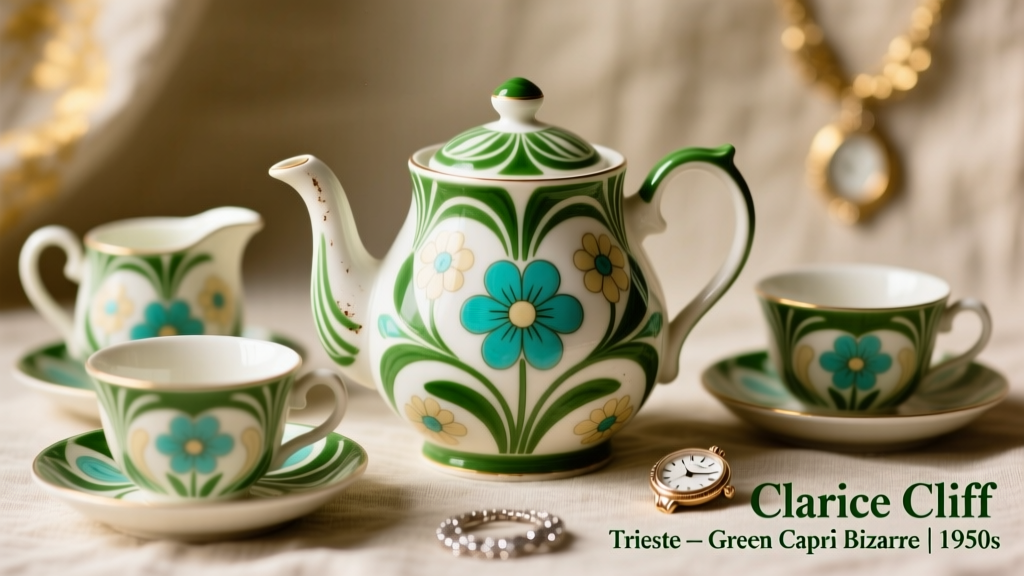
Clarice Cliff Trieste Green Capri Bizarre Tea Set: A Definitive Appraisal of the 5½-Inch Teapot and Matching Three-Piece Service
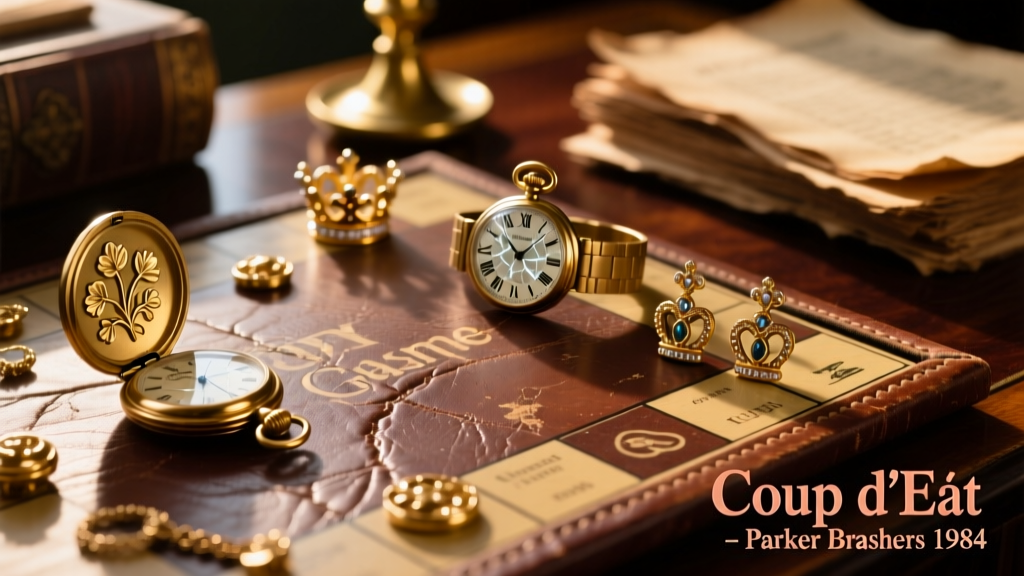
The Game Coup d'État: Parker Brothers’ 1934 Political Satire Board Game and Its Collectible Legacy

Brush Bank Little Audrey: The Forgotten American Wristwatch That Defined Mid-Century Feminine Precision
Ucago China: Decoding the 'Occupied Japan' Mark on Vintage Costume Jewelry
Banks Post Office Metal Lithographed Box (3½ × 5 in): A Study in Mid-Century British Postal Ephemera and Industrial Design
RS Prussia Chocolate Set: Laurel Chain Design in Green-Gold Trim — A Six-Piece Porcelain Treasure from the Golden Age of German Tableware
Toy Boat Torpedo: Unpacking the 2-Deck-Gun Painted Tin Windup Carrette — A 15½-Inch Mechanical Marvel of Mid-Century Play
Disneyana Cookie Jar Mickey Mouse Clock: A Collector’s Guide to the 9¾-Inch Ceramic Timepiece

Banks Magician 'Watch Me Grow' Man: A 1950s German Cylindrical Tin Box with Original Seed Packet & Instruction Sheet — Collector’s Deep Dive