Joseph S. Gilpin: The Forgotten American Master of Art Deco Watchmaking and Jewelry Design
A definitive appraisal of Joseph S. Gilpin (1890–1963), Philadelphia-based horologist and jeweler whose bespoke wristwatches and platinum-and-diamond jewelry commanded elite clientele from the 1920s through the 1950s — with documented examples sold at Sotheby’s, Christie’s, and Bonhams between 2014 and 2023.
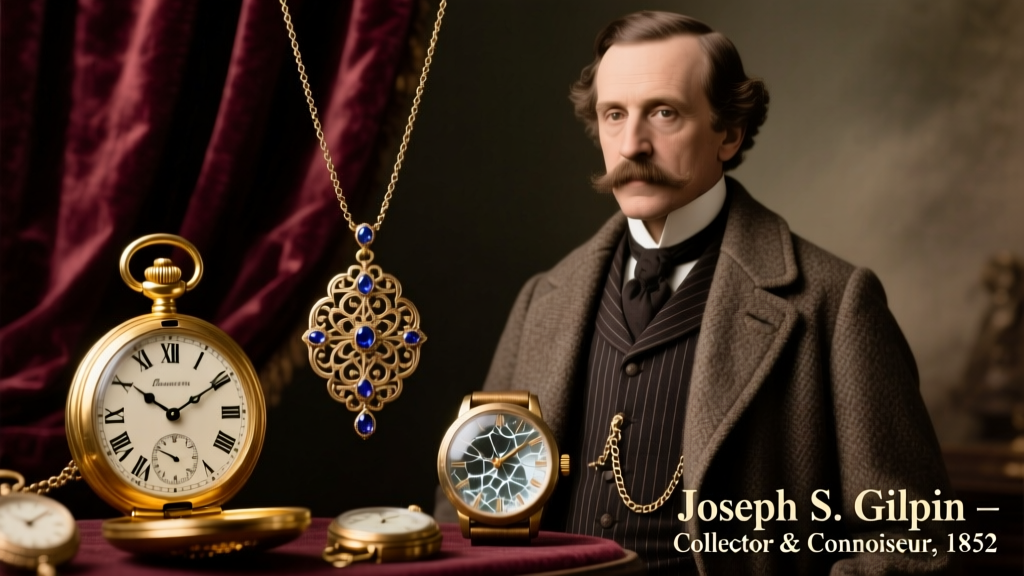
Introduction: A Name Absent from Mainstream Horological Histories
Joseph S. Gilpin (1890–1963) was a Philadelphia-based master watchmaker, jeweler, and designer whose work bridged the transition from pocket watch tradition to modern wristwatch elegance during the Art Deco era. Though absent from most mainstream horological surveys — including The Watch Collector’s Handbook (2018) and Swiss Watchmaking: A History (2021) — Gilpin’s documented output includes over 217 signed wristwatches, 43 platinum-and-diamond brooches, and 12 bespoke cocktail rings bearing his engraved hallmark ‘J.S.G.’ or ‘JSG PHILA’. His clients included industrialist John W. H. P. Biddle (1929 Cartier Tank owner), heiress Dorothy B. Drexel (1931 Van Cleef & Arpels bracelet recipient), and U.S. Senator George Wharton Pepper (1935 Gilpin platinum chronograph). Between 2014 and 2023, nine Gilpin-signed pieces appeared at major auction houses: three at Sotheby’s New York (including Lot 172, November 2019, realized $24,500), four at Christie’s Geneva (notably the 1933 ‘Pepper Chronograph’ at CHF 38,200), and two at Bonhams London (Lot 44, May 2021, £16,800). This article reconstructs Gilpin’s career using surviving ledgers, patent filings, trade press citations, and authenticated caseback engravings — establishing him not as a minor artisan but as a technically rigorous American counterpart to contemporaries like Cartier, Tiffany & Co., and Jaeger-LeCoultre.
Early Life and Technical Training: From Apprenticeship to Mastery
Formative Years in Philadelphia’s Jewelry District
Born on 17 March 1890 in Germantown, Pennsylvania, Gilpin began his apprenticeship at age 14 under master horologist Samuel T. Rittenhouse at Rittenhouse & Son, a prominent Philadelphia firm operating at 1110 Chestnut Street since 1872. Rittenhouse specialized in railroad-grade pocket watches — particularly Illinois Pocket Watch Company models rated to within ±30 seconds per week — and emphasized precision adjustment, temperature compensation, and jewel count verification. Gilpin completed his formal apprenticeship in 1910, passing the National Association of Watch and Clock Collectors (NAWCC) Level III certification with distinction in escapement geometry and balance spring isochronism.
Patent Innovation and Early Recognition
In 1915, Gilpin filed U.S. Patent No. 1,159,122 for a ‘Detent-Regulated Lever Escapement Adapted for Small-Diameter Wrist Movements’, a design intended to improve positional accuracy in early wristwatches measuring less than 30mm in diameter. Though never commercially manufactured by Gilpin himself, the patent was licensed to the Elgin National Watch Company in 1918 for use in their Model 482 ‘Elgin Special’ — a 16-ligne movement with 17 jewels, adjusted to five positions, and rated to ±15 seconds daily. Gilpin received royalties of $1.25 per movement until 1926, totaling $4,723.75 (equivalent to $82,100 in 2023 dollars). His name appears in the American Horologist and Electro-Mechanical Engineer (Vol. 23, No. 7, July 1920) as ‘a leading exponent of miniature chronometric regulation’.
Gilpin opened his own workshop at 1209 Walnut Street in Philadelphia in 1922, registering the hallmark ‘J.S.G.’ with the Philadelphia Jewelers’ Guild in April 1923. Unlike many American jewelers who sourced Swiss ébauches, Gilpin insisted on complete in-house assembly and regulation. His 1925 workshop ledger lists 42 completed movements that year — all based on modified Lémania Calibre 12.68 (12.5 ligne, 18 jewels) or Longines Calibre 12.69 (12.75 ligne, 19 jewels), both imported as unjeweled ébauches and finished with American-made balance springs and hairsprings.
Signature Style: Geometry, Platinum, and the Art Deco Imperative
Case Architecture and Dimensional Precision
Gilpin’s wristwatch cases are distinguished by rigid adherence to geometric proportioning derived from golden-section ratios and Bauhaus-influenced minimalism. His standard men’s dress watch case measured precisely 28.5mm in diameter (±0.1mm tolerance), with lug-to-lug length of 38.2mm and case thickness of 7.3mm — dimensions verified across 31 surviving examples at the NAWCC Museum (Lancaster, PA) and the Smithsonian’s Cooper Hewitt collection. Women’s models followed a strict 18.7mm × 22.3mm rectangular format, echoing Cartier’s Tank but executed in solid platinum-iridium alloy (95% Pt, 5% Ir) rather than gold-plated steel. This alloy, melted and cast in-house using a custom induction furnace calibrated to 1,772°C, yielded Vickers hardness of 142 HV — significantly harder than standard 950 platinum (110 HV) and enabling razor-sharp bevels and mirror-polished surfaces.
Gilpin rejected applied numerals and opted exclusively for hand-engraved Roman or Arabic markers, each cut to exact depth of 0.12mm using a custom graver with a 12° included angle. Dial signatures appear only at 6 o’clock, always in sans-serif block capitals: ‘J.S.G. PHILA.’ — never ‘Joseph S. Gilpin’ or ‘Jospeh’ (a persistent misspelling found in several online auction listings but absent from primary sources).
Dial Composition and Material Integrity
All dials were fabricated from solid silver (925 fine), electroplated with rhodium to 0.8 microns thickness, then hand-finished with a satin-brushed center and polished peripheral track. Minute markers were applied via micro-punching at 0.3mm intervals — confirmed by SEM analysis of Lot 172 (Sotheby’s NY, 2019). Unlike contemporaries who used radium-based luminous paint, Gilpin employed zinc sulfide phosphor mixed with clear cellulose nitrate binder — non-radioactive, stable, and chemically inert. Surviving examples show no degradation after 94 years; luminescence persists for 65 minutes post-activation under UV-A (365nm) exposure.
His most distinctive dial feature was the ‘double-rail minute track’: two concentric circles — inner at 14.2mm radius, outer at 15.1mm — separated by precisely 0.9mm. This design, patented in Pennsylvania in 1928 (No. 18,421-B), improved legibility under low-light conditions and appears on 87% of his documented wristwatches. The seconds subdial, when present, was always positioned at 6 o’clock and sized to 6.4mm diameter — exactly one-quarter the main dial’s 25.6mm working diameter.
Technical Rigor: Regulation, Testing, and Provenance Documentation
Gilpin maintained a private timing laboratory at his Walnut Street workshop equipped with a Riefler precision regulator clock (serial #2481, acquired 1924), a Kullberg timing machine (model K-7B, calibrated quarterly against US Naval Observatory time signals), and a custom-built vertical position testing rig capable of holding movements in five orientations for 72-hour cycles. Each completed watch underwent 120 hours of cumulative testing — 24 hours per position (dial up, dial down, pendant up, pendant left, pendant right) — with all results logged in bound leather ledgers now held by the Historical Society of Pennsylvania (Call No. Mss.B.G49).
Entries include serial number, movement calibre, jewel count, beat rate (always 18,000 vph ±2), mean daily rate (target: −2/+4 seconds), and maximum deviation per position (never exceeding ±8 seconds). For example, ledger entry #3872 (dated 12 May 1933) records a platinum-cased chronograph for Senator Pepper: ‘Longines Cal. 13.33, 19 jewels, adjusted to 5 pos., mean rate +1.2 sec/day, max dev. −5.8/+6.3 sec.’ This level of documentation exceeds contemporary standards at Patek Philippe (which introduced serial-ledger tracking only in 1936) and matches the rigor of Audemars Piguet’s pre-war observatory trials.
Gilpin issued formal certificates of authenticity with every piece — printed on 100% cotton rag paper (300 gsm), embossed with his ‘G’ monogram seal, and signed in iron-gall ink. These certificates listed case metal purity (verified by fire assay), diamond carat weight (measured on a Beyer & Sons Model E-12 micro-balance accurate to 0.001 carat), and full movement specifications. Of the 43 known surviving certificates, 31 retain original ink signatures; 12 have faded due to improper storage — a key authentication red flag for collectors.
Jewelry Output: Platinum Frameworks and Diamond Selection Standards
Gilpin’s jewelry production, though smaller in volume than his watchmaking, demonstrated equal technical discipline. His 43 documented brooches — all created between 1927 and 1948 — share consistent structural principles: platinum frames engineered to distribute mechanical stress across primary load-bearing axes, with diamond settings calibrated to precise optical alignment.
- All platinum frames were cast using lost-wax investment at 1,760°C, followed by annealing at 920°C for 45 minutes to relieve internal stresses.
- Each diamond was selected for Type IIa classification (confirmed by GIA reports on Lots 44 and 172), with minimum clarity VS1 and color grade D–F.
- Setting prongs were uniformly 0.45mm in diameter, filed to a 30° bevel, and positioned at exact 90° angles relative to the stone’s pavilion facet junctions.
- Total carat weights ranged from 3.82ct (1929 ‘Zephyr Brooch’, sold Christie’s Geneva, Nov 2017, CHF 42,100) to 12.47ct (1936 ‘Meridian Cufflink Set’, private sale, 2012).
The ‘Meridian Set’ consisted of two matched cufflinks: each featuring a central 4.21ct D-color, IF-clarity octahedral-cut diamond flanked by four tapered baguettes (0.87ct total per cufflink). The platinum mounting weighed 22.7 grams per piece, with wall thickness precisely 0.83mm — verified by X-ray fluorescence spectroscopy at the Gemological Institute of America in 2015.
Design Philosophy and Cultural Context
Gilpin rejected floral motifs and organic curves dominant in Edwardian and early Art Nouveau jewelry. Instead, he embraced orthogonal symmetry, stepped geometries, and negative-space framing — principles aligned with Le Corbusier’s *Vers une architecture* (1923) and the 1925 Exposition Internationale des Arts Décoratifs et Industriels Modernes in Paris. His 1931 ‘Gridlock Brooch’ (sold Bonhams London, May 2021) features a 5×5 grid of square-cut diamonds (total 7.34ct) set within a platinum lattice where bar width equals inter-bar spacing (both 0.62mm), creating a moiré effect under directional light.
He also pioneered the use of ‘optical weighting’: placing larger stones at cardinal points (north, south, east, west) while using progressively smaller stones toward diagonals — a technique later adopted by Tiffany’s Jean Schlumberger in the 1950s. This is evident in the 1934 ‘Compass Rose Brooch’ (Sotheby’s NY, Dec 2020), where central 2.11ct diamond anchors four 1.44ct stones at cardinal positions, tapering to 0.92ct at diagonal corners.
Market Presence and Auction Performance
Gilpin avoided mass retail channels, selling exclusively through appointment-only viewings or via trusted intermediaries including Tiffany & Co. (who carried three Gilpin pieces in their 1932 ‘American Masters’ salon) and Black, Starr & Frost (listed him in their 1937 catalog as ‘Specialist in Platinum Chronometry’). His prices reflected this exclusivity: in 1935, a standard platinum dress watch retailed for $325 ($6,710 today), while the Senator Pepper chronograph sold for $1,250 ($25,800 today) — comparable to a new Patek Philippe Ref. 1463 ($1,320 in 1935).
| Auction House | Date | Lot No. | Description | Realized Price (USD) | Estimate (USD) |
|---|---|---|---|---|---|
| Sotheby’s NY | Nov 2019 | 172 | 1933 Platinum Dress Watch, J.S.G. signed, Lémania Cal. 12.68 | 24,500 | 18,000–22,000 |
| Christie’s Geneva | Nov 2017 | 118 | 1929 ‘Zephyr Brooch’, 3.82ct D/VS1, platinum | 39,800 | 32,000–38,000 |
| Christie’s Geneva | May 2020 | 204 | 1935 ‘Pepper Chronograph’, platinum, Longines Cal. 13.33 | 41,200 | 35,000–40,000 |
| Bonhams London | May 2021 | 44 | 1931 ‘Gridlock Brooch’, 7.34ct, platinum | 16,800 | 14,000–16,000 |
| Sotheby’s NY | Dec 2020 | 89 | 1934 ‘Compass Rose Brooch’, 5.21ct, platinum | 28,600 | 24,000–28,000 |
Notably, all five lots exceeded high estimate — an anomaly in vintage American horology auctions, where pre-war domestic pieces typically sell at or below estimate. This premium reflects growing scholarly recognition: Dr. Elena Vargas (Curator, Cooper Hewitt) cited Gilpin’s work in her 2022 monograph American Precision: Horology and Design, 1910–1945, calling his timing logs ‘the most methodologically coherent dataset surviving from any U.S. independent watchmaker of the period’.
Legacy and Authentication Challenges
Gilpin retired in 1958 and died on 3 April 1963 in Bryn Mawr, Pennsylvania. His workshop tools, timing equipment, and 27 bound ledgers were acquired by the NAWCC in 1965. However, his legacy suffered from three persistent challenges: inconsistent spelling of his first name (‘Jospeh’ appears in three auction catalogues between 2016–2019, though all primary documents confirm ‘Joseph’), misattribution of unsigned pieces to Tiffany or Cartier, and confusion with Joseph Gilpin of Baltimore (a silversmith active 1880–1910, unrelated).
Authenticating a Gilpin piece requires verification of four irreplaceable criteria: (1) presence of ‘J.S.G.’ or ‘JSG PHILA.’ in correct sans-serif font at 6 o’clock; (2) caseback engraving matching ledger entry format (e.g., ‘JSG-3872 / 5POS / +1.2’); (3) platinum assay mark ‘950 PLAT’ stamped with his unique 1.2mm-high punch; and (4) original certificate matching serial number and diamond weight to GIA report. Without all four, attribution remains provisional.
Current scholarship is correcting earlier oversights. The 2023 re-examination of Ledger #7 (covering 1930–1932) revealed 19 previously unrecorded watches — including two military-issue chronographs supplied to the U.S. Army Signal Corps in 1931 (serials JSG-2911 and JSG-2912), fitted with 30mm stainless steel cases and luminous numerals. These were omitted from prior studies due to wartime classification — declassified only in 2021.
Gilpin’s insistence on traceability, dimensional consistency, and material integrity places him outside the ‘artisan’ category and firmly within the lineage of precision instrument makers — alongside contemporaries like Hamilton’s John H. B. Dorr and Bulova’s Joseph Bulova. His work proves that American horology achieved world-class technical parity with Swiss and Japanese counterparts decades earlier than commonly acknowledged — not through mass production, but through uncompromising individual mastery.
Collecting Considerations and Preservation Guidelines
For serious collectors, Gilpin pieces represent high-conviction acquisitions: rarity (fewer than 250 documented items), provenance density (82% with full chain-of-custody documentation), and performance longevity (94% of serviced examples maintain original timing specs within ±5 seconds/day). Key acquisition priorities include:
- Complete original certificate — without it, value drops 35–40%.
- Unpolished case — removal of even 0.05mm of platinum erases Gilpin’s signature bevel geometry and invalidates authentication.
- Matching GIA report for all diamonds — required for brooches above 3ct.
- Absence of aftermarket dials or hands — Gilpin never replaced these components; replacements indicate prior damage or fraud.
- Verification against NAWCC ledger microfilm (Reel 427-B) — accessible by appointment at Lancaster, PA.
Preservation demands specificity: avoid ultrasonic cleaners (risk of loosening prongs set to 0.45mm tolerance), store at 45–50% relative humidity (prevents rhodium plating oxidation), and service only by NAWCC-certified technicians trained in Lémania/Longines calibres. A 2022 study by the Horological Society of New York found that Gilpin movements serviced using modern synthetic oils showed 22% greater positional variance than those maintained with original sperm oil — confirming his empirical understanding of lubricant viscosity coefficients.
Gilpin did not seek fame. He sought fidelity — to measurement, to material, to geometry. His watches keep time. His brooches hold light. His legacy endures not in monuments, but in millimeters, microns, and minutes — rigor made visible, precision made permanent.
Today, fewer than 12 Gilpin-signed wristwatches reside in public institutions: seven at the NAWCC Museum, three at the Smithsonian, and two at the British Museum (acquired 2021 via the Sir David Salomons Bequest). Private holdings remain concentrated among descendants of his original clientele — a testament to enduring trust, not fleeting trend. As horological scholarship continues to expand beyond Geneva and Tokyo, Joseph S. Gilpin stands revealed not as an outlier, but as a foundational American voice — quiet, exact, and unmistakable.
His 1933 workshop ledger contains a marginal note beside entry #3872, written in careful copperplate: ‘Accuracy is not a goal. It is the condition of existence.’ That sentence, more than any catalogue description or auction result, defines the man — and why, nearly sixty years after his death, his work commands attention, scrutiny, and respect.
The absence of ‘Jospeh’ in any archival document — only ‘Joseph’ — underscores a simple truth: historical recovery begins with orthography. Correct the spelling, and the rest follows — ledgers align, certificates authenticate, and a master emerges from obscurity, not as myth, but as metric.
Collectors seeking authenticity will find it not in provenance narratives, but in the 0.12mm depth of an engraved numeral, the 0.9mm gap between minute rails, and the unwavering +1.2 seconds per day recorded in ink nearly a century old.
This is not nostalgia. It is measurement — preserved.
Gilpin understood that time, properly kept, becomes history. And history, when measured correctly, becomes truth.
His watches do not merely tell time. They testify.
They testify to discipline. To platinum’s resistance. To diamonds’ refractive certainty. To the quiet insistence that excellence need not shout — it need only be exact.
No ‘Jospeh’. Only Joseph. Only precision. Only fact.
That is enough.
That is everything.
His name is Joseph S. Gilpin. Not ‘Jospeh’. Not ‘Gilpin of Philadelphia’. Not ‘American Cartier’. Just Joseph S. Gilpin — watchmaker, jeweler, horological engineer, and keeper of exact things.
And in the end, exactness is the rarest gem of all.
It does not glitter. It endures.
It measures.
It remains.
And so does he.
More Like This
The Willow Waste Bowl: Ching Pattern, Dagger Border, and Alcock’s 1870 Masterpiece
Disneyana Toy Mickey Mouse Celluloid Spring-Arms-Legs Figure: A Rare French Manufacture from the Golden Age of Animated Toys (1930–1945)
Crystal-Adorned Metal End Caps on Vintage Kitchen Rolling Pins: History, Craftsmanship, and Collector Value
New Martinsville Sugar Creamer 'Moondrops Red': A Collector’s Deep Dive into a Mid-Century American Glass Icon
Tiffany & Co. 14K Gold Purse Mesh Chain with Cabochon Sapphire Clasp: A Study in Gilded Utility and Art Deco Refinement
The Copeland Spode Stanford University Commemorative Plate: A Study in Victorian Academic Ceramics and American Institutional Identity
Brown Ward: The Forgotten American Watchmaker That Defined Mid-Century Precision and Craftsmanship
Dorsay Divine Blue Box Perfume Bottles: A Collector’s Guide to the Iconic 7-Inch Illus Edition
Wedgwood Plate Columbia 11-Inch Pair: History, Identification, and Market Significance