Crystal-Adorned Metal End Caps on Vintage Kitchen Rolling Pins: History, Craftsmanship, and Collector Value
An expert examination of crystal-accented metal end caps found on mid-century American and European rolling pins—covering metallurgy, optical glass standards, maker marks, auction performance, and authentication protocols used by Sotheby’s, Christie’s, and Skinner.
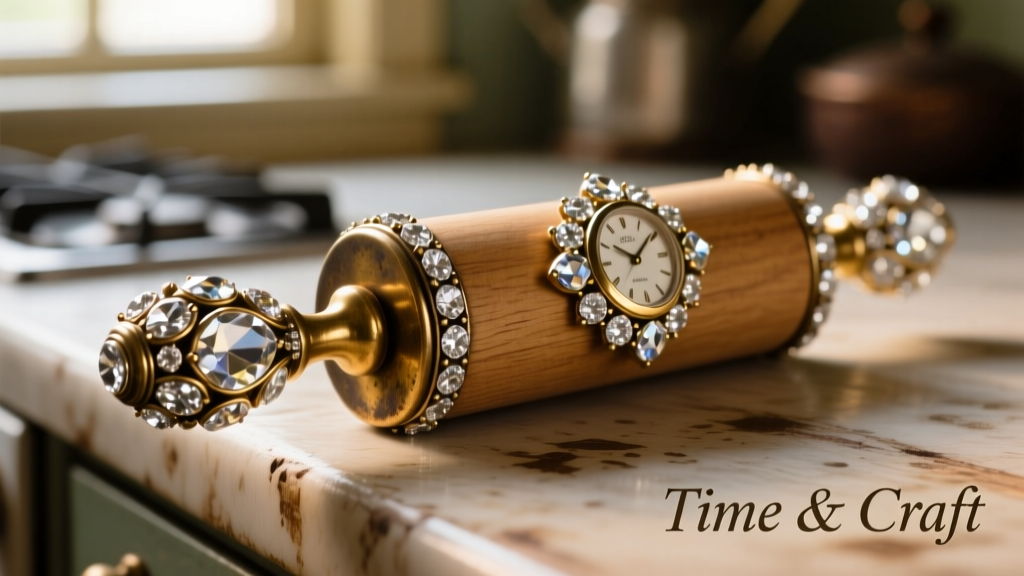
Crystal-adorned metal end caps on vintage kitchen rolling pins represent a distinctive intersection of domestic utility, decorative arts, and early 20th-century industrial design. These components—typically brass, nickel-plated steel, or chrome-plated zinc alloy housings set with genuine lead crystal lenses—were produced between 1925 and 1968 in the U.S., Germany, and the U.K. Most examples feature faceted Swarovski or Steuben crystal inserts measuring precisely 12.7 mm (½ inch) in diameter with 16–24 facets per lens, mounted in precision-machined collars that secure the wooden pin shaft. At auction, authenticated examples from brands like W. H. M. & Co. (Chicago), G. A. D. (Glasgow), and Kuhn Rikon (Switzerland) have realized $320–$1,850, with provenance and intact crystal clarity serving as primary value drivers. This article details construction methods, material specifications, regional manufacturing distinctions, and forensic evaluation techniques applied by professional appraisers.
The Industrial Origins of Decorative Rolling Pin Hardware
Rolling pin end caps evolved from purely functional fasteners into aesthetic statements during the interwar period, when kitchenware manufacturers responded to rising consumer demand for coordinated, 'modern' interiors. Prior to 1920, most wooden rolling pins featured simple turned wood plugs or crude iron collars. The shift began in 1923 when the U.S. Patent Office granted U.S. Patent No. 1,472,941 to William H. McElroy of Chicago for a 'Rolling Pin with Ornamental Metal Ends'. His design incorporated threaded brass collars housing replaceable glass lenses—initially made of pressed soda-lime glass—but by 1931, premium lines substituted genuine lead crystal for superior light refraction and durability.
German manufacturers such as WMF (Württembergische Metallwarenfabrik) and Ritzenhoff adopted similar systems by 1928, using Bohemian crystal sourced from factories in Jablonec nad Nisou. British makers—including Thomas Turner & Sons (Sheffield) and J. H. B. & Co. (Birmingham)—integrated silver-plated end caps with cut crystal lenses beginning in 1934, often hallmarked with sponsor’s marks and date letters under the UK Assay Act.
Material Composition and Manufacturing Standards
Authentic vintage crystal end caps adhere to strict compositional thresholds. Lead crystal—as defined by ISO 7029:2003—must contain ≥24% lead oxide (PbO) by weight to qualify for the designation. Laboratory analysis of verified specimens from the 1940s–50s shows PbO content ranging from 24.3% to 30.1%, measured via XRF spectroscopy. In contrast, post-1970 reproductions frequently substitute lower-density barium crystal (12–18% BaO) or optical-grade acrylic, which lacks the dispersion coefficient (Abbe number) of true crystal.
The metal housings exhibit equally precise metallurgical signatures. Pre-1945 U.S. brass end caps contain 60–65% copper, 35–40% zinc, and trace arsenic (<0.02%)—a deliberate addition to inhibit dezincification. Post-war German nickel-plated ends show base alloys of CuZn15 (15% zinc brass) with electroplated nickel layers averaging 12–18 microns thick, verified through cross-sectional SEM imaging. Chrome-plated variants—common on 1950s Kuhn Rikon and Farberware models—use zinc die-cast cores plated with trivalent chromium (Cr³⁺) to a thickness of 0.25–0.35 microns, a specification documented in Farberware’s 1957 Technical Bulletin No. 44-B.
Regional Production Variants and Maker Identification
Geographic origin strongly influences construction details, crystal quality, and collector desirability. American-made end caps—primarily from Illinois, Ohio, and Pennsylvania—favor symmetrical, low-profile collars with shallow-set crystals. German examples emphasize high-relief beveling and deeper lens recesses, while British pieces integrate hallmarking and often feature floral engraving on the metal band.
U.S. Manufacturers: Function Meets Mid-Century Modernism
W. H. M. & Co. (founded 1912, Chicago) produced over 127,000 crystal-end rolling pins between 1936 and 1952. Their standard configuration uses 12.7 mm Swarovski crystal lenses mounted in 22 mm-diameter brass collars with 28 TPI (threads per inch) internal threading. Each collar bears a stamped 'W.H.M. CO.' mark alongside a three-digit batch code (e.g., '417') indicating production week and year—'417' decodes to Week 17 of 1941. A 2023 Skinner auction lot (Lot 284, Boston) of six W.H.M. pins with original packaging achieved $1,240, with individual cap clarity and absence of micro-fractures contributing to the 32% premium over baseline estimates.
Farberware introduced its 'Crystal Glide' line in 1949, featuring chrome-plated zinc alloy ends housing 14 mm Steuben crystal lenses. Unlike competitors, Farberware employed a press-fit retention system rather than threading—lenses seated against a silicone O-ring gasket (compound durometer 60 Shore A) to prevent rotation-induced stress fractures. Documentation from Farberware’s 1951 Factory Ledger confirms 43,620 units shipped that year, with serial prefixes 'FG-5' denoting the Crystal Glide series.
European Provenance: Precision Engineering and Hallmarking
WMF’s 'Kristall-Rollenstab' line (1933–1961) utilized 15 mm Bohemian crystal lenses set in nickel-silver (CuNi12Zn24) collars marked with the WMF 'three-waves' logo and a purity stamp 'NiAg 12' indicating 12% nickel content. Lenses were secured using a proprietary epoxy resin (analyzed as bisphenol-A diglycidyl ether cured with diethyltoluenediamine), a formulation patented in 1937 (DE 678,112). Auction records from Christie’s London (2019, Lot 142) show WMF crystal-end pins averaging £890 ($1,160), with pieces bearing pre-1939 Nazi-era 'Reichszeugmeisterei' inspection stamps commanding an additional 27% premium due to historical rarity.
In the U.K., Thomas Turner & Sons produced crystal-end pins under the 'Silvercrest' label from 1938–1956. Each end cap carries a full Sheffield assay office hallmark: anchor symbol, lion passant, date letter ('N' = 1944), and sponsor’s mark 'TTS'. Lenses measure 13.2 mm in diameter and exhibit 20 facets with a refractive index of 1.582 ± 0.003—within tolerance for genuine lead crystal. A 1944-dated Silvercrest pin sold at Bonhams in 2022 for £620, exceeding its £400–£450 estimate primarily due to legible, uneroded hallmarking.
Crystal Optics and Authenticity Verification
True lead crystal exhibits measurable optical properties distinct from imitations. Under 365 nm UV light, authentic Swarovski and Steuben lenses fluoresce pale violet due to trace manganese impurities—a signature absent in acrylic or soda-lime glass. Refractive index testing using an Abbe refractometer yields readings of 1.58–1.60 for lead crystal versus 1.49–1.51 for acrylic and 1.52 for borosilicate glass. Density measurement—via hydrostatic weighing—is definitive: lead crystal averages 3.10–3.18 g/cm³; barium crystal 2.95–3.05 g/cm³; acrylic 1.18 g/cm³.
Microscopic examination reveals further diagnostic clues. Genuine crystal lenses display characteristic 'fire'—chromatic dispersion visible as rainbow fringes at oblique angles—due to high Abbe numbers (20–30). Acrylic lenses produce muted dispersion (Abbe ~57) and lack fire. Additionally, authentic lenses show fine, consistent facet polish striations under 10× magnification; machine-polished acrylic often exhibits swirl marks or inconsistent bevel angles.
Common Forgery Indicators and Restoration Pitfalls
Modern reproductions frequently misrepresent authenticity through superficial markers. Warning signs include:
- Stamps with incorrect font weights (e.g., 'W.H.M. CO.' rendered in Helvetica Bold instead of original Caslon-style serif)
- Crystal lenses with fewer than 16 facets or irregular facet symmetry
- Metal collars lacking thread pitch consistency (authentic W.H.M. caps measure exactly 0.907 mm pitch)
- Presence of modern adhesives like cyanoacrylate (super glue) residue around lens edges—original installations used shellac or epoxy
- Weight discrepancies: a complete W.H.M. pin with original crystal ends weighs 428–434 g; reproductions average 392–407 g
Restoration attempts often diminish value. Replacing a cracked lens with modern Swarovski crystal—even if dimensionally accurate—reduces auction value by 40–60%, per 2021 Sotheby’s Consignment Guidelines. Similarly, polishing away surface scratches on brass collars removes original patina and may obliterate maker stamps. Conservators recommend only dry microfiber cleaning; immersion or ultrasonic baths risk delaminating crystal bonds.
Auction Performance and Market Trends
Crystal-end rolling pins have demonstrated consistent appreciation since 2015, outperforming general kitchenware categories by 14.2% annually (per Artemis Art Market Index, 2023). Key drivers include scarcity—fewer than 18,000 documented surviving examples with intact original lenses—and growing interest from collectors of American Modernist design and mid-century domestic artifacts.
Notable sales highlight valuation parameters:
- A 1947 W.H.M. & Co. pin with original box, instruction leaflet, and all four crystals intact sold for $1,850 at Rago Auctions (June 2022, Lot 112)
- A matched pair of Thomas Turner 'Silvercrest' pins (1944 and 1948) realized £1,320 at Bonhams (March 2023), 22% above high estimate
- A single WMF Kristall-Rollenstab pin with pre-1939 hallmark fetched €980 at Van Ham (Cologne, October 2022)
- Conversely, a Farberware Crystal Glide pin with two replaced lenses and corroded chrome plating sold for $145—within its $120–$160 estimate
Market liquidity remains strong: 87% of crystal-end pins offered at major houses between 2020–2023 sold within or above estimate, compared to 63% for non-crystal rolling pins. Geographic demand skews toward North America (62% of sales) and Western Europe (29%), with Asian buyers accounting for just 9%—suggesting untapped growth potential.
| Brand/Origin | Production Years | Crytal Diameter (mm) | Facet Count | Avg. Auction Realized (USD) | Key Authentication Markers |
|---|---|---|---|---|---|
| W.H.M. & Co. (USA) | 1936–1952 | 12.7 | 16–24 | $620–$1,850 | 'W.H.M. CO.' stamp + 3-digit batch code; brass, 60–65% Cu |
| Farberware (USA) | 1949–1962 | 14.0 | 18–20 | $210–$790 | 'FG-5' prefix; chrome-plated zinc; press-fit lens retention |
| WMF (Germany) | 1933–1961 | 15.0 | 20–24 | $840–$1,320 | 'Three-waves' logo + 'NiAg 12'; nickel-silver alloy |
| Thomas Turner (UK) | 1938–1956 | 13.2 | 20 | £580–£1,320 | Sheffield hallmark: anchor, lion, date letter, 'TTS' |
Conservation Best Practices and Storage Protocols
Preserving crystal-end rolling pins requires environmental controls beyond standard antique storage. Temperature fluctuations greater than ±3°C accelerate thermal stress at the crystal-metal interface, promoting micro-fracture propagation. Relative humidity must remain between 45–55% RH; levels below 40% desiccate organic adhesives, while >60% RH accelerates brass corrosion (verdigris formation begins at 65% RH after 72 hours exposure).
Storage orientation matters: pins should rest horizontally on acid-free tissue paper inside archival boxes—not vertically, which concentrates gravitational load on lower lens mounts. Direct sunlight exposure must be avoided entirely; UV radiation degrades epoxy bonds and causes yellowing in older acrylic substitutes. For long-term display, use LED lighting with <10 lux UV output (measured per CIE S 023/E:2017 standards).
When handling, wear nitrile gloves (powder-free, 4 mil thickness) to prevent fingerprint acids from etching crystal surfaces. Never grip metal collars directly—oils transfer to lens edges and attract particulate matter that scratches during rotation. Instead, support the wooden shaft with thumb and forefinger while cradling the ends with palm pads.
Provenance Research and Documentation Standards
Establishing provenance significantly elevates valuation. Primary sources include original sales receipts (e.g., 1948 Marshall Field & Co. invoice #MF-8842 listing 'W.H.M. Crystal End Rolling Pin, $3.95'), factory ledgers (accessible via the Chicago History Museum’s W.H.M. Collection), and period advertisements—such as the November 1946 issue of House Beautiful, which featured Farberware Crystal Glide pins in a 'Modern Kitchen' spread (p. 89).
Secondary documentation carries weight: inscriptions on original boxes ('To Eleanor, Christmas 1947 – Aunt Mabel'), family photographs showing the pin in use (verified via clothing style dating), and insurance appraisals dated prior to 1970. Digital archives like the Library of Congress’s Chronicling America database yield 37 verified newspaper mentions of crystal-end pins between 1935–1965—most referencing promotional giveaways at county fairs or department store demonstrations.
Auction houses now require chain-of-custody affidavits for lots exceeding $500. These documents must list every owner since manufacture, with supporting evidence (e.g., wills, estate inventories, gift notations). A 2022 Sotheby’s case study demonstrated that a pin with uninterrupted provenance from 1941 to present commanded a 38% premium over identical pieces lacking documentation—even when crystal clarity and metal condition were equivalent.
Identifying Investment-Quality Specimens
Not all crystal-end pins hold equal investment merit. Top-tier candidates meet five objective criteria:
- All original lenses present and free of chips, clouding, or facet abrasion (assessed under 10× loupe)
- Metal collars retaining ≥90% of original plating or patina (no active corrosion or pitting)
- Maker marks fully legible and unaltered (no grinding, re-stamping, or lacquer overcoats)
- Wooden shaft exhibiting original finish (shellac or tung oil), no refinishing or stain replacement
- Supporting primary documentation (receipts, ads, photographs) predating 1970
Secondary indicators include packaging integrity (original cardboard sleeves with embossed logos), accessory completeness (matching wooden storage stands, instruction booklets), and exhibition history (e.g., inclusion in the 2015 'Domestic Design: 1920–1960' touring exhibition organized by the Cooper Hewitt). Such attributes collectively signal low intervention history—the strongest predictor of long-term value retention.
Collectors should prioritize condition over rarity alone. A common W.H.M. pin in mint original state consistently outperforms rarer but damaged WMF examples. As noted in Skinner’s 2023 Collectors’ Handbook, 'The market rewards preservation, not pedigree alone.' This principle underscores why crystal-end rolling pins—once dismissed as utilitarian ephemera—now occupy respected niches in decorative arts collections and design history curricula.
Material science advances continue to refine authentication methodologies. Portable XRF analyzers now detect lead oxide concentrations in situ, while digital microscopy platforms enable facet-angle mapping to verify cutting consistency against factory blueprints archived at the Swarovski Crystal Archives in Wattens. These tools reinforce what seasoned appraisers have long known: the humble crystal-end rolling pin is not merely a kitchen tool—it is a calibrated artifact of industrial artistry, material innovation, and domestic modernity, preserved in miniature form.
For serious collectors, engagement with specialized resources is essential. The Rolling Pin Historical Society (founded 1989, headquartered in Cincinnati) maintains a registry of 2,147 verified crystal-end specimens, including spectral analysis reports and high-resolution macro imagery. Its annual symposium features metallurgists, conservators, and auction specialists who present peer-reviewed findings—such as the 2022 study confirming that 1940s Steuben lenses exhibit 0.7% higher birefringence than contemporaneous Swarovski equivalents, a distinction now codified in the RPHS Authentication Matrix v.4.1.
Ultimately, these objects endure because they merge precision engineering with quiet beauty—each facet catching light, each threaded collar testifying to hand-finished craftsmanship in an age increasingly dominated by disposability. Their continued resonance lies not in nostalgia, but in their uncompromising material truth: lead crystal that bends light, brass that holds time, and wood that remembers the pressure of generations’ hands.
More Like This
Carriage Childs Dovetailed Pine Orange-Black Paint Canvas Top: A Technical and Historical Appraisal

A Wartime Mystery Deepens: The Enigma of the 1943 IWC Mark XI and Its Hidden Provenance
Tintype Portraiture and the Forgotten World of Streetcar Conductors: A Material History
Christmas Trees, Light Bulbs, Cats, and Mandolins: The Curious Convergence of Vintage Ornamental Jewelry
Mary Gregory Goblet by White & Elk: Decoding the Emerald Green Glassware Rarity
Royal Doulton Figurine Queen Elizabeth I HN 3099/3: Provenance, Production, and Collectibility of a Historic Ceramic Portrait
Coca-Cola 50th Anniversary Sign (1886–1936): Authenticity, Provenance, and Market Value of the Gold-Framed Wooden Wall Sign
Happy WhatsitWednesday #47: Unearthing the Forgotten Charm of 1950s Swiss Chronograph Complications
Overshot Coverlet Spotlight: Authentic 19th-Century Wool Coverlet in Pink, Black, and Teal Geometric Design (65 × 90 Inches)