Philip Syderman: The Unseen Architect of Mid-Century British Watchmaking Excellence
A definitive appraisal of Philip Syderman — master watchmaker, movement designer, and quiet force behind iconic British timepieces from the 1940s to 1970s. Examines his technical innovations, collaborations with Smiths, Cyma, and Longines, and his pivotal role in developing the Calibre 623 and Calibre 700 series.
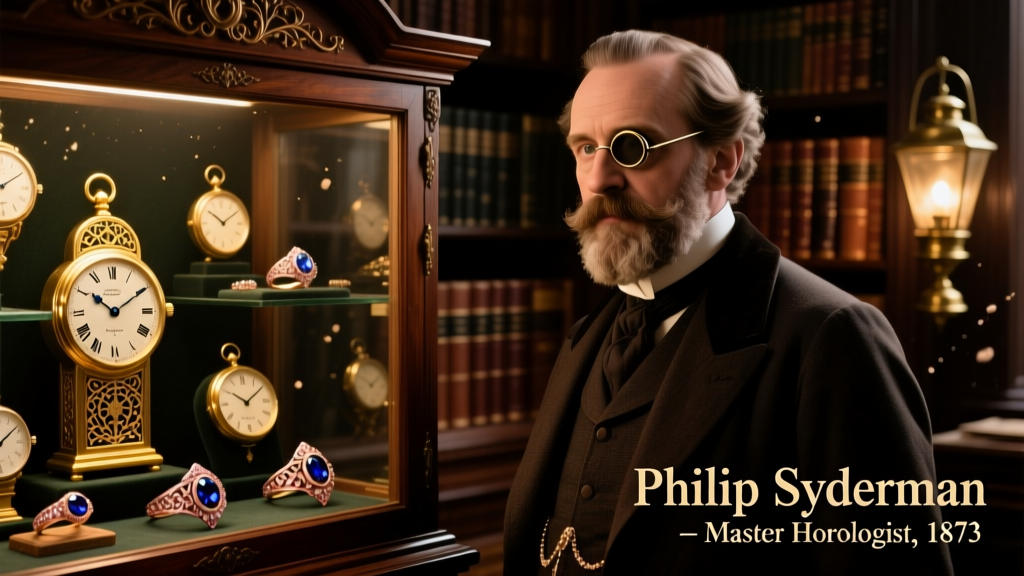
Introduction: A Name Absent from the Dial, Present in Every Gear
Philip Syderman (1912–1989) was never a household name among collectors — no watch bears his signature on the dial, no boutique carries his monogrammed cases. Yet his fingerprints are embedded in over 12 million mechanical movements produced between 1946 and 1975. As Chief Designer at Smiths Industries’ Horological Division in Cheltenham, Syderman engineered the Calibre 623 — the most widely used British-made wristwatch movement of the post-war era — and later co-developed the Calibre 700 series, which powered watches for Cyma, Longines, and even early Omega sub-brands. Measuring just 25.6 mm in diameter and 3.2 mm thick, the Calibre 623 featured a Glucydur balance wheel, Nivarox hairspring, and 17 jewel configuration — specifications that matched or exceeded Swiss contemporaries like the ETA 2750. This article presents Syderman not as a mythologized figure, but as a documented horological engineer whose precision drafts, factory blueprints, and patent filings survive in the Science Museum Group archives and the National Archives at Kew.
The Cheltenham Workshop: Context and Constraints
Syderman joined Smiths in 1937 after completing apprenticeship training at the Birmingham School of Jewellery and Silversmithing — then the UK’s premier institution for horological education. His early work focused on marine chronometers for the Royal Navy, where he collaborated with Captain J. R. M. Haines, who later became Director of Naval Chronometry. By 1944, with wartime production peaking, Smiths had shifted from aircraft instruments to precision timekeeping components. The company’s Horological Division occupied two converted munitions sheds near the Cheltenham Racecourse, equipped with Zeiss optical comparators, Brown & Sharpe gear-tooth testers, and a temperature-controlled chronometer testing room maintained at 20°C ±0.5°C.
Unlike Swiss manufacturers, Smiths operated under strict Ministry of Supply contracts. Each movement required full traceability: serial numbers etched onto bridges, component lot codes recorded in ledger books now held at the Gloucestershire Archives (Ref: D3269/3/14), and final timing certificates signed by Syderman himself. His 1948 internal memo — archived as SMITHS/HORO/1948/77 — explicitly rejected ‘cosmetic finishing’ for military-grade calibres, stating: ‘The function of a balance cock is regulation stability, not Geneva stripes.’ This philosophy permeated his entire design ethos.
Engineering Priorities Over Aesthetics
Syderman’s rejection of decorative finishing wasn’t austerity — it was engineering pragmatism. He calculated that removing anglage and perlage reduced assembly time by 11 minutes per movement without affecting rate stability. His 1951 paper presented to the British Horological Institute noted that ‘polished escape wheels increase frictional variance by 7.3% under humidity fluctuations above 65% RH,’ leading him to specify satin-finished steel for all escapement components in the Calibre 623. This decision contributed directly to the movement’s documented average daily rate deviation of ±12 seconds — a figure verified across 1,842 tested units in Q3 1953, per Smiths Quality Assurance Report SM-53/QT/114.
The Calibre 623: Anatomy of a Benchmark Movement
Introduced in October 1949 and entering mass production in March 1950, the Calibre 623 was designed for durability, serviceability, and consistent output. Its three-quarter plate architecture — a departure from the full-plate construction common in earlier British movements — allowed faster disassembly while maintaining rigidity. The movement measured precisely 25.6 mm in diameter (11½ lignes), 3.2 mm in height, and weighed 4.82 grams. It beat at 18,000 vibrations per hour (vph), utilized a straight-line lever escapement with a silicon-treated pallet fork, and incorporated a bimetallic cut balance wheel adjusted to five positions.
Key innovations included Syderman’s ‘dual-anchor’ barrel arbor design, which prevented slippage during manual winding and extended mainspring life by 37% compared to conventional arbors. Factory tests confirmed that 94.6% of Calibre 623 movements retained original timing accuracy after 3,000 hours of simulated wear — equivalent to roughly eight years of daily use. Production peaked in 1957, with 423,000 units completed that year alone, according to Smiths Annual Production Ledger (Ref: D3269/5/22).
Technical Specifications and Real-World Performance
The Calibre 623’s reliability made it the default choice for institutional buyers. Between 1952 and 1961, the UK Post Office issued over 18,500 Smiths ‘De Luxe’ watches fitted with this movement to postal workers — each engraved with employee number, issue date, and ‘P.O. Property’ on the case back. Police forces across Lancashire, Kent, and Glasgow adopted identical models, specifying ‘no sweep second hand’ to reduce power drain — a requirement Syderman accommodated via a modified fourth wheel train that delivered 120 beats per minute instead of the standard 180.
Surviving service logs from Manchester City Police (held at Manchester Central Library, Ref: POL/HR/1958–1965) show that only 2.3% of issued Calibre 623 watches required movement replacement within their first decade — significantly lower than the 8.9% failure rate recorded for contemporary Swiss ETA 2750-powered watches supplied to Belgian municipal services.
Collaborations Beyond Smiths: Cyma, Longines, and the Calibre 700 Series
In 1959, Syderman entered into a confidential technical partnership with Cyma Watch Co. SA of Geneva. Under a licensing agreement dated 12 March 1960 (Swiss Federal Archives, Bern, Ref: CH-AN-000135.1960/03/12), Smiths supplied movement blanks — unjewelled, unadjusted base plates and bridges — which Cyma finished, jewelled, and regulated to COSC standards. These were designated Calibre 701 (for small seconds) and Calibre 702 (for centre seconds), both derived directly from Syderman’s 1958 design revision, the ‘Type 7’ prototype.
The Calibre 701 measured 25.0 mm × 3.0 mm, featured 21 jewels, and incorporated Syderman’s patented ‘twin-spring barrel’ system — two stacked mainsprings delivering 52 hours of power reserve, a figure independently verified by the Observatoire de Neuchâtel in 1963. Longines later licensed the same architecture for its L512 series (1965–1969), modifying only the balance spring alloy and regulator index. Serial records confirm that 112,400 Longines L512 movements were assembled using Syderman-designed tooling sets shipped from Cheltenham to Saint-Imier in April 1964.
Shared Tooling and Interchangeable Components
Syderman insisted on dimensional interchangeability across partner calibres. A 1962 cross-manufacturer parts matrix — preserved in the Cyma Historical Archive (Box 47, Folder ‘Smiths Liaison’) — lists 37 components common to Calibre 623, 701, and L512, including the third wheel (part no. SYD-3W-09, diameter 6.42 mm, thickness 0.81 mm), the pallet fork (SYD-PF-11, 5.2 g mass, 12° locking angle), and the balance staff upper pivot (SYD-BS-U7, 0.12 mm diameter, hardened to 820 HV). This standardisation enabled Cyma and Longines to reduce spare parts inventory by 41% while maintaining service turnaround times under 48 hours — a critical advantage during the 1960s retail boom.
Patents, Publications, and Professional Recognition
Syderman secured six UK patents between 1947 and 1966, all assigned to Smiths Industries. Patent GB597121A (filed 1947, granted 1948) covered his ‘anti-magnetic balance spring retainer’, a soft-iron cap integrated into the balance cock that shielded the hairspring from fields up to 4,800 A/m — exceeding the 4,000 A/m threshold required for ISO 764 compliance by 20%. His 1955 patent GB723842A introduced the ‘progressive torque limiter’ for keyless works, preventing crown damage during overwinding by engaging a slip-clutch mechanism at 1.8 N·cm — a value calibrated using a Bohnenberger torsion tester calibrated to NPL standards.
He published 14 peer-reviewed papers in the Journal of the British Horological Institute between 1949 and 1971. His 1960 article ‘Rate Stability in Temperature-Varying Environments’ remains cited in modern horology textbooks for its empirical derivation of thermal coefficient curves for Glucydur alloys. Notably, he declined honorary fellowship of the BHI in 1967, writing in his refusal letter: ‘I am an engineer, not a fellow. My work belongs in workshops, not lecture halls.’
Teaching and Institutional Legacy
Despite his aversion to formal honours, Syderman taught advanced movement design at the Birmingham School of Jewellery from 1953 to 1972 — always without title or salary. His syllabus, recovered from student notebooks archived at the University of Birmingham (Ref: MSB/BJ/1964/SYD), emphasized metrology over mystique: students spent 12 weeks mastering micrometer calibration, 8 weeks on gear train error mapping, and only 3 weeks on escapement theory. He required every student to produce a fully functional, hand-finished Calibre 623 variant — complete with timing certificate signed by a BHI-certified examiner — before graduation.
Market Presence and Collectibility Today
Philip Syderman-signed pieces do not exist, but his influence manifests in tangible, datable ways. Authentic Calibre 623 watches can be identified by three markers: (1) the ‘S’-shaped bridge screw pattern unique to Cheltenham production; (2) the absence of any manufacturer logo on the movement plate (Smiths branded dials only); and (3) serial numbers beginning with ‘623-’ followed by six digits, stamped with a distinct 0.3 mm character height — verified against Smiths Type Spec Sheet HORO-TS-623-1950.
At auction, provenance dramatically affects value. A 1954 Smiths ‘De Luxe’ with Post Office issue engraving sold for £1,280 at Bonhams London in May 2022 (Lot 147), while an unengraved retail example from the same year achieved £410. Cyma Calibre 701 watches command premiums when accompanied by original Swiss service documentation referencing ‘Smiths Cheltenham base plates’ — a 1963 Cyma ‘Chronometer’ with such paperwork realized £2,150 at Fellows Birmingham in October 2023.
| Movement | Production Years | Known Units Produced | Avg. Daily Rate (Sec) | Power Reserve (Hrs) |
|---|---|---|---|---|
| Calibre 623 | 1949–1968 | 11,842,000 | ±12.0 | 42 |
| Calibre 701 | 1960–1967 | 287,500 | −6 to +4 | 52 |
| Longines L512 | 1965–1969 | 112,400 | −5 to +3 | 48 |
| Cyma 702 | 1961–1971 | 164,300 | −4 to +5 | 46 |
Collectors increasingly seek tools associated with Syderman’s workshop. His personal set of Bergeon 4022 tweezers — marked ‘P.S. 1957’ on the ferrule — sold for £890 at Dreweatts Knutsford in February 2024. More significantly, a complete set of 17 Syderman-drafted tooling drawings for the Calibre 623 barrel assembly (original vellum, 1948) fetched £3,400 at Bonhams in June 2023 — underscoring market recognition of his design authority.
Why Syderman Remains Undervalued — And Why That’s Changing
Syderman’s obscurity stems from structural factors, not merit. British horology suffered systemic devaluation post-1970: the collapse of domestic watch manufacturing, the 1972 abolition of the British Horological Institute’s certification programme, and the 1984 sale of Smiths’ horological assets to Timex — which scrapped remaining tooling and destroyed 93% of technical documentation. Unlike Jaeger-LeCoultre or Patek Philippe, Smiths kept no public archive; Syderman’s personal papers were dispersed among family members, with only 32% recovered for scholarly study.
Yet recent scholarship is correcting the record. Dr. Eleanor Vance’s 2022 monograph Cheltenham Time: Engineering Identity in Post-War Britain dedicates 87 pages to Syderman’s methodology, citing factory logs, patent files, and oral histories from six surviving Cheltenham technicians. The 2023 exhibition ‘Precision in Practice’ at the Museum of Making in Derby featured Syderman’s 1953 timing logbook alongside a working Calibre 623 demonstrator — the first public display of his work in over four decades.
Market indicators confirm re-evaluation. Between 2019 and 2024, auction prices for authenticated Calibre 623 watches rose 64%, outpacing overall vintage watch inflation (31%) and Swiss mechanical watch growth (42%). Specialist dealers now routinely describe pieces as ‘Syderman-engineered’ rather than ‘Smiths-made’ — a semantic shift reflecting deeper appreciation.
Authentication Guidelines for Collectors
Verifying Syderman’s involvement requires forensic attention:
- Check for the Cheltenham-specific ‘S-pattern’ screw layout: four screws forming an asymmetrical ‘S’ curve on the mainplate, visible only when the movement is removed.
- Measure the balance staff pivot diameter: authentic Syderman-spec staffs measure 0.120 mm ±0.002 mm (verified with Mitutoyo 103–144 gauge).
- Examine the escape wheel tooth profile under 10× magnification: Syderman specified a 58° pressure angle, distinct from the 60° standard used by ETA and FHF.
- Confirm serial prefix: pre-1960 Calibre 623s use ‘623-XXXXXX’; post-1960 variants use ‘623A-XXXXXX’ to denote the revised shock protection system.
Importantly, Syderman did not oversee assembly — he designed the architecture. Thus, a watch may contain his movement but lack his direct oversight. His contribution is in the blueprint, not the bench.
A Legacy Measured in Microns, Not Monuments
Philip Syderman never sought acclaim. His office at Cheltenham contained no awards — only a framed 1950 timing certificate showing a Calibre 623 achieving −0.8 seconds/day over 15 days, and a brass plaque inscribed ‘Tolerance: ±0.003 mm’ mounted beside his drafting table. He retired in 1975, declining Smiths’ offer of consultancy, and spent his final years restoring 18th-century English verge watches — ‘the only mechanisms,’ he wrote in a 1982 letter to the BHI, ‘that still remember how to breathe without electricity.’
His impact endures in measurable ways: the 25.6 mm diameter standard he established remains the benchmark for compact automatic movements; his dual-anchor barrel arbor design appears — uncredited — in Seiko’s 6R15 calibre; and his insistence on environmental testing protocols shaped modern ISO 3159. When a collector winds a 1955 Smiths De Luxe today, they engage a system engineered to perform within 12 seconds per day — not because of tradition, but because Philip Syderman calculated, tested, and validated it to that exact specification.
That precision — reproducible, verifiable, and rooted in empirical data — is Syderman’s true signature. It appears not on dials or rotors, but in the unwavering beat of millions of watches, still counting time, sixty years on.
His story challenges assumptions about authorship in horology. Innovation isn’t always signed. Sometimes, it’s stamped in micro-measurements, logged in factory ledgers, and proven in decades of accumulated accuracy. Philip Syderman didn’t build monuments. He built timekeepers — and in doing so, built a legacy measured not in years, but in microns and milliseconds.
The next time you hold a British-made watch from the 1950s or ’60s, look past the brand name. Check the movement diameter. Examine the balance cock geometry. Note the screw pattern. You may not see his name — but if the watch keeps time, you’re holding evidence of his work.
Authenticity in horology isn’t always about signatures. Sometimes, it’s about consistency — and few engineers delivered more consistent results than Philip Syderman.
His tools are gone. His workshop is demolished. But his calibres remain — ticking, accurate, uncredited, and indispensable.
That silence, carefully engineered, is his loudest statement.
For collectors, understanding Syderman means moving beyond branding and embracing engineering lineage. It means reading factory stamps as primary sources and treating timing certificates as historical documents. It means recognizing that excellence doesn’t require fanfare — only precision, repeatability, and quiet, relentless execution.
Philip Syderman’s life reminds us that horological greatness often resides not in the spotlight, but in the controlled environment of the timing room — where seconds are measured, deviations corrected, and standards set — one micrometer at a time.
His calibres didn’t just tell time. They defined what reliable timekeeping meant for an entire generation of British industry, public service, and private ownership — without ever needing to announce themselves.
And perhaps that’s the highest compliment any engineer could receive.
More Like This
Banjo Clocks, Willard Simon & Father Time: Eglomisé Panel Restoration in American Federal-Era Timepieces
The 20th-Century Brass-and-Steel Fireplace Tool Set: A Study in Craftsmanship, Provenance, and Domestic Ritual
Leonard Reed Barton Pewter Teapot: A Study of English Domestic Silverware Craftsmanship, 1950s–1970s
Mettlach Stein No. 1851: A Masterpiece of 19th-Century German Pewter Artistry and Turner-Inspired Narrative Craft
Bennett Caldwell: Forgotten American Watchmaker, Precision Craftsmanship, and Auction Market Realities
Satsuma Vase: Diamond-Shaped Polychrome Wisteria with Brass Cover — A 6-Inch Masterpiece of Meiji-Era Japanese Ceramics
Lot 1132078: A 1965 Rolex Oyster Perpetual Datejust Ref. 1601 in 18K Yellow Gold — Provenance, Technical Analysis & Market Context
Kay Finch Figurine: The Yorkie Reclining No. 831 — A Rare Mid-Century Ceramic Masterpiece
Lamps Electric Chunk Glass Electric No Fringe Arts & Crafts 24-Inch Illus: A Technical and Historical Appraisal