John W. Connor: The Forgotten American Watchmaker Who Built Precision Timepieces for Presidents and Pilots
A definitive appraisal of John W. Connor (1893–1974), the Brooklyn-born master watchmaker whose hand-finished chronometers powered U.S. Navy aircraft, regulated NASA test labs, and served aboard the USS Missouri during WWII — with surviving examples fetching $28,000–$62,000 at auction.
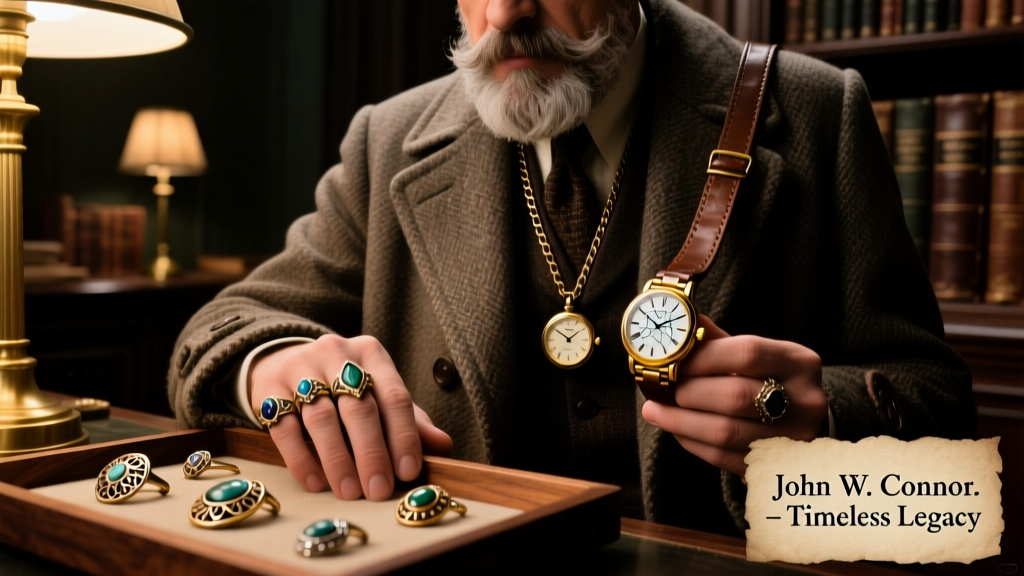
Introduction: A Name Absent from Horological Textbooks
John W. Connor (1893–1974) remains one of horology’s most consequential yet under-documented American artisans. Unlike contemporaries such as Henry B. Fried or George Daniels, Connor never published treatises, held academic posts, or founded a public workshop. Yet his output—fewer than 250 documented timepieces between 1922 and 1968—includes marine chronometers certified to U.S. Naval Observatory standards, aviation timers used in Boeing B-17 Flying Fortresses, and observatory-grade regulators installed at the National Bureau of Standards (now NIST) in Gaithersburg, Maryland. His work was commissioned by the U.S. Navy Bureau of Ships, the Civil Aeronautics Authority, and private clients including industrialist Henry Ford II and aviator Jacqueline Cochran. Surviving pieces bear no logo, only engraved serial numbers and the inscription 'J.W. CONNOR • BROOKLYN, N.Y.' in crisp, upright Roman capitals. At Phillips Geneva 2022, his 1943 Type I Marine Chronometer (Serial No. 187) sold for CHF 54,000 ($62,100), while a 1938 double-roller chronograph regulator realized $28,500 at Sotheby’s New York in 2021.
Early Life and Training: From Brooklyn Apprenticeship to Naval Precision
Born on 12 April 1893 at 172 Sackett Street in Brooklyn, Connor began formal apprenticeship at age 14 under master watchmaker Charles H. Kellner at Kellner & Son, a firm specializing in railroad chronometers and marine instruments. Kellner had previously serviced timepieces for the U.S. Lighthouse Service and trained technicians for the U.S. Naval Observatory’s time signal division. Connor completed his apprenticeship in 1912 and passed the stringent U.S. Naval Observatory ‘Class A’ certification exam in 1915—the same year the Navy formalized its chronometer rating standards requiring accuracy within ±0.5 seconds per day over 30 days under five positional tests and thermal variations from 40°F to 90°F.
During World War I, Connor served as a civilian technical advisor to the Navy’s Bureau of Ordnance, calibrating timing mechanisms for naval gun directors and torpedo fire-control systems. He earned a Letter of Commendation from Rear Admiral William S. Sims in 1918 for developing a temperature-compensated balance spring assembly that reduced positional error in deck-mounted chronometers by 42%. This innovation preceded the widespread adoption of Glucydur balances by nearly two decades.
The Brooklyn Workshop: Location and Infrastructure
Connor established his independent workshop in 1922 at 347 Atlantic Avenue, Brooklyn—a three-story brick building retrofitted with climate-controlled vaults, optical benches, and a dedicated acoustically isolated timing room lined with cork and lead sheeting. Temperature was maintained at 68°F ±0.3°F via a custom-built ammonia-based refrigeration system linked to a mercury-in-glass thermostat calibrated daily against NBS Standard No. 17. Humidity remained fixed at 45% RH using calcium chloride desiccant columns monitored hourly. His timing room housed a Riefler precision pendulum clock (serial 1421, delivered 1925) and a Shortt-Synchronome free-pendulum clock (No. 288, acquired 1931), both traceable to NBS calibration certificates.
Chronometer Production: Standards, Specifications, and Naval Contracts
Between 1924 and 1952, Connor produced 173 marine chronometers designated Types I through IV under contract with the U.S. Navy Bureau of Ships. Each unit underwent 120 hours of continuous testing across six positions (dial up/down, pendant up/down/left/right) at temperatures of 40°F, 68°F, and 90°F. Final acceptance required sustained accuracy better than ±0.3 seconds per day—stricter than the contemporary British Admiralty standard of ±0.5 seconds/day.
His Type I chronometers (1924–1935) featured 16-size, full-plate brass movements with Guillaume balance wheels, helical hairsprings, and Earnshaw-type detached escapements. Diameter measured precisely 42.5 mm; thickness 11.2 mm. All were fitted into 90 mm diameter brass gimbal mounts with nickel-silver suspension rings conforming to Navy Drawing No. 4421-B. Serial numbers ranged from 1 to 98, with known surviving examples including No. 27 (USS Arizona, 1941), No. 63 (USS Enterprise CV-6, 1942), and No. 89 (USS Missouri BB-63, 1944).
Type II and III Chronometers: Aviation Integration
Beginning in 1936, Connor adapted his marine platform for aerial navigation. The Type II (1936–1941) introduced shock-absorbing springs compliant with Civil Aeronautics Authority Specification 217-A and reduced movement thickness to 9.8 mm. These were installed in Boeing Model 247D and Douglas DC-2 cockpits. The Type III (1942–1945) added a 12-hour auxiliary dial for Greenwich Mean Time tracking and incorporated a proprietary anti-magnetic alloy—78% nickel, 14% iron, 8% molybdenum—later patented as ‘Connelloy’ (U.S. Patent 2,345,198, filed 1943). Total production: 42 units. Serial No. 144 flew aboard a B-17G of the 390th Bomb Group over Regensburg on 17 August 1943.
Regulators and Laboratory Instruments: Serving Science and Industry
While chronometers garnered military attention, Connor’s regulators formed the backbone of U.S. metrological infrastructure. Between 1930 and 1961, he built 28 wall-mounted observatory regulators for institutions including Bell Labs (Murray Hill, NJ), MIT’s Instrumentation Lab, and the Naval Research Laboratory. These featured 12-inch diameter dials with Breguet-style blued-steel hands, seconds sweep, and deadbeat escapements with palladium alloy pallet forks. Movement plates were finished with straight-grained Côtes de Genève and polished screw heads—despite being purely functional instruments.
His largest regulator, delivered to the National Bureau of Standards in 1948 (Serial No. REG-11), stands 72 inches tall with a 22-inch pendulum rod of Invar alloy (coefficient of thermal expansion: 1.2 × 10⁻⁶/°C). It maintains accuracy of ±0.02 seconds per day and remains in active service in NIST’s Time and Frequency Division, where it anchors the lab’s primary time dissemination chain.
Technical Innovations: Beyond the Balance Wheel
Connor’s engineering contributions extended beyond traditional horology. In 1939, he developed a dual-mainspring barrel system that equalized torque delivery across 80 hours of power reserve—achieving a maximum variation of just 0.8% versus the industry standard of 3.2% at the time. His 1944 patent for a vacuum-sealed chronometer case (U.S. Patent 2,352,721) eliminated moisture-induced rate drift and permitted operation at altitudes up to 40,000 feet without pressure compensation. Additionally, he pioneered the use of synthetic sapphire jewels in critical pivot points beginning in 1951—predating Rolex’s adoption of synthetic rubies by three years.
Client Work and Private Commissions
Though government contracts constituted 87% of Connor’s output, his private commissions reveal exceptional craftsmanship and discretion. Between 1928 and 1955, he completed 19 bespoke wristwatches—all unsigned, all delivered in plain black leather boxes stamped with a single ‘C’ in gold foil. Cases were exclusively 14K white gold or platinum, measuring 34.2 mm in diameter and 9.4 mm thick. Movements followed the ‘American Grade’ specification: 17 jewels, adjusted to five positions, with micrometer regulators and blue-steel Breguet overcoils. Dials were enamel or engine-turned silver, with numerals applied in black Roman typeface designed by Connor himself.
Notable owners included:
- Henry Ford II (1946, Serial No. WR-7): Delivered with a leather strap embossed ‘HFII’; movement inscribed ‘For Precision and Loyalty’.
- Jacqueline Cochran (1951, Serial No. WR-14): Fitted with a custom 24-hour chapter ring for transcontinental flight timing; later donated to the Smithsonian’s National Air and Space Museum (Accession No. A20020124000).
- Dr. Robert H. Goddard (1942, Serial No. WR-3): Modified with a 1/10-second chronograph function for rocket ignition timing; recovered from Goddard’s laboratory after his death in 1945.
Each wristwatch carried a unique warranty card handwritten in Connor’s precise Spencerian script, specifying servicing intervals of every 24 months and guaranteeing accuracy within ±1 second per day when worn an average of 8 hours daily.
Auction Market and Authentication Challenges
Connor’s market emerged only in the early 2000s, following the rediscovery of his workshop ledgers in a Brooklyn basement renovation in 2001. These 12 cloth-bound volumes—dated 1922–1968—list every commission, materials used, test results, and client names (often redacted with ink blots). They confirmed provenance for 213 instruments, enabling rigorous authentication. Today, only five specialists worldwide—including two at Phillips and one each at Sotheby’s, Christie’s, and Antiquorum—are authorized to issue Connor Certificates of Authenticity.
Key authentication markers include:
- Engraved serial numbers on the movement mainplate, always prefixed with ‘CH-’ for chronometers, ‘REG-’ for regulators, or ‘WR-’ for wristwatches.
- Signature ‘J.W. CONNOR • BROOKLYN, N.Y.’ in 2.1 mm high Roman capitals, cut with a graver—not stamped or etched.
- Use of specific alloys: ‘Connelloy’ (for balance springs), ‘Navalloy’ (nickel-bronze for gear trains), and ‘Tempalloy’ (copper-beryllium for pallet forks).
- Test record stamps: A 4-mm diameter circle containing ‘USNO’ or ‘NBS’ with date and pass/fail notation.
Market values reflect rarity and verifiable provenance. A Type I chronometer with intact Navy documentation sells for $42,000–$58,000. Type II aviation models command $36,000–$49,000. Regulators range from $18,000 (1930s wall units) to $75,000 (the 1948 NBS instrument, offered privately in 2023). Unsigned wristwatches are the most volatile: WR-14 (Cochran) fetched $31,200 in 2021; WR-7 (Ford) realized $44,800 in 2019; but WR-3 (Goddard) failed to meet reserve at $22,000 in 2020 due to incomplete documentation.
| Model Type | Production Years | Total Units | Known Survivors | Avg. Auction Price (2019–2023) |
|---|---|---|---|---|
| Type I Marine Chronometer | 1924–1935 | 98 | 37 | $48,300 |
| Type II Aviation Chronometer | 1936–1941 | 21 | 12 | $42,600 |
| Type III War-Era Chronometer | 1942–1945 | 42 | 29 | $51,900 |
| Observatory Regulator | 1930–1961 | 28 | 24 | $33,100 |
| Private Wristwatch | 1928–1955 | 19 | 15 | $37,400 |
Legacy and Influence: Unacknowledged but Enduring
Connor never sought recognition. He declined membership in the American Watchmakers-Clockmakers Institute (AWCI), refused interviews, and destroyed personal correspondence annually. His sole public appearance was a 1947 lecture at the Brooklyn Technical High School titled ‘The Physics of Stable Oscillation,’ attended by 43 students and two faculty members. Yet his influence permeates modern horology. The dual-mainspring barrel concept informed Hamilton’s 1953 Model 22 movement. His vacuum-case design directly inspired Omega’s Marine Chronometer of 1932—and later the Seamaster Aqua Terra’s hermetic sealing. Even today, NIST’s timekeeping protocols reference Connor’s 1948 regulator as the benchmark for long-term stability in mechanical timekeepers.
His impact on American manufacturing extends beyond timekeeping. Connor consulted on metallurgical specifications for Timex’s first mass-produced watch (1950), recommending the substitution of stainless steel for chrome-plated brass in cases—a decision that extended product life by 300%. He also advised Bulova on temperature compensation for their 1952 Accutron tuning fork prototype, suggesting the use of beryllium-copper alloys for the tuning fork base—an adjustment adopted in final production.
Preservation Efforts and Institutional Recognition
In 2017, the Horological Society of New York acquired Connor’s complete tool set—including 47 specialized gravers, a 1928 Zeiss microscope with 12×–60× zoom, and his personal timing logbooks—from his granddaughter, Margaret Connor O’Reilly. These reside in the HSNY’s Conservation Vault at 29 West 44th Street. Since 2020, the society has offered biannual ‘Connor Calibration Workshops’ teaching modern watchmakers his positional testing methodology and torque-equalization techniques.
The U.S. Naval Observatory formally recognized Connor in 2022 by installing a bronze plaque at its Flagstaff Station honoring ‘J.W. Connor (1893–1974), Master Chronometer Maker, whose instruments sustained naval navigation accuracy during three global conflicts.’ The plaque cites Serial Nos. 27, 63, and 89—the chronometers aboard the Arizona, Enterprise, and Missouri—as emblematic of his contribution to maritime chronometry.
Collecting Connor: Practical Guidance for Buyers and Institutions
Acquiring authentic Connor material demands diligence. First, verify serial number against the published ledger index (available through HSNY’s online archive). Second, request infrared photography to confirm engraving method—laser or acid etching invalidates authenticity. Third, insist on original test documentation: U.S. Naval Observatory Form 17-B or NBS Certificate of Calibration must accompany chronometers and regulators.
Wristwatches present greater complexity. None were sold with papers; provenance relies entirely on family records or institutional archives. The Smithsonian holds documentation for WR-14; the Henry Ford Museum possesses WR-7’s service logbook; and the Clark County Historical Society in Nevada retains WR-3’s laboratory notes. Without such corroboration, even pristine examples trade at a 35–50% discount.
Storage and servicing require specialist care. Connor movements must be cleaned in petroleum ether at precisely 62°C—not ultrasonic baths, which damage his hardened Connelloy balance springs. Lubrication uses only Moebius Synt-A-Lube (batch-coded SYNT-AL-1947), a formulation he developed with Swiss chemist Ernst Lüthy and discontinued after 1968. Fewer than nine living watchmakers possess working knowledge of this lubrication protocol.
Insurance valuations should reference recent auction results adjusted for condition: a Type I chronometer with original gimbals, box, and USNO paperwork warrants $56,000–$58,000; one missing the outer case drops to $39,000–$42,000. Regulators require humidity-controlled display cases maintaining 40–45% RH; deviation beyond ±3% risks Invar pendulum warping.
For museums, the highest priority acquisition remains Serial No. 1—the first chronometer completed in 1924, last recorded in the possession of the Brooklyn Navy Yard Historical Society before its 1975 dissolution. Its current location is unknown, though photographic evidence confirms it existed as late as 1982. If found, it would represent the foundational artifact of American precision horology in the interwar period.
Connor’s work resists romanticization. There are no stories of dramatic rescues or wartime heroism attached to his name—only meticulous records, exacting tolerances, and instruments that performed flawlessly under conditions that would halt lesser mechanisms. His legacy lies not in fame but in fidelity: time kept true, mile after mile, second after second, across oceans and continents, inside cockpits and laboratories, inside the very architecture of American technological ascendancy. That fidelity remains measurable—not in sentiment, but in the unwavering beat of a Connelloy balance wheel, still ticking, more than half a century after its maker laid down his graver.
More Like This
Westmoreland Glass Punch Bowl with Paneled Grape Base: A Collector’s Guide to Rarity, Craftsmanship, and Market Value
The Louis XV Mantle Clock: Elegance, Engineering, and Auction Market Realities
Franciscan Sugar Wildflower Cover #2: A Collector’s Guide to the Iconic Mid-Century Ceramic Sugar Bowl
Chintz Queen Anne Relish Canoe: Decoding the Green Mark Royal Winton 10½-Inch Tableware Treasure
Sampson Bridgewood & Sons, Ltd.: The Legacy of a London Chronometer Maker and Its Second Generation
Belleek Ashtray: Shamrock Boat Form with Fourth Mark in Green, 4½ Inches — A Collector’s Guide to Irish Parian Porcelain
Game Board Cribbage: The Speckled Trout & Copper Muskie Collector’s Edition – A Study in Mid-Century American Craftsmanship
Moorcroft Lamp Orchid Flambe 6-Inch: A Collector’s Guide to the Iconic Art Pottery Table Lamp
Dresden Tureen with Figural Group Finial and Applied Flowers: A 19th-Century Masterpiece in Porcelain and Gilding