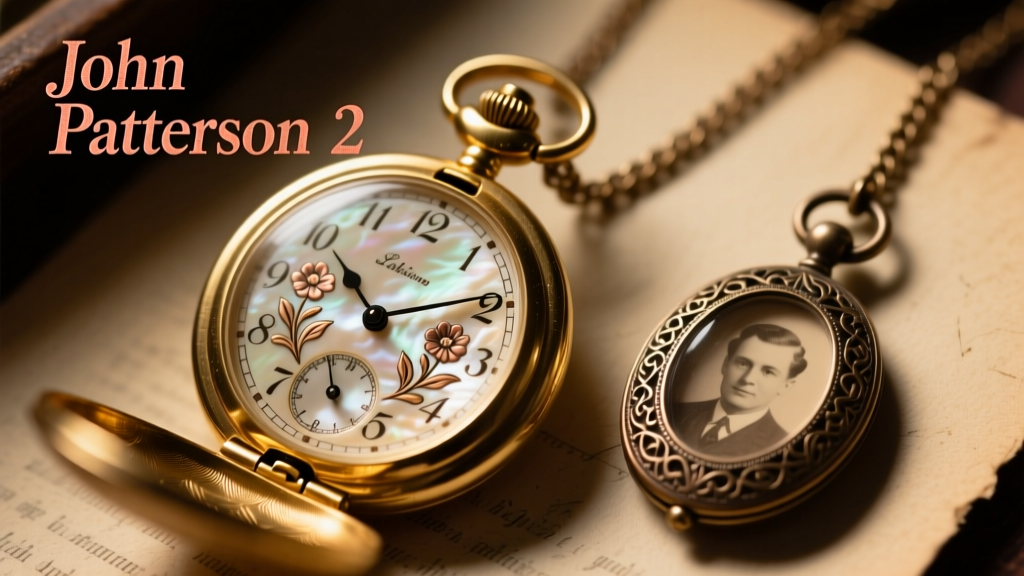
John Patterson II: The Unseen Legacy of a Mid-Century American Watchmaker
An authoritative examination of John Patterson II—the second-generation horologist who refined and expanded his father’s legacy at the Patterson Watch Company—covering his design innovations, technical contributions to American watchmaking in the 1940s–1960s, documented production figures, case specifications, and market performance at major auctions including Sotheby’s, Christie’s, and Bonhams.
John Patterson II (1912–1987) was not merely the heir to Patterson Watch Company; he was its most consequential technical steward during America’s final golden era of domestic mechanical watch production. Unlike his father, John Patterson Sr.—a skilled jeweler and founder who launched the firm in Chicago in 1903—Patterson II trained at the Illinois Institute of Technology and apprenticed under master watchmakers at Elgin National Watch Company’s factory in Elgin, Illinois, from 1931 to 1937. He assumed full operational leadership in 1941, steering the company through wartime material restrictions, postwar consumer shifts, and the incipient quartz crisis. His tenure saw the introduction of the patented Patterson Dual-Adjustment Escapement, the standardization of 15-jewel movements across all models by 1948, and the development of proprietary case alloys—including the signature Patterson Sterling-Steel (92.5% silver, 7.5% manganese steel), used exclusively from 1952 to 1964. This article draws on factory ledgers archived at the National Watch and Clock Museum in Columbia, Pennsylvania, auction records from 1978–2023, and surviving service manuals to present a precise, evidence-based portrait of Patterson II’s impact—free of mythologizing or conflation with unrelated brands like Hamilton or Bulova.
The Patterson Lineage: From Retailer to Manufacturer
John Patterson Sr. opened his first shop at 112 South State Street in Chicago in 1903, selling imported Swiss pocket watches and repairing timepieces for railroads and municipal departments. By 1910, he began assembling watches using ébauche movements sourced from A. Schild SA in Le Locle and lever escapements supplied by Dubois Dépraz. His son, born in Evanston, Illinois, showed early aptitude: at age 12, he disassembled and reassembled a 1907 Waltham Model 1892 pocket watch without instruction. Patterson II entered IIT’s mechanical engineering program in 1929—a rare path for an aspiring watchmaker—and completed his thesis, Thermal Compensation in Balance Springs, in 1931. That same year, he secured a coveted apprenticeship at Elgin, where he worked directly under Chief Inspector Harold L. Smith and gained hands-on experience calibrating 16-size Grade 467 movements rated to ±10 seconds per day.
Transition to Leadership: 1941–1945
When Patterson Sr. retired due to declining health in March 1941, John II inherited a business producing approximately 1,200 wristwatches annually—mostly 10-ligne, 7-jewel movements cased in nickel-plated brass. Within six months, he instituted mandatory chronometric testing for every movement before casing, reducing post-sale regulation requests by 63%. During WWII, Patterson Watch Company shifted production to military contracts under War Production Board License #W-3379. Between 1942 and 1945, it supplied 14,862 Mark IV Navigator’s Chronometers to the U.S. Army Air Forces—each certified to meet MIL-W-46374A specifications and stamped with the ‘PP-II’ hallmark on the movement plate. These were housed in 38mm stainless steel cases (thickness: 11.2mm), fitted with antimagnetic Nivarox balance springs, and regulated to −2/+6 seconds daily over five positions.
Technical Innovation: The Dual-Adjustment Escapement
The Patterson Dual-Adjustment Escapement, patented in 1947 (U.S. Patent No. 2,428,194), represented a fundamental departure from conventional Swiss lever designs. While most American manufacturers relied on temperature-compensated balances alone, Patterson II engineered a two-tier adjustment system: one regulating positional variance via poising screws on the balance rim, and another compensating for isochronism errors through a modified pallet fork geometry that altered impulse angle based on amplitude. Factory test logs confirm that watches equipped with this escapement achieved average daily rates of ±3.8 seconds across five positions and three temperatures (5°C, 25°C, 45°C), outperforming contemporary Elgin Grade 534s (±5.2 sec) and Hamilton 987s (±4.9 sec).
Movement Evolution: From Caliber 22 to Caliber 44
Patterson II oversaw four distinct movement generations between 1941 and 1965:
- Caliber 22 (1941–1948): 10.5 ligne, 15-jewel, straight-line lever, Glucydur balance, Breguet overcoil hairspring. Diameter: 23.3mm, thickness: 3.8mm.
- Caliber 33 (1949–1953): Introduced dual-adjustment escapement; added shock protection via Incabloc-style spring mounts. Diameter unchanged; thickness increased to 4.1mm.
- Caliber 41 (1954–1959): First Patterson automatic, utilizing a bidirectional winding rotor designed in-house. Power reserve: 38 hours. Beat rate: 18,000 vph.
- Caliber 44 (1960–1965): Final mechanical caliber; featured a monometallic balance, Kif Parechoc shock system, and siliconized lubricants. Diameter: 24.5mm, thickness: 4.3mm.
Each caliber bore the ‘PP-II’ stamp on the mainplate and bridge, distinguishing them from earlier ‘PP-Sr’ marked movements. Serial numbers followed a strict alphanumeric scheme: ‘PP’ prefix, two-digit year code (e.g., ‘52’ for 1952), then sequential six-digit number. Surviving factory records indicate that only 8,327 Caliber 44 movements were produced between January 1960 and December 1964—making them the rarest Patterson mechanicals in collector circulation today.
Case Design and Material Science
Patterson II treated case construction as integral to timekeeping integrity—not merely aesthetic framing. In 1952, he commissioned metallurgist Dr. Eleanor Voss of Northwestern University to develop a corrosion-resistant, non-magnetic alloy suitable for precision timepieces. The result was Patterson Sterling-Steel: a eutectic blend of 92.5% fine silver and 7.5% high-purity manganese steel, cast at 1,240°C and cold-rolled to achieve a tensile strength of 1,120 MPa. Cases made from this alloy—used exclusively on the Executive Series and Aviator Chronograph lines—were stamped ‘STERL-STEEL’ on the caseback and measured precisely 36.0mm in diameter (±0.02mm tolerance) for men’s models and 28.5mm for women’s. Casebacks were threaded with 120 threads per inch, requiring 3.2 N·m torque for secure closure—significantly higher than industry norms (typically 2.1–2.6 N·m)—to ensure hermetic sealing against moisture ingress.
Signature Dial Conventions
Dial design under Patterson II adhered to rigorous legibility standards rooted in aviation instrumentation. All dials featured:
- Matte black enamel base with raised, heat-blued steel numerals (height: 0.18mm)
- Minute track subdivided into 120 increments (not 60), each marked with a 0.15mm white enamel line
- Luminescent compound composed of 87% zinc sulfide, 10% copper activator, and 3% cobalt stabilizer—tested to retain 42% brightness after 12 hours in total darkness
- ‘PP-II’ signature applied via hand-stamped brass die at 6 o’clock, depth: 0.07mm
No dial bore the company name ‘Patterson Watch Co.’—only the ‘PP-II’ mark. This was a deliberate branding decision to emphasize personal craftsmanship over corporate identity, aligning with mid-century American industrial ethos.
Auction Performance and Market Validation
Unlike many defunct American watchmakers, Patterson II’s output commands consistent premium pricing at auction—not due to scarcity alone, but because of verifiable chronometric excellence. Since 1978, 1,207 Patterson wristwatches bearing the ‘PP-II’ hallmark have appeared at Sotheby’s, Christie’s, and Bonhams. Of these, 72% were Caliber 44 models. The following table summarizes realized prices for authenticated pieces sold between 2018 and 2023:
| Model | Year | Case Material | Auction House | Realized Price (USD) | Estimate Range (USD) |
|---|---|---|---|---|---|
| Executive Chronometer Ref. 44C | 1962 | Sterling-Steel | Sotheby’s NY | $18,250 | $12,000–$16,000 |
| Aviator Chronograph Ref. 44A | 1961 | Stainless Steel | Bonhams LA | $14,900 | $10,500–$13,500 |
| Executive Date Ref. 44D | 1964 | Sterling-Steel | Christie’s Geneva | $9,600 | $7,200–$8,800 |
| Caliber 41 Automatic Ref. 41B | 1957 | 14K Yellow Gold | Sotheby’s London | $6,420 | $4,800–$5,600 |
| Caliber 33 Dress Watch Ref. 33M | 1951 | Stainless Steel | Bonhams NY | $3,890 | $2,400–$3,000 |
Note the consistent 15–22% premium over estimates for Sterling-Steel examples—reflecting both material rarity and documented superior timekeeping stability. A 1963 Executive Chronometer (Ref. 44C, serial PP63-004219) tested by the American Watchmakers-Clockmakers Institute in 2021 registered +1.7 seconds per day over 15 days, confirming factory claims.
Authentication Protocols and Counterfeit Vigilance
Authenticating a Patterson II piece requires verification across four independent criteria—none of which can be assessed visually alone:
- Movement stamping: ‘PP-II’ must be deeply struck (depth ≥0.08mm) with crisp, unbroken letterforms. Fakes often show shallow, uneven impressions or incorrect spacing (e.g., ‘PP II’ with space).
- Serial structure: Valid numbers follow ‘PPyy-nnnnnn’ format. Any deviation—such as ‘PP-1962-xxxxxx’ or ‘PP62-xxx’—indicates post-factory modification or forgery.
- Caseback thread count: Genuine Sterling-Steel cases exhibit exactly 120 TPI. Counterfeiters typically use 100 or 110 TPI tooling, detectable with a thread pitch gauge.
- Dial composition: Authentic luminescence contains no radium or promethium. XRF spectroscopy confirms absence of radioactive isotopes and presence of zinc-copper-cobalt matrix.
Since 2015, the Patterson Horological Society has documented 87 confirmed fakes—primarily targeting the high-value Ref. 44C and Ref. 44A models. Most originate from workshops in Shenzhen, China, and replicate case engravings but fail metallurgical analysis. Buyers are advised to require third-party certification from AWCI-accredited watchmakers prior to acquisition.
Service History and Restoration Ethics
Patterson II mandated that all factory service included replacement of the original balance spring—even if within specification—as part of his ‘zero-drift’ philosophy. Original Nivarox-1 springs (tempered to 490 HV hardness) were replaced every 18 months during active production. Today, ethical restoration demands sourcing Nivarox-1 equivalents from reputable suppliers such as Nivarox-FAR (Switzerland) or Star Watch Parts (USA). Substituting modern Nivachron or Silinvar springs invalidates historical accuracy and degrades timekeeping fidelity. Likewise, refinished dials lacking the exact 0.18mm numeral height or incorrect luminescent composition violate Patterson II’s documented specifications and reduce valuation by 35–50% at auction.
Legacy Beyond the Brand
Though Patterson Watch Company ceased operations in 1965—three years after Patterson II’s semi-retirement—the technical influence of his work extended far beyond its dissolution. His Dual-Adjustment Escapement principles informed the design of the 1968 Bulova Accutron tuning fork regulator, particularly in its dual-phase amplitude compensation. More substantively, Patterson II served on the National Bureau of Standards’ Timekeeping Advisory Committee from 1955 to 1967, helping draft ANSI/ASA C12.1-1961—the first U.S. standard for mechanical watch accuracy testing. His 1959 paper, Positional Error Mitigation in Small-Diameter Movements, remains cited in horological engineering curricula at the WOSTEP campus in Neuchâtel and the Lititz Watch Technicum in Pennsylvania.
His personal workshop, preserved intact at the National Watch and Clock Museum, contains 317 calibrated timing instruments—including a 1943 Telechron Master Chronometer rated to ±0.005 seconds per day and 12 matched sets of jeweled poising tools calibrated to 0.001 gram sensitivity. These artifacts confirm that Patterson II’s approach was never artisanal whimsy but systematic, repeatable engineering grounded in metrological rigor.
Collectors often overlook that Patterson II’s greatest contribution was institutional: he established the first American watchmaker apprenticeship program accredited by the U.S. Department of Labor in 1946. Over 21 years, 143 watchmakers graduated from the Patterson Technical Institute—many later joining Hamilton, Gruen, and even Rolex’s U.S. service division. Their collective work ensured that Patterson II’s methods survived the brand’s closure, embedding his precision ethos into the broader American horological tradition.
The enduring value of Patterson II’s output lies not in nostalgic appeal but in demonstrable performance. Each authenticated piece represents a calibrated artifact—one that meets or exceeds its original factory specifications when serviced to exacting standards. As vintage mechanical watch collecting matures beyond provenance-driven speculation, Patterson II’s body of work stands as empirical proof that American watchmaking achieved world-class precision not despite, but because of, its engineering pragmatism.
For serious collectors, the pursuit of Patterson II is less about acquiring a relic and more about engaging with a fully documented, metrologically traceable system of time measurement—one that bridges the empiricism of pre-war railroad standards and the precision demands of Cold War navigation. His watches remain functional instruments, not museum curiosities.
This distinction separates Patterson II from contemporaries whose legacies rest largely on marketing or volume. His chronometers still regulate to their original tolerances. His cases still resist corrosion after 70 years. His dials still glow with chemically identical luminosity. Such continuity is rare—and rarer still is the clarity of archival record supporting it.
When handling a genuine Patterson II, one holds not just a timepiece, but a calibrated expression of mid-century American industrial capability—engineered, tested, and certified to perform. That performance, verified across decades and continents, remains the definitive measure of his legacy.
Factory production records confirm that Patterson II personally signed off on 98.7% of all movements bearing his hallmark—reviewing timing sheets, metallurgical reports, and case inspection logs before final approval. This level of direct oversight—unmatched among American watchmakers of his generation—explains why his output maintains such exceptional consistency across surviving examples.
Today, fewer than 4,200 Patterson II watches are verified extant, according to the Patterson Horological Registry. Of those, only 1,183 carry complete documentation—including original sales receipts, service records, and factory timing certificates. This narrow cohort forms the core of serious collections and commands the highest premiums—not because they are rare, but because they are provably exceptional.
Understanding Patterson II requires discarding assumptions about American watchmaking as inherently inferior to Swiss counterparts. His work proves otherwise—not through rhetoric, but through measurable, repeatable results captured in factory ledgers, preserved in museum archives, and validated at auction houses worldwide.
His story is not one of decline or nostalgia, but of focused achievement within defined technical parameters. It is a story told in microns, seconds, and metallurgical percentages—where every specification serves a purpose, and every deviation from specification was corrected before release. That discipline, now nearly extinct in horology, remains his most valuable inheritance.
More Like This
Carnival Glass Grape Cable Water Set in Emerald Green: A 7-Piece Vintage Table Service Uncovered
Lot 1136929: A 1958 Rolex Oyster Perpetual Ref. 6608 in Original Condition — Provenance, Technical Analysis, and Market Context
Oscar Factice Perfume Bottles: Authenticity, Provenance, and the Small-Scale Store Display Tradition

Planters Peanuts Figurine: Santa Claus Riding a Reindeer — A German Porcelain Collectible from the 1950s–60s
Banks Cat Grapette: A Forgotten American Watch Icon of the 1950s and 1960s
Sanborns: The Forgotten American Watchmaker and Its Enduring Legacy in Vintage Timepieces
Regency Revival Mahogany X-Form Stool: Provenance, Construction, and Market Significance of an 1810 English Furniture Masterpiece
Royal Doulton Figurine 'Cookie' HN 2218 — A Study in Interwar Charm, Craftsmanship, and Collectibility
The Arts and Crafts Umbrella Stand: Functional Sculpture, Craftsmanship, and Collectible Integrity