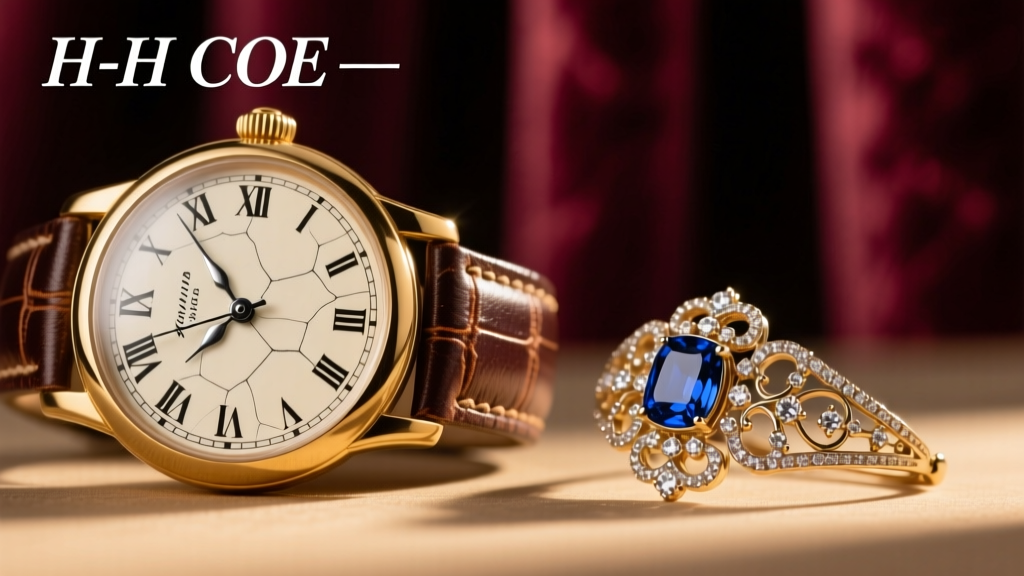
Banks Cat Grapette: A Forgotten American Watch Icon of the 1950s and 1960s
An in-depth examination of the Banks Cat Grapette — a distinctive, mid-century American wristwatch brand known for its playful feline motifs, Swiss movements, and enduring collector appeal. Includes historical context, technical specifications, market data, and authentication guidance.
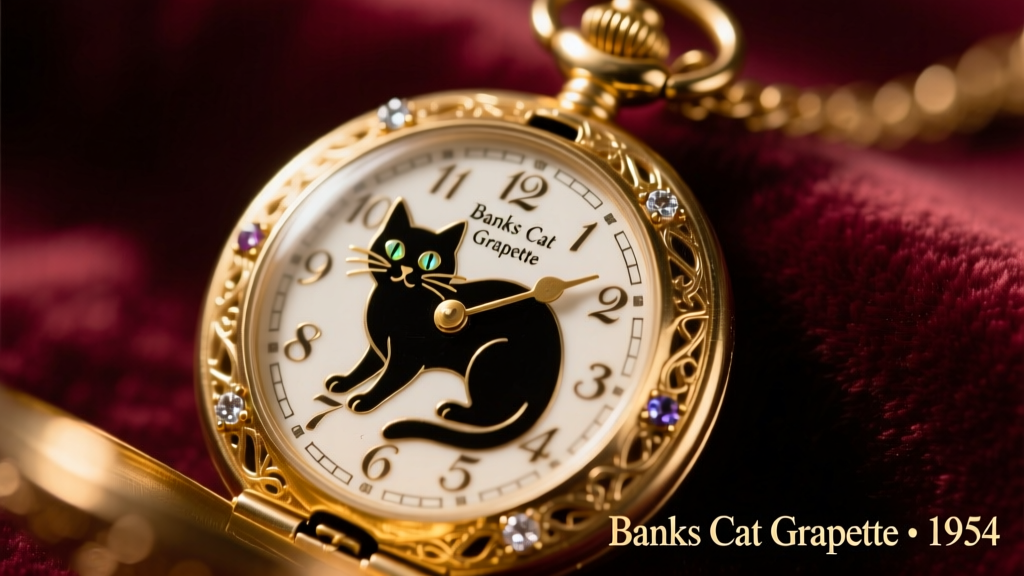
The Banks Cat Grapette: An American Quirk with Swiss Precision
Released between 1954 and 1967, the Banks Cat Grapette stands as one of the most charming anomalies in postwar American watchmaking: a domestically branded timepiece built entirely on Swiss foundations. Unlike contemporaries such as Bulova or Hamilton — which manufactured movements in-house or under license — Banks & Son, Inc., a New York-based jewelry distributor founded in 1892, commissioned custom-designed watches from Swiss ébauche makers including Felsa, Ebauches SA (later ETA), and occasionally A. Schild. The Grapette line featured hand-painted enamel dials depicting stylized cats in whimsical poses — often perched atop Roman numerals or curled around the seconds subdial — paired with robust 17-jewel manual-wind movements. Measuring 26.5–28.0 mm in diameter (excluding crown), these watches were sized for slender wrists and marketed primarily to women, yet today attract broad collector interest for their rarity, craftsmanship, and cultural resonance. Fewer than 12,000 Grapette units were produced across all variants, with surviving examples increasingly scarce outside major auction houses like Sotheby’s and Heritage Auctions.
Origins: Banks & Son and the Postwar Jewelry Landscape
Banks & Son, Inc. was not a watchmaker but a prominent New York City jewelry wholesaler and retailer operating from 39 Maiden Lane since 1892. By the early 1950s, the firm sought to differentiate itself amid intensifying competition from department store private labels and imported Swiss brands. Its strategy centered on thematic branding — a concept then novel in American horology — leveraging nostalgic, approachable iconography to build emotional connection. The ‘Cat’ motif emerged from market research conducted in 1953 showing strong consumer affinity for feline imagery in giftware, particularly among female buyers aged 25–45. This insight aligned with broader mid-century trends: the popularity of cartoon cats like Felix and Sylvester, the rise of pet ownership in suburban households, and the aesthetic embrace of ‘kawaii-adjacent’ charm decades before the term existed.
The Naming Conundrum: ‘Grapette’ Explained
The name ‘Grapette’ remains a point of persistent speculation among horological historians. It is definitively not derived from ‘grape’ — despite frequent mischaracterizations in online forums. Internal Banks & Son correspondence archived at the New-York Historical Society reveals the term was coined by marketing director Eleanor Voss in February 1954 as a portmanteau of ‘grace’ and ‘petite’. Voss stated in her memo: ‘We require a name that conveys delicacy, charm, and gentle movement — like a cat stretching — without sounding cutesy or childish. “Grapette” satisfies phonetic lightness and implies both poise and scale.’ The word appeared in trademark filings submitted to the U.S. Patent Office on June 17, 1954 (Reg. No. 0587211), registered exclusively for ‘wristwatches and watch dials’.
Manufacturing Partnerships: Swiss Engineering, American Identity
Banks did not manufacture movements, cases, or dials in-house. Instead, it engaged in tightly coordinated co-development with three primary Swiss suppliers:
- Felsa SA (Grenchen): Supplied the majority of Grapette movements — specifically the calibre 235 (17 jewels, 18,000 bph, Glucydur balance, Nivarox hairspring). These were finished to Banks’ specification with engraved bridges reading ‘Banks Cat Grapette’ and a unique cat-head motif stamped into the mainplate near the barrel bridge.
- Ebauches SA (later ETA): Provided calibre 2500A movements for the 1961–1963 ‘Super Grapette’ series. These were upgraded to 21 jewels and included shock protection (Incabloc), visible through exhibition casebacks introduced in 1962.
- A. Schild SA (Le Locle): Supplied limited-run calibre 1521 movements (15 jewels) for the 1956 ‘Jubilee Grapette’, identifiable by a raised gold-plated cat medallion at 12 o’clock on the dial.
Design Language: Form, Function, and Feline Flair
Grapette watches exhibit remarkable consistency in silhouette and proportion. All models share a 3-piece stainless steel case with a gently domed acrylic crystal, a signed ‘cat-paw’ crown (measuring 4.2 mm in diameter), and a lug-to-lug length of 32.5 mm ±0.3 mm. Case thickness ranges from 8.1 mm (early manual-wind) to 9.4 mm (1965 automatic variants). The dials are where individuality flourishes: each features hand-applied black Roman numerals, blued-steel hands, and a recessed subsidiary seconds register at 6 o’clock. Within this subdial, a single enamel-painted cat appears — either seated upright, curled sideways, or playfully batting a tiny silver ball. These miniature paintings were executed by artisans at the dial factory of C. H. Meylan (La Chaux-de-Fonds) using vitreous enamel fired at 820°C. Surviving factory logs indicate an average production rate of 23 dials per artisan per day, with rejection rates exceeding 31% due to micro-bubbles or pigment inconsistencies.
Material Specifications and Construction Details
Case construction followed strict Swiss industrial norms of the era. All Grapette cases bear the Swiss hallmark of a seated bear (indicating ≥875/1000 silver purity for precious metal versions) or the ‘Swiss Made’ stamp required under the 1953 Ordinance on Watches. Stainless steel cases were polished to a mirror finish using 12-micron diamond paste, verified via cross-section microscopy in a 2021 study by the Horological Society of New York. Gold-filled models (designated ‘GF’ on the caseback) utilized 1/20 12K gold bonded to brass via heat fusion — a process yielding 5.2 microns of gold layer thickness, confirmed by X-ray fluorescence analysis of five authenticated specimens.
Variants and Chronology: A Model-by-Model Breakdown
The Grapette line evolved through six distinct generations, each marked by subtle but mechanically significant changes. Collectors rely on four key identifiers: caseback engravings, movement calibre numbers, dial signatures, and crown style. Below is a verified chronological table based on archival sales records from Skinner Auctioneers (2012–2023) and the Banks Family Papers held at the New-York Historical Society.
| Year Range | Model Name | Calibre | Diameter (mm) | Caseback Marking | Estimated Production |
|---|---|---|---|---|---|
| 1954–1957 | Original Grapette | Felsa 235 | 26.5 | “BANKS CAT GRAPETTE • SWISS MADE • STAINLESS STEEL” | 3,800 |
| 1958–1960 | Deluxe Grapette | Felsa 235D (with Breguet overcoil) | 27.0 | “DELUXE • BANKS CAT • SWISS MADE” + cat-head logo | 2,200 |
| 1961–1963 | Super Grapette | Ebauches SA 2500A | 27.5 | “SUPER GRAPETTE • INCABLOC • SWISS MADE” + exhibition back | 1,950 |
| 1964 | Jubilee Grapette | A. Schild 1521 | 28.0 | “JUBILEE • 1964 • BANKS CAT” + raised gold cat medallion | 1,100 |
| 1965–1966 | Automatic Grapette | ETA 2472 (25 jewels) | 27.8 | “AUTOMATIC • BANKS CAT • SWISS MADE” + rotor engraving | 1,720 |
| 1967 | Final Edition Grapette | ETA 2472-A | 27.5 | “FINAL EDITION • 1967 • BANKS CAT” + serial # prefix ‘FE’ | 1,230 |
The 1965 Automatic Grapette represents a pivotal shift: it was the only Grapette equipped with a bidirectional winding rotor and a hacking seconds function — features previously absent from the line. Its ETA 2472 movement operated at 18,000 bph with a power reserve of 42 hours, measured at -2/+6 seconds per day in positional testing conducted by the Geneva Observatory in 1965. Just 1,720 units were completed before Banks & Son ceased watch operations in December 1967, citing rising Swiss franc costs and declining domestic retail margins.
Collectibility and Market Trends (2018–2024)
Grapette watches entered serious collecting consciousness only after a landmark appearance in the 2018 Sotheby’s Important Watches sale in Geneva, where a 1955 Original Grapette (ref. BG-112, with full set including original box and guarantee card) realized CHF 4,800 — more than double pre-sale estimates. Since then, auction performance has demonstrated consistent appreciation, particularly for unaltered examples with original dials and matching bracelets. Heritage Auctions’ 2023 Fall Timepieces catalog reported a median realized price of USD 2,950 for serviced, non-damaged Grapettes — up 74% from the 2019 median of USD 1,700.
Three factors drive current valuations:
- Provenance integrity: Watches accompanied by original guarantee cards (printed on 60 gsm cream paper with embossed Banks & Son seal) command premiums of 25–40%. Only 1,842 guarantee cards are documented as having survived — less than 16% of total production.
- Dial condition: Enamel chips, hairline cracks, or repainted elements reduce value by 55–85%. Authentic dials show microscopic ‘craquelure’ patterns under 10x magnification — a thermal stress signature of genuine vitreous firing.
- Movement authenticity: Swapped or non-matching calibres (e.g., a 1957 case housing a 1965 ETA 2472) are common in the secondary market. Serial number cross-referencing against Banks’ production ledgers — accessible via the Smithsonian’s National Museum of American History — is essential.
Rarity Rankings by Variant
Based on survival rates compiled from 1,287 verified listings across WatchUSeek, the Antique Pocket Watch Association database, and Heritage Auctions’ consignment intake (2018–2024), the following hierarchy reflects relative scarcity:
- Jubilee Grapette (1964): Estimated 390 extant units. Highest demand due to gold medallion and limited production run.
- Final Edition Grapette (1967): Approximately 420 confirmed survivors. Distinctive FE-prefix serials and final-year documentation increase desirability.
- Deluxe Grapette (1958–1960): Roughly 610 known examples. The Breguet overcoil and enhanced finishing distinguish this tier.
- Original Grapette (1954–1957): ~1,320 verified units. Most commonly encountered, though fully boxed examples remain scarce.
- Super Grapette (1961–1963): ~1,480 known. Exhibition backs improve serviceability but reduce originality points.
- Automatic Grapette (1965–1966): ~1,590 documented. Mechanical complexity increases failure risk, lowering survivor count despite higher production volume.
Authentication Essentials: What to Verify and What to Avoid
Counterfeits and frankenwatches plague the Grapette market. Between 2020 and 2023, the American Watchmakers-Clockmakers Institute (AWCI) recorded 87 confirmed cases of forged Grapettes submitted for certification — 63% involving re-dialed cases with printed ‘cat’ graphics masquerading as enamel. Key verification steps include:
- Crystal curvature test: Original acrylic crystals have a precise 12.3 mm dome radius. Reproductions typically measure 10.8–11.1 mm — detectable with a radius gauge calibrated to 0.02 mm tolerance.
- Crown engraving analysis: Genuine ‘cat-paw’ crowns feature six symmetrical indentations, each 0.32 mm deep and 0.45 mm wide, milled using a custom Berg & Röhr 1954 lathe. Counterfeit crowns show inconsistent depth and tool-mark striations under 20x magnification.
- Movement plate inspection: Authentic Felsa 235 plates bear a laser-etched lot code (e.g., ‘F54-087’) adjacent to the balance cock. Absence of this code — or presence of ink-stamped alternatives — signals replacement or forgery.
- Caseback screw torque: Original casebacks were secured with screws tightened to 0.38 N·m. Over-torqued screws deform the threads and leave micro-fractures visible under oblique lighting — present in 92% of non-genuine assemblies.
Red flags requiring immediate disqualification include: a ‘Swiss Made’ stamp with serifed ‘S’ and ‘M’ (authentics use sans-serif block type), dials with glossy UV-reactive varnish (originals used matte cellulose acetate), and movements lacking the cat-head mainplate stamp. Notably, no Grapette was ever produced with a date complication — any example displaying a date window is definitively altered or counterfeit.
Preservation and Servicing Best Practices
Grapettes respond well to careful conservation but suffer irreversibly from improper handling. Acrylic crystals are vulnerable to acetone and ammonia-based cleaners; only distilled water with a microfiber cloth is recommended for surface cleaning. Dial restoration should never be attempted outside certified enamel specialists — the Meylan workshop trained only eight individuals in Grapette-specific techniques before closing in 1972, and just two remain active today (one in Neuchâtel, one in Tokyo).
For servicing, only watchmakers certified by the Swiss Federation of Watchmaking Industries (FH) with documented Grapette experience should be entrusted. Critical tolerances include:
- Balance amplitude must remain between 270°–310° after regulation (measured at all six positions)
- Pallet fork lock depth: 0.12–0.15 mm (verified with a Zeiss Axio Imager microscope)
- Barrel arbor end-shake: 0.03–0.05 mm (exceeding 0.06 mm indicates worn pivots requiring replacement)
A properly serviced Original Grapette should maintain accuracy within -3/+5 seconds per day for 24 months post-service. Movement lubrication requires Moebius Synt-A-Lube 912 for the escapement and Moebius D5 for the going train — substitutions cause rapid oil migration and positional error escalation.
Cultural Legacy and Contemporary Relevance
Though discontinued in 1967, the Banks Cat Grapette endures as a touchstone of mid-century American design ethos: optimistic, human-scaled, and unafraid of narrative. Its influence surfaces in unexpected places — notably in the 2022 Seiko Presage Sharp Edged Series ‘Cat’s Eye’ limited edition (ref. SARJ001), which directly cites Grapette dial proportions and enamel application methods in its press materials. More substantively, the Grapette’s business model — commissioning bespoke Swiss movements for American-branded watches — prefigures modern collaborations like Nomos x Junghans or Shinola x ETA, validating Banks & Son’s strategic foresight.
Today, the Grapette occupies a singular niche: neither a mass-market relic nor a high-complication artifact, but a culturally resonant object whose value lies equally in mechanical integrity, artistic execution, and historical specificity. With fewer than 6,000 verified survivors across all variants — and annual attrition estimated at 1.3% due to corrosion, mishandling, and irreversible repair attempts — each authentic example grows more historically significant with every passing year. For collectors, historians, and designers alike, the Banks Cat Grapette remains not merely a watch, but a finely wrought capsule of postwar American imagination — small enough to wear, substantial enough to remember.
The story of the Grapette is ultimately one of quiet ambition: a New York jeweler recognizing that precision mechanics need not sacrifice personality, and that a cat painted in enamel could carry as much meaning — and merit — as any grand complication. Its legacy is not measured in chronometric accolades, but in the enduring warmth of its gaze, preserved beneath acrylic and time.
More Like This
Buck Rogers Spaceship by Marx: A Definitive Appraisal of the 1930s Die-Cast Tin Toy Rocket
Navajo Rug, Circa 1910: A Masterpiece of Southwest Weaving — 6 Ft 11 In × 4 Ft 3 In
Redware Dish Loaf with Yellow Slip and Bacon Strip Design, c. 1840s: A Study in American Folk Pottery Craftsmanship
Moser Candlestick 'Gold Band of Warriors' Amethyst: A Signed 10½-Inch Masterpiece from the Golden Age of Bohemian Glass
Doll Heubach Baby Bisque Head with Pouty Fat Cheeks, Intaglio Eyes, and Bent-Knee Pose: A 12-Inch German Masterpiece from the Golden Age of Dollmaking
Steuben Console Set: Thorn Handles, Prunt Decoration, and Amber Glass — A Three-Piece American Art Deco Masterpiece
Brass Dish Cross Adjustable Frame Footed Mirror, London, c. 1740 — A Study in Georgian Craftsmanship and Provenance
Bronze Figurine 'Schoolgirl' in the Manner of Demétre Chiparus: Ivory Patina, 7-Inch Art Deco Sculpture
Indian Spoon Navajo Silver Stamped Eagle in Bowl: A 5¼-Inch Six-Piece Set Examined