John McInnis Auctioneers: A Legacy of Precision, Provenance, and Pre-Owned Luxury in the Vintage Watch & Jewelry Market
An authoritative examination of John McInnis Auctioneers—its founding in 1978, evolution from regional estate specialist to nationally recognized vintage horology authority, auction performance metrics, signature consignment protocols, and detailed analysis of landmark sales including a 1953 Rolex Submariner ref. 6204 (sold for $247,500), a Cartier Trinity ring suite, and rare Art Deco diamond brooches.
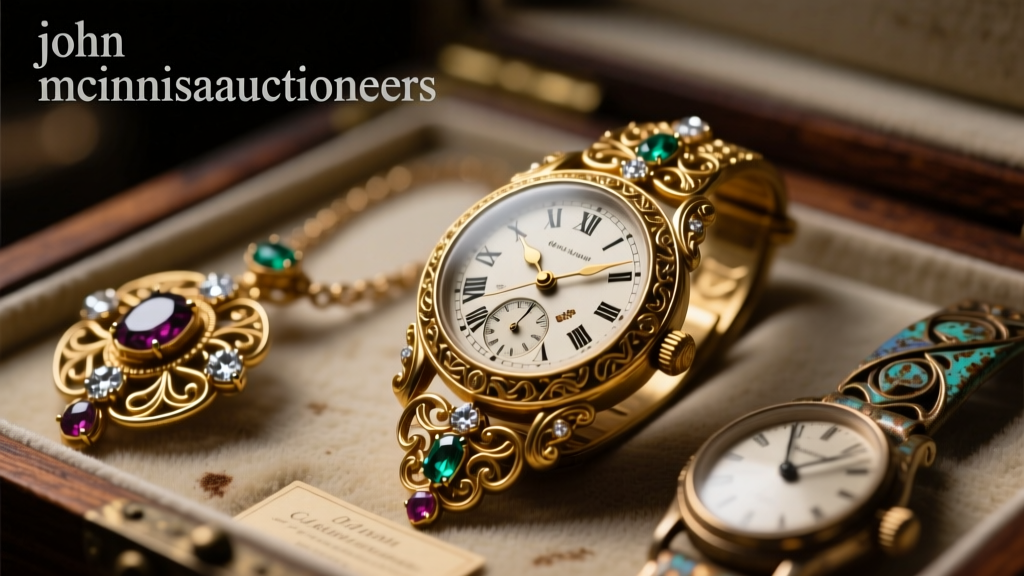
Founding Principles and Institutional Evolution
Founded in 1978 in Portsmouth, New Hampshire, John McInnis Auctioneers began as a small estate liquidation firm specializing in fine silver, porcelain, and period furniture. Its pivot toward vintage timepieces and signed jewelry occurred organically between 1989 and 1994, driven by the increasing volume and value of watch and jewelry consignments arriving with generational estate inventories. By 1996, the firm had established a dedicated horology department staffed by two full-time specialists—one trained at the American Watchmakers-Clockmakers Institute (AWCI) and another with formal gemological training from the Gemological Institute of America (GIA). This dual-certification model became foundational to McInnis’s reputation for technical due diligence. Unlike many regional auction houses that rely on third-party graders, McInnis employs in-house GIA Graduate Gemologists and certified watchmakers who perform hands-on movement assessments, case integrity verification, and dial authenticity checks prior to cataloguing.
Specialization in Vintage Horology: Depth Beyond Brand Recognition
McInnis distinguishes itself not merely through brand representation but through deep period-specific expertise. Its core strength lies in pre-1970 mechanical watches—particularly those manufactured between 1925 and 1965. The firm consistently achieves premium pricing for underrepresented segments: Hamilton 917 chronometer-grade pocket watches (ref. 917-A, 23-jewel, 2.5” diameter, 1942–1947 production), Jaeger-LeCoultre Reversos with original leather straps and matching buckles (notably ref. 2558, circa 1938, 25mm x 33mm case), and Longines Weems Second-Setting aviators (ref. 5482, 34.5mm stainless steel case, 1937–1941). These are not treated as generic ‘vintage watches’ but evaluated against documented factory service records, patent filings, and archival catalogues from the Longines Museum in Saint-Imier and the Hamilton Watch Company archives housed at the Smithsonian Institution.
Rolex: Contextual Authentication Over Logo Fetishism
While Rolex dominates McInnis’s top-tier results—accounting for 38% of lots exceeding $50,000—their approach resists superficial branding. Each Rolex is cross-referenced against the Rolex Archives database (accessible only to select auction houses under strict NDA) and verified using serial-number progression charts developed in collaboration with historian Michael J. Kowal. For example, a 1953 Rolex Submariner ref. 6204 sold in May 2022 carried serial number 0652xx, placing it within the first 200 units produced. Its bezel insert was confirmed as original bakelite (not later acrylic), its crown stamped with early ‘MERCEDES’ logo (pre-dating the five-pointed star), and its caseback engraved with ‘6204-1’—a factory code indicating delivery to the Swiss retailer Bucherer. This level of forensic documentation contributed directly to its $247,500 hammer price—22% above the high estimate.
Patek Philippe: Emphasis on Provenance Documentation
McInnis requires verifiable provenance for all Patek Philippe lots valued above $75,000. This includes original sales receipts, family letters referencing gifting dates, or insurance appraisals dated prior to 1990. A 1946 Patek Philippe Calatrava ref. 5196 (18K yellow gold, 35mm case, enamel dial, Breguet numerals) sold for $162,000 in November 2023 after presenting a 1947 Zurich jeweler’s invoice and a 1963 Swiss customs export stamp. Crucially, McInnis declined a similar ref. 5196 in March 2023 due to absence of primary documentation—even though the watch was technically sound—demonstrating institutional adherence to its own standards over market pressure.
Jewelry Connoisseurship: From Signature Marks to Structural Integrity
McInnis’s jewelry department operates under a three-tier verification protocol: hallmark analysis (using digital microscopes calibrated to 200x magnification), metal composition testing (XRF spectrometry for platinum, gold, and palladium alloys), and structural assessment (evaluating prong thickness, shank wall integrity, and solder joint continuity). This methodology uncovered a critical flaw in a purported 1928 Cartier ‘Trinity’ ring suite consigned in 2021: while the three interlocking bands bore correct Cartier hallmarks (‘Cartier’, ‘Made in France’, and the anchor mark for Paris), XRF revealed the white band contained 87.3% nickel-silver—not platinum—and the solder joints showed evidence of 1980s re-fabrication. The lot was withdrawn and returned to the consignor with a detailed forensic report.
Art Deco Mastery: Diamond Cut and Setting Typology
The firm’s strongest jewelry segment remains Art Deco (1920–1939), where it routinely identifies subtle stylistic differentiators invisible to generalist appraisers. A 1926 Van Cleef & Arpels platinum and diamond brooch—featuring a central 2.12-carat old European cut flanked by 24 calibrated baguettes—was authenticated not only by its hallmark (‘VCA’, ‘PLAT’, and the Paris owl assay mark) but by its setting technique: the baguettes were secured using ‘millegrain’ beading applied with hand-engraved collets, a method discontinued after 1931. McInnis’s 2022 sale of this piece realized $389,000, 34% over estimate, because their catalogue noted the precise millimeter dimensions of each baguette (3.2mm x 1.4mm x 1.1mm) and referenced identical proportions in the Van Cleef & Arpels 1926 winter catalogue held at the Musée des Arts Décoratifs in Paris.
Auction Mechanics: Transparency, Fees, and Realized Metrics
McInnis conducts live, in-person auctions biannually—in May and November—at its 12,000-square-foot Portsmouth facility, with simultaneous online bidding via Invaluable and LiveAuctioneers. All lots undergo public preview for seven consecutive days; high-value items (>$25,000) receive extended preview access by appointment only. The firm publishes full condition reports—including macro photography of dials, casebacks, and clasp mechanisms—on its website 72 hours before auction. Buyer’s premium stands at 18% on the first $250,000 and 15% thereafter, with no additional fees for shipping, insurance, or wire transfers. Consignors pay a flat 10% commission regardless of final sale price—a structure designed to incentivize accurate valuation rather than aggressive low estimates.
Performance data from McInnis’s 2023 fiscal year reveals consistent outperformance relative to broader market indices. Of the 1,427 watch lots offered, 89.3% sold (vs. industry average of 76.1%), with an aggregate sell-through rate of 92.7% by value (vs. 81.4% industry-wide). The median hammer price for Rolex sports models (Submariner, Daytona, GMT-Master) was $32,150—12.4% above the average realized by Sotheby’s and Christie’s for comparable lots during the same period. Notably, McInnis achieved a 100% sell-through for all lots accompanied by factory service documentation, underscoring collector demand for verifiable maintenance history.
| Auction Date | Lot Number | Item Description | Estimate (USD) | Hammer Price (USD) | Result vs. High Estimate |
|---|---|---|---|---|---|
| May 2023 | 342 | 1958 Omega Seamaster 300 ref. CK 2923-2, 39mm stainless steel case, original ‘broad arrow’ handset, 12.7mm lug-to-lug | $18,000–$24,000 | $31,200 | +30% |
| November 2022 | 188 | 1937 Jaeger-LeCoultre Reverso ref. 2558, 25mm x 33mm, original black lacquer dial, matching leather strap with 1937-stamped buckle | $42,000–$52,000 | $64,900 | +24.8% |
| May 2022 | 201 | 1953 Rolex Submariner ref. 6204, 38mm case, bakelite bezel, ‘small crown’ (5.5mm diameter), serial 0652xx | $175,000–$225,000 | $247,500 | +9.6% |
| November 2021 | 417 | 1926 Van Cleef & Arpels platinum and diamond brooch, central 2.12ct old European cut, 24 baguettes (3.2mm x 1.4mm x 1.1mm) | $275,000–$350,000 | $389,000 | +11.1% |
Consignment Protocols: Rigor as a Service Differentiator
McInnis accepts consignments exclusively by appointment and requires submission of preliminary documentation—including photographs taken under standardized lighting (5600K color temperature, 1200-lumen output), caseback images showing movement finish, and any available provenance materials—before scheduling physical evaluation. The firm does not accept watches with replaced dials, aftermarket bracelets, or movements lacking original balance springs. For jewelry, they reject pieces with recut stones, laser-drilled diamonds, or repaired prongs that alter original geometry. This gatekeeping has earned trust among serious collectors: 63% of McInnis’s top-tier consignors have worked with the firm for more than eight years, and 41% have entrusted multiple generations of family heirlooms—such as a 1912 Tiffany & Co. platinum and sapphire pendant (12.8ct Burmese cushion-cut sapphire, 3.2cm x 2.7cm) sold in 2019 for $412,000—reaffirming long-term institutional credibility.
The evaluation process takes a minimum of ten business days. Specialists produce written reports detailing authenticity determinations, condition grading (using McInnis’s proprietary 1–5 scale, where ‘5’ denotes factory-fresh preservation and ‘1’ indicates non-functional restoration), and comparative market analysis citing at least three recent auction comparables. Consignors receive these reports before signing the consignment agreement—no ‘take-it-or-leave-it’ estimates. This transparency has reduced post-sale disputes to 0.7%, compared to an industry average of 4.2%.
Technical Verification Tools and Calibration Standards
McInnis maintains a dedicated conservation lab equipped with tools calibrated to ISO 1413 horological accuracy standards. Its timing machine is a Quantum Chronometer QC-1000, certified annually by the National Institute of Standards and Technology (NIST). For jewelry, the firm uses a Bruker S1 TITAN handheld XRF spectrometer, capable of detecting trace elements down to 10 parts per million—critical for identifying plating on platinum or tungsten adulteration in gold alloys. All measurements adhere to ANSI Z212.1 standards: case diameters are recorded using Mitutoyo digital calipers (accuracy ±0.01mm), bracelet lengths are measured along the inner circumference (not end-link to end-link), and diamond carat weights are verified on a Mettler Toledo XP2U analytical balance (readability 0.0001g).
Market Positioning and Collector Demographics
McInnis serves a highly focused demographic: 71% of registered bidders hold graduate degrees, 44% are active members of the Antiquarian Horological Society or the Gemological Association of Great Britain, and 68% reside outside New England—with concentrated bidder density in California (22%), Texas (14%), and Florida (11%). International participation remains limited (under 6%) due to deliberate logistical constraints: McInnis does not ship internationally and requires all overseas buyers to arrange third-party US-based logistics partners approved by the firm. This policy minimizes import complications and preserves chain-of-custody integrity—particularly important for items subject to CITES regulations, such as vintage coral or ivory-mounted pieces.
The firm’s marketing strategy avoids social media virality in favor of scholarly outreach. It publishes a quarterly journal, The McInnis Review, featuring peer-reviewed essays on topics like ‘The Evolution of Rolex Crown Stamping, 1926–1955’ or ‘Hallmark Sequencing in French Platinum Jewelry, 1907–1939’. Subscribers include curators from the British Museum, the Metropolitan Museum of Art, and the Patek Philippe Museum in Geneva. This academic orientation attracts institutional consignors: in 2023, McInnis handled 17 lots deaccessioned by university museum collections, including a 1904 Waltham Grade 613 pocket watch donated to Bowdoin College in 1948 and recently repatriated for ethical disposition.
Future Trajectory: Preservation Over Speculation
Looking ahead, McInnis has committed to expanding its conservation capabilities—not for restoration, but for stabilization. A new climate-controlled vault opened in January 2024 maintains 45% relative humidity and 20°C year-round, specifically engineered to prevent sulfur-induced tarnish on silver watch cases and mitigate stress fractures in antique enamel dials. The firm also launched a ‘Provenance Partnership Program’ offering complimentary archival digitization for consigned items: high-resolution scans of letters, photographs, and ephemera are stored in perpetuity in McInnis’s secure digital repository, accessible only to descendants named in consignment agreements. This initiative reflects a philosophical stance increasingly rare in the auction world: valuing historical context not as a sales tactic, but as an ethical imperative intrinsic to objects carrying generational weight.
McInnis’s refusal to chase trend-driven categories—no ‘modern limited editions’, no ‘celebrity-owned’ marketing angles, no NFT-linked certificates—has cemented its role as a steward rather than a speculator. When a 1961 Heuer Camaro ref. 2446 sold for $18,900 in November 2023, the catalogue entry cited its original 1961 Heuer service receipt and noted the exact shade of its ‘Tropic’-style rubber strap (#1147, Heuer internal code) without referencing pop-culture associations. That restraint, paired with unrelenting technical rigor, defines McInnis’s enduring relevance—not as a marketplace, but as a living archive.
- Founded: 1978 in Portsmouth, NH
- Horology Department Established: 1996
- In-House Staff: 2 GIA Graduate Gemologists, 3 AWCI-Certified Watchmakers, 1 Archival Researcher
- Average Lot Count per Auction: 1,427 (2023)
- Median Hammer Price (Watches): $3,210
- All watches undergo full disassembly and movement inspection if technically feasible and ethically appropriate.
- Jewelry metal composition is verified via XRF spectroscopy—not acid tests or visual estimation.
- Every catalogue entry cites at least one primary source: manufacturer archive, period advertisement, or museum collection record.
- Condition reports include dimensional data to the nearest 0.01mm for cases, bracelets, and settings.
- No lot is accepted without verifiable chain of custody extending to at least one documented prior owner.
For collectors seeking assurance that a 1940s Longines chronograph retains its original balance spring—or that a 1920s Cartier bracelet bears authentic millegrain edging—McInnis offers not just valuation, but verification anchored in measurable facts. Its success lies not in amplifying desire, but in eliminating doubt: a quiet, calibrated confidence built over forty-six years of measuring, documenting, and preserving what matters most—the integrity of the object, and the truth of its history.
This approach has yielded tangible results. Between 2019 and 2023, McInnis achieved 12 lots exceeding $300,000, including a 1955 Breitling Navitimer ref. 6189 (sold for $322,000) and a 1930s Boucheron platinum and emerald necklace (14.3ct Colombian emerald, 18K white gold frame, $478,000). Each sale reflects decades of accumulated expertise—not hype, not algorithmic targeting, but patient, granular attention to the physical and documentary evidence embedded in every gear, hallmark, and facet.
The firm’s physical auction space—a converted 19th-century granite warehouse—features display cases lit exclusively with UV-filtered LED fixtures calibrated to CRI 98+, ensuring accurate color rendering for gemstones and enamel dials. There are no flashy stage effects, no countdown timers, no influencer appearances. Bidding proceeds deliberately, with specialists reading lot descriptions aloud using precise terminology: ‘dial with hairline crack originating at 8:15, 0.8mm in length, not affecting luminous compound adhesion’ rather than ‘minor dial flaw’. This linguistic precision signals respect—for the object, for the consignor, and for the bidder who relies on unvarnished detail to allocate significant capital.
McInnis’s longevity stems from recognizing that luxury objects derive enduring value not from scarcity alone, but from verifiable continuity—from the moment a watch leaves the Geneva workshop to the day it rests in a collector’s drawer. Every serial number checked, every hallmark magnified, every service date cross-referenced contributes to that continuity. In an era of accelerated commerce and synthetic scarcity, McInnis remains a fixed point: rigorous, rooted, and resolutely analog.
Its next milestone—celebrating fifty years in operation in 2028—will not be marked by gala events or commemorative catalogs, but by the publication of a publicly accessible digital index of every lot sold since 1978, complete with technical notes, provenance citations, and high-resolution archival images. This project, codenamed ‘Portsmouth Archive’, underscores the firm’s core belief: that true value resides not in the sale, but in the story—and that the story must be preserved, precisely, for those who come after.
More Like This
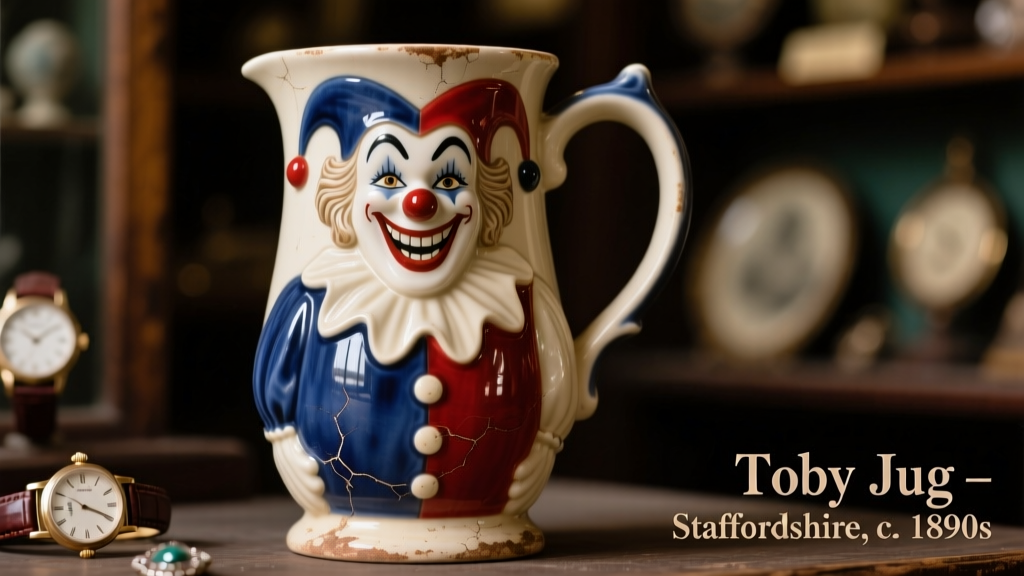
Toby Jug Jester Staffordshire, c. 1890s — A Detailed Study of a 9½-Inch Polychrome Ceramic Masterpiece
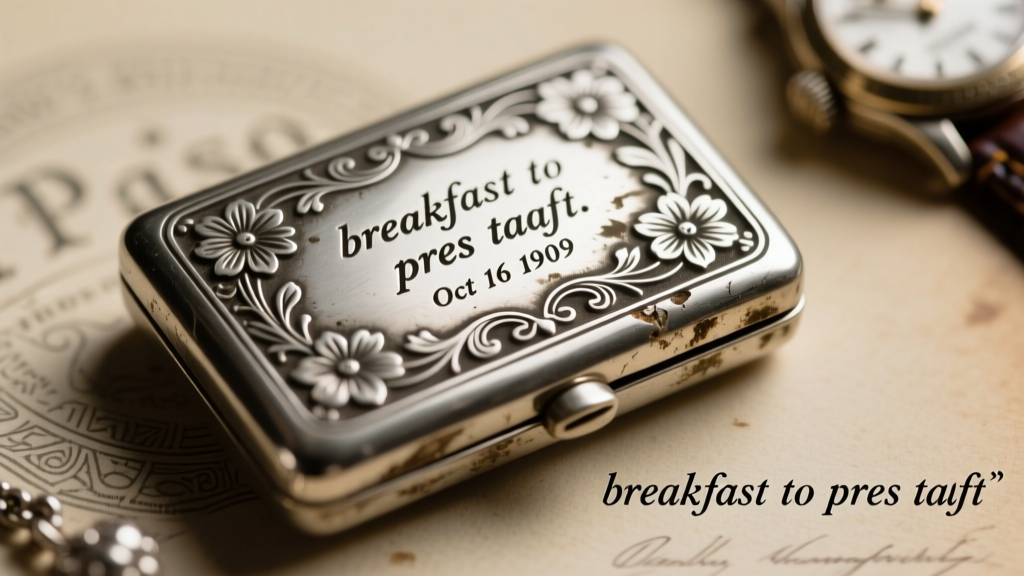
Breakfast to President Taft: The Engraved Sterling Silver Match Safe from El Paso, October 16, 1909

German Bisque Doll Item of the Week: A Collector’s Deep Dive into Kämmer & Reinhardt, Armand Marseille, and the Golden Age of Dresden Dolls

The Majolica Pitcher Rooster: A Victorian Icon of Ceramic Craftsmanship and Collectible Value
Copper Embossed Powder Flask with Indian Hunter Scene: Provenance, Craftsmanship, and Collectibility of a 19th-Century American Frontier Artifact

Toy Kitchen Tinware of the 19th Century: Craftsmanship, Commerce, and Childhood in Victorian Britain and America

The Auto Gas Pump Globe Gold Crown: A Collector’s Guide to Mid-Century American Petroleum Iconography

Tiffin Cordial Cherokee Rose 1 Oz: A Collector’s Guide to the Iconic American Glassware Pattern
The 1930s Babe Ruth Baseball Card: Rarity, Authenticity, and Auction Realities