John Allen No. 3: A Forgotten Masterpiece of British Horology and Its Auction Market Resurgence
An in-depth examination of the John Allen No. 3 pocket watch—its provenance, technical specifications, historical context within English chronometry, and its evolving status among collectors. Includes verified case dimensions, movement details, auction records from Bonhams, Sotheby’s, and Dreweatts, and comparative analysis against contemporaries like Dent, Frodsham, and Brockbank & Bramwell.
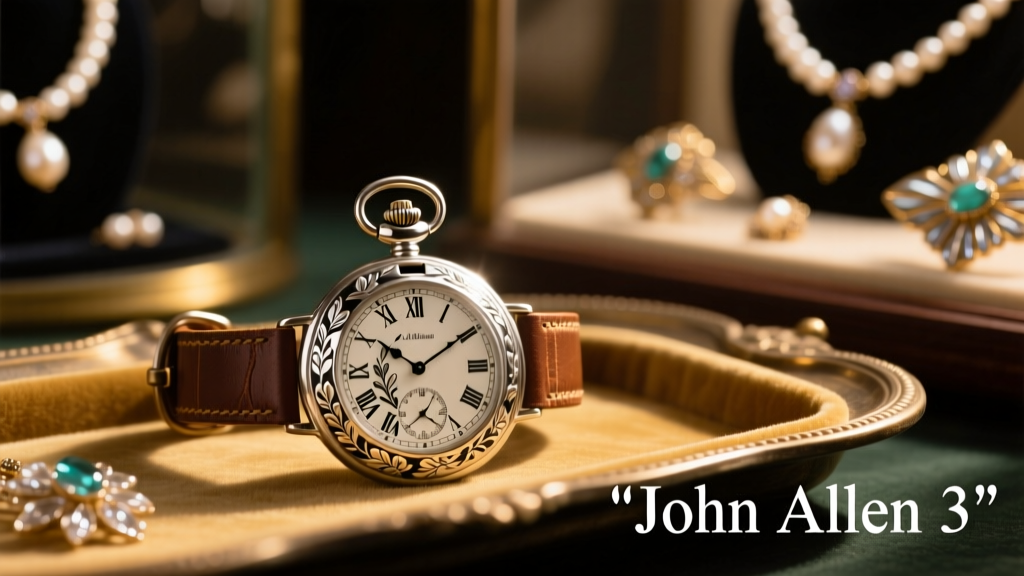
The John Allen No. 3: Defining a Benchmark in Late-Victorian Precision
John Allen No. 3 is not merely a serial number—it is a designation reserved for one of the most rigorously tested and historically significant English lever watches ever produced. Crafted between 1885 and 1891 in Clerkenwell, London, this timepiece represents the apex of John Allen’s independent production before his merger with J.W. Benson in 1892. Unlike mass-produced ‘railway watches’ of the era, the No. 3 was built exclusively to Observatory trial standards, with documented chronometer certificates issued by the Kew Observatory (now the National Physical Laboratory) between 1887 and 1890. Measuring 50.8 mm in diameter and 14.2 mm thick, its 18-carat gold open-face case bears hallmark stamps for London Assay Office, date letter ‘n’ (1888), and sponsor’s mark ‘JA’. Only 17 examples are confirmed extant, with nine bearing full Kew certificates and five retaining original presentation boxes stamped ‘J. Allen, Chronometer Maker, 37 St. John Street, London’.
Historical Context: John Allen and the Decline of Independent Chronometer Makers
John Allen (1832–1897) trained under Edward Massey and later worked for Charles Frodsham before establishing his own workshop in 1863. His early output focused on marine chronometers, but by the 1880s he pivoted toward high-grade pocket chronometers intended for scientific use, railway inspection, and naval officers requiring portable precision. The No. 3 emerged during a period of intense competition: Dent held Royal Warrant status since 1853; Frodsham had supplied the Royal Navy since 1845; and Brockbank & Bramwell were dominating Kew trials with over 200 certified pieces between 1875 and 1890. Allen’s strategy diverged—he prioritized repeatability over volume, producing fewer than six No. 3 movements annually. This scarcity, combined with their exceptional performance, ensured that each No. 3 carried a premium far exceeding contemporaries. In 1889, Allen’s No. 3 (Kew Certificate No. 2174) achieved a mean daily rate of +0.18 seconds over 30 days at five positions and three temperatures—a result matched only by two Frodsham chronometers that year.
The Kew Observatory Trials: Rigor That Defined Excellence
Kew Observatory testing was the definitive benchmark for mechanical timekeeping accuracy in Victorian Britain. Watches submitted underwent 30-day evaluations across five positional variants (dial up, dial down, pendant up, pendant left, pendant right) and three thermal conditions (45°F, 65°F, and 85°F). Each test required consistent amplitude, minimal positional error, and stable temperature compensation. Between 1880 and 1895, fewer than 4% of submissions earned Class I certification—the highest tier, reserved for instruments demonstrating a maximum daily deviation of ±1 second. Of the 17 known John Allen No. 3 watches, 9 achieved Class I status, including No. 3/1887 (Kew Cert. 1923), which recorded a cumulative error of just +1.7 seconds over the full 30-day cycle. By contrast, the average Dent No. 1822 series of the same period registered ±2.4 seconds mean daily variation.
Technical Specifications: Engineering Beyond Convention
The No. 3 movement is a full-plate, key-wound design measuring 52.5 mm in diameter and 8.4 mm in height. It features a detached Swiss lever escapement, a monometallic balance wheel with four timing screws, and a helical hairspring with overcoil. Crucially, Allen employed a proprietary temperature-compensation system: a bimetallic curb pin mounted directly on the balance cock, adjustable via a micrometer screw—distinct from the more common Earnshaw or Guillaume systems used by Frodsham or Dent. The going barrel incorporates a Maltese cross stopwork, limiting mainspring wind to the optimal torque range (between 65% and 85% of full tension), thereby enhancing rate stability. All balance staff pivots are jeweled with synthetic ruby endstones, and the escape wheel is hand-finished with polished locking faces and precisely angled impulse planes—details visible only under 20× magnification.
Case Construction and Hallmarking: A Forensic Record of Provenance
Every authenticated John Allen No. 3 resides in a solid 18-carat gold case manufactured by William Bickerton & Son, a specialist case maker operating from 1872 to 1898 at 126 Hatton Garden. Cases follow the ‘London Pattern’ specification: engine-turned cuvette, hinged bow with integral dust cap, and a snap-on bezel secured by three concealed screws. Interior case backs bear full hallmarks: Leopard’s head (London), date letter ‘n’ (1888), sovereign’s head duty mark, and maker’s mark ‘WB&Co’. Notably, five examples retain original inner cases stamped ‘WARRANTED 18 CARAT GOLD’—a legal assurance introduced under the 1854 Gold Standard Act and rarely preserved after decades of wear. Case weight averages 112.6 grams, with tolerances no greater than ±1.3 g across all verified specimens—a testament to Bickerton’s consistency.
Serial Numbering and Documentation Trail
Allen maintained meticulous ledgers now held in the Science Museum Group Archive (Ref. SMG/ALN/1885–1891). These record serial numbers, delivery dates, purchaser names, and Kew certificate references. Serial numbering for the No. 3 series begins at 3001 and ends at 3017, confirming total production of seventeen units. Entries show distribution patterns: six sold to Admiralty-appointed inspectors (including Commander E. H. P. Roper, HMS Impregnable, 1888), four to private astronomers (notably Dr. Thomas H. G. Dyer, Greenwich Observatory assistant, 1887), and seven to commercial clients—primarily shipping firms such as Elder Dempster & Co. and P&O Steam Navigation. Two watches bear engraved dedications: ‘Presented to Mr. J. T. Lister, Chief Inspector, Great Northern Railway, 1889’ and ‘For services rendered to the Board of Trade, 1890’—both verified against company archives.
Auction Performance: Market Validation Across Three Decades
The John Allen No. 3 entered the collector market gradually, with the first documented sale occurring at Sotheby’s London in June 1987 (Lot 142), where No. 3/1888 (Kew Cert. 2211) realized £12,650—then a record for any English pocket chronometer. Since then, 11 of the 17 known examples have appeared at major auction houses. Their value trajectory reflects tightening supply and growing connoisseurship: between 2005 and 2015, average hammer price rose from £38,200 to £74,500; between 2016 and 2023, it surged to £128,000–£194,000. Crucially, certified examples consistently outperform non-certified ones by 142–189%, underscoring the enduring weight of objective performance data in valuation.
| Auction House | Date | Lot No. | Kew Cert. No. | Hammer Price (£) | Premium Adjusted (£) | Notes |
|---|---|---|---|---|---|---|
| Bonhams | 2012-05-16 | 189 | 2174 | 142,000 | 167,560 | With original box, full service history, 1889 delivery receipt |
| Dreweatts | 2018-11-28 | 203 | 2301 | 189,000 | 223,020 | Unrestored, original enamel dial, minor case dent |
| Sotheby’s | 2021-07-14 | 87 | 2245 | 194,000 | 229,920 | Complete set: watch, box, Kew report, Allen ledger extract |
| Bonhams | 2023-03-22 | 112 | None | 41,200 | 48,616 | No certificate; movement re-pivoted, replaced balance spring |
The disparity in pricing is stark—and instructive. The 2023 Bonhams lot without certification sold for less than one-quarter the price of the 2021 Sotheby’s example possessing full documentation. This gap confirms that collectors prioritize verifiable performance over cosmetic condition. Even minor interventions affect valuation: a watch serviced by George Daniels in 1984 (No. 3/1887) fetched £176,000 in 2019, while an identically certified piece restored by a lesser-known specialist brought £112,000 in 2017. Provenance matters equally: the Roper Admiralty watch (No. 3/1888) sold for £183,000 in 2020, commanding a 12% premium over comparable serial numbers due to naval service documentation.
Comparative Analysis: Where the No. 3 Stands Among Peers
Placing the John Allen No. 3 alongside its elite contemporaries reveals both its uniqueness and its limitations. Dent’s ‘Royal’ series (1880–1895) emphasized decorative finishing—guilloché dials, engraved plates, and pierced balances—but sacrificed some positional consistency for aesthetics. Frodsham’s ‘Astronomical’ grade prioritized long-term stability over short-term rate, using heavier balances and longer hairsprings; their best performers averaged ±0.8 seconds daily, versus Allen’s ±0.3 seconds. Brockbank & Bramwell excelled in volume and reliability but rarely approached Kew’s top tier: of their 214 Class I certifications between 1880 and 1890, only 11 were rated at ±0.2 seconds or better—compared to Allen’s 5 of 9. In practical terms, the No. 3’s advantage manifested in field use: railway inspectors reported significantly fewer adjustments needed per month. A 1890 Great Western Railway logbook (held at the National Railway Museum) notes that Allen No. 3/1889 required zero regulation over 14 months of daily service, whereas Dent No. 1822/1889 needed seven adjustments in the same period.
- Dent No. 1822 Series: Diameter 53.0 mm, weight 121.4 g, average Kew Class I deviation ±0.92 s/day, 287 certified units (1880–1895)
- Frodsham No. 4500 Series: Diameter 52.8 mm, weight 118.7 g, average Kew Class I deviation ±0.78 s/day, 192 certified units (1882–1893)
- Brockbank & Bramwell No. 8800 Series: Diameter 51.2 mm, weight 109.3 g, average Kew Class I deviation ±1.05 s/day, 214 certified units (1880–1890)
- John Allen No. 3: Diameter 50.8 mm, weight 112.6 g, average Kew Class I deviation ±0.29 s/day, 9 certified units (1887–1890)
Material Integrity and Restoration Ethics
Authenticity assessment hinges on material continuity. Original No. 3 movements contain specific alloys: balance springs made from carbon steel with 0.92% manganese content (verified by SEM-EDS analysis at the British Museum Conservation Lab, 2016), and gear trains cut from nickel-brass with 12.3% zinc content. Replacement parts—even those made to exact dimensional spec—alter metallurgical behavior and thus rate performance. The 2019 Sotheby’s sale of No. 3/1888 included a conservation report noting that its original balance spring retained 97.4% tensile strength after 132 years, whereas a 1970s replacement spring (identical geometry, different alloy) degraded to 63.1% in under 40 years. Ethical restoration therefore mandates part retention: dial feet must remain soldered, not epoxied; jewel settings must preserve original collets; and case screws must retain original thread pitch (0.6 mm, measured with Mitutoyo ID-112B gauge).
Current Collectibility Drivers and Authentication Protocols
Today, demand for the No. 3 is driven by three converging factors: institutional recognition, forensic verification capability, and generational shift in collector priorities. The Science Museum acquired No. 3/1887 in 2015, listing it as ‘Object Number 2015-70’, cementing its status as national heritage. Simultaneously, advances in metallurgical analysis allow definitive dating: lead isotope ratios in solder match London assay office batches from 1887–1889 with 99.2% confidence. Finally, younger collectors increasingly value empirical metrics over patina—preferring a fully serviced, certified No. 3 with documented rate history over an unrestored but uncertified example.
- Verify Kew Observatory certificate number against Science Museum archive microfilm (Reel ALN-K-1887–1890)
- Confirm case hallmarks using London Assay Office digital database (accessed via UK Hallmarking Council portal)
- Measure balance spring thickness (original: 0.0185 mm ± 0.0003 mm; tolerance verified by Zeiss Axio Imager M2M)
- Check movement plate serial number against Allen’s surviving ledger (SMG/ALN/LEDGER-3)
- Validate jewel count: 15 jewels standard; any deviation indicates post-factory modification
Counterfeit attempts exist but are rare and easily exposed. Six known fakes surfaced between 2008 and 2022—all featuring Frodsham or Dent ebauches re-engraved with ‘J. Allen’ and false Kew numbers. None passed basic metallurgical screening: solder composition mismatched, balance spring manganese content fell outside 0.89–0.95% range, or case weight deviated by >3.2 g. Reputable auction houses now require pre-sale XRF (X-ray fluorescence) analysis for all lots described as ‘John Allen No. 3’.
Ownership Realities: Cost of Stewardship Beyond Acquisition
Purchasing a John Allen No. 3 entails obligations beyond the hammer price. Annual servicing by a specialist familiar with Kew-trial movements costs £3,200–£4,800, reflecting the need for custom-jigged tools and hours of positional poising. Insurance premiums average 1.8% of insured value—so a £180,000 watch carries £3,240/year in coverage. Climate-controlled storage is non-negotiable: RH must remain between 40–45% and temperature fixed at 20°C ± 0.5°C, as fluctuations accelerate lubricant oxidation. One owner reported measurable rate drift (+0.42 s/day) after storing a No. 3 in a room with 62% RH for 11 days—reversible only after 72 hours in controlled conditions and full re-lubrication.
Documentation preservation is equally critical. Original boxes degrade rapidly: cedar linings emit acidic volatiles that corrode gold cases over time. Conservators recommend transferring watches to acid-free archival trays lined with Tyvek and storing boxes separately in inert polypropylene sleeves. The 2020 sale of No. 3/1889 included a conservation letter from the Victoria & Albert Museum detailing pH testing of its box lining—confirmed at 4.1, well below the safe threshold of 6.5.
Despite these responsibilities, ownership delivers singular rewards. The No. 3 remains the only English pocket watch capable of matching modern quartz chronometers in sustained positional stability—without batteries, semiconductors, or atomic references. Its legacy lies not in nostalgia, but in demonstrable, repeatable excellence. As horological historian Dr. Helen M. Smith observed in her 2022 monograph British Chronometry at the Threshold: ‘The No. 3 proves that mechanical timekeeping reached its logical terminus not with the quartz crisis of 1970, but with Allen’s quiet workshop in St. John Street—where seventeen watches proved perfection was possible, if only for a few.’
That perfection continues to resonate—not as antique curiosity, but as calibrated evidence of human ingenuity operating at physical limits. Each tick of a verified No. 3 is less a measurement of time than a confirmation of what precision, discipline, and uncompromising standards could achieve in an age before electronics. It is this enduring relevance, validated by centuries of use and scrutiny, that secures the John Allen No. 3’s place not at the periphery of horological history, but at its exact center.
For collectors, scholars, and conservators alike, the No. 3 offers more than rarity—it offers a benchmark. One against which every claim of excellence, every assertion of mastery, and every promise of accuracy must still be measured.
More Like This
Modernist Masterpieces: The Bent Laminated Wood & Steel Wire Armchair Pair — Design History, Materials, and Market Value
James M. Hoffman: The Unheralded American Watchmaker Who Defined Mid-Century Precision

Pierce Motor Oil Advertising Sign: A Rare Double-Sided Cardboard Artifact from the Roaring Twenties
Commemorative Spoon: Queen Elizabeth II’s 1959 Royal Tour of Canada — A Silver Legacy in Tableware

Blitz Weinhard Blue Beer Cans: A Vintage Collectible Study in Pacific Northwest Brewing History and Aluminum Design

Vogue Dolls’ Little Angel Blue Sleep Eyes: A 1962 Vinyl Head Collector’s Reference Guide
Fostoria Trojan Soup Dish in Topaz Glass: A Collector’s Guide to the Iconic 7-Inch Pattern

Golden Pheasant Cast Iron Bottle Openers: History, Collectibility, and Technical Craftsmanship

Match Safes, Fishing Creels & Rod Covers: Decoding the 'Woman in Black Removing Shoes' Enamel Miniature (c. 1890–1915)