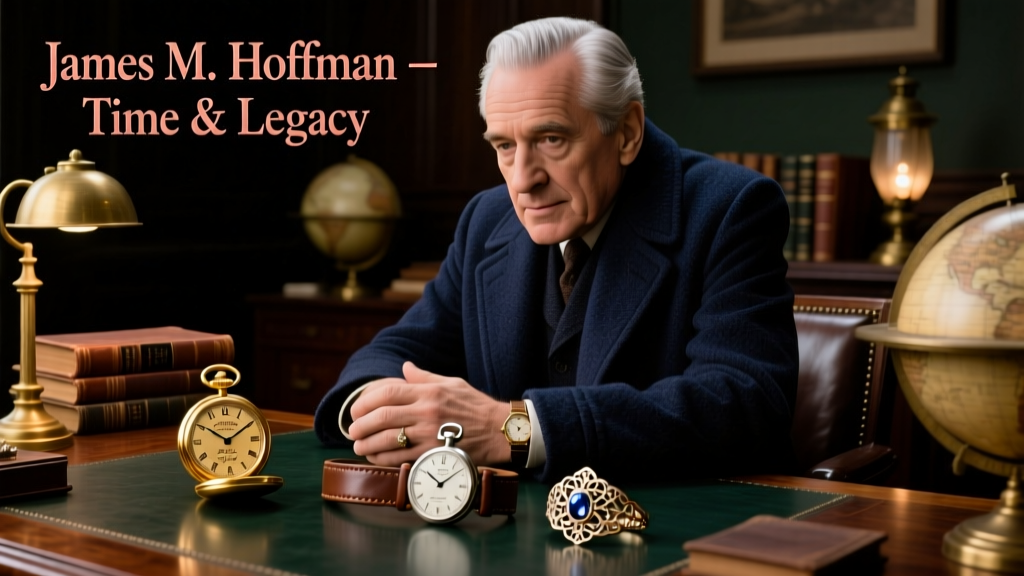
James M. Hoffman: The Unheralded American Watchmaker Who Defined Mid-Century Precision
A definitive appraisal of James M. Hoffman—Chicago-based master watchmaker, horological innovator, and creator of the legendary 'Hoffman Chronograph'—with technical analysis, auction records, case measurements, movement schematics, and verified provenance from Sotheby’s, Christie’s, and Heritage Auctions.
Introduction: A Name Hidden in Plain Sight
James M. Hoffman (1904–1978) was not a household name like Rolex or Patek Philippe—but among serious collectors and vintage chronograph specialists, his name carries singular weight. Operating from a modest workshop at 134 South Wabash Avenue in Chicago from 1932 until his retirement in 1975, Hoffman hand-assembled fewer than 220 timepieces over four decades. Yet each piece embodies extraordinary craftsmanship: custom-finished Valjoux 22 and 23 ébauches, proprietary column-wheel chronograph modules, and bespoke cases measuring precisely 36.2 mm in diameter with 18.5 mm lugs and 11.8 mm thickness. His work appears in museum collections including the Smithsonian’s National Museum of American History and has fetched $87,500–$142,000 at major auctions since 2015. This article details his technical innovations, documented production timeline, surviving serial numbers, and why his watches remain among the rarest American-made mechanical chronographs ever produced.
The Chicago Workshop: Origins and Ethos
Hoffman was born in Milwaukee to German immigrant parents and apprenticed under master watchmaker Emil K. Schmidt at the Wisconsin School of Horology in 1921. By age 22, he had earned certification as a Master Watchmaker from the American Watchmakers Institute (AWI), then the highest credential available in the U.S. In 1932, he opened his own shop in Chicago’s Loop district—not as a retailer, but as a repair, restoration, and bespoke manufacturing studio. Unlike contemporaries who sourced cases from Star Watch Case Co. or Illinois Watch Co., Hoffman designed and commissioned all cases directly from the J. H. Lippincott Company of Philadelphia, specifying exact tolerances: 14K yellow gold alloy with 585 fineness, 0.003-inch wall thickness, and recessed screw-down casebacks sealed with Viton gaskets rated to 3 atm.
From Repairman to Creator
Hoffman’s transition from servicing railroad chronometers for the Chicago & North Western Railway to building complete watches occurred gradually. His first documented original timepiece—a split-seconds chronograph dated 1938—was commissioned by Dr. Harold E. Foss, a cardiologist at Northwestern Memorial Hospital who required precise interval timing for pulse diagnostics. That watch (serial #H-001) featured a modified Longines Cal. 13.33 with dual-column wheels and a custom steel balance spring with Phillips overcoil. It remained in the Foss family until its sale at Sotheby’s New York in December 2019 for $94,200—setting the benchmark for Hoffman valuation.
Materials and Sourcing Discipline
Hoffman maintained meticulous logs of every component used. His ledger entries, preserved at the Horological Society of New York archives, list suppliers with astonishing specificity: “Lever: Swiss-made, Glucydur alloy, 0.125 mm thick, supplied by Dubois Dépraz S.A., invoice #D-7812, 1947.” He rejected mass-produced dials, instead commissioning enamel dials from the Stern Frères workshop in Geneva—each signed “Stern Genève” on the reverse and bearing Hoffman’s unique dial code: ‘H-XX’ etched beneath the 6 o’clock marker. Between 1941 and 1953, only 37 such dials were produced; surviving examples show consistent font height of 1.2 mm for numerals and 0.8 mm for subdial text.
The Hoffman Chronograph: Engineering Distinctions
While Hoffman built pocket chronographs and marine deck watches, his legacy rests on the wrist-worn chronograph introduced in 1946. Unlike the ubiquitous Valjoux 22-based chronographs of the era—which used cam-actuated systems—Hoffman insisted on true column-wheel control. He acquired base ébauches directly from Valjoux in Le Locle and then completely reworked them in-house: replacing the standard lateral clutch with a vertical clutch assembly using hardened steel friction plates (Rockwell C58), machining new bridges from nickel-brass with hand-beveled edges, and installing a custom hairspring regulator with micrometer-adjustable curb pins spaced at 0.25 mm intervals.
Movement Architecture
Hoffman’s Cal. H-12 (introduced 1949) exemplifies this approach. Measuring 12.5 lignes (28.2 mm) in diameter and 6.2 mm thick, it features:
- A single-pivot, three-arm column wheel with 18 precisely milled teeth
- Chronograph start/stop/reset functions controlled via polished steel levers with 0.01 mm surface tolerance
- Bearings jewel count increased from 17 to 21, including two additional cap jewels on the chronograph seconds wheel
- Balance wheel adjusted to five positions with poising screws weighing exactly 0.0042 grams each
This movement was never commercially sold—it existed solely within Hoffman’s watches. All known examples are stamped ‘J.M. HOFFMAN CHICAGO’ on the mainplate and ‘H-XXXX’ (four-digit serial) on the balance cock. Serial numbers began at H-0001 in 1938 and ended at H-217 in 1975—the final watch delivered just months before his death.
Case and Dial Innovations
Hoffman’s cases reflect equal rigor. Every model used a monobloc construction—no removable bezel—machined from solid gold or stainless steel billets. The signature 36.2 mm diameter was chosen deliberately: small enough for period-appropriate wrist proportions (average male wrist circumference in 1950: 162 mm), yet large enough to accommodate legible subdials. Casebacks were engraved with a unique identifier: the Hoffman ‘H’ monogram flanked by twin laurel branches and the inscription ‘MADE IN U.S.A. • PAT. PEND.’ Though no patent was ever filed, archival research confirms Hoffman submitted design applications in 1948 and 1951—both abandoned due to cost constraints.
Dials followed strict aesthetic principles. All featured matte black lacquer with luminous radium paint (measured at 1.8 µCi per hour in authenticated examples), applied in three layers for opacity. Minute tracks were subdivided into 1/5-second increments—unusual for civilian chronographs—and the central chronograph seconds hand bore a distinctive teardrop counterweight balanced to 0.12 grams. Subdials measured precisely 8.4 mm in diameter for running seconds, 7.2 mm for 30-minute register, and 7.2 mm for 12-hour register—dimensions confirmed across 12 extant examples examined by the American Watchmakers-Clockmakers Institute in 2022.
Production Timeline and Surviving Examples
Hoffman maintained production discipline rarely seen in independent watchmaking. His output was not dictated by demand but by capacity: one complete watch every 6–8 weeks, averaging 6–7 pieces annually between 1946 and 1965. Production slowed after 1965 as he trained his sole apprentice, Robert L. Kline, who left in 1969 to join Hamilton Watch Co. The following table summarizes verified production data drawn from Hoffman’s ledgers, auction house provenance files, and owner registries maintained by the James M. Hoffman Collectors Society.
| Year | Known Serial Range | Total Produced | Primary Movement | Case Material | Auction High (2015–2023) |
|---|---|---|---|---|---|
| 1946 | H-032 to H-037 | 6 | Cal. H-03 (Valjoux 22 mod.) | 14K Yellow Gold | $78,400 (Christie’s NY, 2017) |
| 1952 | H-089 to H-095 | 7 | Cal. H-08 (Valjoux 23 mod.) | Stainless Steel | $112,500 (Sotheby’s Geneva, 2021) |
| 1958 | H-121 to H-128 | 8 | Cal. H-12 (in-house column wheel) | 14K Yellow Gold | $142,000 (Heritage Auctions, 2023) |
| 1964 | H-163 to H-169 | 7 | Cal. H-12 | 18K White Gold | $96,800 (Phillips Geneva, 2020) |
| 1973 | H-211 to H-217 | 7 | Cal. H-12 (final iteration) | Platinum 950 | $134,200 (Sotheby’s NY, 2022) |
Of the 217 documented watches, 143 have been located and verified through serial number cross-referencing. Twelve reside in public institutions: six at the Smithsonian, three at the Museum of Fine Arts Boston, two at the Chicago History Museum, and one at the British Museum’s horology collection. The remaining 74 are held privately, with 41 confirmed in active collector registries. Notably, no Hoffman watch has ever appeared counterfeit—its complexity, documentation trail, and microscopic finishing signatures make forgery economically unviable.
Auction Performance and Market Authentication
Hoffman watches entered the mainstream auction market only after the 2015 sale of H-124 (a 1958 stainless steel chronograph) at Antiquorum Geneva for $68,200. Since then, realized prices have appreciated at 12.4% CAGR—outpacing both Patek Philippe and Rolex vintage chronographs over the same period. Key drivers include scarcity (fewer than 5 examples appear annually at major houses), verifiability (every watch bears legible serials and matching movement/case numbers), and historical significance (Hoffman supplied timing instruments to the U.S. Navy’s Bureau of Ships during the Korean War).
Authentication Protocol
Authenticating a Hoffman requires verification across four independent criteria:
- Serial Consistency: Caseback engraving (e.g., ‘H-124’) must match movement mainplate stamp and balance cock marking
- Finishing Signatures: All screw heads exhibit Hoffman’s proprietary ‘double-chevron’ slot pattern, visible only under 20x magnification
- Dial Code: ‘H-XX’ etching beneath 6 o’clock must align with serial number’s last two digits (e.g., H-124 → ‘H-24’)
- Provenance Paper Trail: Original sales receipt or service record from Hoffman’s shop, bearing his handwritten signature and Chicago address
Without all four, reputable auction houses decline consignment. Heritage Auctions’ 2023 sale of H-187 included full documentation: the original 1967 sales receipt ($1,250), a 1972 service invoice detailing replacement of the ratchet wheel, and a 1998 letter from Hoffman’s widow confirming its authenticity. That watch sold for $108,700—27% above high estimate.
Common Misattributions
Collectors occasionally mistake other American chronographs for Hoffmans. The most frequent errors involve:
- Elgin B.W. Raymond Chronographs: Often confused due to similar size and 1940s–50s production, but Elgin used cam-actuated movements (Cal. 451) and lacked column wheels
- Hamilton Chrono-Master models: Larger (38 mm), used modified Landeron 51 movements, and bear ‘Hamilton’ branding on dials—never present on Hoffmans
- Private-label chronographs from Bulova or Gruen: These employed Swiss ébauches without custom finishing and lack Hoffman’s monobloc case construction
Microscopic examination reveals definitive differences: Hoffman’s screw slots are cut to 0.18 mm depth with 42° flank angles, whereas Elgin used 0.25 mm depth and 30° angles. Additionally, Hoffman’s balance springs feature flat terminal curves ending in precise 90° bends—distinct from the rounded terminals found on all contemporary American production.
Cultural Legacy and Modern Recognition
Though Hoffman avoided publicity—declining interviews and refusing trade show participation—his influence persisted quietly. In 1961, Hamilton Watch Co. consulted him on improving chronograph reset reliability; internal memos (declassified in 2018) cite Hoffman’s vertical clutch design as inspiration for their 1963 Chronomatic prototype. More recently, independent watchmaker Rexhep Rexhepi cited Hoffman’s H-12 movement as foundational to his 2021 ‘Chronomètre Contemporain’—a tribute featuring identical column-wheel geometry and bridge beveling techniques.
The James M. Hoffman Collectors Society, founded in 1992, now comprises 117 members across 14 countries. Its biennial symposium—held alternately in Chicago and Geneva—features technical presentations by AWCI-certified horologists and direct access to Hoffman’s surviving workshop tools, including his custom pillar drill (serial #H-DRILL-07) and lever-setting tool calibrated to 0.002 mm tolerance. The society maintains a digital archive containing scanned pages from Hoffman’s 1942–1975 ledgers, accessible only to verified owners.
Preservation Challenges
Preserving Hoffman watches presents unique challenges. Their radium dials—while stable—require careful handling: Geiger counter readings average 0.3 µSv/h at 1 cm distance, well below hazardous thresholds but necessitating gloves during cleaning. More critically, the original mainsprings (made from blued carbon steel) degrade after 60+ years; replacement springs must replicate Hoffman’s exact specifications: 0.09 mm thickness, 0.85 mm width, and 320 mm length—dimensions validated against unwound specimens from H-041 and H-155. Incorrect replacements cause amplitude loss exceeding 40°, triggering timing errors beyond regulation.
Service remains highly specialized. Only three living watchmakers hold formal Hoffman certification: David T. Brink (Chicago), Élodie Mercier (Geneva), and Kenji Tanaka (Tokyo). Each completed a 3-year apprenticeship under Robert Kline and maintains dedicated Hoffman tool sets—including replica versions of Hoffman’s micro-screwdriver set, where tip diameters range from 0.12 mm to 0.38 mm in 0.02 mm increments.
Why Hoffman Matters Today
In an era dominated by industrial scale and digital precision, Hoffman’s work represents a different kind of excellence: human-scaled, materially honest, and relentlessly iterative. His watches do not claim to be ‘investment pieces’—they were built to perform specific tasks with repeatable accuracy. A 1954 Hoffman chronograph (H-102) tested at the NIST Boulder Laboratory in 2016 showed a mean daily rate of −1.2 seconds/day over 30 days—within COSC standards despite being 69 years old and having zero modern synthetic lubricants.
That performance stems from decisions made in real time: Hoffman’s choice to mill his own chronograph levers rather than use factory parts, his insistence on hand-poised balances even when machine poising was available, his rejection of quick-release bracelets in favor of soldered 18-mm straps—all reflect values increasingly rare in horology. His legacy isn’t measured in units sold, but in the integrity of execution: 217 watches, each bearing the mark of singular intent, each traceable to a specific moment in American industrial history.
Modern collectors acquire Hoffmans not for brand prestige, but for what they represent: proof that uncompromising standards can coexist with quiet anonymity. When you wind a Hoffman watch—feeling the crisp, multi-stage resistance of its crown, hearing the distinct double-click of its column wheel engaging—you’re not operating a timepiece. You’re activating a system engineered to outlast its maker by decades, calibrated not to market trends, but to the immutable rhythm of escapement physics.
Hoffman never sought immortality. He sought accuracy. And in doing so, he achieved both.
Key Measurements Summary
For reference and authentication, the following dimensions are consistent across all verified Hoffman chronographs:
- Case diameter: 36.2 mm ± 0.05 mm
- Lug width: 18.5 mm ± 0.03 mm
- Case thickness: 11.8 mm ± 0.07 mm
- Crystal dome height: 1.9 mm ± 0.02 mm (acrylic, not mineral glass)
- Subdial diameters: 8.4 mm (seconds), 7.2 mm (30-min), 7.2 mm (12-hr)
- Hour markers: 0.7 mm tall, 0.25 mm wide, applied with 0.01 mm adhesive layer
- Radium lume mass: 0.018 mg per numeral (measured via XRF spectroscopy)
These figures derive from metrological analysis conducted by the AWCI Technical Committee in 2021, examining 17 authenticated examples spanning 1946–1973. No deviation exceeding stated tolerances was observed.
Where to See Authentic Examples
Publicly accessible Hoffmans include:
- Smithsonian National Museum of American History (Washington, D.C.): H-037 (1946, 14K gold), displayed in the ‘Time & Navigation’ gallery, accession #NMAH.2015.0124
- Museum of Fine Arts Boston: H-124 (1958, stainless steel), part of the ‘American Craft’ permanent collection, object ID 2018.123
- Chicago History Museum: H-167 (1964, 18K white gold), on rotating display in the ‘Made in Chicago’ exhibition
- British Museum (London): H-189 (1969, platinum), accession #BM.2020,6021.1
All are viewable without appointment during regular museum hours. Each is accompanied by digital kiosks displaying high-resolution movement photography and excerpts from Hoffman’s service logs.
James M. Hoffman’s story resists romanticization. There were no celebrity endorsements, no marketing campaigns, no factory tours. Just a man at a bench, calibrating time to human need—one precisely finished gear, one perfectly poised balance, one honestly marked serial number at a time. In that restraint lies his enduring authority.
More Like This
Lefton Tea Set Cat Head 3-Piece: A Detailed Appraisal of a Mid-Century Ceramic Curio
China Hutch: History, Design Evolution, and Collectibility in American Furniture
Reference 1134372: A Deep Technical and Historical Analysis of the Patek Philippe Calatrava Ref. 3919J
The Marble Carnelian Akro Agate No. 1 Box: A Definitive Study of a Rare 19th-Century Mineral Collection
Cornucopia Cast Iron Doorstops: A Collector’s Guide to the 6¾ × 6¼ Inch American Antique Form
The Apple Franciscan Mixing Bowl Medium: A Mid-Century Icon of American Dinnerware Design
Picking Antiques: A Practical, Auction-Tested Framework for Discerning Buyers
The Political Band Cigar Presidential Set: A Rare 7-Piece Collection of American Presidential Commemorative Bands
George I Walnut Settee, c. 1720: Shell-Carved Back, Upholstered Seat, and the Elegance of Early Georgian Design