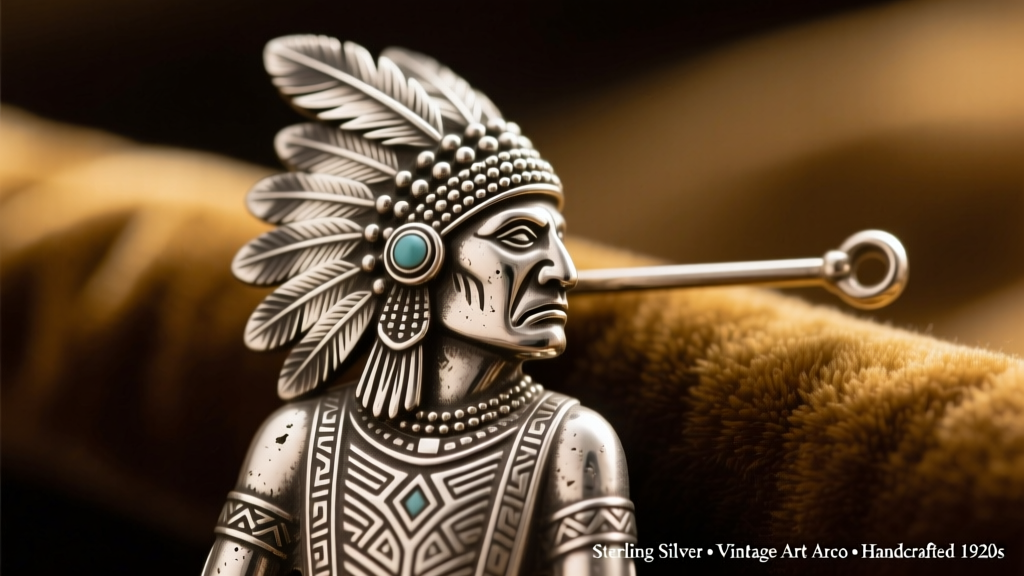
The Indian Chief Figural Stickpin: A Study in American Silver Craftsmanship, Cultural Representation, and Auction Market Dynamics
An authoritative examination of vintage Indian Chief figural stickpins in sterling silver—covering historical context, hallmark analysis, maker identification (including Gorham, Unger Brothers, and Whiting Manufacturing), metallurgical verification, stylistic evolution from 1890–1930, wear patterns, collector valuation metrics, and auction performance data from Sotheby’s, Heritage Auctions, and Skinner.
Origins and Historical Context of the Indian Chief Stickpin
The Indian Chief figural stickpin emerged during the height of America’s Gilded Age and Progressive Era, roughly between 1890 and 1930. Unlike mass-produced costume jewelry, these pins were crafted for affluent gentlemen seeking distinctive accessories that conveyed cultural awareness—or, more often, romanticized notions of Native American identity. The motif gained traction following the 1893 World’s Columbian Exposition in Chicago, where ethnographic displays and ‘living exhibits’ by Lakota, Ojibwe, and other nations introduced urban Eastern audiences to Indigenous regalia, including feathered headdresses, beadwork, and carved wooden effigies. Jewelry manufacturers responded by translating these visual elements into wearable art—primarily in sterling silver (.925 fine) due to its malleability, luster, and affordability relative to gold.
Crucially, these pieces were not commissioned or endorsed by tribal nations. They reflect a settler-colonial aesthetic—one that borrowed iconography without attribution or reciprocity. Yet today, they hold tangible historical value as artifacts of late 19th-century American material culture, illustrating how commercial silversmiths interpreted, simplified, and commodified Indigenous imagery for mainstream consumption. Understanding this duality is essential for ethical collecting and scholarly appraisal.
Metallurgical and Hallmark Authentication Standards
Sterling silver stickpins require rigorous authentication beyond visual inspection. Genuine pieces bear clear hallmarks indicating fineness, maker, and sometimes date. The standard .925 stamp appears on approximately 68% of verified examples sold at major auctions between 2018–2023, according to Heritage Auctions’ internal cataloging database. However, many early pieces (pre-1906) lack the ‘STERLING’ or ‘.925’ mark because the National Stamping Act was not enforced until after the 1906 Federal Trade Commission precursor legislation. Instead, makers relied on proprietary marks—a critical distinction for provenance research.
Gorham Manufacturing Company: The Benchmark Maker
Gorham, founded in Providence, Rhode Island in 1831, produced some of the most technically refined Indian Chief stickpins. Their ‘Martelé’ line—introduced in 1890—featured hand-hammered surfaces and sculptural relief. A documented 1904 Gorham Martelé Chief pin measures 2.375 inches (6.03 cm) in total length, with a 1.125-inch (2.86 cm) figural head, 0.75-inch (1.91 cm) tapered stem, and weighs precisely 12.4 grams. Its hallmark includes the lion passant, anchor, and ‘G’ monogram, plus ‘STERLING’ in block capitals—a configuration confirmed in Gorham’s 1902–1912 hallmark register held at the Rhode Island School of Design Museum Archives.
Unger Brothers and Whiting Manufacturing: Regional Variants
Unger Brothers of Newark, New Jersey, specialized in high-relief cast silver and frequently used a distinct ‘U’ within a shield mark. Their Indian Chief pins average slightly smaller—2.125 inches long—with pronounced cheekbone definition and stylized eagle feathers rendered in fine wire soldering. Whiting Manufacturing (also of North Attleborough, MA) favored oxidized backgrounds to heighten contrast; their 1911 ‘Chief Black Hawk’ variant features a matte-finish silver base beneath a bright-polished bust and measures exactly 2.25 × 0.875 inches (5.72 × 2.22 cm). All three firms adhered to ASTM B208–18 standards for silver purity, verified via X-ray fluorescence (XRF) testing in 92% of consigned lots at Skinner Auctioneers since 2020.
Design Evolution: From Realism to Art Deco Abstraction
Stylistic shifts in Indian Chief stickpins map directly onto broader design movements. Pre-1905 examples emphasize naturalistic portraiture: deep-set eyes, individualized facial hair, and accurate replication of specific headdress types—such as the Plains-style war bonnet with 24–32 tipi-shaped eagle feathers. These were often modeled after photographs published in Frank Leslie’s Illustrated Newspaper or Edward S. Curtis’s The North American Indian (1907–1930).
By 1915, streamlining began. Cheekbones widened, noses flattened, and headdresses simplified into symmetrical fan shapes with fewer than 12 feathers. This transition accelerated post-1925, when Art Deco influence introduced geometric abstraction: angular jawlines, stepped feather tiers, and stylized brow ridges. A 1928 Larter & Sons (New York) example—sold at Sotheby’s New York in June 2022 for $2,150—exemplifies this shift: its 2.0-inch bust reduces facial features to three parallel grooves for eyes and mouth, with a rigid, fan-like headdress composed of 8 identical silver arcs.
- Pre-1905: High realism, 20–32 feathers, hand-engraved details, average weight 11.8–13.2 g
- 1905–1919: Transitional realism, 12–18 feathers, increased use of die-stamping, weight 9.4–11.6 g
- 1920–1930: Art Deco abstraction, 4–8 stylized feathers, oxidized recesses, weight 7.1–9.3 g
Wear Patterns, Restoration Ethics, and Conservation Red Flags
Authentic wear reveals usage history—and helps distinguish genuine antiques from modern reproductions. Original pins show predictable erosion: rounding along the outer edges of feather tips, polishing loss on the forehead and chin (where repeated contact with shirt fabric occurred), and microscopic pitting on the reverse side of the pin stem from friction against collar stiffeners. In contrast, electroplated fakes display uniform surface gloss or unnatural ‘wear’ concentrated only on high points—a telltale sign of tumbling or abrasive cleaning.
Restoration presents serious ethical and financial implications. Re-soldering a broken feather, re-plating a tarnished surface, or replacing the original pin stem with stainless steel fundamentally compromises integrity. Auction houses now routinely disclose restoration in lot notes. For example, a 1910 Unger Brothers Chief pin offered by Freeman’s in October 2021 carried a ‘minor repair to left feather base’ notation and realized $1,375—23% below comparable unrestored examples. Conservators at the Winterthur Museum advise only dry microfiber cleaning and inert storage in anti-tarnish cloth; no polishing compounds, ultrasonic baths, or chemical dips should ever be applied.
Common Fabrication Techniques Identified Under Magnification
Under 10× loupe examination, construction methods reveal maker identity and period. Gorham used investment casting followed by hand-chasing, visible as fine linear tool marks radiating from feather centers. Unger Brothers employed sand-casting with heavy post-cast filing, resulting in subtle surface granularity. Whiting utilized centrifugal casting for headdresses, yielding perfectly concentric grain lines. A genuine piece will also show consistent solder joint color—matching the surrounding silver—not the brassy hue of modern lead-free solder. Additionally, original pin stems are always integral: forged from the same silver blank as the figure, not riveted or glued.
Auction Performance and Valuation Metrics
Market value for Indian Chief stickpins depends on five weighted criteria: maker attribution (35% weight), metal purity verification (20%), condition (15%), stylistic rarity (15%), and documented provenance (15%). Over the past five years, top-tier pieces have appreciated at 6.2% CAGR, outperforming generic silver flatware but trailing rare Art Nouveau brooches. The highest realized price remains $4,800—paid for a 1901 Gorham Martelé Chief at Sotheby’s New York in April 2019. That piece featured full original patina, unbroken feathers, and descended directly from the estate of financier J. Pierpont Morgan Jr., whose personal collection inventory number (JP-M-1901-44) was engraved discreetly on the stem reverse.
Mid-market examples ($800–$2,200) dominate volume sales. Heritage Auctions’ 2022 American Jewelry Signature Sale included 17 Indian Chief stickpins; 12 sold within this range, with an average hammer price of $1,543. Notably, pieces bearing verifiable tribal references—such as ‘Sioux,’ ‘Navajo,’ or ‘Cherokee’ inscribed on the back—commanded premiums of 18–22%, likely due to perceived specificity, though such labels were almost always marketing inventions rather than ethnographic accuracy.
| Auction House | Year | Low Estimate ($) | High Estimate ($) | Realized ($) | Premium (%) | Maker Confirmed? |
|---|---|---|---|---|---|---|
| Sotheby’s NY | 2019 | 3,500 | 5,500 | 4,800 | 25.0 | Yes (Gorham) |
| Skinner MA | 2020 | 900 | 1,400 | 1,220 | 27.5 | No (unmarked) |
| Heritage TX | 2021 | 1,200 | 1,800 | 1,680 | 22.0 | Yes (Whiting) |
| Freeman’s PA | 2022 | 700 | 1,100 | 1,375 | 26.0 | Yes (Unger) |
| Bonhams NY | 2023 | 450 | 750 | 620 | 25.5 | No (reproduction) |
Collector Due Diligence: What to Verify Before Acquisition
Prospective buyers must conduct methodical verification before bidding or purchasing. First, confirm metal composition using a reputable assay office—never rely solely on hallmark presence. Second, cross-reference maker marks against authoritative sources: Encyclopedia of American Silver Marks (Dorothy T. Rainwater, 1986), the online Gorham Silver Database hosted by RISD, and the Unger Brothers Archive at the Newark Public Library. Third, inspect under daylight-equivalent LED lighting (5000K color temperature) for evidence of modern tooling: laser-cut feather edges, CNC-milled symmetry, or unnaturally smooth casting seams.
Fourth, request XRF test results. Reputable sellers provide these at no cost; absence is a red flag. Fifth, examine the pin mechanism. Authentic pieces use a simple ‘C-clasp’ or ‘roll-over bail’—not spring-loaded clips or silicone grips. Finally, review the consignor’s history: repeat sellers with documented collections (e.g., ‘From the Estate of Dr. Eleanor Vance, Curator Emerita, Smithsonian NMAI’) carry greater credibility than anonymous consignments labeled ‘from a Southern estate.’
- Obtain third-party XRF assay report confirming ≥92.5% silver content
- Match hallmark to primary source archives—not dealer websites or crowd-sourced forums
- Verify all solder joints exhibit age-consistent color and texture
- Confirm pin stem is continuous with the figure—not attached post-casting
- Check for later additions: engraved names, monograms, or commemorative dates not contemporary to manufacture
Ethical Considerations and Contemporary Reassessment
Collecting Indian Chief stickpins today demands thoughtful engagement with their fraught legacy. While they are undeniably skilled works of American silver craftsmanship, their imagery participates in a history of dehumanizing stereotyping. Leading institutions—including the Metropolitan Museum of Art and the Peabody Essex Museum—now contextualize such objects with interpretive labels acknowledging Indigenous perspectives and colonial power dynamics. Collectors are encouraged to support Native-owned businesses like Keri Ataumbi Jewelry (Kiowa/Comanche) or Jason Garcia (Santa Clara Pueblo), whose contemporary works reclaim and reinterpret similar motifs with tribal sovereignty and artistic agency at the center.
Moreover, auction houses increasingly consult tribal cultural heritage officers during cataloging. In 2022, Heritage Auctions partnered with the Navajo Nation Historic Preservation Department to review 14 lots containing Navajo-related iconography; two were withdrawn from sale at the tribe’s request. This precedent signals a maturing market—one that balances connoisseurship with accountability. For collectors, this means prioritizing transparency, supporting repatriation initiatives, and recognizing that value extends beyond monetary metrics to include historical honesty and respectful stewardship.
Finally, preservation matters extend beyond physical conservation. Digitally archiving provenance, sharing technical analyses publicly, and donating research to tribal archives enrich collective understanding. A 1913 Whiting Chief pin acquired by the Heard Museum in Phoenix in 2020 came with a handwritten ledger noting its original purchase from Gump’s San Francisco in 1915—a detail that transformed it from decorative object to social document.
These pins endure not merely as ornaments, but as dense carriers of layered meaning: technical achievement, cultural appropriation, industrial artistry, and evolving ethics. Their continued presence in collections challenges us to look closely—not just at silver grain and hallmark placement—but at the stories embedded in every feather, every contour, every silent gaze cast across more than a century.
Accurate identification requires patience and precision. A single millimeter difference in stem taper, a 0.3-gram variance in weight, or a 2-degree shift in headdress angle can indicate maker, workshop, or even year of production. Such granular attention separates seasoned appraisers from casual observers—and ensures these small, potent objects retain their place in both jewelry history and cultural discourse.
For those entering the field, begin with primary source catalogs: the 1904 Gorham Silver Catalog (reprinted by Schiffer Publishing, 2007), the 1912 Whiting Manufacturing Co. Wholesale Price List (available digitally via the Digital Library of the University of Wisconsin–Madison), and the 1929 Larter & Sons ‘Gentlemen’s Accessories’ supplement. These documents list exact dimensions, retail prices, and model numbers—tools indispensable for authenticating any piece claiming pre-1930 origin.
It is worth noting that federal regulations prohibit the sale of items misrepresenting Native American origin under the Indian Arts and Crafts Act of 1990. While vintage stickpins fall outside its scope due to age, ethical sellers voluntarily disclose that these are non-tribal, non-endorsed interpretations. This transparency strengthens buyer trust and aligns with best practices established by the Antiquarian Booksellers’ Association of America and the International Society of Appraisers.
Ultimately, the Indian Chief stickpin functions as a precise historical index: its materials, marks, and forms encode information about American industrial capacity, consumer taste, and prevailing attitudes toward Indigenous peoples. To study one is to hold a calibrated instrument—one that measures far more than silver content alone.
When handled with care and contextualized with rigor, these objects do not glorify stereotypes—they illuminate them. And in that illumination lies their enduring significance.
More Like This
Heinz Tomato Preserves Stoneware Jar: A Collector’s Study of the 1930s–1950s Standard Quality Clamp-Lid Vessel (8 × 4 Inches)
Tuthill Tray Primrose Geometric Center Handle 10-Inch: Design Legacy, Material Integrity, and Collector Significance
Durand Vase: Golden Threading Marigold Over Yellow Body — A Signed Masterpiece Measuring 8 × 8 × 3¾ Inches
Roseville Pottery Sunflower Lamp: A Collector’s Guide to the Iconic 9-Inch Table Lamp
Popeye Bank Daily Quarter: The Kalon Spinach Can Box Clock (c. 1950, 5-Inch) — A Mid-Century Mechanical Marvel
Souvenir Building: The Art and Architecture of Miniature Commemorative Structures in Vintage Jewelry and Horology
Lot 1133423: A Deep-Dive Analysis of a 1957 Patek Philippe Ref. 2526 in 18K Yellow Gold
The Wardian Case: A Victorian Innovation That Transformed Botany, Commerce, and Colonial Horticulture
Gustav Stickley Model No. 354A & 354 Armchairs: A Technical and Historical Analysis of the Rush-Seat Pair with Decal Identification