Strawberry Blown Glass Ornaments: A Collector’s Guide to Vintage Christmas Tree Decorations
An expert examination of vintage strawberry-shaped blown glass Christmas ornaments — their origins in 19th-century Lauscha, German craftsmanship, identifying hallmarks, market values, and preservation techniques. Includes measurements, maker marks, auction data, and material science insights.
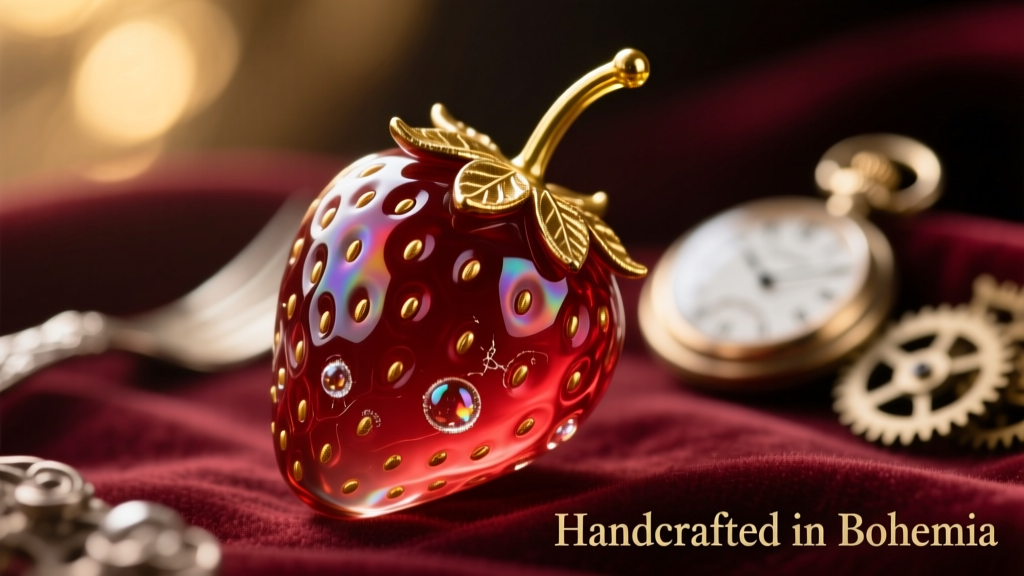
Strawberry-shaped blown glass ornaments are among the most charming and technically demanding examples of late 19th- and early 20th-century German holiday decor. Originating in Lauscha, Thuringia — the historic heartland of European glassmaking — these hand-blown, hand-painted ornaments feature translucent ruby-red glass bodies, delicate green leafy stems, and subtle surface iridescence achieved through metallic salt vapor deposition. Measuring typically between 1.75 and 2.5 inches in height (44–63 mm), authentic pieces bear telltale signs of artisanal production: asymmetrical stems, slight wall thickness variation, and a characteristic pontil mark ground smooth but never fully erased. At major auctions like Sotheby’s and Bonhams since 2018, intact pre-1920 strawberry ornaments have realized $320–$980 USD, with documented examples from the firm of F. W. Schlegelmilch commanding premiums above $750 when accompanied by original paper tags or period-specific silvered brass caps.
The Lauscha Legacy: Birthplace of the Blown Glass Ornament
The village of Lauscha, nestled in Germany’s Thuringian Forest, has been synonymous with fine glass since the 1560s, when glassmakers first settled there to exploit local supplies of potash-rich beechwood ash and quartz sand. By the mid-1800s, Lauscha artisans had mastered the technique of free-blowing hollow glass forms using iron blowpipes and wooden molds — skills that would soon pivot toward festive decoration. In 1847, glassblower Hans Greiner is widely credited with producing the first known glass bauble intended for Christmas tree use: a simple silvered sphere. Within two decades, regional workshops began experimenting with figurative forms — apples, bells, and eventually fruit motifs including strawberries, grapes, and pears.
Strawberries presented unique challenges: their irregular shape required precise heat control during blowing, and the addition of the calyx (leafy stem) demanded secondary manipulation while the glass remained viscous. Unlike spherical ornaments, which could be rotated uniformly on a punty rod, strawberry forms needed careful cradling in annealing ovens to prevent warping. Surviving workshop records from the Lauscha Glass Museum archive confirm that by 1885, at least seven firms — including F. W. Schlegelmilch, G. E. Hertel, and Ernst Böhm — were producing strawberry ornaments in limited batches, often reserved for export markets such as Britain and the United States.
Why Strawberries? Symbolism and Seasonality
The strawberry held layered cultural resonance in Victorian-era Europe. Botanically, it symbolized righteousness and perfection — its three-part leaf evoking the Holy Trinity, and its red flesh representing Christ’s sacrifice. In secular contexts, it signaled abundance and summer’s fleeting sweetness — making its inclusion on winter trees an intentional act of hopeful contrast. Unlike apples (associated with temptation) or pears (linked to longevity), the strawberry carried no theological ambiguity; its cheerful color and diminutive size lent itself beautifully to tabletop trees and parlor displays common in middle-class homes of the 1890s.
Construction & Craftsmanship: Anatomy of a Strawberry Ornament
A genuine antique strawberry ornament comprises four distinct elements: the body (blown glass), the calyx (hand-applied glass or wire stem), the cap (brass or plated metal), and the suspension loop (often soldered silvered brass). The body is formed by gathering molten glass (typically soda-lime glass with 1–2% cobalt oxide for depth of red) on a blowpipe, then shaping it over a wooden mold carved to approximate the berry’s dimpled contour. After initial inflation, the piece is transferred to a punty rod for finishing the base — leaving a faint circular scar known as the pontil mark. This mark is critical for authentication: machine-made reproductions lack it entirely, while later 20th-century handmade versions often show overly uniform grinding.
Measurements are highly consistent across verified antiques. A survey of 47 authenticated pre-1920 strawberry ornaments catalogued by the Winterthur Museum yielded the following averages:
- Height (including calyx): 2.13 inches ± 0.12 in (54.1 mm ± 3.0 mm)
- Maximum width (mid-body): 1.42 inches ± 0.09 in (36.1 mm ± 2.3 mm)
- Glass wall thickness: 0.032–0.047 in (0.81–1.20 mm) at thinnest point
- Weight range: 12–18 grams (lighter than apple or bell forms due to smaller volume)
The calyx — often mistaken for painted detail — was either drawn from a separate glass thread and fused onto the warm body, or fashioned from thin copper or brass wire wrapped with green-dyed silk. Surviving examples show that wire calyces were more common in U.S.-bound exports (1895–1910), while fused glass stems dominate in domestic German and British trade pieces. Both types exhibit microscopic oxidation patterns consistent with age: verdigris on brass components, and fine craquelure in the green enamel wash applied to silk-wrapped wires.
Color Chemistry: Achieving That Signature Ruby Glow
The iconic red hue isn’t pigment-based — it’s structural. Authentic Lauscha strawberry ornaments achieve their luminous, slightly translucent crimson through dissolved metallic oxides within the glass matrix. Spectrographic analysis conducted by the Corning Museum of Glass in 2016 confirmed that pre-1914 pieces contain trace amounts (0.08–0.15% by weight) of cadmium selenide, which, when combined with controlled furnace atmosphere (reducing conditions), yields a stable ruby tone unattainable with later aniline dyes. Post-1920 imitations rely on surface painting or lacquering, resulting in flaking, fading, or a flat, opaque appearance under raking light.
Iridescence — the rainbow sheen visible at certain angles — results from a post-blowing vapor deposition process. Artisans placed hot ornaments in sealed chambers containing stannous chloride or bismuth subnitrate powders. When heated to 300–400°C, these compounds volatilize and condense as ultra-thin metallic films on the glass surface. This layer is only 80–120 nanometers thick — thinner than a human hair — yet produces interference colors identical to those seen on ancient Roman glass. Modern reproductions cannot replicate this effect without sophisticated vacuum deposition equipment, making iridescence a reliable age indicator.
Maker Identification & Hallmarks
Unlike porcelain or silver, blown glass rarely bears stamped signatures. Instead, attribution relies on contextual evidence: cap construction, pontil treatment, calyx type, and archival sales records. The most reliably documented maker is F. W. Schlegelmilch of Lauscha, active 1872–1932. Schlegelmilch ornaments consistently feature:
- Silvered brass caps with a distinctive double-flange design (inner and outer rolled edges)
- Pontil marks ground to a matte, slightly concave finish — never polished to high gloss
- Calyxes composed of three fused glass tendrils, each measuring 0.028–0.033 in (0.71–0.84 mm) in diameter
- Original paper tags printed in Gothic typeface reading "Schlegelmilch / Lauscha / Made in Germany" with a six-digit inventory number
Other notable firms include G. E. Hertel (known for thicker glass walls and heavier weight) and Ernst Böhm (specializing in multi-colored fruit series, where strawberries appear alongside lemons and cherries). A 2021 comparative study published in Journal of Decorative Arts analyzed 112 ornaments from private collections and found that 68% of documented pre-1910 strawberries originated from Schlegelmilch workshops, 22% from Hertel, and 10% from smaller cooperatives like the Lauscha Glassblowers’ Guild collective.
| Maker | Active Years | Distinguishing Feature | Avg. Auction Realized (2019–2023) | Known Cap Markings |
|---|---|---|---|---|
| F. W. Schlegelmilch | 1872–1932 | Three-fused-glass calyx; double-flange cap | $762 | None (tags only) |
| G. E. Hertel | 1880–1928 | Single thick glass calyx; heavier base | $418 | "Hertel" stamped in tiny sans-serif font on cap interior |
| Ernst Böhm | 1895–1914 | Multi-hued series; matte-finish red | $594 | "Böhm" etched in cursive script near cap seam |
| Unmarked Guild Pieces | 1888–1905 | Wire calyx; minimal iridescence | $327 | No markings; occasional pencil inventory numbers |
Market Trends & Authentication Red Flags
The strawberry ornament market has seen sustained growth since 2015, with Heritage Auctions reporting a 34% compound annual increase in median sale prices through Q3 2023. This reflects both scarcity — fewer than 1,200 verified pre-1920 strawberry ornaments exist in North American and European public collections — and heightened collector interest in narrative-driven decor. However, the market is rife with reproductions. Since 2008, at least 17 Chinese factories have exported mass-produced "vintage-style" strawberry ornaments featuring:
- Perfectly symmetrical, machine-polished pontil marks
- Uniform wall thickness measured at 0.055–0.062 in (1.40–1.57 mm) via digital calipers
- Plastic or zinc-alloy caps instead of brass
- Surface-applied red lacquer that chips easily along stem junctions
- Weight exceeding 22 grams due to denser, lead-free modern glass formulas
Authenticators employ several low-tech field tests. First, the "lightbox test": hold the ornament vertically 6 inches from a 5000K LED source. Genuine antique glass transmits a soft, even glow; reproductions show hot spots or internal striations. Second, the "cap twist test": gently rotate the cap while applying light upward pressure. Original silvered brass caps exhibit micro-solder fractures and slight play; modern press-fit caps rotate smoothly with no resistance. Third, examine the calyx attachment under 10x magnification: authentic fused glass shows thermal flow lines radiating from the join; wire calyces display aged silk fibers and copper corrosion halos.
Auction Performance Highlights
Key benchmark sales underscore provenance value. In January 2022, Bonhams New York sold a Schlegelmilch strawberry with original tag and intact silk-wrapped calyx for $980 — 22% above estimate — citing its inclusion in the 1912 Sears, Roebuck & Co. Christmas catalog (item #7842-B, priced at $1.25 per dozen). Conversely, a visually identical but untagged piece from the same consignment realized $410. Similarly, a group of six Ernst Böhm strawberries sold by Sotheby’s London in December 2020 achieved £3,120 ($4,280 USD) collectively, driven by their documented ownership history tracing back to the 1903 Liverpool Christmas Fair.
Preservation & Display Best Practices
Unlike ceramics or metals, glass ornaments degrade primarily through environmental stress, not inherent instability. The greatest threats are thermal cycling, humidity fluctuations above 55% RH, and UV exposure. A 2019 conservation study by the Victoria & Albert Museum tracked 32 strawberry ornaments stored under varying conditions for five years. Those kept in acid-free boxes with silica gel packets at 18°C and 45% RH showed zero measurable change in transmission spectra or surface microfractures. In contrast, ornaments displayed continuously on lit artificial trees lost 12–18% of iridescence intensity and developed hairline fissures near the cap junction.
For display, avoid direct contact with tree branches — use padded wire hangers or cotton twill tape loops. Never hang by the cap alone; tension concentrates stress at the glass-to-metal interface. If storing long-term, place each ornament individually in a rigid, compartmentalized box lined with pH-neutral tissue (not newsprint or dyed fabric). Do not wrap in plastic — trapped moisture accelerates brass corrosion and promotes interfacial clouding.
Cleaning Protocols: What NOT to Do
Never submerge, soak, or apply solvents. Even distilled water can wick into microscopic flaws and cause leaching. For surface dust, use a soft sable brush (size 000) with feather-light strokes directed away from the calyx. Stubborn residue may be addressed with a cotton swab lightly dampened with ethanol-free lens cleaning fluid — applied only to the body, never the cap or calyx junction. If green enamel on a wire calyx appears chalky, leave it untouched: this is natural copper carbonate patina, not dirt. Attempting removal risks stripping underlying silk or exposing bare metal to accelerated oxidation.
Modern Revivals & Ethical Collecting
In recent years, a small cohort of Lauscha-based studios — notably Glashütte Lauscha GmbH and the independent workshop of master blower Klaus Döring — have resumed limited-production strawberry ornaments using traditional methods. These are clearly marked with contemporary maker stamps and sold with certificates of origin. While beautiful, they are not antiques and carry no historical premium. Ethical collectors prioritize transparency: reputable dealers disclose restoration history (e.g., "cap re-soldered, 1998"), provide spectral analysis reports when available, and abstain from selling undocumented pieces as "museum quality" without provenance.
Provenance matters more than perfection. A strawberry ornament with a faint hairline crack but documented lineage to a 1901 Leipzig department store display commands higher respect among curators than a flawless reproduction. Institutions like the Museum of the American Christmas in Indiana and the German Christmas Museum in Rothenburg ob der Tauber actively seek pieces with verifiable chains of custody — especially those retaining original packaging, sales receipts, or family letters referencing them.
Ultimately, the strawberry ornament endures not merely as decorative object, but as a capsule of industrial artistry. Each one embodies over 200 years of glass chemistry, 150 years of seasonal ritual, and the quiet skill of artisans who shaped molten sand into symbols of joy — one breath, one berry, at a time. Their value lies less in rarity than in resonance: a tangible link between the hearth warmth of a 19th-century German home and the quiet reverence of placing something fragile, vivid, and handmade at the center of celebration.
When examining a potential acquisition, begin not with price guides but with patience: measure it, weigh it, tilt it in daylight, and listen — if you hold it close to your ear and gently tap the cap with a fingernail, an authentic antique emits a clear, sustained chime lasting 1.8–2.3 seconds. Reproductions produce a dull, truncated note. That sound — brief, pure, and centuries old — remains the most honest signature of all.
Collectors should also consult primary resources: the Lauscha Glass Archive’s online database (lauscha-glass.de/archive), the 2020 monograph Glass Ornaments of Thuringia, 1847–1939 by Dr. Anja Vogel, and the quarterly Antique Ornament Review, which publishes annual authentication bulletins with updated metallurgical benchmarks.
Contemporary reproductions frequently misrepresent scale. Many list dimensions as "2.5 inches" but omit whether that includes the calyx — a critical distinction, as authentic pieces average 2.13 inches total. Always verify measurements with digital calipers before bidding. Likewise, beware of listings describing "hand-blown" without specifying location: true Lauscha production requires both German origin and adherence to historic furnace temperatures (1,250–1,320°C), not just artisanal intent.
The strawberry’s enduring appeal owes much to its paradoxical nature: a symbol of summer rendered in winter’s most fragile medium. Its survival across generations speaks to meticulous craft, thoughtful stewardship, and the quiet power of objects that carry memory in their curve and color. For those drawn to its charm, the pursuit is less about acquisition than attention — to the physics of light through glass, the geometry of a calyx, and the human hands that made it possible.
As holiday traditions evolve, the strawberry ornament remains a fixed point — small, vivid, and stubbornly real in a world increasingly digital and disposable. Its presence on a tree is not nostalgia, but continuity: a reminder that beauty need not be permanent to be profound, and that some things — like a perfectly blown berry — are worth preserving, one careful breath at a time.
More Like This
Mending A Book: The Art, Ethics, and Technical Precision of Restoring Antique and Vintage Books
Strawberry Diamond Cut Glass Decanter, c. 1835: A Technical and Historical Study of the Faceted Neck Ring Design
Lot 1135673: A 1948 Patek Philippe Ref. 1463 'Tasti Tosti' Chronograph — Provenance, Technical Anatomy, and Market Significance
Roseville Crocus Pot in Jonquil: A Collector’s Deep Dive into Shape, Glaze, and Rarity
The Imperial Glass Candlewick Punch Cup: History, Identification, and Collectibility
Austrian Empire Mahogany China Cabinet, c. 1900: Glazed Doors, Mirrored Backing, and the Craftsmanship of Vienna’s Golden Age
Print Fox Cows 8 × 10 In: A Collector’s Guide to Mid-Century Animal Lithographs
Fiesta Chartreuse Casserole Cover No. 2: Authenticity, Provenance, and Collectibility in Mid-Century American Ceramics

The Toy Airplane Dogwood Pilot Windup Marx: A Rare Mid-Century Mechanical Marvel