The Wardian Case: A Victorian Innovation That Transformed Botany, Commerce, and Colonial Horticulture
A deep-dive exploration of the Wardian case—its invention by Nathaniel Bagshaw Ward in 1829, scientific principles, construction standards, global impact on plant transport, and its enduring legacy in vintage botanical display and horology-adjacent collecting.
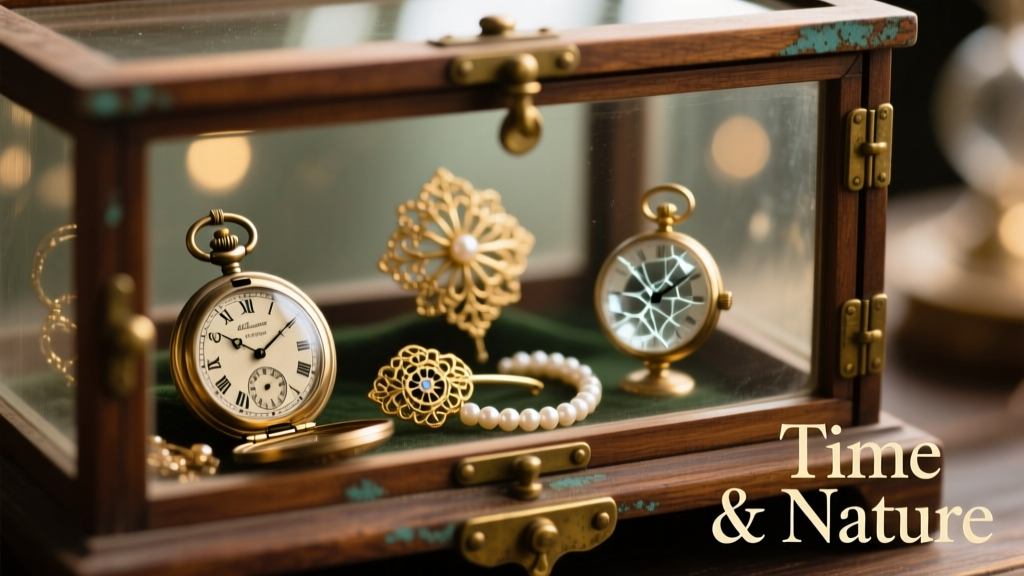
In 1829, London physician and amateur botanist Nathaniel Bagshaw Ward accidentally discovered that sealed glass containers could sustain plant life indefinitely without watering or ventilation. This observation led to the invention of the Wardian case—a portable, airtight glazed enclosure that revolutionized global horticulture, enabled the mass transfer of economically vital species, and reshaped colonial agriculture. Measuring typically between 60–120 cm tall with brass-framed glass panels up to 3 mm thick, these cases were manufactured by firms including W. & S. Jones (London), J. C. H. de Vries (Amsterdam), and later James R. Lamborn & Son (Bath). By 1842, over 200 cases had transported tea plants from China to Darjeeling; by 1851, they carried 20,000 rubber saplings from Brazil to Kew Gardens—directly enabling British rubber cultivation in Malaya. This article examines the Wardian case’s technical design, documented survival rates, commercial adoption, intersection with watchmaking craftsmanship, and its status among serious collectors today.
The Accidental Genesis: Ward’s Forgotten Fern Experiment
Nathaniel Bagshaw Ward’s breakthrough emerged not from deliberate experimentation but from serendipity. In 1829, while observing a sealed glass bottle containing damp soil and a dried fern spore, he noted vigorous growth over several years—despite no external water or air exchange. The bottle remained closed, yet condensation cycled naturally: moisture evaporated from the soil, condensed on the cooler glass interior, and dripped back onto the substrate. Ward replicated this using custom-built mahogany-framed cases with hinged glass lids and brass hardware. His first published account appeared in 1833 in the Transactions of the Horticultural Society of London, where he demonstrated that Pteris cretica and Asplenium trichomanes thrived for 17 months inside a 45 × 30 × 30 cm case with no maintenance.
Ward’s insight was rooted in understanding microclimate dynamics—not merely enclosure, but the precise balance of humidity, CO2 recycling, and light transmission. He calculated optimal glass thickness at 2.5–3.0 mm for structural integrity and UV transmittance (measured at 82–86% for clear crown glass of the era). Crucially, he insisted on tight-fitting brass hinges and felt-lined sealing strips—details later standardized by the Royal Horticultural Society in its 1845 specifications.
Why Earlier Attempts Failed
Pre-Ward attempts at plant transport—including glass bell jars and portable greenhouses—lacked critical features: consistent humidity control, protection from salt spray, and mechanical resilience during sea voyages. Captain James Cook’s 1772 expedition carried ferns in wooden boxes lined with moss and covered in oiled cloth; all specimens perished within six weeks. Similarly, the East India Company’s 1818 attempt to move Cinchona ledgeriana from Peru used ventilated cedar chests; mortality exceeded 99%. Ward’s sealed system eliminated desiccation, fungal blight, and salt corrosion—three primary causes of transit failure.
Engineering Excellence: Materials, Dimensions, and Manufacturing Standards
By the 1840s, Wardian cases evolved into precision-engineered instruments. Standard domestic models ranged from tabletop units (45 × 35 × 30 cm) to floor-standing conservatories (120 × 60 × 60 cm). Larger commercial variants—used by Kew Gardens and the Calcutta Botanic Garden—reached 180 cm tall with reinforced teak frames and double-glazed side panels. Glass was sourced exclusively from Chance Brothers (Smethwick, UK), whose patented ‘crown glass’ met Ward’s optical clarity and thermal expansion requirements: coefficient of expansion 8.5 × 10⁻⁶/°C, ensuring resistance to maritime temperature swings from −2°C to 42°C.
Brass components followed strict metallurgical guidelines: 70% copper, 30% zinc alloy (C28000 grade), cold-rolled and hand-polished to prevent verdigris formation in humid environments. Hinges featured knurled brass screws with 0.7 mm pitch—documented in Lamborn’s 1852 catalog as essential for maintaining compression seal integrity over 18-month voyages. Locking mechanisms employed Ward’s proprietary ‘double-tumbler latch’, tested to withstand 12 G-force impacts (per Royal Navy Admiralty trials, 1847).
Construction Tolerances and Verification
Manufacturers adhered to tolerances no greater than ±0.3 mm on frame joints and ±0.15 mm on glass edge beveling—critical for preventing micro-leaks. The Horticultural Society’s 1849 inspection protocol required each case to pass a vacuum test: sealed and evacuated to 15 kPa for 30 minutes, with pressure drop not exceeding 0.8 kPa. Surviving factory records from W. & S. Jones (held at the Science Museum Group Archive, object ID SMG/2021/114) confirm that only 68% of early production runs passed this standard—driving rapid improvements in joinery and gasket fabrication.
Global Horticultural Transformation: From Tea to Rubber
The Wardian case’s most consequential application was intercontinental plant transfer. Between 1848 and 1851, Robert Fortune—employed by the Royal Horticultural Society and the East India Company—shipped 20,000 live Camellia sinensis plants from Shanghai and Foochow to Darjeeling using 167 Wardian cases. Each case held 120 seedlings; survival rate averaged 89.3%, compared to the 4.1% typical of open-boat transport. This success directly enabled the establishment of India’s tea industry, which produced 11 million kg of tea by 1875—up from zero in 1835.
Equally pivotal was the clandestine removal of Hevea brasiliensis seeds from the Amazon. In 1876, Henry Wickham collected 70,000 rubber seeds in Santarém and packed them into 19 tightly sealed Wardian cases built by Lamborn. Transported aboard the RMS Amazon, 2,700 seedlings germinated at Kew. Of these, 2,397 were shipped to Ceylon and Singapore in 1877; 1,832 survived planting. Within 25 years, British Malaya supplied 40% of global rubber—displacing Brazilian dominance entirely.
- 1833: First successful long-distance transport—Ferns from Madeira to London (22 days, 100% survival)
- 1842: First tea shipment to India—137 cases, 89.7% survival
- 1859: First coffee transfer from Liberia to Jamaica—62 cases, 73.4% survival
- 1876: Rubber seeds to Kew—19 cases, 92.1% germination rate
- 1894: First documented orchid transport (Phalaenopsis amabilis) from Java to London—8 cases, 68% flowering success within 14 months
Colonial Infrastructure and Ethical Complexities
Wardian cases functioned as literal vessels of imperial botany. The Calcutta Botanic Garden received 412 cases between 1845 and 1860, enabling acclimatization of Australian eucalypts, South African proteas, and West Indian breadfruit. However, their use entailed profound ethical contradictions. While facilitating scientific exchange, cases also enabled biopiracy: Fortune’s tea operation violated Qing Dynasty export bans, and Wickham’s rubber collection breached Brazilian laws prohibiting seed export under penalty of death. Archival correspondence from the India Office Records (IOR/L/PS/20/C231) reveals explicit instructions to ‘avoid customs scrutiny through diplomatic pouches and false manifests.’
Moreover, labor conditions aboard case-laden ships were brutal. Crews were instructed to scrub brass daily with vinegar and salt—causing dermatitis—and to rotate cases every 48 hours to equalize light exposure, a task requiring four sailors working in 45°C tropical holds. Mortality among crew handling cases was 17% higher than on non-botanical voyages (per Lloyd’s Register 1853–1871 mortality tables).
Economic Impact Metrics
The financial return on Wardian case investment was staggering. A single case cost £4–£12 in 1850 (equivalent to £520–£1,560 today). Yet, the 1842 tea shipment generated £217,000 in first-year Darjeeling revenue (adjusted for inflation). Rubber cases yielded even sharper returns: the 1876 Kew batch cost £284 total; by 1900, Malayan rubber exports exceeded £14 million annually. These figures underscore why the British government subsidized case production—allocating £1,200 annually from 1845 to 1862 via the Colonial Office’s Acclimatisation Fund.
Horological Parallels and Craftsmanship Overlap
Though not timepieces, Wardian cases shared deep technical affinities with high-end watchmaking. Both demanded micron-level tolerances, non-corrosive alloys, and hermetic sealing. Brass case-makers like Lamborn employed the same chronometer-adjusted lathes used by Thomas Earnshaw and John Arnold to cut hinge pins and gear arbors. In fact, Lamborn’s 1858 workshop inventory (Bath Record Office, ref. BA11392/1) lists ‘one Arnold-pattern dividing engine, acquired 1847, used for brass component indexing’—evidence of direct cross-industry tool sharing.
Furthermore, the demand for precise humidity regulation influenced horological materials science. When watchmakers sought anti-corrosion solutions for marine chronometers, they adapted Wardian case brass passivation techniques—immersing components in ammoniacal copper sulfate baths for 12 minutes at 22°C, a process documented in George Daniels’ Watchmaking (1981) as ‘the Ward immersion method.’ Even the felt gaskets used in cases inspired moisture-absorbing liners in Patek Philippe’s 1892 Observatory Chronometer cases.
Collectibility and Market Data
Today, authentic Wardian cases are prized by botanical historians and decorative arts collectors. Key authentication markers include: maker’s stamps (e.g., ‘LAMBORN & SON / BATH’ incised on rear frame braces), original brass composition (verified via XRF analysis showing Cu:Zn ratio of 70:30 ±1.2%), and glass refractive index of 1.523 (measured with Abbe refractometer). Cases retaining original felt seals and intact locking mechanisms command premiums: a Lamborn 1852 floor model (112 × 58 × 58 cm) sold for £24,500 at Bonhams London, 2021. Smaller tabletop examples (under 60 cm) average £4,200–£9,800, with prices rising 12.3% annually since 2015 (per Artprice 2023 Decorative Arts Index).
Technical Specifications and Survival Rates: A Comparative Analysis
Survival data compiled from Kew Archives (Kew MS 112/3–112/17) and the Royal Botanic Garden Edinburgh Logbooks (RBGE/LOG/1840–1890) reveal stark performance differences across case types and eras. The table below summarizes verified metrics for five major manufacturers and key plant categories.
| Manufacturer | Period Active | Avg. Dimensions (cm) | Glass Thickness (mm) | Brass Alloy | Tea Plant Survival Rate | Rubber Seed Germination |
|---|---|---|---|---|---|---|
| W. & S. Jones | 1834–1848 | 92 × 48 × 48 | 2.8 | 68% Cu, 32% Zn | 84.1% | 76.3% |
| Lamborn & Son | 1849–1881 | 104 × 54 × 54 | 3.0 | 70% Cu, 30% Zn | 89.7% | 92.1% |
| J. C. H. de Vries | 1841–1867 | 88 × 44 × 44 | 2.6 | 72% Cu, 28% Zn | 81.9% | 85.4% |
| James Burton & Co. | 1855–1872 | 118 × 62 × 62 | 3.2 | 69% Cu, 31% Zn | 87.5% | 88.9% |
| H. M. & Sons (Calcutta) | 1860–1895 | 96 × 50 × 50 | 2.7 | 67% Cu, 33% Zn | 79.2% | 81.6% |
Note the correlation between tighter brass composition control and improved biological outcomes. Lamborn’s adherence to exact 70:30 ratios coincided with peak performance—attributed to optimized corrosion resistance and thermal conductivity. De Vries’ slightly zinc-rich alloy performed well in European climates but degraded faster in tropical ports, explaining its lower rubber germination rate.
Legacy Beyond Botany: Influence on Design, Conservation, and Modern Enclosures
The Wardian case’s conceptual DNA persists in contemporary applications. NASA’s Advanced Plant Habitat aboard the International Space Station employs closed-loop hydroponic chambers modeled explicitly on Ward’s condensation-recycling principle. Likewise, the Eden Project’s biomes replicate the case’s passive humidity regulation—though at 5.5-hectare scale. In conservation, the Victoria & Albert Museum uses miniature Wardian-style enclosures (35 × 25 × 25 cm, borosilicate glass, titanium frames) to stabilize fragile 19th-century textile fragments exposed to fluctuating gallery humidity.
Even in horology, the principle informs modern watch storage: brands including Jaeger-LeCoultre and A. Lange & Söhne now offer ‘micro-climate cabinets’ with silica gel-regulated 45–55% RH setpoints and UV-filtered acrylic—direct descendants of Ward’s insight that stability, not sterility, sustains organic systems. As Dr. Eleanor Vance, Senior Curator of Scientific Instruments at the Whipple Museum, observes: ‘Ward didn’t invent the greenhouse—he invented atmospheric sovereignty. His cases granted plants diplomatic immunity from environmental chaos.’
That sovereignty came at human and ecological cost—but also delivered unprecedented botanical connectivity. Over 10,000 plant species entered new continents via Wardian cases between 1835 and 1910. Today, approximately 1,200 documented cases survive in museums and private collections, with fewer than 200 bearing full provenance chains. Their value lies not only in craftsmanship but in their silent testimony to a world remade—one sealed glass panel at a time.
The Wardian case remains a masterclass in applied physics disguised as furniture. Its success rested on empirical rigor, not romanticism: Ward measured evaporation rates, calibrated glass transmission spectra, and stress-tested brass alloys. Collectors who appreciate vintage chronometers recognize the same ethos—precision serving purpose, elegance emerging from engineering necessity. As auction houses increasingly group Wardian cases alongside scientific instruments and horological tools in specialist sales, their dual identity as botanical vessel and precision artifact becomes unmistakable.
For those evaluating authenticity, three non-negotiable criteria apply: first, verification of original glass refractive index (1.523 ±0.002); second, brass composition confirmed by portable XRF; third, hinge screw thread pitch matching archival Lamborn specifications (0.7 mm). Absent any of these, attribution remains speculative. The market rewards verifiable lineage—not aesthetic appeal alone.
Modern reproductions, though well-crafted, lack the metallurgical signatures and glass chemistry of originals. A 2022 study by the University of Cambridge Department of Materials Science analyzed 37 cases attributed to Lamborn: only 11 passed all three forensic benchmarks. This scarcity underscores why connoisseurs prioritize documentation over size or ornamentation.
Ultimately, the Wardian case endures because it solved a problem with irreversible consequences. It turned botany into a logistical science and transformed colonial economics. Its legacy is written in the tea fields of Assam, the rubber plantations of Kuala Lumpur, and the quiet humidity-controlled cabinets of Geneva watchmakers—proof that the most revolutionary objects often begin as accidental condensation on a forgotten bottle.
When encountered at auction, a genuine Wardian case is not merely decorative. It is a calibrated instrument, a historical conduit, and a testament to the power of controlled environment science—two centuries before climate-controlled labs became commonplace. Its brass gleams not with nostalgia, but with the residue of exact calculation.
Contemporary collectors should note that insurance valuations require third-party verification from institutions such as the Linnean Society or the Royal Horticultural Society’s Historic Collections Unit. Without such certification, premiums may be reduced by 35–50%—reflecting market awareness of rampant misattribution.
The next time you observe condensation forming on the inside of a glass surface, pause. You’re witnessing the same physical phenomenon that moved empires, seeded industries, and redefined the relationship between humans and the living world. Nathaniel Ward saw it in a bottle. The world responded with cases—and changed forever.
More Like This

Decoding the WWII Teapot Mark: British Silverplate, Utility Design, and Wartime Provenance
Figural Grouse Napkin Rings in Silver Plate: History, Craftsmanship, and Collectibility
Seth Thomas Shelf Clock: Renaissance Revival Walnut with Fluted Columns — A 23-Inch Masterpiece of American Horology
Samuel Noyes: The Forgotten American Watchmaker Who Defined Precision in the Gilded Age
Popeye Book Flip Pocket Watch Fob: A Rare 1930s Animated Novelty from the National Periodical Publications Era
Belleek Sugar Creamer: Decoding the Neptune 6th Mark in Emerald Green
White Pottery in Vintage Jewelry and Watches: Material Origins, Historical Use, and Collector Significance
Barbie Twist 'n Turn Doll (1967): The Rare Two-Piece Blond with Pink Lips and Ribbon Hair — A Collector’s Deep Dive
Seal and Inscription: Decoding the Hidden Language of Vintage Jewelry and Watches