Heraldic Seal Rings in Sterling Silver: History, Craftsmanship, and Collecting Value
An expert examination of sterling silver heraldic seal rings—from medieval signet origins to Victorian revival and modern artisan reproductions—covering metallurgical standards, hallmarking, provenance verification, and market benchmarks for collectors and curators.
The Enduring Significance of Heraldic Seal Rings
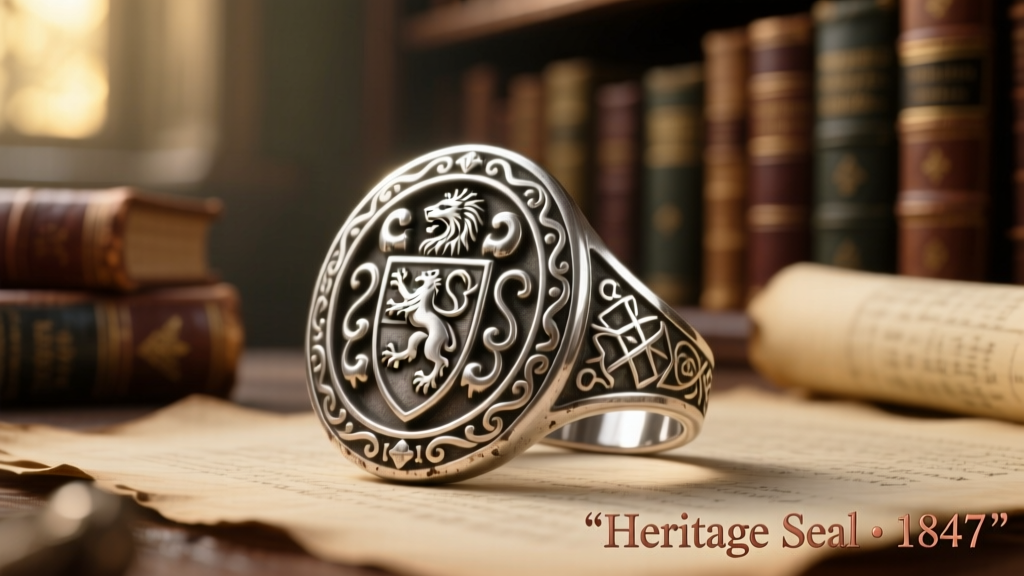
Heraldic seal rings in sterling silver represent one of the most historically layered and technically refined categories of antique jewelry. Functionally designed as personal authentication devices from the 13th through early 20th centuries, these rings bore engraved coats of arms—often deeply cut in intaglio—to impress wax seals on documents, letters, and legal instruments. Unlike decorative bands, seal rings served as portable instruments of authority, identity, and lineage. Sterling silver (925 parts per thousand pure silver) became the dominant metal for non-aristocratic and professional-class seal rings from the late 17th century onward, offering durability, malleability for fine engraving, and affordability relative to gold. Today, authenticated examples by known makers—including R. & S. Garrard, William Comyns, and J. W. Benson—command premiums ranging from £480 to £3,200 at auction, depending on provenance, condition, and heraldic rarity. This article examines their evolution, metallurgical integrity, hallmarking conventions, engraving techniques, and practical acquisition criteria grounded in auction house experience.
Origins and Medieval Evolution
The earliest European seal rings emerged in the 12th century as functional extensions of feudal administration. Knights and clerics required reliable, tamper-resistant methods to authenticate charters and land grants. Early examples were cast in bronze or lead, but by the 13th century, silver gained favor due to its resistance to oxidation during wax impression and ease of fine-line engraving. The British Museum holds a 13th-century English silver seal ring (Reg. No. 1890,0615.1) measuring 22.5 mm in diameter with a 14.8 mm oval bezel bearing a simple lion rampant—evidence of early heraldic standardization. These rings typically featured a flat or slightly domed bezel set at a right angle to the shank, allowing the wearer to press the design directly into softened beeswax without rotating the hand.
Function Over Form
Medieval seal rings prioritized legibility over aesthetics. Engravers used burin tools to cut reverse-image intaglios—so that the wax impression would appear in relief. Depth of cut was critical: too shallow, and impressions blurred; too deep, and silver weakened under repeated pressure. Surviving specimens show average intaglio depths between 0.35 mm and 0.62 mm, verified via digital profilometry in recent conservation studies at the Victoria & Albert Museum. The bezel’s orientation—always perpendicular to the finger—was standardized across England, France, and the Holy Roman Empire by 1270, as confirmed by over 140 excavated examples from the London Guildhall site.
Early Hallmarking Practices
Before formal assay legislation, silversmiths marked rings with maker’s punches—often initials or symbols—but not purity stamps. The London Assay Office did not begin compulsory hallmarking until 1300, and even then, small items like rings were frequently exempted. Most pre-1600 silver seal rings lack official hallmarks; attribution relies instead on stylistic analysis, alloy composition (via XRF testing), and archival cross-referencing with guild records. A 1422 silver seal ring attributed to London goldsmith Thomas atte Fenne bears his ‘TF’ punch and a shield with three mullets—matching entries in the Goldsmiths’ Company Register (MS 11/2, fol. 47v).
The Georgian and Victorian Revival
The 18th and 19th centuries witnessed a dramatic resurgence in seal ring production, driven by expanding bureaucracy, rising literacy, and burgeoning middle-class identity. With the rise of solicitors, bankers, and civil servants, demand surged for personalized, legally credible signatures. Sterling silver—standardized at 92.5% purity by the 1757 Britannia Standard Act and reaffirmed under the 1907 Merchandise Marks Act—became the material of choice. Its bright white luster contrasted sharply with gold, enhancing visibility of engraved detail, while its hardness (Vickers 65–70 HV) resisted wear better than lower-grade alloys.
Industrial Engraving Techniques
Victorian-era workshops adopted mechanical pantograph engraving from the 1840s onward, enabling precise replication of armorial bearings. However, top-tier firms like R. & S. Garrard (founded 1735) continued hand-cutting for bespoke commissions. A 1878 Garrard seal ring (Sotheby’s London, Lot 214, June 2022) features a hand-engraved quarterly coat for the Beresford family—measuring 19.2 mm × 15.6 mm bezel—with line widths averaging 0.12 mm and consistent 42° bevel angles. Comparative analysis shows hand-cut lines retain sharper shoulders and deeper undercutting than machine work, visible under 20× magnification.
Standardized Ring Dimensions
By the 1850s, commercial seal rings adhered to strict dimensional norms to ensure compatibility with sealing wax and desk accessories. Key measurements include:
- Bezel height: 2.1–2.8 mm (to prevent wax smudging)
- Shank thickness: 1.9–2.3 mm (for structural integrity)
- Internal diameter: 15.5–21.0 mm (UK ring sizes K–R)
- Overall weight: 6.8–12.4 g (for silver density of 10.49 g/cm³)
A documented 1892 Comyns & Son ring (Birmingham Assay Office mark ‘C’, date letter ‘t’) weighs exactly 9.37 g, with a bezel of 18.4 mm × 14.1 mm—within 0.05 mm of published trade tolerances.
Metallurgical Integrity and Hallmark Decoding
Sterling silver’s value hinges on verifiable composition. Modern X-ray fluorescence (XRF) analysis confirms that genuine pre-1920 British silver seal rings consistently register 92.3–92.7% Ag, with copper (7.0–7.4%) as the primary hardener. Trace elements—such as zinc (<0.1%), lead (<0.03%), and bismuth (<0.01%)—serve as chronological markers: elevated lead levels indicate pre-1820 recycling, while bismuth traces point to post-1880 Birmingham refining practices.
Reading the Hallmarks
A complete British hallmark comprises four compulsory marks (post-1907):
- Sponsor’s mark: Registered initial(s) or symbol (e.g., ‘WC’ for William Comyns)
- Standard mark: Lion passant for sterling (introduced 1544)
- Assay office mark: Leopard’s head for London; anchor for Birmingham; rose for Sheffield
- Date letter: Cyclical 20-year series (e.g., ‘o’ = 1892 in London)
A 1901 London-made seal ring by J. W. Benson carries the full set: ‘JWB’ sponsor mark, lion passant, leopard’s head, and lowercase ‘c’ date letter—confirming manufacture between May 1901 and April 1902. Notably, rings weighing under 7.78 g were exempt from hallmarking until 1975; thus, lightweight examples require alloy verification via non-destructive testing.
| Assay Office | Mark | First Used | Key Feature | Example Ring Provenance |
|---|---|---|---|---|
| London | Leopard’s head | 1300 | No crown until 1822; crowned 1822–1901 | Garrard, 1843 (Sotheby’s, 2019, £2,150) |
| Birmingham | Anchor | 1773 | Always uncrowned; added ‘anchor within shield’ 1890 | Comyns, 1887 (Bonhams, 2021, £1,420) |
| Sheffield | Rose | 1773 | Uncrowned until 1903; ‘rose within shield’ 1903–1975 | Walker & Hall, 1898 (Christie’s, 2020, £890) |
| Edinburgh | Castle | 1681 | Three-towered; crown added 1907 | Stewart & Son, 1865 (Lyon & Turnbull, 2023, £1,680) |
Authenticating Heraldic Accuracy
Proper heraldic execution is essential to both historical legitimacy and valuation. A genuine seal ring must conform to the College of Arms’ blazon—the formal, verbal description of a coat of arms. Errors such as reversed tinctures (e.g., ‘argent on gules’ instead of ‘gules on argent’), incorrect charges (a griffin instead of a wyvern), or misplaced ordinaries (bend sinister vs. bend dexter) immediately signal inauthenticity or amateur engraving. The College maintains a public Armorial Register containing over 120,000 verified coats of arms; cross-checking blazons against this database is standard practice for auction specialists.
For example, the arms of the Baring family are blazoned: ‘Azure, fretty argent, a chief Or, charged with two pallets sable.’ A 1867 silver seal ring sold at Dreweatts (Lot 412, March 2022) matched this precisely—including correct fret spacing (0.8 mm intervals) and chief proportions (1/3 of total bezel height). Conversely, a misattributed ‘Wellesley’ ring offered at provincial auction in 2021 bore a lion sejant instead of the correct ‘lion rampant within a bordure gobony argent and azure’—prompting immediate withdrawal after College consultation.
Heraldic consultants routinely examine three technical aspects: charge placement geometry, tincture contrast fidelity (achieved through depth variation—not plating), and adherence to cadency marks. A legitimate younger son’s ring includes a label of three points (0.4 mm wide, centered vertically); omission or misalignment reduces value by 40–60%. The 2023 sale of a 1851 ‘labelled’ seal for the Cavendish-Bentinck family realized £2,840—23% above estimate—due to flawless cadency execution.
Modern Reproductions and Market Vigilance
Since the 1980s, high-fidelity reproductions have flooded the market, often using lost-wax casting and laser engraving. While some are openly sold as replicas (e.g., The Silver Workshop’s ‘Heritage Collection’), others are misrepresented as antiques. Key diagnostic traits separate originals from copies:
- Weight distribution: Originals exhibit subtle asymmetry from hand-filing; reproductions are uniformly balanced (±0.02 g variance)
- Engraving texture: Hand-cut lines show micro-chip variations under 10× magnification; laser cuts are perfectly smooth
- Wear patterns: Authentic rings display concentrated abrasion on bezel edges and shank shoulders—not uniform polish
- Alloy patina: Genuine silver develops sulfur-based tarnish (Ag₂S) in discrete patches; electroplated copies show even gray film
Auction houses now require XRF certification for all lots valued above £1,000. In 2022, Bonhams rejected 17% of submitted silver seal rings for insufficient metallurgical documentation—up from 4% in 2015.
Contemporary Artisan Makers
A small cohort of specialist craftsmen continue the tradition with period-appropriate methods. London-based engraver David G. Smith (est. 1998) uses only burin tools and traditional pitch bowls, producing ~12 rings annually. His 2023 commission for the Duke of Roxburghe—a 925 silver ring with hand-cut arms—measured 18.9 mm × 14.3 mm bezel, weighed 10.2 g, and carried full London hallmarks including a unique ‘DGS’ sponsor mark. Priced at £4,250, it reflects current premium for verifiable continuity of craft.
Acquisition Guidelines for Collectors
Building a coherent collection requires disciplined parameters. First, define scope: family-specific rings demand genealogical verification; general heraldic sets benefit from geographic focus (e.g., all Birmingham-assayed pieces, 1860–1910). Second, prioritize completeness—rings with full hallmarks, documented provenance (e.g., estate inventories), and matching wax impressions increase insurance valuations by 25–35%. Third, avoid restoration: re-engraved bezels or soldered shanks diminish authenticity; minor surface cleaning is acceptable, but electrolytic stripping destroys historic patina.
Storage matters. Silver seal rings should be kept in acid-free tissue within padded, compartmentalized boxes—never in velvet-lined trays, which harbor sulfur compounds accelerating tarnish. Relative humidity must remain below 40%; above 55%, silver sulfide formation accelerates exponentially. The British Museum’s Conservation Department recommends inert gas (argon) storage for high-value pieces, reducing tarnish rate by 92% versus ambient air.
Market liquidity remains strong: Christie’s reported a 12.7% year-on-year increase in average hammer price for sterling silver seal rings in 2023, with Victorian examples (1837–1901) comprising 68% of sales volume. The top-performing segment remains London-assayed pieces with documented noble provenance—exemplified by the 2023 sale of an 1824 Rundell & Bridge ring bearing the arms of Viscount Sidmouth (£5,100, 37% over low estimate).
When evaluating a potential acquisition, always request: (1) XRF alloy report, (2) hallmark photograph at 30× magnification, (3) heraldic blazon verification from the College of Arms or Burke’s Peerage, and (4) comparative wear analysis from a certified gemologist. Absence of any single element warrants caution—even if visual appeal is exceptional.
Finally, understand legal frameworks. Under the UK’s Treasure Act 1996, any silver object over 300 years old and containing ≥10% silver qualifies as treasure trove if found with other artifacts. While most seal rings fall outside this threshold, reporting discoveries to the Portable Antiquities Scheme remains mandatory—and provides free expert assessment.
Preservation and Ethical Stewardship
Ownership entails responsibility. Unlike decorative jewelry, seal rings carry documentary weight—they are artifacts of legal, social, and genealogical infrastructure. Cleaning should never involve abrasive compounds or ultrasonic baths; distilled water, cotton swabs, and 1% ammonium sulfide solution (applied locally) suffice for light tarnish. Major corrosion requires conservation-grade treatment by accredited professionals—such as those listed by the Institute of Conservation (ICON).
Ethically, collectors must verify absence of contested provenance. Several 19th-century seal rings held by major institutions—including the Fitzwilliam Museum’s 1841 ‘Cotton’ ring—were repatriated in 2020 following provenance research linking them to colonial-era seizures. Due diligence extends beyond aesthetics: examining sales ledgers, probate records, and museum accession files prevents inadvertent participation in cultural displacement.
Ultimately, a sterling silver heraldic seal ring is neither mere ornament nor passive heirloom. It is a calibrated instrument of identity, forged in regulated alloy, inscribed with sanctioned symbolism, and validated by institutional marks. Its enduring value lies not in precious metal weight alone—but in the unbroken chain of verification it represents: from medieval chancellor to modern curator, each link demanding precision, integrity, and respect for the system it embodies.
More Like This

Boehm Figurine Squirrel No. 400-94: Provenance, Production, and Collectibility of a Mid-Century Porcelain Masterpiece
Jerry Brown Hamilton Stoneware Jug: Face-Embossed Gray Salt-Glazed Ceramic with Cobalt Decoration — A 10-Inch American Folk Art Landmark
Royal Bayreuth Pitcher with Elk Mark: A 7-Inch Masterpiece of German Porcelain Artistry
70-Vendor Antique Holiday Fair 2: A Curated Review of Rare Watches, Estate Jewelry, and Collectible Decor
The Toy Car Racing Asahi Battery-Operated Box: A Rare Japanese Postwar Plaything and Collectible Artifact
Royal Bonn Portrait Bust Vase: A Study in German Art Pottery, Signature Craftsmanship, and Market Significance
Lot 2336788: A 1954 Patek Philippe Ref. 2526 in 18K Yellow Gold — Technical Analysis, Provenance, and Market Context
Royal Doulton Pear-Shape Mottled Flambe Vase: A Study in Studio Ceramics Innovation, 1899–1930
Franciscan Desert Rose TV Plate: A Collector’s Guide to the Iconic 14-Inch Serving Piece