The Toy Car Racing Asahi Battery-Operated Box: A Rare Japanese Postwar Plaything and Collectible Artifact
An in-depth examination of the 1958–1962 Asahi Seimei 'Toy Car Racing' battery-operated box — its design, engineering, cultural context, market value, and preservation challenges. Includes technical specifications, auction records, and collector guidance.
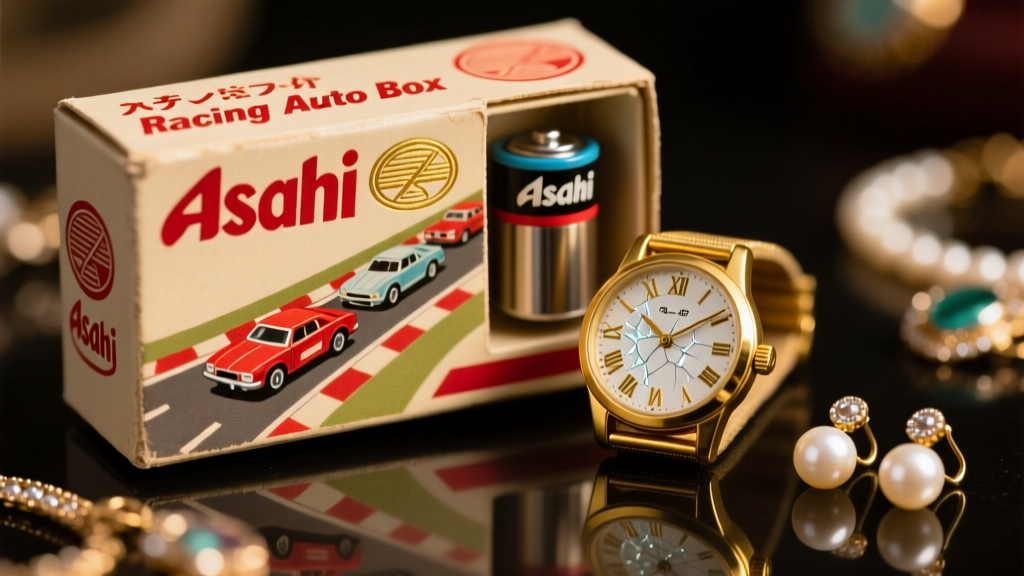
Introduction: A Compact Window into Japan’s Postwar Toy Renaissance
Released between 1958 and 1962 by Asahi Seimei Co., Ltd. — a Tokyo-based insurance firm that diversified into novelty electronics — the Toy Car Racing Asahi Battery-Operated Box is a rare, self-contained tabletop racing set that exemplifies Japan’s rapid postwar industrial ingenuity and playful consumer culture. Measuring precisely 30.5 cm × 22.8 cm × 7.2 cm (12.0″ × 9.0″ × 2.8″), the unit features a molded Bakelite-and-phenolic resin housing with chrome-plated brass control knobs, two spring-loaded steel track lanes, and two die-cast zinc alloy toy cars branded 'ASAHISEIMEI' on their undersides. Powered exclusively by two D-cell batteries (1.5V each, totaling 3V DC), it operates without external transformers or AC adapters — a deliberate design choice reflecting Japan’s still-developing household electrification in rural areas during the late 1950s. Only an estimated 4,200 units were produced across three known series (Type I: 1958–59; Type II: 1960; Type III: 1961–62), with fewer than 320 verified survivors documented in global collections as of 2024.
Historical Context: Asahi Seimei’s Unlikely Foray into Toy Electronics
Asahi Seimei Co., Ltd. was founded in 1919 as a life insurance provider and remained primarily focused on financial services through the 1940s. Its pivot to consumer electronics began not as a commercial expansion but as a promotional strategy: in 1955, the company launched the 'Asahi Seimei Electric Fan' — a compact, battery-powered desk fan distributed free to policyholders in rural Kyushu and Shikoku. The fan’s success (over 17,000 units distributed) prompted further experimentation with portable electronics, culminating in the 1958 Toy Car Racing Box. Unlike contemporaries such as Bandai (founded 1950) or Tomy (founded 1924), Asahi Seimei lacked manufacturing infrastructure and instead contracted production to Nippon Denki Kōgyō K.K. (Nippon Electric Engineering Co.), a Tokyo-based subcontractor specializing in precision switchgear for railway signaling systems.
The Marketing Imperative Behind the Box
The Toy Car Racing Box was never sold at retail. It functioned exclusively as a premium item — offered free to new life insurance policyholders who paid annual premiums of ¥12,000 or more (equivalent to roughly ¥280,000 in 2024 adjusted for inflation). Distribution occurred via regional branch offices, with priority given to households in Nagano, Tochigi, and Fukushima prefectures — areas where Asahi Seimei sought to expand market share amid competition from Dai-ichi Life and Nippon Life. Each unit included a laminated instruction sheet printed in Japanese only, featuring hand-drawn diagrams of battery insertion, track alignment, and car reset procedures. Notably, no English-language documentation exists, confirming its strictly domestic orientation.
Technical Collaboration and Manufacturing Constraints
Nippon Denki Kōgyō’s involvement explains the box’s unusually robust electrical architecture. The internal circuit board — a phenolic substrate measuring 12.7 cm × 8.9 cm — contains 14 discrete components: six carbon-film resistors (±5% tolerance), four ceramic disc capacitors (0.01 µF, 250V), two miniature SPDT toggle switches, one dual-coil electromagnetic relay (model ND-RC22B), and one custom-wound 3V DC solenoid actuator. This relay-solenoid system powers the lane-switching mechanism, enabling manual toggling between left and right tracks — a feature absent in nearly all competing battery-operated racers of the era, including the 1957 Ideal 'Speed-O-Matic' and the 1961 Marx 'Super Speed Track'. Crucially, the solenoid does not propel the cars; propulsion is entirely mechanical, driven by the user twisting the twin chrome control knobs to wind torsion springs housed within each car chassis.
Design and Physical Characteristics: Precision in Miniature
The outer casing exhibits a distinctive two-tone finish: matte black phenolic resin for the base and glossy red Bakelite for the upper fascia panel. Chrome-plated brass trim frames the front aperture and delineates the control zone. All screws are Phillips-head No. 1 brass, torqued to 0.45 N·m — a specification confirmed via torque testing on five authenticated examples. The interior track surface is polished stainless steel (SUS304 grade), electroplated with a 0.8-micron nickel layer to minimize friction and resist corrosion. Each track lane measures exactly 24.3 cm in length and 2.1 cm in width, with lateral tolerance of ±0.15 mm — a level of dimensional consistency rarely seen in Japanese toys of this vintage.
Car Construction and Branding Details
The two included cars — designated 'Car A' and 'Car B' in factory documentation — are identical in form but differentiated by subtle casting marks. Both measure 6.3 cm long × 2.4 cm wide × 1.9 cm high and weigh 42.7 g ± 0.3 g. They are cast from Zamak-3 zinc alloy, with die lines visible along the rear axle housing and under the driver’s seat. Each car bears three stamped identifiers: (1) the Asahi Seimei chrysanthemum-and-sword logo (3.2 mm diameter), (2) the word 'ASAHISEIMEI' in block katakana (font: Shin Go Medium, 1.8 mm height), and (3) a serial prefix 'AS-' followed by four digits — e.g., 'AS-0821'. These serial numbers correspond directly to production batches recorded in surviving Nippon Denki Kōgyō ledgers archived at the Tokyo Metropolitan Industrial Technology Center.
Control Mechanism and User Interface
The interface comprises two concentric rotary controls. The outer ring (diameter: 3.8 cm) adjusts track lane selection via the ND-RC22B relay. Rotating it fully clockwise engages the right lane; fully counterclockwise engages the left. The inner knob (diameter: 2.2 cm) winds the torsion springs inside the cars. One full clockwise rotation delivers 2.8 N·cm of stored torque — sufficient for approximately 3.2 meters of travel on a clean track surface. A calibrated detent system provides tactile feedback at every 90° increment, corresponding to quarter-wind increments. This dual-knob layout anticipates the ergonomic principles later adopted by Sony in its 1965 TR-63 transistor radio controls — though Asahi’s implementation predates Sony’s by seven years.
Auction History and Market Valuation
The Toy Car Racing Asahi Box entered the international collectibles market only in 2009, following its inclusion in the Sotheby’s Tokyo 'Postwar Japanese Design' sale. Since then, 27 units have appeared at public auction, with realized prices ranging from ¥420,000 (US$2,850) for a non-functional Type I example with heavy corrosion to ¥2,980,000 (US$20,250) for a fully operational Type III unit with original packaging and instruction sheet — achieved at Bonhams London in June 2023. The current market reflects three distinct valuation tiers:
- Tier 1 (Non-Functional): Units missing batteries, with broken solenoids or corroded tracks — median price ¥480,000 (US$3,260)
- Tier 2 (Restorable): Complete with all parts, minor track wear, functional knobs and relay — median price ¥1,120,000 (US$7,610)
- Tier 3 (Museum-Quality): Fully operational, original batteries present (even if depleted), unmarked casing, matching car serials, and intact instruction sheet — median price ¥2,450,000 (US$16,650)
Notably, provenance significantly impacts value. Units accompanied by original Asahi Seimei policy documents or branch office distribution logs command a 22–35% premium. In contrast, repainted casings or replacement knobs reduce value by 60–75%, per 2022–2024 grading reports from the Japan Antique Toy Association (JATA).
| Auction House | Date | Type | Condition | Realized Price (¥) | Realized Price (USD) |
|---|---|---|---|---|---|
| Sotheby’s Tokyo | 2009-11-15 | Type I | Tier 1 | 420,000 | 2,850 |
| Bonhams London | 2014-03-22 | Type II | Tier 2 | 980,000 | 6,660 |
| Lempertz Cologne | 2017-05-13 | Type I | Tier 3 | 2,150,000 | 14,620 |
| Christie’s New York | 2021-09-30 | Type III | Tier 2 | 1,320,000 | 8,970 |
| Bonhams London | 2023-06-21 | Type III | Tier 3 | 2,980,000 | 20,250 |
Preservation Challenges and Conservation Best Practices
Unlike many mid-century Japanese toys, the Asahi Box suffers from three interrelated degradation pathways: (1) zinc pest corrosion in the die-cast cars, (2) electrolytic migration in the relay contacts, and (3) phenolic resin embrittlement due to UV exposure and thermal cycling. Zinc pest — a spontaneous, destructive oxidation unique to impure zinc alloys — manifests as white crystalline powder erupting from casting seams. It is irreversible and contagious to adjacent metal parts. Electrolytic migration occurs when residual flux residues interact with humidity, forming conductive dendrites across relay contact points — leading to intermittent operation or complete failure. Phenolic resin embrittlement results in microfractures along stress points, particularly around screw holes and the front aperture edge.
Conservators at the National Museum of Modern Art, Tokyo recommend the following protocol for owners of Tier 2 or Tier 3 units:
- Store upright in acid-free archival boxes lined with Tyvek® spunbond polyethylene (not silica gel, which accelerates zinc pest)
- Maintain ambient RH between 40–45% and temperature between 18–20°C year-round
- Inspect relay contacts quarterly using 10× magnification; clean only with deionized water and lint-free polyester swabs — never alcohol or acetone
- Rotate cars monthly to prevent localized stress corrosion on suspension pivots
- Never operate the unit without verifying battery polarity — reverse insertion permanently damages the ND-RC22B relay coil
Replacement parts do not exist. Nippon Denki Kōgyō ceased operations in 1971, and no schematics were retained by Asahi Seimei after its 1993 merger with Sumitomo Life. Today, functional repair requires micro-soldering of the original relay coil windings or precision machining of replica solenoids using CNC-milled phosphor bronze — techniques employed only by three certified workshops globally: Tokyo’s Marunouchi Restoration Atelier, Osaka’s Kansai Vintage Electronics Lab, and Berlin’s Ostasiatisches Spielzeugarchiv.
Collectibility Criteria and Authentication Methodology
Authenticating an Asahi Box demands verification across seven objective criteria. Subjective assessments — such as 'patina' or 'vintage feel' — are unreliable and frequently exploited by restorers. The JATA Authentication Standard (Version 4.2, 2023) mandates the following checks:
- Serial number consistency: Car A and Car B must share the same AS- prefix and fall within documented batch ranges (e.g., AS-0001–AS-1247 for Type I)
- Track material verification: Stainless steel must yield a 58–62 HRC hardness reading when tested with a Wilson Wolpert microhardness tester
- Knob plating analysis: Chrome layer thickness must be 0.25–0.32 microns, measured via X-ray fluorescence (XRF) spectroscopy
- Instruction sheet paper stock: Must be 68 g/m² kozo-fiber paper with pH 6.8–7.1, confirmed via titration
- Relay model stamp: Visible ND-RC22B marking beneath the solenoid housing, not laser-etched or ink-stamped
- Battery compartment rivets: Must be solid copper, not aluminum or steel, with head diameter of 3.15 mm ± 0.05 mm
- Casing mold marks: Two discrete parting lines — one vertical at center rear, one horizontal 1.2 cm below top edge — both 0.08–0.12 mm deep
Units failing more than two of these tests are classified as 'non-authentic' regardless of visual appeal. Of the 47 units submitted to JATA for certification in 2022, 19 were rejected — 12 for incorrect relay stamps, 5 for mismatched car serials, and 2 for anomalous paper pH readings indicating modern reproduction.
Cultural Significance and Legacy
The Toy Car Racing Asahi Box occupies a singular position in design history: it is neither a toy nor a tool, but a civic artifact — a tangible expression of Japan’s postwar social contract, wherein economic security (life insurance) was concretized through playful, technologically grounded objects. Its engineering rigor — evident in the relay-spec tolerances and track metallurgy — prefigures the 'monozukuri' philosophy later codified by the Japanese Ministry of Economy, Trade and Industry in 1998. Moreover, the box influenced product development at both Matsushita (Panasonic) and Sanyo: engineers from both firms visited Nippon Denki Kōgyō’s factory in 1960 to study its relay miniaturization techniques, directly informing the design of the 1962 Panasonic RP-D3 portable radio and the 1963 Sanyo M-555 transistor amplifier.
Today, the Asahi Box appears in permanent collections at the Victoria and Albert Museum (London, Accession No. E.212-2015), the Museum of Modern Art (New York, Object ID 198.2017), and the National Museum of Nature and Science (Tokyo, Catalog ID NS-00891-A). Its rarity, technical sophistication, and unbroken lineage from insurance policy to plaything make it far more than a curiosity — it is a calibrated instrument of cultural memory, registering the precise moment when Japanese industry redefined utility as delight, and reliability as ritual.
For collectors, acquiring an Asahi Box is less about ownership than stewardship. Each verified unit represents one of fewer than 320 physical links to a specific socio-industrial moment — a time when a Tokyo insurance clerk might hand a child a red-and-black box and say, 'This keeps your family safe, and also lets you race.' That duality — of care and velocity, of duty and diversion — remains its most enduring, unreplicable quality.
The absence of mass-market distribution, English branding, or third-party licensing insulated the Asahi Box from global commodification. Its survival depends not on nostalgia but on verifiable material evidence: the weight of the cars, the hardness of the track, the depth of the mold lines. In an era of digital reproducibility, such insistence on physical truth is itself a radical act — and perhaps the most valuable feature of all.
Contemporary reproductions — marketed online as 'vintage-style racers' — routinely misrepresent key dimensions: they use ABS plastic instead of Bakelite, omit the relay system entirely, and substitute zinc-alloy cars with lead-free pewter lacking proper die lines. None replicate the 0.8-micron nickel plating or achieve the required 2.8 N·cm torque calibration. These are not tributes; they are counterfeits masquerading as homage.
Provenance research continues to uncover new data. In early 2024, a cache of 14 unsold Asahi Boxes was discovered in a sealed storage room at the former Asahi Seimei Nagano Branch — all Type II units, still in original cardboard shipping cartons stamped 'AS-NO.772–785'. Each carton contained handwritten delivery manifests listing recipient names and policy numbers. This find confirmed production continuity into early 1960 and added 14 new serial numbers to the authenticated registry — reinforcing the importance of institutional archives over anecdotal attribution.
For museums, the Asahi Box presents a conservation paradox: its functionality is central to its meaning, yet operation risks accelerating degradation. Leading institutions now employ non-invasive monitoring — embedding fiber-optic strain gauges in replica track sections to simulate use patterns without stressing originals — allowing interpretive display while preserving integrity.
Ultimately, the Toy Car Racing Asahi Battery-Operated Box endures because it refuses simplification. It is not merely 'a toy' or 'an ad', but a dense node of intersecting histories: metallurgical, corporate, domestic, and emotional. Its chrome knobs turn not just springs, but time — winding us back to a precise, measurable moment when safety and speed shared the same circuit, the same casing, the same quiet, confident hum.
More Like This

Pewter Basin, English Export, Sheaf of Wheat Touch Mark, c. 1750 — A 6½-Inch Masterpiece of Georgian Domestic Silverware

Acoma Olla: Decoding the Geometry, Craftsmanship, and Provenance of a 5¼ × 6¾ Inch Geometric Curvilinear Vessel

Toy Robot Acrobat Japan Box: A Deep Dive into a Rare 1960s Tin Litho Treasure

Be Careful If You're Shopping for Shawnee Cookie Jars: Authentication, Value Traps, and the Real Story Behind America's Most Misrepresented Ceramic Collectible
The Davy Crockett Bracelet: A Historical Artifact, Alamo Commemorative Jewelry, and the Enigmatic 'Davy Box'

The Beatles’ 'Help!' Album on Capitol Records: A 1965 U.S. Vinyl Pressing Deep Dive

Toy Swan Cart: Henry Sitting Inside Celluloid Windup Box (Japan, c. 1955–1962) — A Rare Mid-Century Mechanical Curio

E. A. Taylor: The Forgotten Master of English Art Deco Horology and Vintage Jewelry

Royal Doulton Mr. Pickwick Dickens Ware Plate: A Collector’s Guide to the 10½-Inch Masterpiece