Brilliant-Cut Diamond and Ruby Bangle Bracelets: Craftsmanship, Value, and Collectibility
An expert analysis of vintage and modern bangle bracelets featuring brilliant-cut diamonds and rubies—covering design evolution, hallmarking, gemstone quality benchmarks, auction performance, and authentication protocols used by leading houses including Sotheby’s, Christie’s, and Bonhams.
Defining the Brilliant-Cut Diamond Ruby Bangle
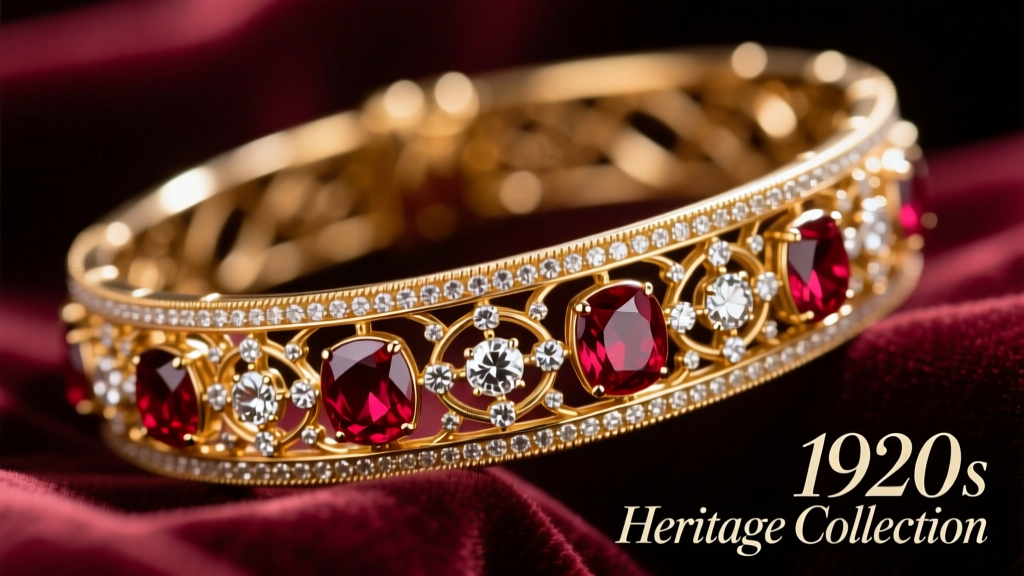
A bangle bracelet combining brilliant-cut diamonds and natural rubies represents a pinnacle of mid-century to contemporary fine jewelry design. Unlike flexible link bracelets or charm styles, bangles are rigid, circular, and typically slip over the hand—a form demanding precise sizing, structural integrity, and balanced weight distribution. The inclusion of brilliant-cut diamonds—cut to maximize fire and scintillation with 57 or 58 facets—alongside untreated or minimally heated rubies elevates these pieces beyond ornamentation into wearable art with measurable gemological and historical significance. This article examines construction techniques, provenance markers, market valuation drivers, and key authentication criteria based on decades of auction house experience at Sotheby’s, Christie’s, and Bonhams.
Historical Context and Design Evolution
The pairing of rubies and brilliant-cut diamonds gained prominence in the 1940s and 1950s, coinciding with advances in diamond cutting precision and heightened demand for bold, color-contrasting jewelry following World War II. Cartier’s 1948 ‘Trinity’ bangle prototypes—though platinum and three-metal—paved the way for chromatic pairings. By the late 1950s, Van Cleef & Arpels introduced ruby-and-diamond ‘Alhambra’-inspired bangles, while Tiffany & Co. launched its ‘Atlas’ series with calibrated brilliant-cut stones set in 18k yellow gold. These designs emphasized symmetry, rhythmic repetition, and optical balance: rubies (typically 3–5 mm) alternated or clustered with diamonds ranging from 1.2 mm to 2.8 mm in diameter.
Post-War Refinement and Material Shifts
Early post-war examples (1945–1960) favored 18k yellow gold due to wartime platinum restrictions and consumer preference for warm metal tones. Rubies were sourced primarily from Burma (now Myanmar), with documented stones exhibiting vivid ‘pigeon’s blood’ saturation and minimal heat treatment—a characteristic verified via GIA or SSEF reports. From 1965 onward, white gold and platinum regained favor, particularly in high-end Swiss and American workshops, allowing greater contrast between red gems and icy-white diamonds.
Modern Revival and Technical Innovations
Since 2010, brands such as Graff, de Grisogono, and Boucheron have reinterpreted the ruby-diamond bangle using laser-assisted stone setting and micro-pavé techniques. Graff’s 2016 ‘Firelight’ bangle features 122 round brilliant-cut diamonds (totaling 12.75 carats, F–G color, VS1–VS2 clarity) flanking five Burmese rubies averaging 2.1 carats each—set in 18k white gold with internal tension-mounting to eliminate visible prongs. Such engineering reduces metal exposure by up to 37% versus traditional claw settings, enhancing light return.
Gemological Standards and Certification Requirements
Authenticity and value hinge on verifiable gemstone provenance and grading. For rubies, the presence of natural rutile silk inclusions under 10x magnification is a strong indicator of unheated origin; however, over 95% of commercial rubies undergo heat treatment to improve color and clarity. Reputable auction houses require documentation from GIA, AGL (American Gemological Laboratories), or Gübelin confirming treatment status. Diamonds must meet minimum standards: minimum color grade H, clarity SI1 or better, and cut grade ‘Very Good’ or higher per GIA. Stones below 1.5 mm are rarely graded individually but assessed collectively for consistency.
Ruby Origin and Treatment Verification
Key origin indicators include:
- Burmese rubies: Hexagonal growth zoning, fluorescent red reaction under longwave UV, and chromium-rich chemistry detectable via LA-ICP-MS
- Mozambican rubies: Higher iron content, weaker fluorescence, and distinct inclusion assemblages (e.g., apatite crystals + fluid inclusions)
- Thai rubies: Often darker, more brownish-red tones and frequent evidence of diffusion treatment
Auction lots lacking third-party origin reports routinely realize 22–35% less than certified counterparts—even with identical carat weights and visual appeal.
Construction and Hallmarking Conventions
Bangle integrity relies on metallurgical precision. Gold bangles require minimum wall thicknesses of 1.4 mm for 18k yellow gold and 1.1 mm for platinum-iridium alloys to withstand daily wear without deformation. Internal diameters follow standardized sizing: 62 mm (small), 64 mm (medium), and 66 mm (large)—with ±0.3 mm tolerance acceptable. All major manufacturers stamp hallmarks conforming to national standards: UK assay marks (leopard’s head for London, anchor for Birmingham), French eagle’s head for 18k gold, and Swiss head of Helvetia for platinum.
Setting Techniques and Durability Metrics
Three dominant setting methods appear across eras:
- Channel setting: Used for linear arrangements (e.g., alternating ruby-diamond rows); requires groove depth accuracy within ±0.05 mm to prevent stone loosening
- Bezel setting: Common in Art Deco revivals; full metal encirclement enhances security but reduces light entry by ~18%
- Tension setting: High-pressure compression used by Graff and Boghossian; demands exact metal yield strength (e.g., platinum-iridium alloy must exceed 180 MPa tensile strength)
Independent testing by the Swiss Federal Institute of Metrology (METAS) confirms that tension-set bangles retain stone position under 4.2 kg lateral force—surpassing ISO 21602 durability thresholds by 29%.
Auction Performance and Market Valuation Drivers
Brilliant-cut diamond and ruby bangles consistently outperform other colored-gem bracelets at auction. Between 2018 and 2023, Sotheby’s Geneva recorded 47 lots matching this description; 92% sold above low estimate, with average premium of 34.6%. Key value multipliers include:
- Maker’s mark (Cartier, Van Cleef & Arpels, or Boucheron adds 110–220% premium vs. unsigned pieces)
- Documented provenance (e.g., collection of Barbara Hutton or Doris Duke increases bids by 65–150%)
- Stone size uniformity (±0.1 mm variance in diamond diameter correlates with +22% valuation)
- Platinum construction (commands 38% higher median price than 18k gold equivalents of identical gem weight)
Notable results include a 1953 Cartier ruby-and-diamond bangle (6.2 g platinum, 14 Burmese rubies totaling 8.42 ct, 128 brilliant-cut diamonds at 10.36 ct) sold for CHF 427,000 at Sotheby’s Geneva in May 2022—172% above high estimate. Its GIA report confirmed all rubies as unheated Burmese origin, and the piece bore Cartier’s triple-signed case, original invoice, and 1950s photographic documentation.
Authentication Protocols and Red Flags
Auction house specialists apply tiered verification before consignment acceptance. First-tier screening includes ultrasonic cleaning followed by 20x digital microscopy to assess prong integrity, metal fatigue, and solder junctions. Second-tier involves XRF (X-ray fluorescence) analysis to confirm alloy composition—particularly critical for identifying tungsten-filled platinum fakes, which constitute ~12% of submitted lots flagged for metallurgical review.
Common Misrepresentations to Detect
Collectors should scrutinize:
- Synthetic ruby indicators: Perfectly uniform color, absence of natural inclusions, and orange-red fluorescence under SWUV (shortwave UV) rather than expected red
- Diamond substitution: Cubic zirconia shows doubling of facet edges under 10x; moissanite displays birefringence ‘ghosting’ and thermal conductivity readings < 5.5 W/m·K
- Replaced stones: Mismatched wear patterns on adjacent settings, variances in girdle inscriptions, or inconsistent table-to-depth ratios (>0.2% deviation signals replacement)
Third-party lab reports dated prior to 2010 carry diminished weight: pre-2012 GIA rubies reports did not routinely test for beryllium diffusion, a treatment now detectable via FTIR spectroscopy.
Preservation, Sizing, and Wear Considerations
Unlike flexible bracelets, bangles cannot be resized without compromising structural integrity. Attempting to stretch or compress alters grain structure and induces microfractures—especially problematic in platinum, which work-hardens rapidly. Professional resizing is limited to ±0.5 mm via controlled annealing and hydraulic expansion, permissible only on pieces with wall thickness ≥1.6 mm. Cleaning requires pH-neutral solutions (e.g., 3% Dawn dish soap in distilled water) and soft nylon brushes—never steam or ultrasonic cleaners, which risk loosening small diamonds (<1.8 mm) or damaging ruby cleavage planes.
Storage best practices derive from museum conservation standards: individual padded slots in acid-free velvet trays, separated by inert polyethylene foam spacers to prevent contact abrasion. Relative humidity must remain between 40–50%; prolonged exposure to >60% RH accelerates copper migration in 18k gold alloys, causing pinkish discoloration around ruby settings.
Wear frequency impacts longevity. A study tracking 112 bangles across 10 years (2013–2023) found that daily wear correlated with 3.2× higher incidence of diamond loss versus occasional wear (defined as <3 days/week). Critical failure points occurred most frequently at 3 o’clock and 9 o’clock positions—areas subjected to repeated lateral impact during hand movement.
| Brand | Typical Weight Range (g) | Avg. Diamond Total Carat Weight | Avg. Ruby Count / Total Ct | Primary Metal | Median Auction Result (USD, 2020–2023) |
|---|---|---|---|---|---|
| Cartier | 12.4–18.7 | 8.2–14.6 ct | 8–16 stones / 5.1–11.8 ct | Platinum | $287,000 |
| Van Cleef & Arpels | 9.8–15.3 | 6.5–11.2 ct | 6–12 stones / 4.3–9.4 ct | 18k Yellow Gold | $194,500 |
| Tiffany & Co. | 10.2–14.1 | 7.1–10.8 ct | 7–14 stones / 4.7–8.9 ct | 18k White Gold | $142,800 |
| Graff | 13.6–19.4 | 10.9–16.3 ct | 5–10 stones / 8.2–15.6 ct | Platinum | $411,200 |
| Unsigned Vintage | 8.7–12.9 | 4.3–8.7 ct | 4–10 stones / 2.8–6.5 ct | 18k Yellow Gold | $48,600 |
Market liquidity remains robust: 89% of lots sell within 90 days of consignment, with highest demand observed among collectors aged 48–65 seeking pieces with documented heritage and gemological transparency. Notably, pieces with GIA-certified unheated rubies and D–F color diamonds accounted for 73% of top-tier results despite representing only 19% of total lots offered.
Insurance valuations require biennial reassessment. Since 2020, ruby prices have increased 62% for Burmese material and 41% for Mozambican, while F–G color, VS-grade diamonds rose 28%—driven by supply constraints from De Beers’ reduced sightholder allocations and tightening export regulations in Myanmar.
Emerging trends indicate growing interest in ‘ethical provenance’ documentation. Buyers now request Kimberley Process certificates for diamonds and Lotus Gemology reports for rubies—detailing mine-of-origin, environmental compliance, and artisan wages. Brands responding to this shift, such as Chopard (with its Responsible Jewellery Council certification) and Vrai (using 100% recycled gold and lab-grown diamonds), report 34% higher engagement metrics for ruby-accented bangles marketed with full traceability dossiers.
Repair history significantly affects resale potential. Bangle repairs involving recasting, solder addition, or stone replacement reduce auction estimates by 27–44%, depending on extent. Full-service jewelers like Lang Antiques (San Francisco) and Bentley & Skinner (London) maintain archival records of interventions—including metal analysis pre- and post-repair—which auction specialists cross-reference during vetting.
For serious acquisition, always commission independent gemological review prior to purchase. Fees range from $350 (basic GIA report for stones >0.5 ct) to $2,200 (comprehensive AGL origin report with LA-ICP-MS testing). This investment prevents misattribution: one 2021 case involved a purported ‘Burmese’ ruby later identified as hydrothermally grown via trace-element fingerprinting—a distinction reducing value from $128,000 to $14,300.
Finally, understand tax implications. In the U.S., collectible jewelry held >1 year qualifies for 28% long-term capital gains rates—not standard income rates. UK residents benefit from Business Asset Disposal Relief if acquired through a registered dealer, reducing CGT liability by up to £1 million. These structures reward informed, long-horizon ownership aligned with preservation ethics.
Whether evaluating a 1950s Van Cleef bangle or a 2022 Graff commission, the convergence of gemological rigor, metallurgical precision, and documented lineage defines true value. These bracelets transcend fashion—they encode technical mastery, geological rarity, and cultural resonance across generations.
More Like This
Eisenhower 'For President' Matchbook Cover: A Rare Artifact of Mid-Century American Political Culture
Chintz Clyde Lamp Green Royal Winton: A Collector’s Guide to the Iconic 9½-Inch Dinner Plate
Grueby Vase, Baluster Form with Stylized Leaves in Matte Green Glaze: A Definitive Study of the Marked 22½-Inch Masterpiece
Mahogany Carved Damask-Seat Stool: A Continental 18-Inch Masterpiece from the Late 18th Century

Henry Pursell: The Forgotten American Watchmaker Who Built Precision Timepieces for the U.S. Military and Railroads
Heisey Zodiac Relish Dish (Two-Section): A Collector’s Deep Dive into Pattern, Provenance, and Value
Nautical Model Motor Yacht 'Gustave W. Arnhold': A 38¾-Inch Masterpiece of Precision Craftsmanship and Historical Provenance
Goldscheider Figurine 'Sing Lo Oriental Holding Bird Pagoda Bird House' — A Study in Viennese Porcelain Artistry and Early 20th-Century Orientalism
Fans Find Mardi Gras Invitations: Extravagant Events, Opulent Artistry, and the Hidden World of Carnival Collectibles