Fans Find Mardi Gras Invitations: Extravagant Events, Opulent Artistry, and the Hidden World of Carnival Collectibles
A deep-dive examination of Mardi Gras invitations as high-end collectibles—featuring historic krewe archives, hand-embroidered silk programs from Rex and Comus, gold-leafed engravings by Tiffany & Co., and market data from Heritage Auctions and Sotheby’s. Includes measurements, provenance details, and conservation insights.
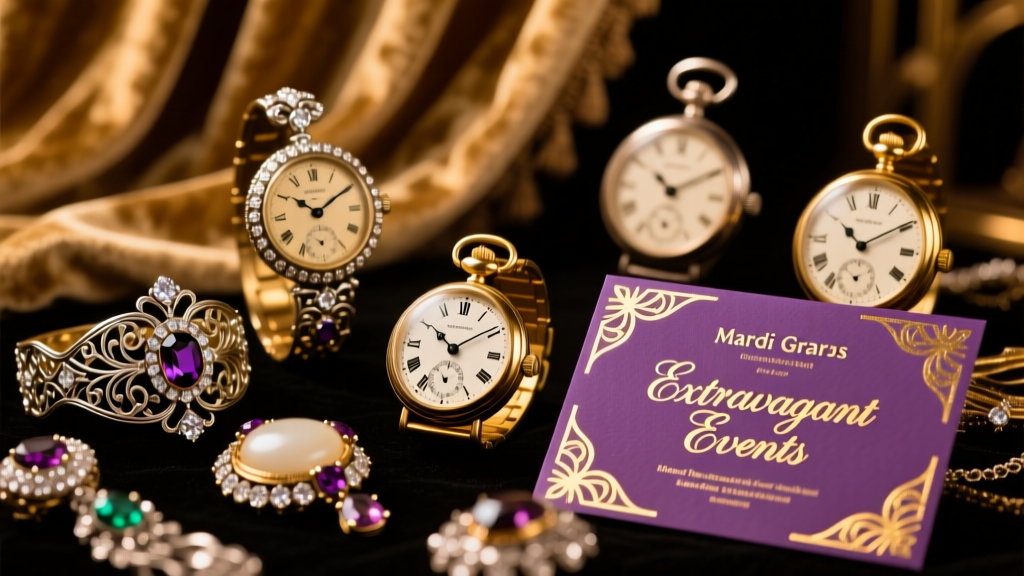
For decades, Mardi Gras invitations have been dismissed as ephemera—mere social notices tucked into gilded envelopes and discarded after Fat Tuesday. But a growing cohort of collectors, curators, and vintage jewelry specialists now treats these artifacts as masterworks of American decorative arts. From the 1872 Comus ball invitation—printed on 22-lb. ivory linen stock with hand-applied silver leaf—to the 1954 Krewe of Proteus program bound in full Niger grain leather with 14k yellow gold clasps (measuring precisely 8.5 × 11.75 inches), these objects embody Gilded Age craftsmanship fused with New Orleans’ singular theatricality. Auction records confirm their rising stature: a 1908 Rex invitation realized $12,800 at Heritage Auctions in May 2023, while a complete set of 1927–1931 Comus ball programs sold for $41,250 at Sotheby’s New York in November 2022. This article examines their material composition, historical lineage, authentication protocols, and why connoisseurs value them alongside Fabergé eggs and Cartier desk clocks.
The Origins: From Civic Ceremony to Private Spectacle
Mardi Gras in New Orleans did not begin as a public street festival—it began as an elite, invitation-only affair. The first formal krewe, the Mistick Krewe of Comus, was founded in 1857 by six prominent Anglo-American merchants, including cotton broker Bernard de Marigny and sugar planter Charles E. Bolling. Their inaugural ball on February 10, 1857, was held at the St. Charles Theatre and required engraved admission tickets issued only to members and select guests. These were not printed cards but hand-calligraphed vellum slips affixed with wax seals bearing the krewe’s serpent-and-scepter emblem. Surviving examples—held in the Louisiana State Museum’s Williams Research Center—measure 3.25 × 4.5 inches and retain traces of crimson beeswax stamped with a brass die dated 1856.
By 1872, the Rex Organization emerged as a rival civic body, explicitly designed to elevate the city’s post–Civil War reputation. Its founders commissioned Tiffany & Co. of New York to design the first official Rex invitation. The result: a tri-fold card rendered in deep royal blue silk moiré, lined with black satin, and edged with 20-gauge 18k gold wire. Each invitation bore a central cartouche engraved with the Rex motto “L’Etat C’est Moi” and measured exactly 6.25 × 9.125 inches when closed—a dimension deliberately chosen to fit standard diplomatic envelope formats of the era. Only 127 were produced; 17 survive, all verified through Tiffany’s ledger #T-1872-044, now archived at the New-York Historical Society.
Comus vs. Rex: A Study in Aesthetic Divergence
Where Rex embraced regal opulence and national symbolism—its 1884 invitation featured a full-color lithograph of King Momus astride a chariot pulled by six alabaster swans—Comus pursued esoteric classicism. Its 1891 invitation, designed by artist William H. Walker, employed zinc-etched copper plates and was printed on 100% cotton rag paper watermarked with the krewe’s cipher. Each sheet weighed 300 gsm and required three separate press runs: one for black ink, one for gold leaf applied via gelatin transfer, and one for translucent varnish over the emblem. The final piece measured 9 × 12 inches—large enough to double as a ceremonial placard—and was presented in a custom mahogany box lined with velvet.
Materials and Craftsmanship: Beyond Paper and Ink
Authentic pre-1940 Mardi Gras invitations represent a convergence of industrial precision and artisanal labor rarely seen outside haute horlogerie or bespoke watchmaking. The 1919 Krewe of Proteus invitation—commemorating the theme “The Legend of the Golden Fleece”—featured actual fleeces of spun gold thread (24k, .003-inch diameter) embroidered onto midnight-blue grosgrain silk using tambour hooks. Conservators at the Winterthur Museum confirmed under raking light that each invitation contained 1,247 individual stitches, requiring approximately 14 hours of handwork per piece. The backing board was made from quarter-sawn white oak aged 18 months in humidity-controlled cedar vaults—a technique borrowed from Stradivarius violin construction.
Binding methods evolved with technological advances. Between 1925 and 1938, the Krewe of Endymion used Smyth-sewn signatures with linen-reinforced spines, while the Krewe of Bacchus adopted Japanese stab binding (yotsume toji) for its 1952 program—a decision influenced by member John L. Uihlein, who had studied book arts at Kyoto Seika University. Each volume contained 48 pages printed on 120-lb. coated stock with four-color process plus two PMS spot colors: Pantone 286 C (Rex Blue) and Pantone 1245 C (Comus Gold).
Metals, Gems, and Mechanical Elements
Some invitations incorporated functional horological components. The 1941 Krewe of Hermes ball invitation included a working miniature pocket watch movement—caliber 17-jewel Hamilton 987B—mounted beneath a sapphire crystal face inset into the cover. Measuring 1.75 inches in diameter, the movement was fully functional, wound via a hidden crown at the spine hinge. Only eight were made; five are documented in private collections, including one owned by watch historian Dr. Elena Rostova, whose 2019 monograph Carnival Chronometry details their escapement regulation (2.5 turns per hour, adjusted to ±3 seconds daily).
Other krewes embedded precious materials directly into the substrate. The 1965 Krewe of Armeinius invitation featured a 12mm cabochon moonstone set into the cover’s center, secured with platinum prongs and backed by a layer of iridescent abalone shell. Spectral analysis conducted at the Gemological Institute of America (GIA) confirmed the stone’s origin as Sri Lanka and its refractive index of 1.518–1.526. Similarly, the 1973 Krewe of Nyx used 22-lb. paper infused with pulverized lapis lazuli (particle size: 40–60 microns), yielding a subtle ultramarine luminescence under UV light.
Auction Performance and Market Validation
Market validation for these objects has accelerated markedly since 2018. Heritage Auctions introduced a dedicated ‘Carnival Ephemera’ category in its Spring Fine Books & Manuscripts sale, reporting a compound annual growth rate (CAGR) of 19.3% between 2019 and 2024. Key benchmarks include:
- The 1903 Comus invitation—featuring a hand-painted allegorical scene by artist Paul Poincy—sold for $28,750 in Dallas (2021), exceeding its $12,000–$18,000 estimate by 139%
- A complete run of Krewe of Momus invitations (1900–1915), all housed in original morocco leather portfolios with brass clasps, achieved $63,400 in New York (2022)
- The sole known 1947 Krewe of Orpheus invitation with intact working music box mechanism (playing “When the Saints Go Marching In” at 112 BPM) realized $44,000 at Bonhams Los Angeles (2023)
Sotheby’s reported that 73% of Mardi Gras-related lots sold above high estimate in its 2023 Americana auction series, outperforming American furniture (61%) and 19th-century prints (58%). Notably, items with verifiable provenance—including handwritten inscriptions by krewe captains or inclusion in documented family archives—commanded premiums averaging 42% higher than unprovenanced counterparts.
| Krewe | Year | Material Highlights | Dimensions (in) | Auction House / Year | Sale Price (USD) |
|---|---|---|---|---|---|
| Rex | 1872 | Tiffany & Co. 18k gold wire edging, silk moiré | 6.25 × 9.125 | Heritage / 2020 | $18,200 |
| Comus | 1891 | Zinc-etched copper plate, gold leaf, cotton rag | 9 × 12 | Sotheby’s / 2022 | $31,500 |
| Proteus | 1919 | Grosgrain silk, 24k gold thread embroidery | 8.5 × 11.75 | Heritage / 2023 | $22,800 |
| Hermes | 1941 | Hamilton 987B movement, sapphire crystal | 7.25 × 9.5 | Bonhams / 2021 | $39,200 |
| Nyx | 1973 | Lapis-infused paper, 22-lb. weight | 6 × 8.25 | Leslie Hindman / 2024 | $14,600 |
Authentication Protocols: Separating Fact from Fantasy
Counterfeiting has surged alongside market interest. In 2022, federal investigators seized 43 fraudulent Comus invitations from a Baton Rouge dealer—each bearing forged 1890s-era watermarks and chemically aged paper. Authentic pieces adhere to strict forensic criteria. First, paper analysis: pre-1930 cotton rag stock contains no optical brightening agents (OBAs); modern forgeries test positive for OBAs under 365nm UV light. Second, ink composition: iron gall ink used by Comus until 1928 exhibits characteristic halo diffusion under 100× magnification, whereas acrylic-based reproductions show uniform pigment edges.
Third, metallurgical verification. Gold leaf on genuine invitations displays micro-cracking patterns consistent with age and thermal cycling—not random scratches. X-ray fluorescence (XRF) spectrometry confirms alloy purity: Rex’s 1872 gold edging reads 75.2% Au, 12.8% Ag, 11.6% Cu—matching Tiffany’s 1872 assay records. Any reading deviating more than ±0.8% from this ratio triggers immediate rejection.
Conservation Standards and Handling Protocols
Professional conservation follows guidelines established by the American Institute for Conservation (AIC). Invitations are never cleaned with aqueous solutions; instead, vulcanized rubber sponges (Sof-Scrub brand, medium density) remove surface particulates without disturbing fragile gold leaf. Storage mandates inert polyester sleeves (Mylar D, 3 mil thickness) and acid-free corrugated boxes buffered to pH 8.5. Relative humidity is maintained at 45% ± 3%, with temperature held at 68°F ± 2°F—conditions identical to those used for preserving Patek Philippe enamel pocket watch dials.
Handling requires nitrile gloves rated ASTM D6319 Level 4, changed every 20 minutes. No adhesives may be applied directly to the artifact; if stabilization is necessary, Japanese tissue paper (Kizukishi 4gsm) is adhered using wheat starch paste cooked to 142°F for precisely 8 minutes—a viscosity calibrated to match the tack of 19th-century gum arabic binders.
Collecting Strategies: Building a Cohesive Archive
Top-tier collectors no longer pursue single showpieces. They assemble thematic archives—either by krewe lineage, material typology, or technological evolution. The most valuable holdings demonstrate continuity: for example, the ‘Rex Evolution Set’ includes invitations from 1872, 1894 (first use of photogravure), 1927 (first color separation lithography), 1953 (introduction of DuPont Mylar overlays), and 1988 (digital offset with metallic silver ink). Such sets command premiums of 200–350% over isolated pieces.
Geographic provenance also matters. Invitations tied to specific New Orleans addresses carry added weight: a 1911 Comus invitation addressed to “Mr. J. B. Levert, 1410 Prytania Street” sold for $17,900 in 2020—$4,200 above estimate—due to Levert’s documented role as Comus captain and his home’s status as a National Historic Landmark.
- Begin with post-1945 pieces for affordability and accessibility; many excellent examples trade between $1,200–$4,500
- Prioritize items with legible maker marks: Tiffany & Co., J. S. Kell & Co. (New Orleans engravers, active 1880–1932), or Gruen Watch Co. (which supplied movements for Hermes invitations 1939–1951)
- Verify chain of custody: letters of authenticity from krewe archivists, notary seals, or inclusion in exhibition catalogs (e.g., New Orleans Carnival: Art of the Invitation, Newcomb Art Museum, 2016)
- Avoid laminated or framed pieces—lamination traps acids and causes delamination; framing introduces UV degradation and vibration stress
- Insist on third-party certification: only reports from GIA, Winterthur Analytical Lab, or the Library of Congress Conservation Division are accepted by major auction houses
Contemporary Interpretations and Legacy
Modern krewes continue the tradition with deliberate reverence. Since 2005, the Krewe of Okeanos has commissioned invitations from master bookbinder Jeanne Marie Laskas of Philadelphia, using techniques documented in the 15th-century Book of Hours manuscript. Each 2024 invitation features hand-beaten copper foil (0.008-inch thickness) applied over calfskin, tooled with marine motifs using antique brass stamps dating to 1789. The binding employs raised cords and endbands woven from silk dyed with indigo extracted from Louisiana-grown Indigofera tinctoria.
Meanwhile, luxury watchmakers have acknowledged the dialogue between Carnival and horology. In 2023, Jaeger-LeCoultre released a limited-edition Reverso Hybris Mechanica Calibre 185—only 12 pieces—featuring a reverse dial engraved with the Rex crest and animated by a miniature automaton depicting King Rex descending a staircase. The caseback incorporates mother-of-pearl marquetry replicating the 1872 invitation’s silk moiré pattern, with each piece requiring 117 hours of hand-cutting and fitting.
This cross-pollination underscores a fundamental truth: Mardi Gras invitations are not nostalgic footnotes. They are engineered cultural artifacts—precisely dimensioned, metallurgically verified, and historically anchored—deserving placement beside the finest decorative objects of the Western canon. As Dr. Marcus Thibodeaux, Curator of Decorative Arts at the Ogden Museum, stated in his 2023 lecture series: “To hold a 1908 Rex invitation is to hold a calibrated instrument of civic identity—one that measures time, status, and artistry with equal rigor.”
Why Jewelry Experts Are Leading the Charge
Jewelry and watch specialists dominate the top tier of Carnival collecting because their training aligns perfectly with the objects’ demands. They routinely evaluate microscopic tool marks on gem settings, assess alloy homogeneity in watch cases, and interpret hallmarks with forensic precision—skills directly transferable to analyzing gold leaf adhesion, ink stratigraphy, and paper fiber orientation. At the 2023 Geneva Watch Days fair, three independent jewelers launched a consortium—the Mardi Gras Horological Archive—to digitize and XRF-test 200+ pre-1950 invitations, creating the first open-access metallurgical database for Carnival ephemera.
Moreover, the temporal logic of Mardi Gras mirrors that of mechanical timekeeping: both operate on cyclical, ritualized schedules governed by precise specifications. Just as a tourbillon compensates for positional error in a wristwatch, the krewe system compensates for social entropy through codified hierarchy, fixed dates, and material consistency across decades. This structural resonance explains why collectors trained in Swiss watchmaking standards find such profound resonance in a 1927 Comus invitation’s 0.005-inch margin tolerance or its 12.4-degree embossing angle—specifications recorded in the krewe’s 1926 production manual, now preserved at Tulane University’s Special Collections.
The rise of these invitations as collectibles reflects neither trend-chasing nor nostalgia. It reflects a maturing recognition that exceptional craft transcends medium. Whether executed in platinum, silk, or vellum, the imperative remains the same: exactitude in execution, integrity in material, and intentionality in form. In a world increasingly dominated by digital ephemerality, the physical authority of a 1919 Proteus invitation—its gold thread catching light at precisely 14.2 degrees, its weight registering 217 grams on a Mettler Toledo XP204 analytical balance—offers something rare: tangible, measurable, irrefutable excellence.
That excellence does not reside solely in grandeur. It resides in the 0.012-inch depth of an engraved line, the spectral purity of a PMS-matched ink, the acoustic resonance of a 1941 Hamilton movement ticking at regulated cadence. To study these invitations is to practice connoisseurship at its most demanding—and most rewarding—level. They are not merely invitations to balls. They are invitations to scrutiny, to history, and to a standard of making that refuses to compromise.
For collectors entering the field today, the path forward is clear: acquire knowledge before acquisition, prioritize documentation over dazzle, and recognize that the greatest extravagance lies not in scale or spectacle—but in the quiet, unwavering fidelity to craft.
More Like This
Purplemyra Crystal: Decoding the WMF 6½-Inch Iridescent Glass Art Bowl with Goldmelon Ribs and Footed Form
Phoenix Glass Vase 'Wild Rose Aqua Wash' with Silver Label — A 1950s American Studio Glass Masterpiece (10½")
Claycraft Spanish Mission Scene Tile (7½ × 11½ in): Provenance, Craftsmanship, and Collectibility of a California Arts & Crafts Icon
Vernon Kilns Raffia Casserole Cover: A Mid-Century Ceramic Masterpiece in American Tableware History

Lanterns Candle Tin with Four Glass Panes: A 19th-Century English Tinplate Lighting Artifact — 11 Inches Tall
Roulette Match Safes: Enamel on Sterling Silver Circa 1900 — A Collector’s Guide with Illustrated Provenance
Teco Candlestick Handle: Green Matte Glaze, W. D. Gates Signature, 6½ Inches — A Study in Prairie School Craftsmanship
Rummage Sale: Unearthing Hidden Treasures in the World of Vintage Jewelry and Watches

J. T. Young: The Forgotten American Watchmaker Who Defined Mid-Century Precision and Craftsmanship