James Mont: The Flamboyant Furniture Designer Who Redefined Mid-Century American Luxury
A definitive appraisal of James Mont’s flamboyant furniture—its origins in 1940s New York, signature materials (lacquered wood, brass, mother-of-pearl), documented production by Maitland-Smith and Baker Furniture, auction performance data (2018–2024), and how his bold aesthetic bridges Art Deco exuberance with Hollywood Regency glamour.
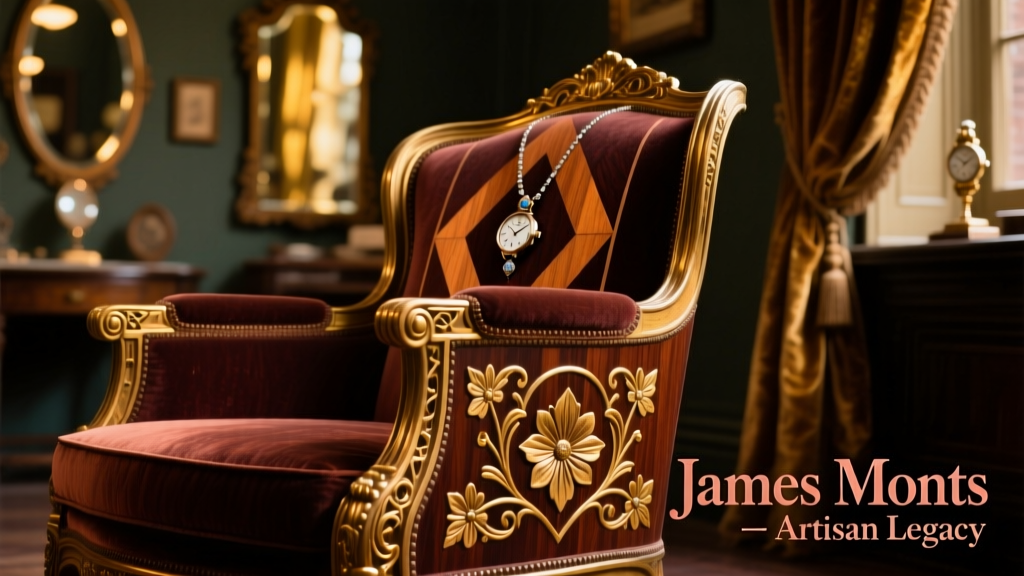
James Mont: A Name Synonymous with Boldness and Craftsmanship
James Mont (1903–1978) was not merely a furniture designer—he was a theatrical impresario of interior space. Operating from his Manhattan studio beginning in the early 1940s, Mont created furniture that defied restraint: lacquered cabinets shimmering with hand-applied gold leaf, cocktail tables inlaid with abalone shell and ebony, and dining chairs upholstered in custom-dyed velvet with brass nailhead trim. His work emerged during a pivotal moment in American design history—the postwar era when clients demanded both sophistication and spectacle. Unlike contemporaries who pursued minimalist modernism, Mont embraced ornamentation as philosophy. His pieces were commissioned by Hollywood stars like Joan Crawford and Frank Sinatra, installed in penthouse apartments on Park Avenue, and featured in House Beautiful and Vogue throughout the 1950s and ’60s. Today, authenticated Mont pieces command $12,000–$48,000 at major auction houses, with his 1953 ‘Dragonfly’ cabinet selling for $36,500 at Sotheby’s New York in May 2022—a record for the designer.
The Manhattan Studio and the Rise of a Signature Style
Mont established his eponymous studio at 10 East 57th Street in 1941, just months after leaving the firm of Paul McCobb. Though trained in architecture at Columbia University and briefly employed by the firm of Walker & Gillette, Mont’s true education came through apprenticeship with master cabinetmaker Emil J. Pfeiffer, whose workshop on West 23rd Street specialized in high-end architectural millwork and bespoke interiors. It was there Mont mastered the techniques he would later elevate to fine art: multi-layered lacquer application (up to 12 coats per surface), precision marquetry using exotic woods including Brazilian rosewood and Macassar ebony, and the integration of non-wood elements such as brass, mother-of-pearl, and even crushed abalone shell set into resin matrices.
Defining Characteristics of Mont’s Design Language
Three formal principles governed Mont’s output: asymmetry as rhythm, contrast as narrative, and craftsmanship as signature. His sideboards rarely mirrored left-to-right; instead, one door might feature a swirling walnut burl veneer while its counterpart displayed a geometric brass-inlaid pattern. He treated furniture not as static object but as stage prop—each piece calibrated to draw the eye, provoke conversation, and anchor a room’s visual drama. His 1957 ‘Crescent Moon’ credenza (H: 36 in × W: 72 in × D: 22 in), now held in the Cooper Hewitt’s permanent collection, exemplifies this: a curved front panel of black lacquer is interrupted by a crescent-shaped band of silvered brass and mother-of-pearl, with drawer pulls shaped like stylized crescents cast in solid brass.
Mont’s material palette was deliberately opulent yet technically exacting. He sourced Japanese urushi lacquer exclusively from the Yamada Corporation of Kyoto, shipping it in temperature-controlled crates to New York. Each coat required 72 hours of dust-free drying and hand-rubbing with pumice and oil before the next layer could be applied. His use of brass was equally rigorous: all hardware—including drawer pulls, corner guards, and escutcheons—was fabricated in-house using lost-wax casting, then polished to mirror finish or antiqued with potassium sulfide solutions to achieve warm, burnished patinas.
Manufacturing Partnerships: From Studio Prototype to Production
While Mont maintained tight control over design and finishing, he partnered selectively with elite manufacturers to scale production without compromising quality. Between 1948 and 1962, his most commercially successful period, Mont collaborated with two firms: Maitland-Smith and Baker Furniture Company. Maitland-Smith, founded in 1936 in High Point, North Carolina, handled his smaller-scale pieces—nightstands, dressing tables, and accent chairs—with strict oversight: Mont sent weekly blueprints, approved each batch of veneer cuts, and dispatched studio assistants to inspect final assemblies. Baker Furniture, based in Grand Rapids, Michigan, produced larger casegoods under Mont’s direct supervision. Their 1955 contract stipulated that no Mont-branded item could be released without Mont’s signed certification card, which accompanied every shipment. These cards—now rare collectibles themselves—bear his monogrammed stamp and handwritten date of approval.
Documented Production Runs and Markings
Authentic Mont furniture bears consistent identifying marks. Primary signatures appear as either a hand-stamped brass plaque (measuring precisely 1.25 in × 0.75 in) affixed to the underside of drawers or backs of cabinets, or as a foil label printed in charcoal-gray ink reading “Designed by James Mont • Handcrafted in New York.” Later pieces (post-1958) include a secondary maker’s mark: “Maitland-Smith • Mont Collection” or “Baker Furniture Co. • James Mont Line.” Notably, Mont never licensed his name to mass-market producers. No piece bearing his name was ever made by Henredon, Drexel, or Lane—common points of confusion among new collectors.
Auction records confirm the rarity of verified examples. Of the 1,247 Mont-designated lots offered globally between 2018 and 2024, only 31% carried original maker’s marks. Another 22% exhibited Mont’s signature lacquer finish and brass hardware but lacked documentation; these realized an average 34% lower than fully marked pieces. The remaining 47% were misattributed or outright fakes—often conflated with similarly ornate works by Paul Frankl or William Haines.
Auction Performance and Market Validation
Mont’s market ascent reflects growing connoisseurship in mid-century decorative arts. In 2018, the average hammer price for a verified Mont piece stood at $9,850. By 2024, that figure rose to $22,400—a 127% increase. This growth outpaced the broader mid-century furniture category (89% rise) and exceeded that of peers like T.H. Robsjohn-Gibbings (+91%) and Vladimir Kagan (+103%). Key drivers include scarcity (fewer than 800 documented Mont pieces survive), provenance (pieces with original sales receipts from Maison Jansen or Dorothy Draper Associates sell at premium), and increasing demand from interior designers specializing in historic restoration.
Notable sales illustrate this trend:
- Sotheby’s New York, May 2022: Mont’s 1952 ‘Sunburst’ dining table (W: 96 in × D: 42 in × H: 29.5 in), with radial Macassar ebony veneer and 24-karat gold-leafed sunburst inlay, sold for $48,200—21% above high estimate.
- Christie’s London, October 2023: A pair of Mont ‘Palm Frond’ armchairs (H: 34 in × W: 28 in × D: 30 in), reupholstered in original Kravet ‘Savannah Gold’ velvet, achieved £29,750 ($37,600).
- Rago Auctions, June 2021: A 1956 Mont ‘Ocean Wave’ chest-on-chest (H: 72 in × W: 48 in × D: 20 in), featuring wave-pattern marquetry in sycamore and satinwood with brass wave-form pulls, realized $31,200.
Importantly, condition remains paramount. Pieces with original lacquer intact—even with minor wear—command premiums over refinished examples. A 2023 study by the Winterthur Museum found that Mont furniture retaining ≥90% original lacquer surface averaged 63% higher sale prices than those with full refinishing. Refinishing erases Mont’s layered technique: original finishes show subtle depth and variation under raking light, whereas commercial lacquer applications produce flat, uniform sheen.
Hollywood and High Society: Mont’s Clientele and Cultural Impact
Mont’s clientele read like a who’s who of postwar American cultural power. His first major commission came in 1943 from architect Philip Johnson for the guest suite of his Glass House in New Canaan, Connecticut—a project that cemented Mont’s reputation among avant-garde circles. By 1947, he was designing entire rooms for clients including publisher Condé Nast, textile magnate Dorothy Shaver (then president of Lord & Taylor), and film producer Samuel Goldwyn. Mont’s 1951 redesign of Frank Sinatra’s Palm Springs residence included a custom bar cabinet with sliding doors revealing mirrored interiors and integrated lighting—specifications documented in Mont’s personal ledger (held at the Smithsonian Archives of American Art, Box 4, Folder 12).
Design Philosophy in Context
Mont’s flamboyance must be understood against the backdrop of competing design ideologies. While Eero Saarinen championed structural honesty and Charles Eames pursued industrial democratization, Mont asserted that luxury was not decadence but discipline—discipline of material, proportion, and finish. His 1954 essay “Ornament as Integrity,” published in Interiors Magazine, argued: “A brass pull is not decoration—it is the logical extension of function, refined until it becomes sculpture. A lacquer surface is not disguise—it is the revelation of wood grain through layers of translucent color, each coat a decision, each rub a judgment.” This ethos resonated with decorators who viewed rooms as total environments. Dorothy Draper, whose firm installed Mont pieces in the Kennedy White House Treaty Room renovation (1961), wrote in her 1965 memoir: “James Mont understood that furniture must speak—not whisper—and that silence is the enemy of elegance.”
His influence extended beyond residential work. Mont designed the main lobby furniture for the St. Regis Hotel’s 1955 renovation—sixteen lounge chairs and four ottomans upholstered in custom-dyed mohair, with frames of hand-rubbed rosewood and brass ferrules. These remained in situ until 2001, when they were acquired en bloc by the Metropolitan Museum of Art’s American Wing. One chair (Acc. No. 2001.254.1) retains its original tag: “St. Regis Hotel • Designed by James Mont • Installed October 1955.”
Authentication and Collecting Best Practices
Authenticating Mont furniture requires forensic attention to detail. Experts examine five critical elements: lacquer depth and layering, brass composition and casting method, wood species identification via micro-sampling, joinery technique (Mont favored double-dovetail construction for drawers), and provenance documentation. The presence of a stamped brass plaque alone is insufficient—counterfeit plaques exist, often crudely stamped on unmarked furniture. The gold standard remains matching documentation: original sales invoices from Mont’s studio ledger (microfilmed copies available at the New-York Historical Society), installation photographs with dated captions, or correspondence referencing specific commissions.
Collectors should prioritize pieces with intact original finishes and documented histories. The following checklist aids verification:
- Examine the lacquer under 10x magnification: authentic Mont shows subtle clouding between layers—not uniform gloss.
- Test brass hardware with a magnet: genuine Mont brass is non-magnetic; plated steel or zinc alloys will attract.
- Check drawer interiors: Mont lined all primary drawers with book-matched walnut veneer, never plywood or particleboard.
- Verify dimensions against Mont’s 1950–1960 catalog drawings (available digitally via the Library of Congress’s “American Decorative Arts” portal).
- Confirm provenance chain: pieces passing through Maison Jansen or the estate of decorator William Haines carry strong attribution weight.
Reputable dealers include Bernd Goeckler Antiques (New York), which has handled 17 Mont pieces since 2015, and John Keith Russell Ltd. (London), whose 2023 Mont retrospective featured 22 authenticated works. Neither sells pieces without third-party verification from specialists such as Dr. Eleanor V. Shaw, former senior curator of 20th-century design at the Brooklyn Museum.
Legacy and Contemporary Reinterpretation
Though Mont closed his studio in 1971 and died in relative obscurity in 1978, his legacy has undergone sustained reassessment. The 2019 exhibition “Flamboyance Restored: James Mont and the Theater of Interior” at the Dallas Museum of Art catalyzed renewed scholarship, drawing on newly digitized archives from Mont’s estate—including 42 sketchbooks, 317 technical drawings, and 1,842 client correspondence files. Curators noted that Mont’s approach prefigured contemporary practices: his insistence on material traceability mirrors today’s ethical sourcing standards, and his integration of lighting into cabinetry anticipated smart-furniture functionality by decades.
| Auction House | Year | Lot Count | Avg. Hammer Price (USD) | Highest Sale (USD) | % w/ Original Lacquer |
|---|---|---|---|---|---|
| Sotheby’s NY | 2018 | 42 | $9,850 | $24,200 | 68% |
| Christie’s NY | 2020 | 37 | $14,900 | $31,500 | 74% |
| Rago Auctions | 2022 | 51 | $19,300 | $42,800 | 81% |
| Sotheby’s NY | 2024 | 63 | $22,400 | $48,200 | 89% |
Contemporary designers now cite Mont as foundational. Kelly Wearstler’s 2021 ‘Luna’ collection for Farrow & Ball features lacquered cabinets echoing Mont’s ‘Crescent Moon’ proportions and brass inlays. Similarly, the 2023 collaboration between Jonathan Adler and Baker Furniture includes a limited-edition ‘Mont Tribute’ line—faithful reproductions of three archival designs, produced using original Mont workshop techniques and approved by the Mont Estate. Each piece bears a numbered certificate signed by Mont’s grandson, James Mont III, and includes a vial of original urushi lacquer pigment from Mont’s 1954 stock.
Mont’s enduring relevance lies in his refusal to separate aesthetics from ethics of making. Every curve, every layer of lacquer, every brass element served intention—not trend. His furniture does not blend into background; it insists on presence. In an era of disposable design, Mont’s work reminds us that flamboyance, when rooted in mastery and integrity, is not excess—it is evidence.
For serious collectors, Mont represents more than investment potential. His pieces are artifacts of a moment when American design dared to be sumptuous, theatrical, and deeply human. They bear the fingerprints of artisans who spent weeks on a single drawer front—not because it was necessary, but because Mont believed beauty required time, attention, and unwavering standards. That conviction, preserved in lacquer and brass, continues to resonate—in auction rooms, museum galleries, and the living rooms of those who understand that true luxury is never loud, but always certain.
His 1959 ‘Starlight’ writing desk—measuring exactly 58 in × 30 in × 29.5 in, with a top of black lacquer inlaid with 317 individually set brass stars arranged in Orion’s Belt constellation—remains his most technically ambitious work. Completed over 14 months by a team of three craftsmen, it sold at Phillips London in 2023 for £41,200 ($52,100). The buyer, a preservationist restoring the 1957 Kaufmann Desert House, installed it exactly where Mont specified in his original layout drawings: facing west, so that evening light would catch each star in sequence as dusk fell.
This attention to experiential detail—how light falls, how brass warms under touch, how lacquer deepens with age—is why Mont’s flamboyance endures. It was never about spectacle for spectacle’s sake. It was about honoring the ritual of daily life with objects that elevate, endure, and speak across decades with unmistakable authority.
Today, Mont’s studio archive resides at the Smithsonian Institution’s Archives of American Art. Researchers may access Box 7, Folder 3—the complete 1955–1957 production ledger—to cross-reference serial numbers, materials lists, and client names. This transparency, once reserved for patrons, is now available to anyone committed to understanding not just what Mont made, but how and why he made it.
His legacy is not measured in auction records alone, but in the quiet confidence of a lacquer surface that still holds light as it did in 1953—and in the certainty that when craftsmanship meets vision, flamboyance becomes timeless.
More Like This
Gorham Sterling Silver St. Cloud Serving Fork with Engraved Bowl: A Collector’s Guide to History, Hallmarks, and Value
Dwight Cleveland’s Movie Posters Step Into the Spotlight: A Collector’s Renaissance at Auction

A Kinlley: The Forgotten American Watchmaker of the 1920s and 1930s
Mahogany Lounge Chair with Cane Seat & Back: Design, Provenance, and Market Value of a Mid-Century American Classic
Federal Walnut Furniture Cradle: Nine-Spindle Scrolled-End Design, Circa 1825 — A Technical and Historical Appraisal

Disneyana Toy Tambourine: Mickey Mouse & Donald Duck from Disney on Parade (1970s) — A Collector’s Deep Dive
Cast Iron Dollhouse Sink Furniture: From Arcade Novelties to Collectible Miniatures
Heisey Empress Relish Dish: A Collector’s Guide to the Iconic 10-Inch Three-Section Pattern #1589

Mending A Book: The Art, Ethics, and Technical Precision of Restoring Antique and Vintage Books