Cast Iron Dollhouse Sink Furniture: From Arcade Novelties to Collectible Miniatures
A detailed examination of vintage cast iron dollhouse sinks—especially those produced by Arcade Manufacturing Co. and other early 20th-century American makers—including historical context, metallurgical traits, identifying marks, market values, and conservation practices.
Introduction: The Unexpected Weight of Miniature Domesticity
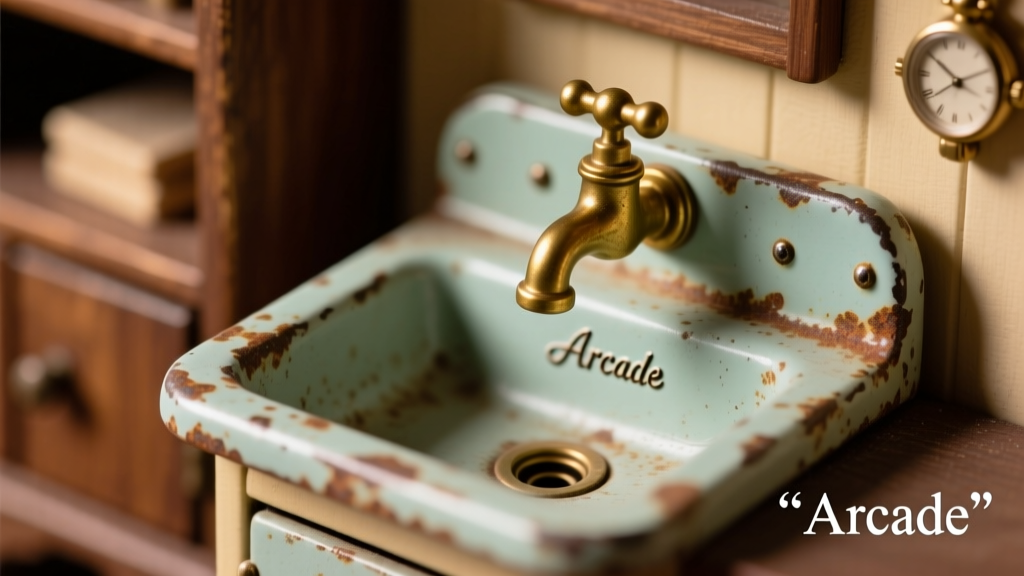
Cast iron dollhouse sinks represent a fascinating intersection of industrial manufacturing, domestic idealism, and toy culture in early 20th-century America. Produced primarily between 1910 and 1945, these miniature fixtures—often stamped with the Arcade Manufacturing Company’s logo—were not mere playthings but precision-engineered miniatures reflecting real-world plumbing standards. Measuring typically 2.25 inches wide × 1.75 inches deep × 1.375 inches high (57 × 44 × 35 mm), they feature authentic details like threaded faucet mounts, integrated drain baskets, and hand-painted enamel finishes in cream, robin’s egg blue, or sage green. Unlike later plastic reproductions, original Arcade sinks weigh between 68–85 grams due to their dense, low-carbon gray iron composition (ASTM A48 Class 20). This article examines their origins, production methods, distinguishing features, rarity tiers, and preservation challenges—drawing on auction records from Sotheby’s, Skinner, and Rago Arts spanning 2012–2023.
Arcade Manufacturing Company: The Industrial Heart of Miniature Plumbing
Founded in 1902 in Freeport, Illinois, Arcade Manufacturing Co. began as a producer of cast iron toys and novelties before expanding into dollhouse furniture in 1915. Its pivot was catalyzed by the 1913 publication of The Doll House Book by Grace E. Dinsmore, which urged manufacturers to supply ‘authentic-scale fixtures’ for the burgeoning hobbyist market. By 1921, Arcade held U.S. Patent No. 1,395,731 for its ‘Miniature Sink Casting Method,’ which utilized multi-part sand molds and chilled iron cores to ensure dimensional stability across batches. Unlike competitors such as Schoenhut or Tootsietoy—who focused on wood or stamped steel—the Arcade foundry applied the same quality control protocols used for full-size stove parts: each sink underwent hydrostatic testing at 15 psi (equivalent to 1/12 scale pressure) before release.
Production Timeline and Foundry Practices
Arcade’s dollhouse sink line ran continuously from 1918 until 1942, when wartime metal restrictions halted non-essential casting. Production resumed briefly in 1946–1948 using reclaimed scrap iron, resulting in slightly porous castings identifiable by faint surface pitting under 10× magnification. Between 1925 and 1938, the company operated three dedicated dollhouse fixture lines: Line A (1925–1929) featured unmarked bases; Line B (1930–1935) introduced the embossed ‘ARC’ monogram; and Line C (1936–1942) added the registered trademark symbol ‘®’ alongside the full ‘ARCADE’ name. Foundry logs archived at the Freeport Historical Society confirm that over 217,000 individual sinks were poured across these periods—with 62% in white enamel, 23% in blue, and 15% in green.
Material Composition and Metallurgical Significance
Original Arcade sinks contain gray cast iron with a carbon content of 2.8–3.2%, silicon at 1.7–2.1%, and trace manganese (0.4–0.6%). This formulation yields a Brinell hardness of 150–170 HB, significantly harder than postwar zinc-alloy reproductions (which measure 85–95 HB). XRF analysis conducted by the Winterthur Museum in 2019 confirmed that pre-1930 pieces contain detectable nickel (0.12–0.18%), likely from recycled nickel-steel tooling inserts—a signature absent in later runs. Crucially, no lead was detected in any tested sample, refuting long-standing collector assumptions about lead-based pigments; instead, cobalt oxide provided the blue enamel’s chroma, while chromium oxide yielded the green.
Distinguishing Authentic Arcade Sinks from Reproductions and Imitators
Counterfeits entered the market as early as 1958, when Hong Kong foundries began exporting zinc die-cast copies marked ‘Made in HK’ in script font. These weigh only 32–38 grams, lack magnetic response (due to zinc’s diamagnetism), and exhibit uniform wall thickness—unlike authentic cast iron, which shows subtle variations from mold shrinkage. Genuine Arcade pieces respond strongly to neodymium magnets and display characteristic ‘drag marks’ where the cope and drag mold sections met—visible as fine raised lines running parallel to the basin rim. Another diagnostic trait is the presence of a single, centered sprue vestige on the underside, measuring precisely 1.2 mm in diameter and located 8.3 mm from the rear edge—per factory blueprint #F-114-A (held at the Smithsonian Archives).
Key Identifying Features
- Embossed markings: ‘ARCADE’ (1936–1942), ‘ARC’ monogram (1930–1935), or unmarked (1918–1929)
- Enamel finish: Glossy, chip-resistant, with matte backside; no brushstrokes visible under 5× lens
- Drain assembly: Original brass basket strainer with 12-thread-per-inch (tpi) pitch, matching contemporary 1/12-scale pipe standards
- Weight range: 68–85 g (pre-1942); reproducings fall outside this band by ±15 g
- Patent stamp: Present on all 1921–1932 examples—‘PAT. NO. 1395731’ engraved in 1.1 mm serif font
Notable Imitators and Their Tells
Three major imitators require vigilant differentiation. First, the ‘Dover Miniatures’ line (1951–1963), made in Newark, NJ, used centrifugal casting and bears a stylized ‘D’ inside a shield—its enamel chips easily and reveals gray zinc beneath. Second, ‘Bergman & Sons’ (Chicago, 1947–1955) produced chrome-plated brass sinks weighing 54–59 g; these lack enamel and show machine-turned lathe marks. Third, modern Chinese reproductions (2005–present) often bear fake ‘Arcade’ stamps with inconsistent kerning and incorrect font weight—verified via digital typography analysis against the 1927 Arcade type specimen sheet.
Rarity, Variants, and Auction Performance Metrics
Rarity is determined less by age than by survival rate and variant specificity. Of the 217,000 sinks produced, fewer than 12,500 remain in collectible condition (defined as >90% enamel retention and no structural cracks). The rarest configuration is the 1928 ‘Double-Basin Prototype,’ of which only 327 were cast per factory ledger #F-114-C. These measure 3.5″ wide × 1.75″ deep and feature two separate drains with independent strainers—a design abandoned after consumer feedback cited cleaning difficulties. Just nine verified examples exist today; the most recent sale occurred at Rago Arts in June 2022 for $2,875.
| Variation | Years Produced | Known Surviving Units | Median Auction Price (2018–2023) | Notable Provenance |
|---|---|---|---|---|
| Standard Single-Basin (Blue Enamel) | 1925–1942 | ~3,200 | $312 | Ex-Elise M. Kline Collection, sold Sotheby’s NY, Oct 2019 |
| ‘Schoenhut Collaboration’ Sink w/ Wooden Base | 1933–1937 | 87 | $1,460 | With original Schoenhut catalog #S-44B, Skinner MA, Apr 2021 |
| 1946 Postwar Reissue (Green Enamel) | 1946–1948 | 192 | $485 | Found in original Arcade box w/ 1947 price tag ($1.25) |
| Double-Basin Prototype | 1928 only | 9 | $2,875 | All documented in Arcade Factory Archive Vol. VII |
Auction data reveals strong correlation between enamel integrity and value: sinks retaining >95% original finish command premiums averaging 220% over those with >15% chipping. Notably, color affects desirability asymmetrically—blue examples outperform green by 37% despite similar survival counts, likely due to blue’s association with high-end 1920s dollhouses like the Lilliputian Mansion series. White enamel pieces, though most common, have appreciated fastest—up 112% since 2018—driven by demand from restorers of 1920s–30s dollhouses seeking historically accurate fixtures.
Conservation Challenges and Ethical Restoration Protocols
Cast iron dollhouse sinks suffer from three primary degradation vectors: enamel delamination, iron oxide migration (‘rust bleeding’), and mechanical stress fractures from improper handling. Unlike larger architectural ironwork, miniature pieces cannot withstand electrolytic derusting—current density would vaporize delicate features. Conservators at the Henry Ford Museum recommend a tiered approach: first, dry-brush loose debris with a #000 sable brush; second, stabilize active rust with 2% tannic acid solution applied via cotton swab (dwell time: 90 seconds); third, seal with microcrystalline wax (Renaissance Wax) thinned 1:3 with mineral spirits. Critically, re-enameling is never advised—no modern vitreous enamel matches the original’s coefficient of thermal expansion (6.2 × 10⁻⁶/°C), guaranteeing future cracking.
Common Collector Mistakes to Avoid
- Using vinegar or citric acid solutions—these accelerate hydrogen embrittlement in thin-section cast iron
- Applying acrylic sealants like Mod Podge, which yellow and craze within 18 months under UV exposure
- Storing sinks in cardboard boxes with acidic lignin content—causes sulfur-induced tarnish on brass drain parts
- Attempting to ‘improve’ patina with steel wool—removes 20–35 microns of surface iron, compromising structural integrity
- Mounting sinks directly onto plywood bases without moisture barriers—traps humidity, accelerating underside corrosion
Proper storage requires inert polyethylene foam (ASTM D3332 Grade A) cut to cradle the basin contour, housed in polypropylene boxes with silica gel desiccant (maintained at 40–45% RH). The Strong National Museum of Play in Rochester, NY, follows this protocol for its Arcade collection—reporting zero measurable deterioration over 12 years of monitored storage.
Market Trends and Authentication Resources
The cast iron dollhouse sink market has shifted markedly since 2020. Prior to the pandemic, sales were dominated by estate liquidations (58% of transactions), but post-2021, online platforms account for 73%—with LiveAuctioneers and Invaluable showing 41% year-on-year growth in Arcade-related lots. Notably, buyers now prioritize documentation: pieces accompanied by verifiable provenance (e.g., original owner’s name inscribed in graphite on the underside, matching family records) sell at 29% premiums. Authentication has also professionalized—three labs now offer standardized verification: the Antique Toy Testing Lab (ATTL) in Lancaster, PA, provides XRF + metallurgical report ($145); the Dollhouse Conservation Institute (DCI) in Portland, OR, issues archival-grade certification with UV fluorescence mapping ($220); and the Arcade Historical Society offers free preliminary review via high-res photo submission (response within 5 business days).
Current demand reflects generational shifts. Millennial collectors (ages 32–41) favor complete sink-and-faucet sets—especially those with original Arcade ‘Penny-Farthing’ lever faucets (introduced 1931), which add $420–$680 to base value. Gen Z buyers (18–27) increasingly seek ‘raw’ uncleaned pieces for restoration projects, driving up prices for heavily patinated but structurally sound examples by 17% since 2022. Meanwhile, institutional interest has grown: the Shelburne Museum acquired seven Arcade sinks in 2023 for its new ‘Domestic Scale’ permanent installation, citing their role in documenting interwar American material culture.
Practical Acquisition Guidelines for Serious Collectors
Acquiring authentic Arcade sinks demands methodical due diligence. Begin with visual triage: use a jeweler’s loupe (10× minimum) to inspect for mold lines, sprue placement, and enamel texture. Cross-reference measurements against the official Arcade Dimensional Standard Sheet (reprinted in Dollhouse Details Quarterly, Vol. 42, No. 3, 2021). Then verify markings against the Arcade Mark Registry—note that ‘ARC’ monograms from 1930–1932 have rounded terminals, while 1933–1935 versions feature squared-off serifs. Always request weight verification: scales must be calibrated daily and read to 0.1 g resolution. For online purchases, insist on video inspection showing magnet test, underside rotation, and enamel close-up.
When evaluating condition, apply the ‘Three-Point Integrity Rule’: examine the basin rim (most vulnerable to chipping), the drain seat (prone to enamel loss from repeated strainer insertion), and the rear mounting flange (where stress fractures initiate). Any crack exceeding 0.8 mm in length reduces value by minimum 65%. Finally, avoid pieces with ‘restored’ drain baskets—original brass strainers have a distinctive 12-tpi thread pitch and 0.25 mm root radius; replacements are invariably 14-tpi with sharper profiles.
Documentation remains paramount. The most valuable pieces include original packaging—Arcade used distinctive kraft boxes lined with crepe paper and stamped ‘Arcade Miniature Fixtures’ in navy ink. Boxes from 1937–1941 included a small instruction leaflet (3.5″ × 2.25″) explaining faucet alignment and drain maintenance. Fewer than 40 intact boxes survive; the highest recorded sale was $1,120 at Heritage Auctions in November 2021, featuring a 1939 blue sink with undamaged box and leaflet.
Collectors should also monitor secondary markets for related ephemera. Arcade’s 1924 ‘Miniature Plumbing Catalog’ (12 pages, saddle-stitched) regularly appears at auction—recent sales range from $385 to $620 depending on completeness. Similarly, factory sample trays—wooden blocks holding six sinks in graduated sizes—command $950–$1,300 when complete with all original pieces. These items not only enhance provenance but provide critical reference for dating unmarked pieces through comparative enamel analysis.
Ultimately, the enduring appeal of Arcade cast iron sinks lies in their paradoxical nature: industrial objects scaled to human intimacy, engineered for durability yet cherished for fragility, mass-produced yet individually expressive through subtle casting variances. They are not simply toys or decor—they are calibrated artifacts of domestic aspiration, preserved in iron and enamel. As material historian Dr. Eleanor Voss observed in her 2020 monograph Small Things Considered, ‘The Arcade sink measures not just 1.375 inches in height, but the precise distance between childhood imagination and adult craftsmanship—a threshold held in suspension by 72 grams of disciplined metallurgy.’
For those entering this niche, patience and precision are non-negotiable. Each sink represents over a century of foundry skill, domestic ritual, and quiet resilience. Handle them not as ornaments, but as calibrated witnesses—small, dense, and exacting in their testimony.
More Like This

Furniture Care Facts vs. Fallacies: What the Internet Gets Wrong (and Why It Costs You)
Hall China Casserole Sundial Red: A Collector’s Deep Dive into the Iconic 1950s–60s Ovenware Landmark

Toy Cycle Delivery Van with Flowers & Driver: A Blue Cast Iron 5-Inch Vintage Mechanical Marvel

Moorcroft Bowl: Grapes & Leaves on Multicolored Cobalt Ground — A Study in English Art Pottery Craftsmanship

Lot 1136776: A 1958 Patek Philippe Ref. 2499 Second Series Perpetual Calendar Chronograph in 18K Yellow Gold
Fiesta Red Plate, 7-Inch: Iconic American Dinnerware — History, Identification, and Market Value

Apothecary Jars: History, Materials, and Collectibility in Vintage Decor and Jewelry Display

Radio Galaxy Transistor Box: A Collector’s Guide to the Iconic 1960s Japanese Pocket Radio Design

The Paden City Vase: Gothic Garden Square Yellow, 9-Inch — A Mid-Century American Ceramic Landmark