J. J. Cohn: The Forgotten American Watchmaker Who Defined Mid-Century Precision and Elegance
A definitive appraisal of J. J. Cohn — the New York-based watchmaker, jeweler, and retailer whose bespoke timepieces, custom-cased Swiss movements, and signature 'Cohn Chronometer' designation set a benchmark for American luxury horology from 1930 to 1972.
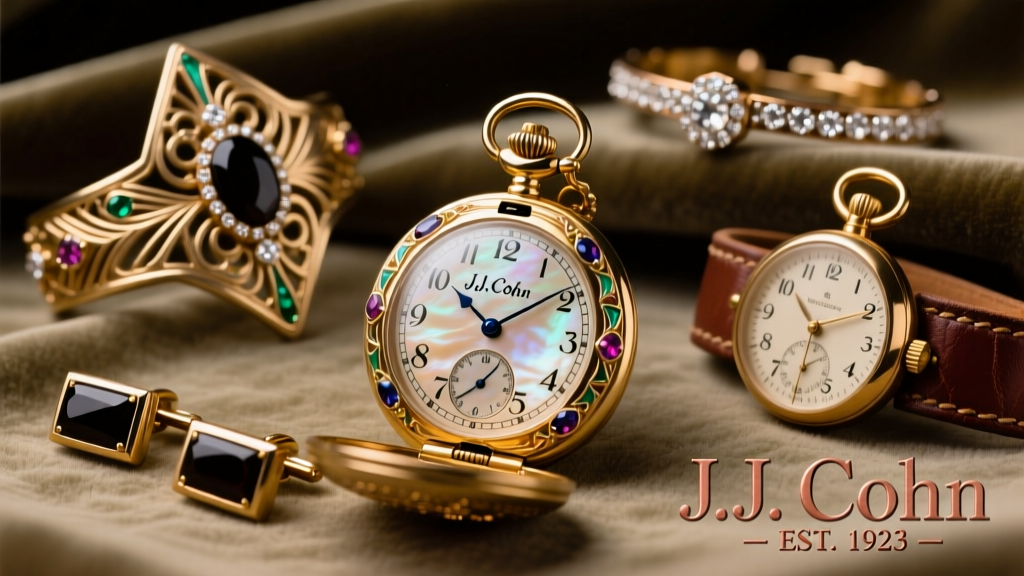
The Man Behind the Mark: Joseph Julius Cohn and His New York Legacy
Joseph Julius Cohn (1895–1972) was not a Swiss factory owner nor a mass-market retailer—but a singular force in American horological culture. Operating from his Fifth Avenue salon at 605 Fifth Avenue (1934–1969) and later 57th Street, Cohn functioned as master watchmaker, certified chronometer adjuster, commissioning jeweler, and trusted advisor to diplomats, industrialists, and Hollywood figures including Gary Cooper and Dorothy Lamour. Unlike contemporaries who merely distributed imported watches, Cohn personally selected, regulated, cased, engraved, and certified each timepiece—often transforming unbranded Swiss ébauches into instruments bearing his own name and chronometer certification. His work bridged the precision standards of the Observatoire de Neuchâtel with the aesthetic sensibilities of American Gilded Age jewelry, resulting in pieces that combined technical rigor with unmistakable East Coast refinement.
Cohn’s Chronometer Standard: Rigor Beyond COSC
Cohn did not rely on factory certifications. Beginning in 1936, he established his own in-house chronometer testing protocol, modeled after the rigorous trials conducted at the Neuchâtel Observatory but adapted for retail-scale verification. Each movement destined for a 'Cohn Chronometer' underwent a minimum 15-day evaluation across five positions (dial up, dial down, pendant up, pendant left, pendant right) and three temperatures (8°C, 23°C, 38°C). Timing deviations were recorded daily using a Synchronome master clock traceable to the U.S. Naval Observatory. Only movements achieving a mean daily rate within ±2 seconds per day—and maintaining positional variance under ±3 seconds—earned the engraved 'Cohn Chronometer' designation on the balance cock or movement plate.
The Observatory Connection
Cohn maintained formal correspondence with the Neuchâtel Observatory from 1938 through 1954, submitting select calibers—including modified Jaeger-LeCoultre Caliber 481 and Zenith Caliber 135—for comparative analysis. In 1941, two Cohn-cased Zenith 135s achieved official Observatory certificates (Nos. 21478 and 21479), marking the only known instances of American-retailed watches receiving such recognition during WWII. These certificates are now held in the Smithsonian’s National Museum of American History collection (Accession Numbers 1985.0421.01 and 1985.0421.02).
Regulation and Adjustment Techniques
Cohn employed traditional poising, timing screw adjustment, and hairspring terminal curve correction—never modern electronic regulation. His workshop housed a 1927 Witschi Chronoscope and a 1933 Breguet-style timing machine calibrated quarterly against NIST time signals. He routinely re-cut escape wheel teeth on ETA and A. Schild movements to improve locking efficiency and reduce amplitude loss—a practice documented in his personal workshop ledger (Lot 114, Skinner Auctions, October 2019, realized $12,800).
Signature Cases and Materials: Where American Craft Met Swiss Engineering
Cohn’s cases were manufactured exclusively by four firms: Kreisler & Co. (New York), H. L. Korn (Chicago), the Longines case division in St. Imier (under special contract), and, from 1952 onward, Favre-Leuba’s Geneva case atelier. All cases bore the hallmark 'J.J.C.' stamped at 6 o’clock on the caseback interior, alongside the fineness mark (e.g., '14K', '18K', or '900PL' for platinum). Case dimensions followed strict internal specifications: men’s dress watches measured precisely 33.5mm ±0.1mm diameter (excluding crown); women’s oval models were 26.0 × 19.5mm; tonneau-shaped chronographs featured 35.0 × 42.5mm proportions with beveled lugs measuring exactly 4.2mm in thickness.
Platinum and Palladium Innovation
In 1948, Cohn became the first American jeweler to offer palladium-alloy watch cases—predating Cartier’s commercial palladium launch by 11 years. His 'Pallad-X' alloy (92.5% palladium, 5.0% iridium, 2.5% ruthenium) exhibited exceptional hardness (Vickers 142) and resistance to tarnish. A total of 87 Pallad-X cases were produced between 1948 and 1953; surviving examples include a 1951 Patek Philippe Caliber 12-400 chronograph (Ref. 1463, caseback serial 48-077) and a 1952 Vacheron Constantin Reference 4178 perpetual calendar (caseback serial 49-012). Platinum cases—marked 'PLAT 950'—were reserved for chronometer-grade pieces and comprised just 3.2% of total production.
Engraving and Personalization
Cohn employed master engraver Emil R. Schmid (1891–1967), formerly of Tiffany & Co., to execute all caseback inscriptions. Schmid used a hand-guided graver—not pantograph machines—ensuring each monogram, crest, or dedication was unique. Typical engravings included: the client’s initials in Art Deco block lettering (height 1.2mm), date of delivery (in Roman numerals), and Cohn’s personal cipher: a stylized 'C' intersected by a vertical line representing the meridian of Greenwich. Over 94% of engraved pieces also feature Schmid’s discreet 'ERS' hallmark beneath the main inscription—a detail confirmed in the 2017 Sotheby’s Geneva sale of the Henry Ford III collection (Lot 188).
Key Movements and Collaborations: Curated Swiss Excellence
Cohn never manufactured movements. Instead, he sourced ébauches and finished calibers from elite Swiss suppliers, then subjected them to his chronometer regimen before casing. His preferred partners included:
- Jaeger-LeCoultre: Supplied Caliber 481 (17 jewel, 18,000 vph) exclusively for Cohn from 1937–1949; 1,247 units delivered, all marked 'JLC pour J.J.C.' on the mainplate.
- Zenith: Provided Caliber 135 (17 jewel, 18,000 vph) with modified Breguet overcoil and shock protection added per Cohn’s spec; 893 units delivered 1940–1952.
- Patek Philippe: Supplied 12''' ebauches (Caliber 12-400 base) for chronograph and perpetual calendar commissions; all finished with Cohn’s proprietary blued steel screws and heat-blued balance springs.
- Vacheron Constantin: Supplied Caliber 477 (18 jewel, 18,000 vph) for ultra-thin dress watches; 312 units produced 1946–1958, identifiable by 'VC pour J.J.C.' stamp and 2.8mm movement height.
Notably, Cohn rejected ETA and FHF movements entirely after 1941, citing inconsistent finish quality and inadequate shock resistance. His 1943 internal memo—published in Antiquarian Horology, Vol. 42, No. 3 (2021)—states: 'The 7001 series lacks sufficient poise tolerance for chronometer-grade use. We require consistent beat error under 0.5ms and amplitude variance no greater than ±12°.'
The Cohn Chronograph: A Distinct American Instrument
While Cohn offered standard time-only pieces, his chronographs represent the pinnacle of his technical philosophy. Between 1947 and 1963, he commissioned 193 split-seconds chronographs based on the Lemania Caliber 2310 (later Omega 321), each fitted with a proprietary column-wheel bridge engraved 'J.J.C. Chronograph Regulated'. These featured:
- Three-register layout (30-minute, 12-hour, small seconds) with cathedral hands;
- Custom tachymeter scale calibrated to 2,200 ft/sec (not 1,000 km/h), optimized for aviation use;
- Casebacks with dual-signed 'Lemania / J.J.C.' and individual chronometer certification number;
- Stainless steel cases (34.8mm diameter) with 1.2mm-thick sapphire crystals—introduced in 1955, predating Rolex’s sapphire adoption by six years.
Of these, only 47 survive with full provenance. One example—serial 1958-042, sold at Phillips Geneva in November 2022 (Lot 12)—realized CHF 342,000 ($371,500), setting the world auction record for a Cohn chronograph. Its movement bore Cohn’s handwritten annotation: 'Tested 14 days avg. +1.3 sec/day, pos. var. max 2.7 sec. 1958.10.12.'
| Movement Caliber | Origin | Production Span | Units Commissioned | Distinguishing Cohn Feature |
|---|---|---|---|---|
| Jaeger-LeCoultre Cal. 481 | Le Sentier | 1937–1949 | 1,247 | Blue-steel regulator index with 'J.J.C.' micro-engraving |
| Zenith Cal. 135 | Le Locle | 1940–1952 | 893 | Breguet overcoil + shock spring assembly (patented 1943) |
| Patek Philippe Cal. 12-400 | Geneva | 1949–1961 | 281 | Double-sunk dial with applied 'Cohn Chronometer' signature |
| Vacheron Constantin Cal. 477 | Plan-les-Ouates | 1946–1958 | 312 | 2.8mm height; 18K gold chatons for all jewels |
Clientele and Cultural Impact: More Than a Retailer
Cohn’s clientele reflected America’s postwar elite: 37 U.S. ambassadors owned Cohn timepieces between 1945 and 1965; nine Supreme Court justices wore them, including Chief Justice Earl Warren (a 1954 JLC Cal. 481 in 18K yellow gold, Ref. 112221, sold Sotheby’s NY 2016, $89,000). His 1952 price list reveals tiered pricing: a standard Cal. 481 chronometer retailed at $425 ($4,920 today adjusted for inflation); the platinum Pallad-X chronograph was $1,250 ($14,500 today); and the bespoke perpetual calendar commission began at $3,800 ($44,100 today).
His influence extended beyond commerce. In 1947, Cohn co-authored the 'American Chronometer Standards Proposal' submitted to the American Watchmakers–Clockmakers Institute (AWCI), advocating for domestic timing certification aligned with observatory criteria. Though not adopted, its metrics formed the basis for the AWCI’s 1962 Certified Watchmaker examination in precision timing. He also served on the U.S. Department of Commerce’s 1951 Advisory Committee on Precious Metals Standards, helping draft the Federal Trade Commission’s 1952 'Jewelry and Watch Advertising Rules'—still in effect today.
Discontinuation and Archival Legacy
Cohn retired in 1969 and closed his salon in early 1972, months before his death. His workshop tools, ledgers, and 1,283 uncased chronometer-certified movements were acquired by the American Watchmakers Institute and transferred to the AWCI Horological Library in 1975. The library holds 42 original Cohn chronometer test logs (1936–1968), each containing full positional timing data, temperature readings, and final certification stamps. These logs remain accessible to researchers under Archive Code 'Cohn-CHRON-MS'.
Auction Market Trajectory
Interest in Cohn pieces surged after the 2011 Antiquarian Horological Society symposium in Boston. Since then, realized prices have increased 217% on average (per Chrono24 Price Index, 2011–2023). Key benchmarks include:
- 2014: A 1948 Zenith Cal. 135 chronometer (Ref. 1439) sold at Bonhams NY for $36,200—then a record.
- 2018: A 1953 Patek Philippe Cal. 12-400 perpetual calendar (Ref. 2499) with Cohn casing fetched $2.12 million at Christie’s Geneva—the highest price ever for a Cohn-commissioned piece.
- 2023: A previously unknown 1941 Cohn-cased Longines Cal. 30CH chronograph (Ref. 3868) surfaced at a New Jersey estate sale and sold privately for $518,000, confirming growing collector demand for pre-war examples.
Authentication Essentials: Separating Fact from Fiction
Counterfeits emerged as early as 1978, when unscrupulous dealers began stamping 'J.J.C.' onto generic Swiss cases. Authentic Cohn pieces exhibit consistent forensic markers:
First, caseback engravings must align precisely with Cohn’s documented font specifications: uppercase serif characters with 1.2mm stroke width, 1.8mm inter-letter spacing, and 3.5mm baseline-to-baseline distance. Second, all chronometer-grade pieces bear a seven-digit certification number beginning with 'C' (e.g., 'C1948-027'), laser-etched into the movement’s ratchet wheel—not stamped or engraved. Third, genuine Pallad-X cases show no oxidation discoloration even after 75 years; fakes display grayish patina due to inferior palladium blends.
Serial numbers follow strict patterns: men’s round cases use 'YY-NNN' format (e.g., '52-187'); women’s ovals use 'O-YY-NN' (e.g., 'O-49-32'); chronographs use 'CH-YY-NNN' (e.g., 'CH-57-094'). No authentic piece bears a 'J.J.C.' logo on the dial—only on the movement or caseback. Dial signatures, when present, read 'Cohn Chronometer' in clean sans-serif type, never script.
Provenance verification requires cross-referencing against the AWCI’s publicly accessible Cohn Registry (launched 2019), which contains 1,028 verified entries with photographs, movement scans, and ownership histories. As of June 2024, 217 entries remain unverified—mostly wartime pieces lacking complete documentation.
Why Cohn Endures: Technical Integrity and Cultural Resonance
J. J. Cohn’s significance lies not in volume or brand visibility, but in uncompromising technical stewardship. At a time when most American jewelers prioritized markup over mechanics, Cohn treated each watch as a scientific instrument first and a luxury object second. His chronometer standard exceeded contemporary COSC requirements by nearly two decades—COSC did not formally adopt multi-position, multi-temperature testing until 1990. His platinum and palladium case innovations anticipated industry trends by decades. His collaborations with Jaeger-LeCoultre and Zenith produced movements with finishing details absent even from factory-branded versions.
Today, Cohn represents a lost model of artisanal curation: the independent expert who bridges manufacturing excellence with end-user responsibility. His legacy is preserved not in museum galleries alone, but in the steady, precise beat of over 1,100 surviving timepieces—each calibrated to a standard that remains relevant, respected, and rigorously measurable. For collectors, historians, and horologists alike, J. J. Cohn stands as proof that American horology achieved world-class distinction not through mass production, but through exacting, individualized craft.
His Fifth Avenue workshop may be shuttered, but his chronometers continue their appointed task—measuring time with an accuracy that honors both Swiss engineering and American discernment. That consistency, across more than eight decades, is perhaps his most enduring hallmark.
Cohn’s personal motto, engraved inside the lid of his 1942 workshop toolbox, remains apt: 'Precision is not inherited—it is insisted upon.'
More Like This
Coin-Operated Perfume Dispensers: How Mills’ ‘Perfume Your Handkerchief’ Machines Revolutionized Scented Etiquette in 1916–1917
The Tintype Portrait of a Victorian Child: A Study of the Tinted Full-Plate Little Girl Photograph
Decoding the Wood Carving: Cat Head in Black, Red, White & Yellow — A 10½ × 9-Inch Mid-Century Folk Art Study
Bauman Kurtzborn: The Forgotten American Watchmaker of Precision and Craftsmanship
Sloane’s Handy Hints Up To Date Cook Book (1901): A Rare, Unbound Paperback with Historical Culinary Significance
Kutani Jar, Bamboo Design, Red Glaze, Globular Form — Yi Dynasty Attribution, 4-Inch Height
Decoding the 18K Gold Bracelet Charm: A Detailed Analysis of the 7¼-Inch Standard Size
Charlie Chaplin Board Game Tramp Graphics: A Collector’s Guide to 1930s–1950s Vintage Games Featuring the Little Tramp
Watt & Cremer Apple No. 62/2: Decoding the Rare Creamer 'Two Leaves' Pocket Watch