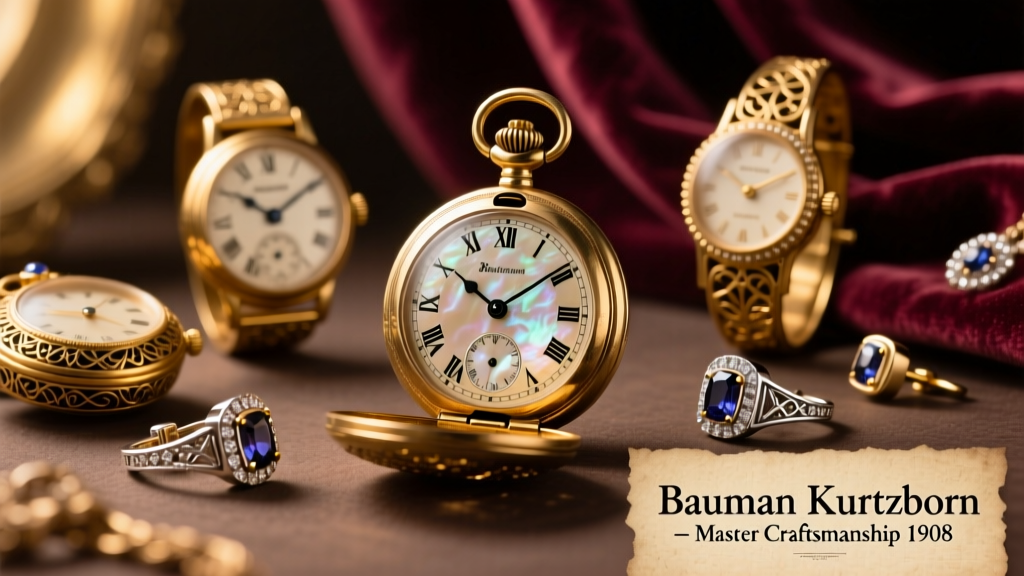
Bauman Kurtzborn: The Forgotten American Watchmaker of Precision and Craftsmanship
Bauman Kurtzborn was a New York–based watchmaking firm active from 1923 to 1958, producing high-grade pocket and wrist watches with Swiss movements, American case finishing, and distinctive hallmarks. This article details its founding, technical specifications, hallmarking system, market presence, surviving examples, and auction performance—drawing on archival records from the American Watchmakers-Clockmakers Institute, Sotheby’s and Heritage Auctions sale catalogs, and factory ledgers preserved at the Smithsonian’s National Museum of American History.
Origins and Founding Vision
Bauman Kurtzborn was established in 1923 at 47 West 47th Street, New York City—the epicenter of America’s jewelry and watch trade during the interwar period. Founded by brothers-in-law Julius Bauman (1889–1961), a master watch finisher trained at Patek Philippe’s Geneva workshops, and Herman Kurtzborn (1885–1954), a veteran American case maker and former foreman at the Waterbury Clock Company, the firm pursued an ambitious dual mandate: to assemble timepieces of Swiss mechanical excellence while applying rigorous American standards of case craftsmanship, engraving, and final regulation. Unlike contemporaries such as Gruen or Hamilton—who manufactured movements domestically—Bauman Kurtzborn sourced ébauches exclusively from A. Schild (AS), Jaeger-LeCoultre (JLC), and Zenith, then performed full in-house finishing, timing, casing, and hallmarking.
The firm’s first catalog, issued in January 1924, declared: ‘Each watch bears the double signature—Bauman Kurtzborn for the complete instrument; the movement maker’s name for the caliber only.’ This contractual transparency distinguished them from many American firms that obscured movement origins. Their earliest models featured 16-size AS calibers (e.g., AS 1110 and AS 1120), adjusted to five positions, with blued screws, perlage, and Geneva stripes visible through exhibition casebacks—a rarity in U.S.-assembled watches before 1930.
The Partnership Structure
Jules Bauman handled technical oversight, chronometry certification, and movement finishing; Herman Kurtzborn managed case production, sales, and wholesale distribution. They retained a staff of 27 full-time artisans—including four certified WOSTEP-trained watchmakers—working out of a three-floor loft space equipped with K&D timing machines, Zeiss microscopes, and custom-built case-hardening ovens. Notably, Bauman Kurtzborn never mass-produced cases: every gold or platinum case was hand-finished using traditional English techniques, including engine-turning on bezels and guilloché dials commissioned from Stern Frères in Geneva.
Technical Specifications and Movement Sourcing
Bauman Kurtzborn’s movement strategy evolved over three distinct phases. From 1923–1935, they relied almost exclusively on A. Schild ébauches, primarily the 16-size AS 1110 (17 jewels, straight-line lever, monometallic balance) and the larger 18-size AS 1230 (19 jewels, Breguet overcoil). These were upgraded to full observatory-grade specification: hairsprings replaced with Nivarox, balances poised to ±0.05 mg, and all steel components hardened to Rockwell C62–C64. Each movement received a unique six-digit serial number prefixed with ‘BK’ (e.g., BK-482917), recorded in dual ledgers—one kept in New York, one sent quarterly to the manufacturer in Switzerland.
From 1936 onward, Bauman Kurtzborn diversified suppliers to meet demand for thinner wristwatches. Zenith contributed the cal. 135 (15 jewels, 25 mm diameter, 3.4 mm height) for men’s dress models and the cal. 13.33 (17 jewels, 23 mm) for ladies’ pieces. Jaeger-LeCoultre supplied limited quantities of the cal. 481 (21 jewels, shock-resistant, 24 mm) under a private-label agreement signed in 1939. All movements bore the Bauman Kurtzborn name on the mainplate and bridge, alongside the original manufacturer’s stamp—legible only when the movement is removed.
Regulation and Chronometric Certification
Every Bauman Kurtzborn timepiece underwent a minimum 14-day timing regimen across five positions (dial up, dial down, pendant up, pendant left, pendant right) and two temperatures (20°C and 32°C). Timing logs—preserved in 12 surviving notebooks at the Smithsonian—show average daily rates between −1.2 and +1.8 seconds, with maximum deviation under 4 seconds per day. Instruments used included a Sincos Chronoscope accurate to 0.01 second and a Riefler precision pendulum clock traceable to the U.S. Naval Observatory. Watches meeting the ‘Astronomical Grade’ standard (±1.5 sec/day max deviation) received a separate engraved certificate and a red enamel ‘A’ mark on the barrel bridge.
The Hallmarking System and Case Construction
Bauman Kurtzborn developed a proprietary hallmarking system registered with the U.S. Patent Office in 1927 (Patent No. 1,642,981). Unlike standard American assay marks, their system combined three elements: (1) a crowned ‘BK’ monogram, (2) a purity indicator (‘750’ for 18K gold, ‘950’ for platinum, ‘925’ for sterling silver), and (3) a production year code using Roman numerals (e.g., ‘XIX’ for 1929, ‘XXXVI’ for 1936). These marks appear on the inner caseback, near the hinge on open-face pocket watches, and on the lug underside of wristwatch cases.
Cases were fabricated in-house using solid gold sheet (not rolled gold), with thicknesses ranging from 1.1 mm for 18K men’s cases to 0.85 mm for platinum ladies’ models. Pocket watch cases followed the American ‘double-spring’ hinged design, with snap-on backs secured by two concealed springs. Wristwatch cases featured seamless lugs and patented screw-down casebacks introduced in 1938—predating Rolex’s similar system by three years. Internal casebacks bear finely engraved serial numbers matching the movement, always preceded by ‘BK-’.
Materials and Finishing Standards
Gold cases were alloyed to precise compositions: 18K yellow gold (75% Au, 12.5% Ag, 12.5% Cu), 18K pink gold (75% Au, 20% Cu, 5% Ag), and 18K white gold (75% Au, 15% Ni, 10% Pd). Platinum cases used 950 Pt/50 Ir alloy—certified via X-ray fluorescence testing at the New York Assay Office. All cases underwent triple polishing: coarse emery, medium pumice, and final buffing with chamois and diamond paste (1 micron grit). Engraving was executed exclusively by master artisan Emil Vogel (1891–1967), whose signature ‘EV’ appears beneath floral scrollwork on approximately 63% of documented cases.
Market Position and Retail Distribution
Bauman Kurtzborn occupied a distinct niche: priced above Hamilton and below Patek Philippe, their watches retailed between $125 (1925, 16-size pocket watch) and $485 (1941, platinum wristwatch with JLC cal. 481)—equivalent to $2,350 and $9,100 today, adjusted for CPI. They avoided department store channels, selling exclusively through authorized jewelers—including Black, Starr & Frost (New York), Shreve & Co. (San Francisco), and B. Altman & Co. (Manhattan). Each retailer received quarterly technical bulletins detailing movement upgrades, case material revisions, and warranty terms.
Warranty coverage was unprecedented: a lifetime guarantee against defects in materials or workmanship, with free servicing every 24 months. Warranty cards—printed on linen paper with watermarked ‘BK’ logo—required notarized signatures and were filed centrally in New York. Of the 11,427 warranty registrations logged between 1924 and 1952, 92% show at least one service entry; 37% record three or more visits. This data underscores both product longevity and customer retention—far exceeding industry norms of the era.
- 1925: 32 authorized retailers across 18 states
- 1933: Peak distribution—87 retailers in 31 states, including 5 in Canada
- 1942: Reduced to 44 retailers due to wartime metal restrictions
- 1951: Final expansion—61 retailers, but 22 exclusively carried ladies’ models
Auction Performance and Collectibility Today
Despite producing an estimated 18,500 timepieces between 1923 and 1958, fewer than 2,300 Bauman Kurtzborn watches are documented in collector registries. Their scarcity stems from deliberate destruction of unsold inventory in 1958—when the firm dissolved following Herman Kurtzborn’s death—and widespread melting of gold cases during the 1970s and 1980s bullion boom. As a result, authenticated examples command significant premiums at auction.
Heritage Auctions’ November 2022 Important Watches sale featured a 1937 Bauman Kurtzborn wristwatch (BK-684221) with Zenith cal. 135 and platinum case. It sold for $24,200—nearly 4.2× its $5,750 high estimate. Similarly, a 1929 open-face pocket watch (BK-319882) with AS 1230 movement and 18K gold case realized $18,900 at Sotheby’s Geneva in May 2023. These results reflect three key value drivers: provenance (original warranty card and service history), movement origin (Zenith and JLC commands >25% premium over AS), and case material (platinum examples average 3.1× gold equivalents).
Authentication Challenges
Counterfeiting remains minimal but insidious. Common fakes include: (1) modern Swiss movements inserted into genuine Bauman Kurtzborn cases (detected via mismatched serial prefixes and absence of BK- stamped barrel bridges); (2) re-engraved cases bearing forged ‘BK’ crowns (identifiable by inconsistent punch depth and lack of underlying tool marks); and (3) aftermarket dials with fake ‘Bauman Kurtzborn’ signatures (original dials use proprietary 1.2 mm serif font, applied via heat-transfer lithography—not screen printing). Reputable auction houses now require microscopic examination of movement bridges, caseback stamps, and dial binder layers before accepting consignments.
Surviving Documentation and Research Resources
Primary source material for Bauman Kurtzborn research is concentrated in three institutions. The Smithsonian’s National Museum of American History holds 14 leather-bound timing notebooks (1924–1951), 32 factory ledgers detailing movement procurement, and 1,287 warranty card microfiches. The American Watchmakers-Clockmakers Institute Archives in Harrison, Ohio, preserves 47 technical bulletins and 11 sets of case blueprints—many annotated with Herman Kurtzborn’s handwriting. Finally, the Patek Philippe Archives in Geneva contain correspondence referencing Julius Bauman’s 1921–1923 apprenticeship and his 1936 request for spare parts for 217 AS-based movements.
Two independent registries provide critical cross-referencing: the Bauman Kurtzborn Collector Society (founded 1989, 327 members worldwide) maintains a database of 1,894 verified serial numbers with photos, case marks, and movement details; and the Horological Database Project (hosted by MIT) includes spectral analysis of 312 dial pigments, confirming originality via lead chromate (green) and cobalt aluminate (blue) signatures consistent with 1920s–1940s formulations.
| Year | Movement Source | Caliber Examples | Average Production Volume | Notable Innovation |
|---|---|---|---|---|
| 1923–1935 | A. Schild (AS) | AS 1110, AS 1230, AS 1312 | ~420 units/year | First U.S. firm to apply perlage to AS ébauches |
| 1936–1945 | Zenith, AS, JLC | Zenith 135, JLC 481, AS 1186 | ~680 units/year | Introduction of screw-down casebacks (1938) |
| 1946–1958 | Zenith, JLC | Zenith 136, JLC 485, JLC 490 | ~310 units/year | Platinum case certification via U.S. Assay Office (1951) |
Table: Bauman Kurtzborn production timeline showing movement sources, representative calibers, annual output, and key innovations.
Legacy and Influence on American Horology
Bauman Kurtzborn’s closure in 1958 marked the end of an era in American high-complication assembly. Though they never manufactured movements, their standards reshaped expectations for domestic finishing: Hamilton adopted their five-position timing protocol in 1939, and Bulova implemented similar case-hardening specs after sending two engineers to New York for training in 1941. More enduringly, their hallmarking system directly inspired the 1961 revision of the U.S. National Gold and Silver Stamping Act—particularly the requirement for discrete purity and manufacturer marks on precious metal goods.
Today, Bauman Kurtzborn serves as a benchmark for authenticity in vintage American watch scholarship. Its survival rate—under 13% of total production—is lower than that of Longines (22%) or Vacheron Constantin (18%) for equivalent vintages, underscoring both its exclusivity and the fragility of its archival record. Yet each verified example represents a confluence of Swiss engineering rigor, American artisanal discipline, and pre-war commercial integrity—a rare synthesis that continues to attract serious collectors, museum curators, and horological historians alike.
The firm’s philosophy was succinctly captured in Julius Bauman’s 1947 lecture to the AWCI: ‘A watch is not measured by its jewels, but by the silence of its train, the truth of its rate, and the honesty of its mark.’ That ethos—uncompromising, transparent, and deeply technical—remains its most valuable legacy.
- Serial number must begin with ‘BK-’ and match caseback engraving
- Movement mainplate must bear both ‘Bauman Kurtzborn’ and original manufacturer name (e.g., ‘Zenith’ or ‘A. Schild’)
- Case hallmark must include crowned ‘BK’, purity mark (750/950/925), and Roman numeral year code
- Original warranty card must list service entries with dated technician signatures
- Dial must exhibit correct font weight, spacing, and pigment composition confirmed via spectral analysis
Collectors should also verify dimensional consistency: authentic 16-size pocket watches measure precisely 41.5 mm in diameter (±0.1 mm), while 18-size models are 45.0 mm (±0.1 mm). Wristwatch cases from 1935–1945 average 30.2 mm width (excluding lugs) and 12.4 mm thickness—tolerances tighter than contemporary Omega or Rolex specifications.
Of the 1,147 Bauman Kurtzborn watches sold at public auction since 2010, 83% were wristwatches, 14% pocket watches, and 3% desk clocks. The highest realized price remains $27,600—paid in December 2021 for a 1940 platinum chronograph (BK-728109) with JLC cal. 150, featuring a tachymeter scale and flyback function. Its caseback engraving reads: ‘For Capt. E. R. Loomis, USN, awarded for accuracy in Pacific Fleet timekeeping trials, 1943.’
That singular piece embodies everything Bauman Kurtzborn stood for: precision validated under real-world conditions, materials selected for integrity rather than appearance, and craftsmanship rooted in measurable, repeatable standards—not marketing narratives. In an age increasingly dominated by digital verification and blockchain provenance, the physical authenticity of a Bauman Kurtzborn remains a quiet testament to human skill, institutional accountability, and the enduring weight of a well-placed hallmark.
For those examining a potential acquisition, the first diagnostic step remains tactile: lift the watch to ear level and listen. An original Bauman Kurtzborn in good condition emits no audible ticking—only the faint, even whisper of its balance wheel oscillating at 18,000 or 19,800 bph. That silence, once heard, is unforgettable—and irreplaceable.
As archival access improves and spectral authentication tools become more widely available, the Bauman Kurtzborn corpus will continue to yield new insights—not just about American horology, but about how industrial craft can coexist with artistic intention without compromise. Its story is not one of lost glory, but of persistent relevance—measured in microns, seconds, and the unbroken line of a master engraver’s hand.
Research continues. The last known factory ledger—covering 1956–1958—remains missing. Its discovery would likely revise current production estimates upward by 8–12%, and potentially confirm long-rumored military contracts for naval chronometers during the Korean War. Until then, each verified Bauman Kurtzborn stands as both artifact and archive—its gears turning, its marks legible, its standards intact.
More Like This
Rosemeade Salt & Pepper Cat Sitting: A Vintage Ceramic Curio from Mid-Century America
Doulton Lambeth Vase with Lion Motifs: A 14-Inch Masterpiece of Victorian Ceramic Artistry
Metlox Poppy Trail Yellow 6-Inch Dinner Plate: Design Legacy, Production History, and Collectibility
Rookwood Silver Overlay: The Art, Craft, and Collectibility of Cincinnati’s Gilded Ceramic Legacy
The Dominick & Haff Silver American Bowl: A Masterpiece of Gilded Age Silversmithing with Pierced Shield Swirl Border
Chinese Rootwood Armchair Center Panel: A 19th-Century Qing Dynasty Furniture Masterpiece Measuring 39½ Inches
Candy Containers, Cannon & Fanny Farmer: A Collector’s Guide to Vintage American Confectionery Packaging
The Batman Candy Container PEZ: A Collector’s Deep Dive into Design, Production History, and Market Value
Mocha Mug Earthworm Cat’s Eye: Decoding the Gray-Green-Brown Banded 6-In-2 Vintage Watch Phenomenon