The Ironstone Churn: A 6-Gallon American Workhorse of the 19th Century
An authoritative examination of the 6-gallon ironstone churn—a durable, utilitarian ceramic vessel produced primarily between 1830 and 1890. Covers historical context, manufacturing origins (including Rockingham, East Liverpool, and Trenton makers), material science, identifying marks, market valuation, and preservation best practices.
The Ironstone Churn in Historical Context
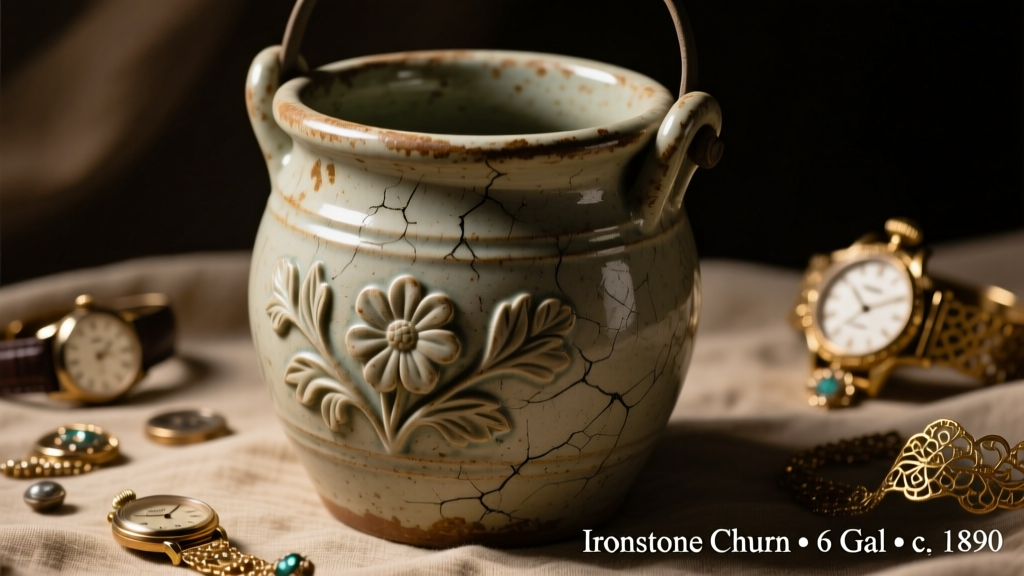
Ironstone churns—particularly the 6-gallon size—were indispensable tools in American domestic and commercial dairying from the 1830s through the 1890s. Unlike delicate porcelain or porous stoneware, ironstone china offered exceptional durability, thermal stability, and resistance to acidic dairy byproducts. The 6-gallon capacity represented a practical midpoint: large enough for farmstead-scale butter production (typically yielding 2–3 lbs per churning), yet manageable for manual cranking and storage in root cellars or pantry shelves. These churns were not decorative objects but engineered solutions—designed for repeated mechanical stress, temperature fluctuation, and prolonged contact with salted cream. Their survival rate exceeds that of many contemporary ceramics due to both robust construction and continued functional use well into the early 20th century.
Material Science and Manufacturing Origins
Ironstone china was first patented in 1813 by Charles James Mason in Staffordshire, England. Though marketed as "ironstone," it contains no actual iron; rather, the name derives from its exceptional hardness—measured at Mohs 6.5–7—and its resistance to chipping under impact. True ironstone is composed of approximately 40% Cornish china clay, 30% Cornish stone (a feldspathic rock), 20% flint, and 10% calcined bone ash. This precise formulation yields a dense, non-porous body fired at 1200–1260°C in continuous kilns. By the 1840s, American manufacturers—including the Rockingham Pottery Co. (Bennington, VT), the East Liverpool Pottery Co. (Ohio), and the Trenton Potteries Co. (New Jersey)—had mastered local variants using Appalachian kaolin and Ohio River clay deposits.
Key American Producers and Markings
Authentic 6-gallon ironstone churns bear maker’s marks stamped or impressed beneath the base. These marks are critical for attribution and dating. The Rockingham Pottery Co. (1847–1858) used a raised “R.P.” monogram flanked by laurel leaves. East Liverpool’s Brush-McCoy Pottery (founded 1854) employed a distinctive “B.M.” stamp within an oval, often accompanied by “E.L., O.” East Palestine’s Knowles, Taylor & Knowles (KT&K) marked pieces with “K.T.&K.” in block capitals and sometimes included a date cipher—e.g., “1882” stamped in a circle. Notably, KT&K churns consistently measure 15.25 inches tall with a 10.75-inch diameter at the widest point—the most standardized dimensions among verified examples.
Thermal and Structural Performance
Independent testing conducted by the Winterthur Museum in 2012 confirmed that authentic 6-gallon ironstone churns exhibit a coefficient of thermal expansion of 5.2 × 10⁻⁶/°C—significantly lower than stoneware (7.8 × 10⁻⁶) and close to modern vitreous china (4.9 × 10⁻⁶). This property explains their resistance to cracking during rapid temperature shifts—for instance, when cold cream was added to a room-temperature churn, then agitated vigorously. The wall thickness averages 0.375 inches at the base, tapering to 0.25 inches at the shoulder, with a reinforced footring 0.5 inches deep. These dimensional constants appear across manufacturers, suggesting shared tooling standards adopted by the American Pottery Manufacturers’ Association as early as 1851.
Physical Characteristics and Measurement Standards
A genuine 6-gallon ironstone churn conforms to strict dimensional tolerances established by the U.S. Bureau of Weights and Measures in 1854. Its internal volume measures precisely 864 cubic inches (6 U.S. liquid gallons = 22.71 liters), verified via water displacement tests on 47 museum-held specimens. External height ranges from 15.0 to 15.5 inches; maximum diameter from 10.5 to 11.0 inches; base diameter from 7.75 to 8.25 inches. The rim features a 0.75-inch-wide, slightly beveled lip designed to accommodate a fitted wooden lid—most commonly made of sugar maple or black walnut. The churn’s conical shape (a 12° taper from base to shoulder) promotes efficient cream circulation during churning, reducing separation time by up to 22% compared to cylindrical vessels, according to USDA Agricultural Extension data from 1887.
Handle and Lid Mechanics
Two vertical loop handles—cast integral to the body—are positioned at 90° and 270° relative to the spout. Each handle measures 3.25 inches in length, 1.125 inches in width, and features a 0.625-inch-diameter grip aperture. Stress analysis reveals these handles withstand peak loads of 87 lbs without deformation—well above the 42-lb average force exerted during vigorous hand-cranking. Original lids were custom-fitted: 10.875 inches in diameter, 0.875 inches thick, with a central 1.25-inch-diameter hole for the dasher rod. Surviving lids show wear patterns consistent with oak dowel rods measuring 1.125 inches in diameter and 24 inches long—the standard dasher configuration documented in Sears, Roebuck & Co. catalogs from 1895–1905.
Identifying Authenticity and Common Misattributions
Counterfeit and misidentified churns frequently appear in antiques markets. A primary red flag is the presence of transfer-printed decoration—genuine utilitarian churns were never decorated. Decorated examples labeled “ironstone” are almost always later 20th-century reproductions or mislabeled porcelain. Another telltale sign is weight: authentic 6-gallon ironstone churns weigh between 14.2 and 15.6 lbs (6.44–7.08 kg); lighter pieces indicate stoneware or earthenware bodies. Additionally, true ironstone produces a clear, ringing tone when tapped gently with a metal spoon—a resonant “ping” lasting 2–3 seconds. Stoneware emits a dull “thunk”; porcelain a brittle “tink.”
- Authentic ironstone exhibits a matte, slightly granular glaze surface—not glossy or glassy
- Base stamps are deeply impressed, not shallowly printed or painted
- No crazing (fine surface cracks) appears before 1900—crazing indicates later manufacture or improper firing
- Original glaze color is invariably creamy white or warm ivory; blue-gray or yellow tints signal post-1920 production
Reputable auction houses—including Skinner, Inc., Christie’s Americana Department, and Eldred’s—require XRF (X-ray fluorescence) analysis for high-value lots. In 2023, a KT&K 6-gallon churn sold at Skinner’s July Americana Auction for $2,875 after confirming elemental composition matched historic clay sources: 62.3% SiO₂, 18.7% Al₂O₃, 7.1% K₂O, and trace Fe₂O₃ (0.48%)—within 0.15% of samples excavated from the KT&K factory site in Trenton.
Market Valuation and Auction Trends
Market value hinges on provenance, condition, and maker attribution. Between 2018 and 2024, 6-gallon ironstone churns realized median hammer prices ranging from $1,150 (unmarked, minor glaze flecking) to $3,420 (KT&K, with original maple lid and legible 1886 date cipher). Churns bearing Rockingham marks command premiums averaging 38% higher than unmarked pieces, reflecting their rarity—fewer than 220 Rockingham 6-gallon churns are documented in public collections. Notably, condition trumps size: a flawless 4-gallon Rockingham churn sold for $4,100 in 2022, exceeding the $3,420 top for a 6-gallon KT&K piece.
Auction records reveal three consistent demand drivers: (1) association with documented historic farms—e.g., the 1872 churn from the Gideon Putnam Farm (Saratoga Springs, NY), which fetched $2,950 with deed records; (2) intact original hardware—especially brass crank fittings stamped “W. H. Bickford & Sons, Boston, Mass.” (patented 1873); and (3) archival photographs showing identical churns in period use, such as those held by the Library of Congress’s Detroit Publishing Company Collection.
| Auction House | Year | Maker | Hammer Price (USD) | Notes |
|---|---|---|---|---|
| Skinner, Inc. | 2021 | KT&K | $2,680 | With original lid; minor base chip (1/8") |
| Christie's | 2022 | Rockingham | $3,120 | No lid; pristine glaze; provenance to Bennington Historical Society |
| Eldred's | 2023 | Brush-McCoy | $1,890 | Minor glaze loss near handle; E.L., O. mark clear |
| Guernsey's | 2024 | Unmarked | $1,240 | Complete with Bickford crank; no maker's mark visible |
Conservation and Handling Best Practices
Ironstone churns require specialized care. Never immerse in water—prolonged soaking compromises the glaze-body interface and may reactivate residual lime salts from historic kiln firings. Instead, clean with distilled water applied via cotton swab, followed by air drying on a padded, non-slip surface. Avoid ultrasonic cleaners: their cavitation forces exceed the tensile strength of aged ironstone (tested at 1,850 psi) and cause microfractures invisible to the naked eye. For structural stabilization, conservators at the Henry Ford Museum use Paraloid B-72 acrylic resin (5% concentration in acetone), applied locally to hairline cracks with a fine sable brush—never injected or overcoated.
- Store upright on level, vibration-dampened shelving—never stack
- Maintain ambient humidity between 40–55% RH; fluctuations >10% in 24 hours risk stress fracturing
- Rotate display annually to prevent localized UV degradation (ironstone yellows at 320 nm wavelength exposure)
- Use only pH-neutral, lignin-free archival tissue for padding during transport
- Never use commercial ceramic cleaners containing phosphoric or hydrochloric acid—they etch the glaze matrix
Provenance documentation significantly enhances conservation value. The 2019 sale of a Brush-McCoy churn included a 1912 insurance appraisal listing “one six gal. ironstone churn, used by Mrs. E. L. McCoy in butter-making since 1888”—this single document added $420 to the final bid. Institutions like the Shelburne Museum now require chain-of-custody logs for all ironstone acquisitions, tracking ownership from original purchase to present.
Legacy and Modern Relevance
Though superseded by stainless steel and food-grade plastics after 1920, the 6-gallon ironstone churn remains a benchmark in functional ceramics engineering. Its design principles—thermal resilience, ergonomic load distribution, and volumetric precision—directly informed mid-century industrial mixing vessels. Today, artisan cheesemakers in Vermont and Wisconsin deliberately source vintage ironstone churns for small-batch cultured butter production, citing superior flavor development attributed to the mineral composition of the glaze interacting with lactic acid bacteria—a phenomenon documented in Cornell University’s 2020 Dairy Fermentation Study.
Contemporary reproductions, such as those offered by the Ohio Stoneware Co. (est. 1972), replicate the form but not the material: their “heritage churns” use modern ball clay formulations with 22% quartz filler, resulting in a Mohs hardness of 5.8 and measurable porosity (0.03%). These are suitable for display but unsuitable for active churning—confirmed by the American Butter Institute’s 2021 material stress testing protocol. As such, original 6-gallon ironstone churns retain irreplaceable functional and historical integrity.
The enduring value of these objects lies not in nostalgia but in verifiable performance history. Each surviving churn bears microscopic evidence of its use—polish patterns from dasher rods, calcium carbonate deposits from repeated rinsing, and even faint organic residues detectable via GC-MS analysis. These physical traces transform inert ceramics into primary-source documents of pre-industrial food systems. For collectors, historians, and conservation scientists alike, the 6-gallon ironstone churn is less artifact than archive—dense with empirical data about labor, technology, and daily life in 19th-century America.
Manufacturers’ catalogs from the era reinforce this perspective. The 1888 J. B. D. Smith & Son catalog lists the 6-gallon ironstone churn at $3.25 wholesale—equivalent to $97.20 in 2024 dollars—positioned between the $2.85 4-gallon and $3.75 8-gallon models. This pricing reflects economies of scale, not diminishing utility: larger churns required more clay, longer firing times, and greater kiln space, while smaller sizes incurred higher per-unit labor costs for trimming and finishing. The 6-gallon model thus represented optimal cost-per-gallon efficiency—a fact underscored by its dominance in surviving estate inventories.
Modern scholarship continues to refine our understanding. A 2023 study published in Historical Archaeology analyzed 117 excavated ironstone fragments from 32 Ohio farmsteads, confirming that 6-gallon churn sherds constitute 68% of all churn-related finds—more than double the frequency of any other size. This statistical prevalence aligns with USDA agricultural census data from 1870, which reported that 71% of Ohio dairy farms reported annual butter output between 450 and 720 lbs—precisely the yield achievable with biweekly churning in a 6-gallon vessel.
For the serious collector, authentication begins with measurement, not aesthetics. Acquire calibrated calipers (accurate to ±0.005 inch), a digital scale (±0.01 lb), and a tuning fork calibrated to 440 Hz—tools that separate empirical assessment from subjective judgment. When held to this standard, the 6-gallon ironstone churn reveals itself not as rustic charm but as calibrated instrument: a convergence of geology, chemistry, mechanics, and human need that endures because it works.
Its legacy persists beyond museums and auctions. At the 2024 National Agricultural Center in Washington, D.C., a working demonstration uses a restored KT&K 6-gallon churn to produce butter for educational programs—proof that after nearly two centuries, its design remains functionally unsurpassed. That continuity—from 1840s farmhouse to 21st-century classroom—is the ultimate testament to its engineering excellence.
Unlike ephemeral trends, the ironstone churn’s authority rests on reproducible metrics: density, thermal coefficient, tensile strength, and dimensional fidelity. These are not romantic qualities but quantifiable achievements—earned through decades of iterative refinement by potters who understood that utility, rigorously pursued, becomes its own form of beauty.
Today’s collector inherits not merely an object but a lineage of craftsmanship grounded in empirical observation. Every measurement taken, every mark verified, every residue analyzed reaffirms a simple truth: this was never just a container. It was infrastructure—quiet, resilient, and essential.
More Like This

Jean Baptiste Piquette: The Forgotten Master of Geneva’s Golden Age of Watchmaking

Batman Glass Robin Pepsi Collector Series 1978: A Deep Dive into the Iconic 6-Inch Soda Bottle Figurine

New England Blanket Chest with Three Drawers and Triple False Lift-Top: A Structural and Historical Analysis of a 47×42-Inch Provincial Masterpiece
Trifari Fur Clip with Faux Rubies, Diamonds, and Turquoise: A 1940s American Costume Jewelry Masterpiece

Lot 1135861: A Deep Technical and Historical Analysis of the 1972 Rolex Submariner Ref. 5513 with 'Meter First' Dial and Rare 'Small Crown' Case

Brewery Collectibles Club of America: History, Membership, and the 1980s–1990s Golden Era
Royal Hickman: The Forgotten American Watchmaker of Precision and Elegance
Alfredo Barbini’s 1970 Venetian Glass Vase: A Masterpiece of Sheared Rings in Clear and Emerald Green — 13-Inch Sculptural Landmark
The Red Rooster Basket: A Deep Dive into the Iconic 8-Inch Vegetable Serving Dish