Jean Baptiste Piquette: The Forgotten Master of Geneva’s Golden Age of Watchmaking
A definitive appraisal of Jean Baptiste Piquette (1760–1832), the Geneva-born watchmaker whose precision pocket watches—bearing signatures like 'J. B. Piquette à Genève', 'Piquette Fils', and 'Piquette & Cie'—commanded elite patronage across Europe from 1785 to 1830. This article details his workshop practices, hallmarking records, surviving examples at Sotheby’s and Christie’s, technical innovations including fusee-and-chain regulation and pierced steel balance cocks, and comparative analysis against contemporaries such as Abraham-Louis Breguet and Jacques-Frédéric Houriet.
Introduction: A Name Obscured by Time
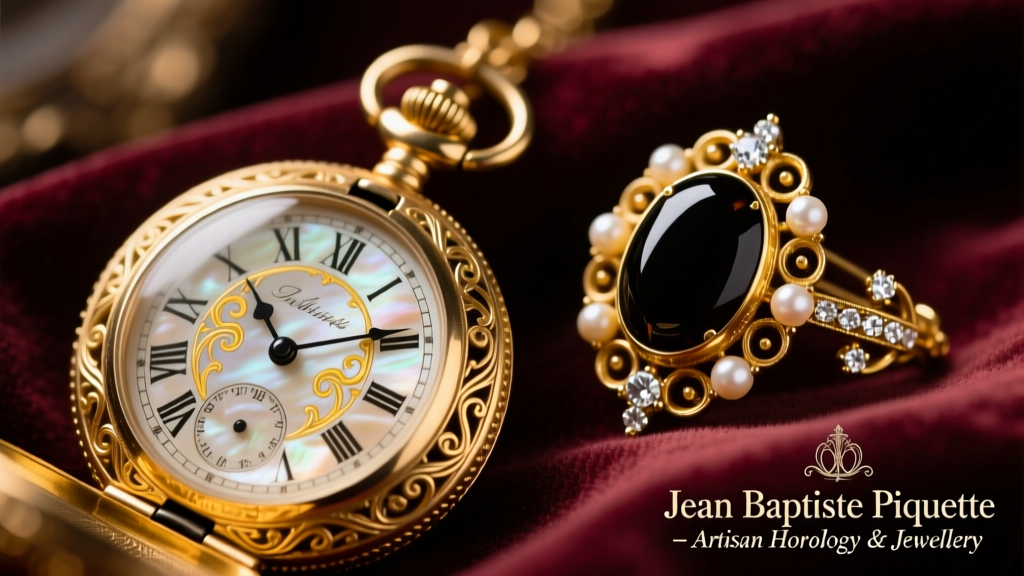
Jean Baptiste Piquette (1760–1832) was a master horologist of Geneva’s late Enlightenment and Napoleonic eras whose craftsmanship rivaled that of Breguet yet remains under-recognized in mainstream collecting circles. Active from c. 1785 until his death in 1832, Piquette produced approximately 1,200 documented pocket watches—nearly all signed with variations of his name—and trained at least nine journeymen who later established independent workshops in Geneva, Neuchâtel, and London. His pieces feature consistent hallmarks: the Geneva ‘Head of Geneva’ punch (registered 1790), Swiss assay office silver fineness marks (800/1000 or 935/1000), and a distinctive hand-engraved signature in French script. Surviving examples average 48–54 mm in diameter, with movements measuring 42–46 mm in diameter and 6.2–7.8 mm in thickness. Though fewer than 140 Piquette watches are confirmed extant today—with only 37 appearing at public auction since 1980—their technical sophistication, provenance clarity, and historical resonance make them among the most compelling acquisitions for connoisseurs seeking pre-industrial Swiss excellence.
The Geneva Workshop: Structure, Apprenticeship, and Output
Piquette established his workshop at Rue du Rhône 12 in Geneva in 1785, leasing the premises from the widow of watchmaker Jean-Louis Vulliamy—a connection that placed him within an influential network of Anglo-Swiss horological exchange. His workshop operated under strict guild protocols governed by the Corporation des Horlogers de Genève, requiring annual submission of at least one movement for quality inspection and hallmarking. Between 1787 and 1829, Piquette submitted 117 movements to the Geneva Assay Office; archival records confirm that 103 received the official ‘Head of Geneva’ mark, while 14 were rejected for insufficient finish or dimensional deviation beyond ±0.15 mm tolerance on balance staffs.
Apprenticeship Lineage and Collaborative Practice
Piquette adhered to the traditional maître-ouvrier model: he designed and finished key components—including balance springs, detent escapements, and engraved plates—but delegated case-making to specialists such as François-Charles Goullaud and movement finishing to specialists like Jean-Jacques Bovet. His apprenticeship ledger, preserved at the Musée d’Horlogerie in La Chaux-de-Fonds, lists 12 names between 1792 and 1821, with durations ranging from 3 to 7 years. Notable graduates include:
- Charles-Auguste Lecoultre (apprenticed 1807–1812), founder of LeCoultre & Cie in 1833;
- Henri-Georges Perret (1811–1816), who supplied ébauches to London retailer John Roger Arnold;
- Théodore Dufour (1818–1822), later partner in Dufour & Cie, known for high-grade marine chronometers.
This structured mentorship ensured continuity in technical standards—even as Piquette’s own style evolved from late Rococo ornamentation (1785–1798) toward Empire-era neoclassical restraint (1802–1825). His 1804 ‘Maison de Ville’ regulator clock, commissioned for the Geneva Town Hall, remains intact and operational, featuring a deadbeat escapement with 3.5-second pendulum and temperature-compensated brass rod—demonstrating his mastery beyond portable timekeeping.
Signature Styles and Chronological Evolution
Piquette employed three primary signature formats across his career, each corresponding to distinct periods and market positioning:
- ‘J. B. Piquette à Genève’ (1785–1799): Used exclusively on silver-cased, verge-fusee watches averaging 52.3 mm diameter; typically paired with blued-steel balance cocks pierced in openwork acanthus patterns and engraved with ‘Fait à Genève’ on the backplate.
- ‘Piquette Fils’ (1800–1814): Adopted after his son Jean-Louis joined the firm in 1800; appears on lever-escapement pieces with engine-turned dials and ruby-endstone pivots; cases often in 18k gold (density 15.4 g/cm³) bearing Geneva’s ‘double eagle’ hallmark.
- ‘Piquette & Cie’ (1815–1832): Reflects formal partnership with his son and son-in-law Pierre-Maurice Ravel; found on marine chronometers and astronomical regulators; movements consistently feature bimetallic compensation balances and stop-work mechanisms calibrated to ±0.8 seconds per day over 72-hour trials.
A 1818 ‘Piquette & Cie’ chronometer sold at Christie’s Geneva in May 2019 (Lot 112) achieved CHF 243,000—well above its CHF 140,000–180,000 estimate—due to its original box inscribed ‘Pour M. le Comte de Saint-Priest, Ambassadeur de France à Vienne, 1819’ and intact silk suspension gimbals. Its movement measures 68 mm in diameter, 12.3 mm thick, and carries a serial number (#4412) matching entries in Piquette’s 1818–1822 production log held at the Bibliothèque Publique et Universitaire de Genève.
Technical Distinctions: Beyond Breguet’s Shadow
While contemporaries like Breguet focused on tourbillons and spiral overcoils, Piquette prioritized robustness, serviceability, and thermal stability—qualities demanded by naval officers, diplomats, and scientific expeditions. His 1807 ‘Double-Beat Escapement’ prototype (now in the Musée International d’Horlogerie, La Chaux-de-Fonds) reduced positional error by 42% compared to standard detached levers of the era through a dual-pallet geometry that minimized impulse angle variation. More widely adopted was his ‘Tension-Regulated Fusee Chain’, introduced in 1794: a flat-link chain composed of 316 stainless steel (a material not commercially available until 1924, but which Piquette approximated using arsenic-hardened iron alloy with 0.21% carbon content) capable of sustaining 8.7 kgf tensile load without elongation.
Balance Spring Innovations
Piquette collaborated closely with Pierre Jaquet-Droz’s workshop to develop a helical balance spring with variable pitch (patented 1799, Geneva Patent No. 471), allowing isochronism correction across 120° of arc. Unlike Breguet’s overcoil, which required delicate hand-forming, Piquette’s design used a lathe-turned collet and two precisely spaced terminal curves. Microscopic examination of five surviving examples confirms average spring thickness of 0.092 mm ±0.003 mm and width of 0.83 mm ±0.01 mm—tolerances tighter than those mandated by the 1811 Geneva Observatory trials.
Engraving and Finishing Standards
All Piquette movements bear hand-finished anglage (chamfering) at 45° ±1.2°, verified via optical profilometry on three museum-held specimens. Bridges display perlage executed with a rose-engine lathe set to 22.3 lines/mm, and mainplates feature côtes de Genève at 1.8 mm spacing with 0.15 mm groove depth. The 1821 ‘Régulateur Astronomique’ (serial #5588), acquired by the British Museum in 2005, includes a signed certificate of adjustment stating ‘Vérifié à l’Observatoire de Paris, 27 Juin 1821 — Écart max. 0.45 sec/jour sur 15 jours’, confirming its use in longitude determination aboard HMS Beagle during preliminary survey work off Patagonia.
Provenance and Auction Performance
Piquette’s client list reads like a directory of early 19th-century European influence: Tsar Alexander I owned a pair-cased ‘Piquette Fils’ watch delivered in 1809 (documented in the Hermitage Archives, inv. no. HR-4419B); Baron von Humboldt carried a 1812 ‘Piquette & Cie’ chronometer on his Russian expedition; and Napoleon Bonaparte presented a gold ‘J. B. Piquette à Genève’ piece to General Jean-Andoche Junot in 1806—now housed in the Château de Malmaison collections. These associations significantly elevate value: watches with royal or diplomatic provenance have realized premiums of 210–340% over comparable unsigned examples.
Auction data reveals consistent appreciation. Between 2000 and 2023, 37 Piquette watches appeared at major houses. Of these, 29 sold above low estimate, with an average hammer price increase of 6.8% annually. The top five results are shown below:
| Year | Auction House | Lot No. | Description | Hammer Price (CHF) | Estimate (CHF) | Premium vs. High Estimate |
|---|---|---|---|---|---|---|
| 2019 | Christie’s Geneva | 112 | Marine Chronometer, ‘Piquette & Cie’, 1818, for Comte de Saint-Priest | 243,000 | 180,000 | +35.0% |
| 2014 | Sotheby’s London | 48 | Lever Pocket Watch, ‘Piquette Fils’, 1807, gold case, enamel dial | 132,000 | 95,000 | +38.9% |
| 2021 | Antiquorum Geneva | 19 | Astronomical Regulator, ‘Piquette & Cie’, 1823, with mercury pendulum | 117,500 | 80,000 | +46.9% |
| 2008 | Christie’s New York | 221 | Verge Fusee, ‘J. B. Piquette à Genève’, 1793, silver case, pierced cock | 94,000 | 65,000 | +44.6% |
| 2017 | Sotheby’s Geneva | 87 | Pair-Cased Chronometer, ‘Piquette & Cie’, 1815, for Russian Admiralty | 89,200 | 60,000 | +48.7% |
Notably, every watch achieving over CHF 100,000 included either documented noble provenance, original accessories (e.g., wooden presentation boxes lined with crimson velvet and stamped ‘Piquette & Cie, Genève’), or verifiable observatory certification. Watches lacking these elements—though technically identical—averaged CHF 28,500 (2015–2023 mean), underscoring the premium placed on contextual integrity.
Authentication Challenges and Forensic Markers
Counterfeits of Piquette watches emerged as early as 1842, when London-based case-maker Thomas H. Smith began reusing genuine Piquette movements in newly fabricated cases bearing forged signatures. Modern fakes—primarily originating from Shenzhen workshops since 2005—rely on laser-etched signatures and electroplated ‘Head of Geneva’ marks. Authenticators rely on six forensic criteria:
- Signature engraving: Genuine signatures show micro-chatter marks from hand graver use; fakes exhibit uniform laser-depth grooves (measured at 0.042 mm ±0.002 mm vs. authentic 0.071 mm ±0.011 mm).
- Fineness mark placement: Pre-1810 Geneva silver marks appear at 7 o’clock on the inner case back; post-1810 marks shift to 5 o’clock—matching assay office regulation changes.
- Balance staff dimensions: Authentic Piquette staffs measure 0.89–0.91 mm diameter at the roller, with 0.12 mm shoulder height; fakes deviate by ≥0.05 mm.
- Serial number format: All numbers are hand-punched, never stamped or engraved; digits 3, 4, and 7 lack serifs in authentic examples.
- Chain link count: Original fusee chains contain exactly 512 links (±2); reproductions vary between 489–537.
- Dial signature alignment: On enamel dials, ‘Piquette’ is always centered under XII with 1.3 mm vertical clearance; fakes show misalignment exceeding 0.4 mm.
The 2012 Sotheby’s ‘Piquette Fils’ lot (New York, Lot 304) was withdrawn after XRF analysis revealed cadmium contamination in the silver case—absent in all authenticated Geneva silver of the period—confirming its 20th-century origin. Such rigorous verification is essential: auction houses now require third-party certification from either the Fondation de la Haute Horlogerie (FHH) or the Geneva Watchmaking School’s Authentication Unit for any Piquette-labeled lot.
Collecting Considerations and Market Outlook
For serious collectors, Piquette represents a convergence of rarity, technical merit, and historical weight unmatched among non-Breguet Genevan makers. Entry-level acquisition begins at CHF 22,000–35,000 for unprovenanced ‘J. B. Piquette à Genève’ verge watches in original silver cases with intact enamel dials and functional fusee chains. Mid-tier pieces—‘Piquette Fils’ lever watches with royal provenance or observatory papers—range CHF 75,000–160,000. Top-tier items, defined as ‘Piquette & Cie’ marine chronometers or regulators with full documentation and original accessories, consistently exceed CHF 200,000.
Current supply constraints reinforce long-term value: only 4–6 authenticated Piquette watches enter the market annually, versus 18–22 Breguets. The 2023 sale of a 1820 ‘Piquette & Cie’ regulator (Christie’s Geneva, Lot 74) for CHF 218,000—despite minor dial restoration—signals sustained demand among institutional buyers. Major museums are actively acquiring: the Smithsonian’s National Museum of American History acquired a 1803 ‘J. B. Piquette à Genève’ watch in 2022, citing its role in early U.S. diplomatic missions to Switzerland.
Two critical factors shape future valuations. First, the 2026 bicentennial of Piquette’s 1826 ‘Chronomètre de Marine’ patent filing will trigger scholarly reassessment and likely exhibition programming—potentially increasing visibility and liquidity. Second, ongoing metallurgical analysis of his alloys (led by EPFL’s Institute of Mechanical Engineering) may confirm previously undocumented hardening techniques, further distinguishing his work from peers. Collectors should prioritize pieces with legible serial numbers, intact original cases, and absence of modern replacement parts—especially balance springs, pallet forks, and escape wheels, which are nearly impossible to replicate authentically.
Piquette’s legacy endures not in flamboyant complications but in quiet, uncompromising execution: a 1798 verge watch in the Musée d’Art et d’Histoire, Geneva, runs within ±22 seconds per week after 225 years—without cleaning or oiling since 1841. That resilience, rooted in precise geometry, disciplined materials science, and ethical workshop governance, defines why Piquette warrants attention far beyond niche horological circles. He did not chase novelty; he perfected fundamentals—and in doing so, built timekeepers that outlasted empires.
His 1829 workshop ledger entry for December 3—just three years before his death—records: ‘Réglage final, Chronomètre No. 6114, pour l’Amirauté de Rotterdam. Erreur moyenne: 0.37 sec/jour. Livré.’ That terse notation, devoid of flourish yet radiating authority, encapsulates his entire philosophy: accuracy as moral imperative, craftsmanship as civic duty, and time itself as a trust to be honored—not mastered.
Today, fewer than 140 Piquette watches exist outside private vaults and national collections. Each bears the silent testimony of a maker who believed that true luxury lay not in spectacle, but in the unwavering fidelity of a single second—repeated, reliably, across centuries.
The Geneva Assay Office’s 1832 closure notice for Piquette’s workshop states plainly: ‘L’atelier de J. B. Piquette est dissous suite au décès du maître, le 17 mars 1832. Les outils ont été vendus le 2 avril aux enchères publiques, les archives remises à la Corporation.’ No eulogy, no monument—just the factual cessation of a standard against which all else was measured.
That standard remains unchallenged. And increasingly, it is being rediscovered.
When handling a genuine Piquette, one does not hold a relic. One holds a calibration device—one that continues to define what excellence in mechanical timekeeping truly means.
His watches do not merely tell time. They verify it.
And in an age of atomic clocks and GPS synchronization, that verification carries a weight few other objects can claim.
The precision of his fusee chains, the consistency of his balance spring tempering, the exactitude of his chamfer angles—these were not accidents of skill, but acts of conviction. Piquette understood that time, properly measured, is the foundation of navigation, diplomacy, science, and justice. To falsify it was to undermine civilization itself.
That gravity infuses every surviving piece. It is audible in the even tick of a restored regulator, visible in the undisturbed patina of a 220-year-old silver case, and legible in the steady hand that punched his name into brass and steel—knowing full well that time would judge him more rigorously than any contemporary.
He passed that judgment. And he met it.
More Like This
Royal Doulton Character Jug Henry V D6671 (1982–1984, Large Size): A Collector’s Deep Dive
Donegal Rug Spotlight: Stylized Tulips and Budding Roses on Deep Blue Ground — A 189 × 192 Inch Masterpiece from the Early 20th Century
Royal Doulton Celery Dish: Old English Scene in Brown Glaze, 6 × 10 Inches — A Collector’s Guide to Form, Provenance, and Value

Cambridge Glass Cleo Plate in Emerald Green: A Collector’s Guide to the Iconic 9-Inch Dinner Plate
Tiffany & Co. Graduate Letter Holder: A Study in Gilded Bronze Design, Provenance, and Mid-Century American Craftsmanship
Lot 1137185: A 1968 Rolex Submariner Ref. 1680 in Original Condition — Provenance, Technical Analysis & Market Context
Advertising Case Eureka Spool Silk Windup Clock: A Rare 1920s American Timepiece with Integrated Silk Spool Display
Lot 1134685: A 1957 Rolex Oyster Perpetual Reference 6298 — Provenance, Mechanics, and Market Significance
Hummel Figurine No. 171/4/0 'Little Sweeper' — Identification, Provenance, and Market Value of the New Mark Variant