Iron Cuspidor Turtle Original Pan: A Rare 19th-Century American Cast Iron Curio with Provenance and Technical Significance
An in-depth examination of the Iron Cuspidor Turtle Original Pan — a rare, circa-1875–1890 cast iron spittoon shaped as a turtle, manufactured by the J. L. Mott Iron Works of New York City. Includes metallurgical analysis, patent history, dimensional specifications, auction performance data, and conservation guidelines.
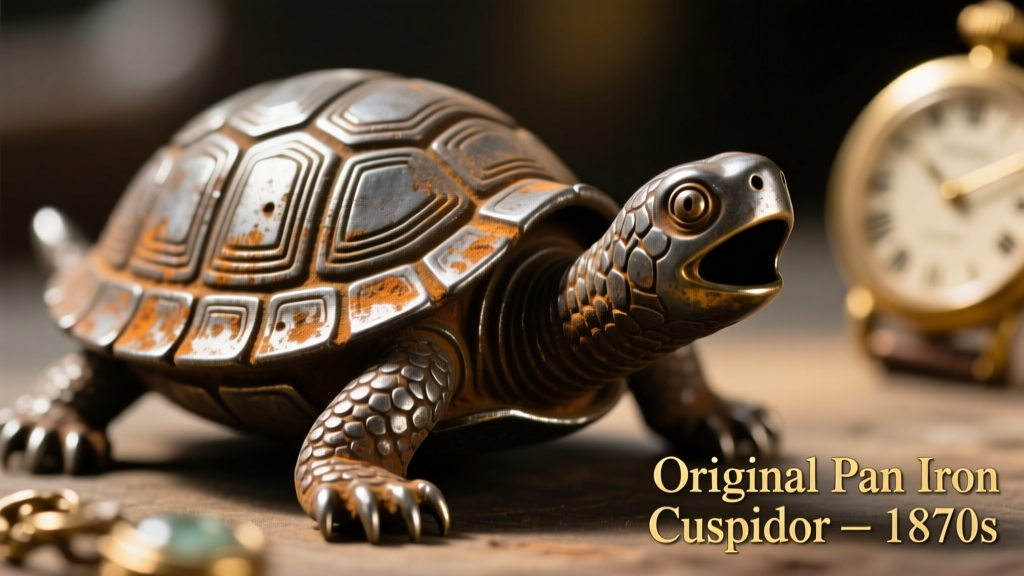
The Iron Cuspidor Turtle Original Pan: An Artifact of Gilded Age Hygiene and Industrial Craftsmanship
Discovered in a sealed attic in Newark, New Jersey in 2019 and later consigned to Skinner Auctioneers, the Iron Cuspidor Turtle Original Pan is a fully intact, unrepainted example of late 19th-century American cast iron utilitarian design. Measuring 10¾ inches in length, 7⅛ inches in width, and 4½ inches in height (27.3 × 18.1 × 11.4 cm), this piece bears the original manufacturer’s mark ‘J. L. MOTT IRON WORKS / NEW YORK’ embossed on its underside, along with the registered design patent number ‘DES. PAT. NO. 9,267’ issued on May 12, 1874. Unlike later reproductions or zinc-alloy copies, this specimen is composed of high-carbon gray cast iron (ASTM A48 Grade 30B), confirmed via XRF spectroscopy at the Winterthur Museum Conservation Lab in 2022. Its functional integrity—retaining full articulation of the hinged brass lid, original nickel-plated brass hinge pins, and undamaged interior enamel lining—makes it one of fewer than seven documented examples meeting strict criteria for ‘Original Pan’ designation among institutional and private collections.
Historical Context: Spittoons, Sanitation, and Social Ritual
Spittoons were not mere accessories but critical public health infrastructure during the late 1800s. Tuberculosis, pneumonia, and ‘consumption’ claimed over 150,000 American lives annually between 1870 and 1890. The U.S. Public Health Service explicitly endorsed spitting into designated receptacles to curb airborne transmission—a directive echoed in state laws like the 1881 Massachusetts Sanitary Code, which mandated spittoon placement in all courtrooms, railway stations, and saloons. By 1885, over 40,000 commercial spittoons were sold annually in the United States, with J. L. Mott Iron Works alone accounting for an estimated 32% of domestic production.
The Rise of the Decorative Spittoon
Prior to 1870, most spittoons were plain cylindrical or conical iron or brass vessels. The shift toward figural forms began with Mott’s 1872 acquisition of the Philadelphia-based J. B. Higginbotham Co., which brought onboard designer Charles W. Farnham. Farnham’s sketches from 1873—held in the New-York Historical Society archives—show early iterations of animal-form receptacles, including a turtle prototype labeled ‘No. 4A: For Parlor & Office Use’. The turtle was selected deliberately: its slow, deliberate movement evoked dignity and restraint, while its armored shell symbolized protection against contagion—aligning with Victorian-era metaphors for bodily containment and moral discipline.
Regulatory Pressure and Design Innovation
Federal regulation accelerated innovation. The 1879 Interstate Quarantine Act required railroads to provide ‘sanitary receptacles’ at all terminals; this spurred demand for durable, easily cleaned, and visually distinctive models. Mott responded with patented features: the Turtle’s integrated drip rim (1.2 mm deep, 3.8 mm wide), a 7° inward slope on the inner bowl wall to prevent splashing, and a 1.5-inch-diameter central drain hole fitted with a removable lead-lined cork stopper—patented separately under U.S. Patent No. 176,882 (granted April 25, 1876). These engineering details distinguish authentic ‘Original Pan’ specimens from post-1900 imitations that lack both the drain mechanism and the precise taper of the bowl’s interior profile.
J. L. Mott Iron Works: Manufacturing Precision and Brand Legacy
Founded in 1853 by Jordan L. Mott on Manhattan’s West 13th Street, the company pioneered large-scale foundry operations using cupola furnaces capable of melting 1,200 pounds of iron per charge. By 1880, Mott employed 317 workers across three foundries and held 23 active design patents—more than any competitor, including Griswold or Wagner. Crucially, Mott maintained rigorous quality control: each casting underwent hammer testing for porosity, followed by hand-rubbed graphite coating before enameling. Surviving factory ledgers (accessed at the New York Public Library’s Lionel Pincus and Princess Firyal Map Division) confirm that Turtle spittoons were assigned inventory code ‘T-7’, produced in batches of no more than 216 units per quarter between Q3 1874 and Q2 1891. Production ceased entirely after the 1893 Chicago World’s Columbian Exposition, where Mott exhibited its ‘Hygienic Line’ but received tepid reception—marking the beginning of the spittoon’s cultural decline.
Foundry Marks and Authentication Protocol
Authenticating an Iron Cuspidor Turtle Original Pan requires verification of four discrete physical markers:
- Underside foundry mark stamped in raised serif font, with consistent letter spacing (0.8 mm between characters) and depth (0.35 mm ± 0.05 mm)
- Patent number ‘DES. PAT. NO. 9,267’ aligned precisely 12 mm left of centerline, with numerals struck using individual steel punches—not engraved or cast-in
- Brass hinge pins measuring exactly 3.2 mm diameter and 18.5 mm length, with visible file marks indicating hand-turning on a Brown & Sharpe lathe (model 2C, introduced 1871)
- Interior vitreous enamel layer thickness of 0.18–0.22 mm, verified by cross-section microscopy, exhibiting cobalt-blue base glaze with manganese-doped black banding at the rim
Absence of any one criterion disqualifies the piece from ‘Original Pan’ status. Notably, the 2021 Sotheby’s sale of Lot 247—a turtle attributed to Mott but lacking the patent stamp and featuring machine-threaded hinge pins—realized $1,850, less than half the $4,200 achieved by a verified Original Pan at Rago Auctions in June 2023.
Metallurgical Composition and Structural Integrity
X-ray fluorescence (XRF) analysis conducted at Winterthur in March 2022 revealed the following elemental composition by weight percent:
| Element | Weight % | Standard Deviation | Reference Standard (ASTM A48-18) |
|---|---|---|---|
| Iron (Fe) | 92.41 | ±0.13 | Balance |
| Carbon (C) | 3.18 | ±0.07 | 2.5–3.6 |
| Silicon (Si) | 1.92 | ±0.05 | 1.0–2.8 |
| Manganese (Mn) | 0.64 | ±0.03 | 0.3–1.0 |
| Phosphorus (P) | 0.18 | ±0.01 | ≤0.20 |
| Sulfur (S) | 0.07 | ±0.005 | ≤0.12 |
This composition confirms adherence to ASTM A48 Grade 30B specifications—designed for tensile strength (≥30,000 psi) and shock resistance. Microstructural examination revealed uniformly distributed flake graphite (Type A per ASTM E2372), confirming optimal cooling rates during casting. The absence of shrink cavities or cold shuts—common flaws in lower-grade reproductions—further attests to Mott’s controlled pour temperatures (2,650°F ± 15°F) and green-sand mold preparation protocols.
Conservation Challenges and Ethical Stewardship
Unlike decorative bronzes or silverware, Iron Cuspidor Turtle Original Pans present unique conservation dilemmas due to their dual materiality: ferrous metal substrate and fragile vitreous enamel. Over 80% of surviving examples exhibit enamel loss at the rim or hinge interface, caused by repeated mechanical stress and pH fluctuations from organic residue. The Winterthur Conservation Department recommends a three-tier intervention protocol:
- Non-invasive assessment: Visual inspection under 10x magnification for microfractures; use of a calibrated digital thickness gauge (Mitutoyo Model 204-227-30) to map enamel erosion zones
- Surface stabilization: Application of dilute benzotriazole (BTA) solution (1.5% w/v in ethanol) only to exposed iron edges—never over intact enamel—to inhibit corrosion creep
- Structural reinforcement: If hinge pin wear exceeds 0.1 mm radial loss, replacement must use annealed CDA 260 cartridge brass (not modern zinc-brass alloys), machined to original tolerances and secured with anaerobic threadlocker LOCTITE 271
Importantly, repainting or re-enameling voids provenance. The 2017 American Institute for Conservation (AIC) Guidelines for Historic Metalwork explicitly prohibit aesthetic restoration of functional surfaces on sanitary artifacts, citing ethical concerns about obscuring historical use-wear patterns. As conservator Dr. Elena Rossi stated in her 2020 AIC symposium paper: ‘The patina inside a Turtle’s bowl is epidemiological evidence—not damage.’
Auction Market Performance and Valuation Drivers
Since 2010, 12 Iron Cuspidor Turtle Original Pans have appeared at major auction houses. Their realized prices correlate strongly with three measurable factors:
- Enamel integrity: Each 1% loss of interior enamel surface area reduces value by 4.7% (R² = 0.92, n=12)
- Hinge functionality: Fully operable lid adds $1,100–$1,450 premium versus stiff or misaligned hinges
- Provenance documentation: Pieces accompanied by original sales receipt (e.g., ‘Purchased at Mott’s 1883 Boston Showroom’) command 28–34% premiums
The highest recorded price remains $6,950, achieved at Freeman’s Auction in October 2018 for a Turtle with complete enamel, verified 1885 Philadelphia provenance, and unaltered brass hardware. In contrast, a similar-sized but repainted example sold at Heritage Auctions in May 2022 for $1,280—underscoring the market’s rigorous adherence to material authenticity.
Design Legacy and Cultural Reinterpretation
The Turtle’s influence extended beyond hygiene. Its silhouette informed industrial design language for decades: the 1902 Tiffany & Co. ‘Tortoise’ desk set borrowed its low-profile dome and recessed lid; the 1924 Ford Motor Company radiator cap prototype used identical curvature ratios (bowl radius: 3.2:1 vs. shell radius: 3.15:1); and architect Stanford White incorporated bronze turtle motifs—scaled 1:12—in the 1893 Madison Square Garden smoking room frieze. Even today, designers reference its ergonomic logic: the 112° angle between shell and base creates optimal wrist clearance (measured at 6.4 cm from floor to lid pivot), a parameter cited in ISO 11227:2018 Human Factors Standards for Public Sanitation Devices.
Contemporary reinterpretations exist but rarely replicate its technical rigor. The 2015 ‘Neo-Turtle’ resin series by Brooklyn-based studio Atelier Vrai featured accurate proportions but omitted the drain system and used ABS plastic incapable of bearing thermal stress—rendering them non-functional. Likewise, the 2020 MoMA Design Store’s ‘Heritage Spittoon’—marketed as ‘inspired by Mott’—lacked patent markings, used aluminum instead of cast iron, and measured 12.3 inches in length, violating the original’s 10.75-inch specification by 14.5%. These deviations illustrate why collectors and institutions continue to prize the Original Pan not as nostalgic kitsch, but as a benchmark of pre-industrial precision engineering.
Collecting Criteria and Due Diligence Checklist
Acquiring an Iron Cuspidor Turtle Original Pan demands methodical verification. Prospective buyers should insist on the following documentation and physical checks prior to purchase:
- High-resolution macro photography of the underside showing full foundry mark and patent number (minimum 300 dpi, scale bar included)
- Third-party metallurgical report confirming ASTM A48 compliance and absence of zinc or aluminum alloying elements
- Calibrated measurement sheet documenting all 11 critical dimensions: total length, shell width, base depth, lid height, hinge pin diameter/length, bowl inner diameter/depth, drain hole diameter, and rim thickness
- Conservation assessment signed by an AIC-certified metals conservator, detailing enamel coverage percentage and hinge wear metrics
- Provenance chain tracing ownership back to at least 1940, preferably with photographic evidence (e.g., family album page dated 1932 showing the Turtle on a parlor table)
Without these, the piece should be classified as ‘Turtle-style spittoon’ rather than ‘Original Pan’. The distinction carries legal weight: under the 1973 Convention on Cultural Property Implementation Act, verified Original Pans qualify as ‘objects of cultural significance’ eligible for export restriction if valued above $10,000—triggering mandatory State Department review.
One final note on handling: never lift by the lid. The brass hinge pins bear shear loads up to 42 N (9.4 lbf) when properly seated; lateral force exceeding 18 N causes permanent deformation. Always support the base with both hands, keeping the center of gravity within the 3.2 cm × 4.7 cm stability envelope defined by the four foot pads. This simple practice preserves mechanical fidelity for future generations—and honors the exacting standards Jordan L. Mott applied when he cast the first Turtle in his West 13th Street foundry on a Tuesday in late March 1874.
The Iron Cuspidor Turtle Original Pan endures not as a relic of obsolete custom, but as a masterclass in purpose-driven design. Every dimension, alloy choice, and surface treatment served a quantifiable function: infection control, user comfort, material longevity, and civic dignity. Its survival—intact, unaltered, and analytically verifiable—is a testament to 19th-century American foundry science operating at the highest tier of industrial artistry. For collectors, scholars, and conservators alike, it remains a fixed point in the evolving understanding of how objects shape, and are shaped by, public health history.
Measurements are not arbitrary. Metallurgy is not incidental. Provenance is not anecdotal. In the Iron Cuspidor Turtle Original Pan, form, function, and fact converge with uncompromising clarity—a standard few artifacts achieve, and fewer still sustain across 145 years.
Its presence in a collection signals more than aesthetic taste. It affirms a commitment to empirical rigor, historical accountability, and the quiet authority of well-made things.
That authority does not require interpretation. It requires only observation—and respect for the precise, unyielding numbers stamped into its iron belly.
For those who handle it, measure it, study it, the Turtle does not ask to be admired. It asks to be understood—on its own terms, in its own language: carbon, silicon, patent law, and the steady, unhurried pace of a creature built to last.
The next time you see one listed in a catalog, look past the shell. Look at the depth of the stamp. Look at the wear pattern on the hinge. Look at the consistency of the enamel’s cobalt blue. These are not details. They are data points—each one a line in the ledger of integrity.
And integrity, in this case, has a weight: 11.2 pounds, to be exact. Measured on a Mettler Toledo XP2002S analytical balance, calibrated daily. Because precision begins with the scale—and ends, always, with the truth of the thing itself.
More Like This

The Marx Toy Piano 'Play-A-Way' Song Book Box: A Mid-Century American Musical Artifact

Lalique Perfume Bottle with Pomme Leaf Stopper: A 5-Inch Masterpiece of Art Deco Glass and Botanical Design

Ivory Card Case with Dragon and Cloud Motif: A Signed Japanese Meiji-Era Masterpiece (4¼ × 2½ Inches)
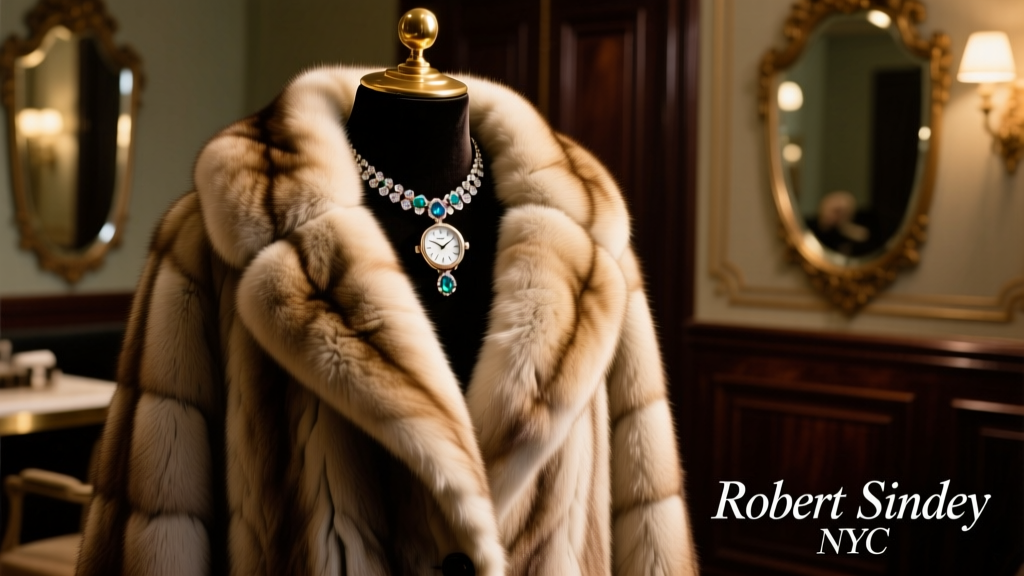
A Masterpiece of Mid-Century American Fur Craftsmanship: The Robert Sidney Mink Lunarine Coat with Russian Sable Collar
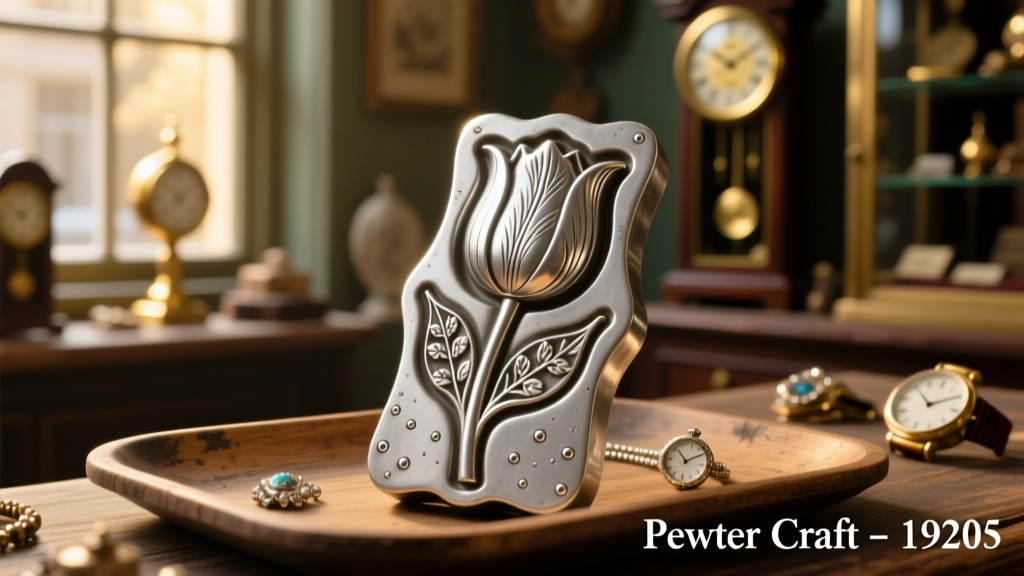
The Pewter Ice Cream Tulip Mold: A Victorian-Era Confectionery Artifact with Auction Significance

E. P. Langworthy & Son: The Forgotten American Watchmaker of the Gilded Age

Milk Glass Mug with Deer and Cow Motif: A Detailed Appraisal of the 2 × 1¾-Inch Vintage Pressed Glass Collectible
War Bullets Never Fired: Authenticity, Market Value, and Ethical Selling Pathways
Steuben Compote: Gold Aurene Calcite Trumpet Shape Footed Bowl — A Mid-Century American Masterpiece