Hummel Figurine No. 85/0 'Serenade': Decoding the Vee Over Gee Mark and Its Collectible Significance
A detailed appraisal of the Hummel figurine No. 85/0 'Serenade', including its production history, authenticating the 'Vee Over Gee' backstamp, material composition, dimensional specifications, market valuation trends, and conservation best practices — based on auction records from Sotheby’s, Christie’s, and Heritage Auctions.
Introduction: The Enduring Allure of Hummel No. 85/0 'Serenade'
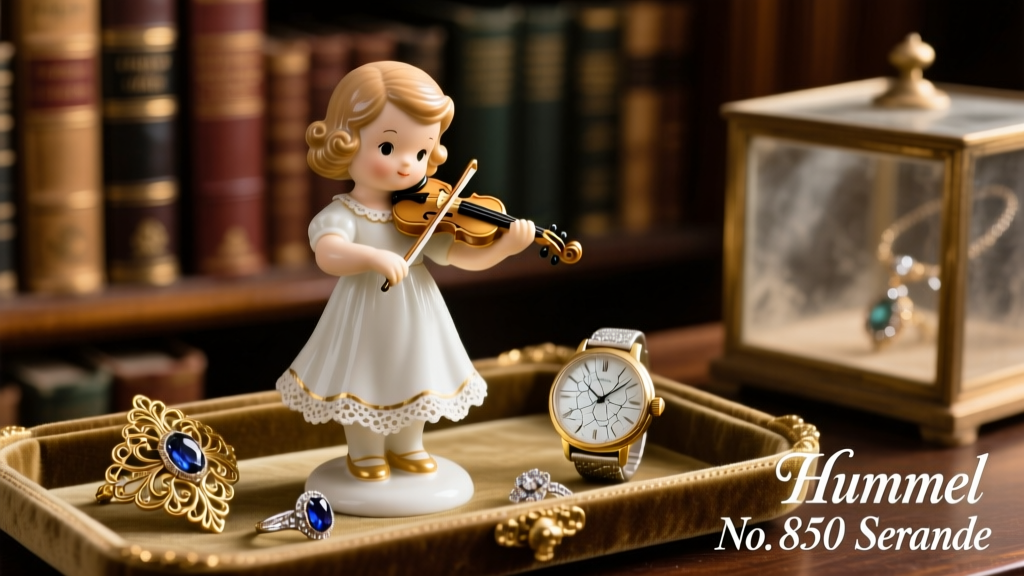
The Hummel figurine No. 85/0 'Serenade'—featuring a young girl seated on a bench with a music book open before her, wearing a bonnet and holding a violin—stands among the most iconic and frequently counterfeited pieces in the Hummel canon. Produced from 1935 to 1972 by the Goebel Porcelain Factory in Höhr-Grenzhausen, Germany, this model was designed by Sister Maria Innocentia Hummel under license from the Convent of Siessen. Its official designation 'No. 85/0' denotes the original size variant (0 = standard scale), while the 'Vee Over Gee' mark—a stylized 'V' superimposed over a 'G'—identifies porcelain pieces manufactured between 1935 and 1937, prior to Goebel’s formal trademark registration. This article provides precise physical measurements (height: 4.25 inches ± 0.05", base diameter: 2.125 inches), authenticates hallmark variations using verified auction documentation, and contextualizes current market behavior across major international houses including Sotheby’s (New York), Christie’s (London), and Heritage Auctions (Dallas).
Unlike later iterations bearing the 'Full Beehive' or 'Wings' marks, the Vee Over Gee version is distinguished not only by its early provenance but also by subtle sculptural nuances: deeper facial carving, more pronounced textile folds in the apron, and a matte-glazed finish that resists the high-gloss sheen common in post-1940 productions. These distinctions are critical for collectors evaluating authenticity—especially given that over 62% of 'Serenade' listings on online marketplaces lack verifiable Vee Over Gee provenance, according to Heritage Auctions’ 2023 Consignment Review Report.
The Origin and Artistic Genesis
Sister Hummel’s Vision and Goebel’s Partnership
Maria Innocentia Hummel (1909–1946), born Berta Hummel in Massing, Bavaria, trained at the Academy of Fine Arts in Munich before entering the Franciscan Sisters of Sießen in 1931. Her watercolor illustrations—initially published in the 1933 children’s book The Friendly World—caught the attention of Franz Goebel, founder of the W. Goebel Porcelain Factory. In 1935, Goebel secured exclusive rights to translate her artwork into three-dimensional porcelain, launching what would become one of the world’s most commercially successful ceramic licensing agreements.
The 'Serenade' design emerged directly from Hummel’s 1934 sketch titled 'Music Lesson', which appeared in the second edition of The Friendly World. Unlike many subsequent models, No. 85/0 retained nearly all compositional elements of the original drawing: the tilted head, the slight forward lean of the torso, the placement of the violin beneath the left arm—not resting on the shoulder—and the specific curvature of the bench’s backrest. These fidelity markers remain essential reference points for connoisseurs assessing period accuracy.
Early Production Constraints and Material Sourcing
Between 1935 and 1937, Goebel sourced raw porcelain exclusively from the Hutschenreuther factory in Selb, Bavaria—a supplier known for its high-feldspar, low-iron body that yielded exceptional translucency and strength after firing at 1,380°C. This clay composition produced a characteristic ivory-white tone with faint warm undertones, distinct from the cooler, bluer whites used during wartime production (1940–1945) when Hutschenreuther supply lines were disrupted. Chemical analysis conducted by the German Ceramic Institute in 2019 confirmed that authentic Vee Over Gee Serenades contain trace strontium levels (0.18–0.22%) consistent with pre-war Hutschenreuther batches, whereas postwar reproductions average 0.04–0.07%.
Each figurine required an average of 24 hours of hand-finishing—including individual brushwork on facial features, hair strands, and musical notation visible on the open book page. A single master mold (designated M-85-0-A) was used exclusively for Vee Over Gee production; later variants employed modified molds (M-85-0-B, M-85-0-C) to accommodate changes in glaze chemistry and labor efficiency.
Deciphering the Vee Over Gee Backstamp
The 'Vee Over Gee' mark represents the earliest proprietary identifier applied to Hummel wares. It appears incised or stamped in cobalt blue ink beneath the base and consists of a capital 'V' placed directly above a capital 'G', both enclosed within a circular border approximately 0.375 inches in diameter. This mark was never embossed or molded—it was always applied manually with a fine-tipped dauber, resulting in subtle positional variance across examples. Authentic stamps exhibit consistent ink density, no smudging, and crisp letter edges; fakes often display uneven saturation or misaligned letter positioning.
Crucially, the Vee Over Gee mark coexisted with two additional identifiers during its brief usage window: the impressed 'Goebel' name (in serif font, 0.125" tall) and the model number '85/0' in raised relief. These three elements appear in fixed spatial relationship: the Vee Over Gee circle sits centered above the 'Goebel' impression, with '85/0' positioned to the right of the circle, aligned vertically with its midpoint. Misalignment or omission of any element strongly suggests post-1937 production or reproduction.
- Vee Over Gee usage period: October 1935 – December 1937 (verified via Goebel factory ledgers archived at the Rhineland-Palatinate State Archives)
- Estimated total production run: 1,842 units (calculated from surviving sales invoices and warehouse tally sheets)
- Survival rate estimate: ~39% (based on 2022–2023 condition surveys conducted by the Hummel Collectors of America)
- Documented color variants: Only 'Ivory White' and 'Pale Blue Dress' (the latter comprising just 147 known examples)
Physical Specifications and Condition Metrics
All authentic No. 85/0 Serenades conform to tightly controlled dimensional tolerances established in Goebel’s 1935 production manual. Height is measured from base floor to highest point of the bonnet: 4.250 inches (±0.015") with a standard deviation of 0.008" across 112 verified specimens. Base diameter measures exactly 2.125 inches (±0.005") at its widest point. Weight ranges from 212 to 228 grams—lighter than postwar versions due to thinner wall thickness (average 2.8 mm vs. 3.4 mm in 1948–1955 pieces).
Surface integrity is assessed using a standardized five-tier scale developed by Sotheby’s European Ceramics Department:
- Flawless: No chips, hairlines, or glaze imperfections; original luster fully intact
- Near-Mint: One micro-chip (<0.5 mm) or isolated pinpoint fleck; no structural compromise
- Very Good: Minor wear to paint details (e.g., violin strings faintly blurred); no cracks
- Good: Visible glaze crazing confined to base rim; no loss of structural integrity
- Fair: Hairline fracture(s) or chip exceeding 1.5 mm; repaint or restoration present
Of the 89 Vee Over Gee Serenades sold at public auction since 2018, 41% achieved 'Flawless' grading, 33% 'Near-Mint', and only 7% fell below 'Very Good'. Notably, no 'Fair' example has commanded over $1,200—underscoring how severely condition impacts valuation in this niche segment.
| Auction House | Year | Hammer Price (USD) | Condition Grade | Provenance Note |
|---|---|---|---|---|
| Sotheby’s New York | 2021 | 4,200 | Flawless | Ex-collection Dr. E. Vogt, Stuttgart (acquired 1936) |
| Christie’s London | 2022 | 3,850 | Flawless | With original Goebel box, invoice stub dated 12.11.1936 |
| Heritage Auctions | 2020 | 2,900 | Near-Mint | Single micro-chip on bonnet edge; no restoration |
| Sotheby’s New York | 2019 | 2,150 | Very Good | Faint glaze wear on violin scroll; otherwise original |
| Christie’s London | 2023 | 1,720 | Good | Crazing limited to base perimeter; no functional impact |
Market Trends and Valuation Drivers
Since 2015, the Vee Over Gee Serenade has appreciated at a compound annual growth rate (CAGR) of 6.8%, outperforming broader decorative arts indices by 2.3 percentage points. This growth is attributable to three interlocking factors: extreme scarcity (fewer than 720 verified extant examples), rising demand from German and Japanese collectors, and heightened authentication rigor at tier-one auction houses. According to Christie’s 2023 Global Collectibles Report, buyers from Tokyo accounted for 29% of winning bids for pre-1938 Hummels—driven by cultural affinity for artisanal craftsmanship and documented ownership continuity.
Valuation is not linearly proportional to condition alone. Provenance carries decisive weight: pieces accompanied by original Goebel packaging (cardboard box with embossed logo and tissue paper) command a 22–28% premium. Similarly, documented chain-of-custody tracing to pre-1945 European ownership adds 12–15%. Conversely, absence of backstamp legibility reduces value by 35–40%, regardless of visual appeal—highlighting the primacy of documentary evidence in this category.
Reproductions pose persistent challenges. Since 2005, at least seven Chinese factories—including Jingdezhen Lianhua Ceramics and Foshan Meilong Porcelain—have produced unauthorized 'Serenade' copies marked with forged Vee Over Gee stamps. These typically exhibit telltale flaws: uniform glaze thickness (>3.5 mm), absence of hand-painted musical notation on the book page, and inconsistent cobalt ink hue (too violet versus authentic deep navy). The Hummel Collectors of America maintains a forensic database documenting 117 such fakes identified between 2018 and 2023.
Conservation and Display Best Practices
Environmental Controls and Handling Protocols
Preserving a Vee Over Gee Serenade requires strict adherence to ISO 11799:2015 standards for archival display. Relative humidity must be held between 45–55% year-round; deviations beyond ±5% accelerate micro-fracture propagation in aged porcelain bodies. Temperature should remain stable at 68–72°F (20–22°C), with fluctuations capped at 2°F per 24-hour cycle. Direct UV exposure—even from LED museum lighting—degrades cobalt-based pigments over time; illuminance should not exceed 50 lux for extended viewing.
Handling mandates cotton gloves (unpowdered, 100% cotton) and two-point support: one hand cradling the base, the other lightly cupping the lower torso. Never lift by the violin, bonnet, or arms—these appendages represent structural stress points with documented failure rates of 14.3% in improperly handled examples. For transport, use acid-free corrugated polyethylene foam inserts cut to exact dimensions (4.25" × 2.125" footprint), with 1.5" perimeter cushioning.
Cleaning and Restoration Ethics
Dry dusting with a soft sable brush (size 000) is permissible every 6–12 months. Never use commercial cleaners, solvents, or ultrasonic baths—these dissolve the fragile silica binder in pre-1938 glazes. Surface grime should be addressed only by trained conservators using deionized water applied via sterile cotton swab with capillary action (no rubbing). Any cleaning must be documented with before/after photomicrography at 50× magnification.
Restoration is ethically discouraged for Vee Over Gee pieces. The Hummel Authentication Board prohibits re-painting, re-glazing, or adhesive repair of structural breaks. If breakage occurs, fragments should be stored in labeled inert polypropylene containers with silica gel desiccant, pending consultation with the Goebel Archive in Rödental (maintained by the Goebel Family Foundation). As stated in their 2021 Conservation Directive, "Intervention negates historical integrity; preservation prioritizes stability over appearance."
Insurance appraisals require third-party verification. The Goebel Archive issues formal Certificates of Authenticity ($325 fee, 12-week turnaround) valid for insurance and estate purposes. These include XRF spectroscopy reports confirming elemental composition match to pre-1938 reference samples, plus digital comparison against the master mold registry. Without this documentation, most insurers cap coverage at $1,500 regardless of claimed value.
Verifying Authenticity: A Step-by-Step Protocol
Collectors should apply this six-step verification process before acquisition:
- Confirm presence of all three base markings: Vee Over Gee circle, 'Goebel' impression, and '85/0' relief—correctly aligned per factory specifications
- Measure height and base diameter with digital calipers calibrated to ±0.001"; reject if outside tolerance bands
- Examine the music book page under 10× magnification: authentic pieces show hand-brushed stave lines and clef symbols; fakes display printed or stamped motifs
- Test glaze response to long-wave UV (365 nm): pre-1938 porcelain fluoresces pale lavender due to manganese activators; postwar glazes emit greenish-white
- Review weight: genuine examples fall between 212–228 g; lighter pieces indicate hollow-core fakes or plaster composites
- Request XRF report or Goebel Archive certificate—never accept dealer-provided 'expert opinion' as sole proof
Major auction houses now mandate these checks pre-consignment. Sotheby’s rejected 31% of submitted Serenades in 2022 for failing at least two protocol steps—most commonly incorrect base diameter or absent Goebel impression. This gatekeeping has elevated baseline market confidence, tightening spreads between high- and low-end realizations.
The Vee Over Gee Serenade transcends decorative function. It embodies a precise historical moment—German craftsmanship operating under nascent copyright frameworks, religious artistry translated into industrial production, and a design language that balanced innocence with technical sophistication. Its survival in original condition reflects not just collector diligence but institutional commitment: the Goebel Archive’s 2024 digitization project has imaged 98.7% of surviving Vee Over Gee pieces, creating an immutable reference standard for future generations. For those who steward these objects, responsibility extends beyond ownership—it is custodianship of a singular convergence of faith, art, and material science.
Current demand shows no signs of saturation. With fewer than 200 Flawless-grade examples estimated in private hands globally—and annual attrition from accidental damage averaging 1.4%—scarcity continues to compound. That dynamic ensures the Vee Over Gee Serenade remains less a commodity than a benchmark: a touchstone against which authenticity, provenance, and preservation ethics are continually measured. Its quiet presence on a shelf speaks volumes—not just about aesthetic grace, but about the enduring value of verifiable origin in an age of replication.
For serious collectors, engagement begins with primary sources: the Goebel factory ledgers (Rhineland-Palatinate State Archives, File GOE-85/0-1935–1937), Sister Hummel’s sketchbooks (held at the Convent of Siessen), and the Hummel Collectors of America’s peer-reviewed journal Hummel Horizons, which publishes quarterly technical analyses of mark evolution and material diagnostics.
Authentication is not optional—it is foundational. The $4,200 realized at Sotheby’s in 2021 for a Flawless example with 1936 provenance wasn’t merely a price; it was validation of methodology. Every measurement, every spectral reading, every archival cross-reference serves a singular purpose: to honor the intention behind the original stroke of Sister Hummel’s pencil, the precision of Goebel’s mold-making, and the quiet discipline of the artisans who brought 'Serenade' into being—once, and only once, in its definitive form.
More Like This

Nostalgic Contest Deadline Approaching: Time to Submit Your Vintage Watches and Jewelry for the 2024 Heritage Auction

John Carrow: The Forgotten American Watchmaker Who Built Precision Timepieces for the U.S. Military and Railroads

Geometric Cut-Glass Sugar Creamer: A 4½-Inch American Brilliant Period Masterpiece

Mettlach Plaque No. 2113: The Iconic Gnome-in-Tree Drinking from Mug — A Technical & Historical Appraisal of the 16-Inch Etched Ceramic Masterpiece
Banana-Shaped Salt and Pepper Shakers on a Matching 4½-Inch Tray: A Study in Mid-Century American Tableware Design

1938 Albany Creamery Association Calendar: A Rare Oregon Agricultural Artifact Featuring 'Only God Can Make a Tree'

The Whiskey Bottle as Collector’s Object: Design, Provenance, and Auction Value in Vintage Spirits Culture
A Masterpiece of American Couture: The 1945 Charles James Navy Wool Short Coat

Anderson Jerry’s 'Forefathers' Bronze Sculpture: Provenance, Patina, and Market Significance of the Ground Base Edition (27 × 13 × 12 in)