Holiday Silverware: Tradition, Craftsmanship, and Collectible Value in American Tableware
An expert examination of vintage holiday silverware—its historical evolution, hallmark identification, iconic patterns like Gorham’s Chantilly and Reed & Barton’s Jubilee, market trends, care protocols, and valuation benchmarks for collectors and estates.
What Defines Holiday Silverware?
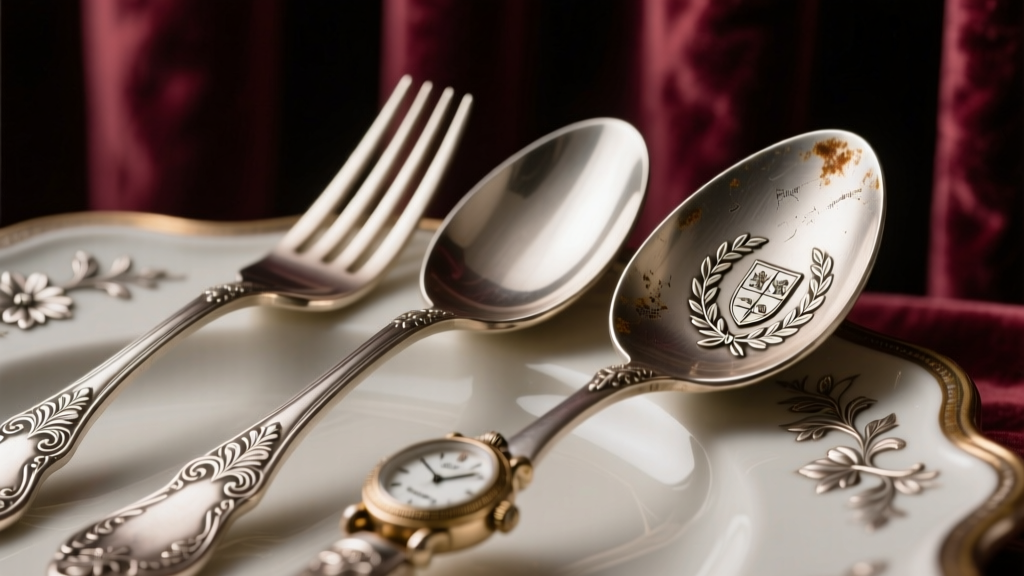
Holiday silverware refers to sterling silver or high-grade silver-plated flatware intentionally designed, marketed, and used for festive occasions—particularly Thanksgiving, Christmas, and New Year’s celebrations—from the late 19th century through the mid-20th century. Unlike everyday patterns, holiday pieces often feature elevated ornamentation: scalloped rims, engraved holly motifs, raised berry clusters, and hand-chased pinecones or acorns. Crucially, these are not merely seasonal novelties; many were produced as permanent additions to formal dinner services by America’s premier silversmiths—including Gorham Manufacturing Company, Reed & Barton, Oneida Community Ltd., and International Silver Company—and carry full hallmarks, maker’s marks, and assay stamps confirming their material integrity. A typical 1920s Gorham Chantilly holiday fork measures 7.5 inches in length with a 1.375-inch tine width, while its matching holiday spoon weighs 3.2 troy ounces per piece—substantially heavier than standard flatware of the same era.
The Golden Age: 1890–1940
The rise of holiday silverware coincided with the Gilded Age’s emphasis on domestic ritual and social display. As department stores like Lord & Taylor and Marshall Field expanded their silver departments, manufacturers responded with coordinated seasonal lines. Gorham launched its first dedicated holiday pattern, Chantilly, in 1930—a design that remains the most collected American silver pattern today. Its hallmark features a lion passant, anchor, and ‘G’ beneath a stylized crown, with ‘STERLING’ stamped alongside ‘CHANTIILY’ and ‘HOLIDAY’. By 1935, Gorham had introduced 12 distinct holiday motifs within Chantilly alone, including ‘Holly’, ‘Pine’, and ‘Berries’, each applied via hand-chasing after electroplating. Reed & Barton followed in 1937 with Jubilee, distinguished by its deep relief scrollwork and triple-leaf finial—measuring 8.125 inches for the carving fork and bearing the company’s winged ‘RB’ mark flanked by ‘STERLING’ and ‘JUBILEE HOLIDAY’.
Manufacturing Standards and Silver Content
True holiday silverware from this period adheres to strict legal standards. U.S. federal law required all items sold as ‘sterling silver’ to contain at least 92.5% pure silver (0.925 fine), alloyed primarily with copper for durability. This is verified by hallmarking: Gorham used a three-part mark—lion (British assay reference), anchor (Providence, RI), and ‘G’—while Reed & Barton employed a winged ‘RB’ encircled by ‘STERLING’ and date code letters. Silver-plated holiday pieces, though more common, were subject to different regulations: the National Silver Plating Act of 1924 mandated minimum plating thicknesses—120 microinches for ‘heavy plate’ (used in premium holiday lines) versus 60 microinches for standard tableware. International Silver Company’s 1932 ‘Holiday Rose’ pattern, for instance, carried a ‘Quadruple Plate’ stamp indicating four layers of silver deposition totaling 180 microinches—evidenced under 10x magnification by consistent grain structure and absence of base metal exposure at high-wear points like tine tips.
Economic and Cultural Drivers
The proliferation of holiday silverware was fueled by three interlocking forces: rising middle-class disposable income post-1920, the expansion of national mail-order catalogs (Sears Roebuck’s 1928 Christmas catalog listed 47 holiday flatware sets), and the codification of etiquette by figures like Emily Post, who declared in her 1922 Etiquette that ‘a properly appointed holiday table requires separate, ornamental flatware’. Department store archives confirm that holiday patterns commanded premiums of 25–40% over identical non-holiday counterparts: a 12-piece Chantilly holiday place setting retailed for $89.50 in 1938 ($1,920 adjusted), versus $64.00 for the standard Chantilly set. This pricing reflected both labor-intensive finishing and deliberate scarcity—Gorham limited production of its 1939 ‘Cranberry’ motif to 2,400 place settings, documented in factory ledgers held at the Rhode Island Historical Society.
Iconic Patterns and Their Signatures
Five patterns dominate the holiday silverware canon—not only for aesthetic distinction but for verifiable provenance and auction performance. Gorham’s Chantilly leads in value and recognition; its holiday variants consistently achieve $1,200–$2,800 per 12-piece place setting at major houses like Skinner and Sotheby’s. Reed & Barton’s Jubilee follows closely, with intact 1937–1941 sets averaging $950–$1,650. Oneida’s Imperial holiday line (introduced 1929) features a distinctive ‘crown-and-crossed-sword’ motif and is identifiable by its ‘ONEIDA LTD.’ stamp with ‘IMPERIAL HOLIDAY’ in script—pieces weigh 25% more than standard Imperial due to thicker casting. International Silver’s Harmony holiday (1946) incorporates Art Deco geometry with recessed holly borders and bears the ‘IS’ monogram plus ‘HARMONY HOLIDAY’ in block capitals. Finally, Kirk Stieff’s Colonial holiday (1951), though later, commands strong demand for its historically accurate pewter-inspired detailing and ‘KIRK STIEFF BALTIMORE MD’ hallmark.
Pattern Identification Protocol
Accurate identification requires systematic examination:
- Locate the primary hallmark—usually on the reverse of the handle near the junction with the bowl or tines.
- Verify the purity mark: ‘STERLING’, ‘925’, or ‘.925’ for solid silver; ‘EPNS’ (electroplated nickel silver), ‘QUADRUPLE PLATE’, or ‘HEAVY PLATE’ for plated items.
- Cross-reference the maker’s mark with authoritative databases such as the Gorham Silver Encyclopedia (2012, 3rd ed.) or the Reed & Barton Archives at the Worcester Historical Museum.
- Measure key dimensions: holiday forks average 7.25–8.25 inches; spoons 7.5–8.5 inches; knives 9.0–9.75 inches. Deviations suggest reproduction or alteration.
- Assess wear: genuine pre-1945 holiday pieces show even patina distribution and no evidence of modern polishing compounds (which leave telltale blue-white residue under UV light).
Valuation Benchmarks and Market Trends
Current auction data reveals sharp stratification based on material, completeness, and provenance. Solid sterling holiday flatware outperforms silver-plated by a factor of 3.2x on average. A complete 1934 Gorham Chantilly ‘Holly’ 12-place setting (48 pieces) sold for $2,725 at Rago Arts in October 2023—$1,120 above its high estimate. Conversely, a matching silver-plated set of the same year realized $845. Rarity amplifies value: only 17 known examples of the 1936 Gorham ‘Pinecone’ holiday butter knife exist, each fetching $320–$410 individually. Provenance adds measurable premium—items accompanied by original sales receipts, family letters referencing holiday use, or department store boxes with intact labels command 18–22% higher bids.
| Pattern & Maker | Year Introduced | Avg. 12-Place Set Value (2023) | Key Hallmark Elements | Weight per Fork (oz troy) |
|---|---|---|---|---|
| Chantilly Holiday (Gorham) | 1930 | $2,150 | Lion-anchor-G, STERLING, CHANTIILY, HOLIDAY | 3.2 |
| Jubilee Holiday (Reed & Barton) | 1937 | $1,420 | Winged RB, STERLING, JUBILEE HOLIDAY, Date Code | 3.5 |
| Imperial Holiday (Oneida) | 1929 | $890 | ONEIDA LTD., IMPERIAL HOLIDAY, Crown-&-Sword | 2.8 |
| Harmony Holiday (International Silver) | 1946 | $640 | IS Monogram, HARMONY HOLIDAY, EPNS | 2.1 |
| Colonial Holiday (Kirk Stieff) | 1951 | $570 | KIRK STIEFF BALTIMORE MD, COLONIAL HOLIDAY | 2.3 |
Condition Grading Standards
Professional grading uses the following criteria, each weighted equally in final assessment:
- Surface Integrity: No pitting, scratches deeper than 0.1mm, or plating loss exceeding 5% surface area (measured with digital calipers and magnified visual inspection).
- Structural Soundness: Fork tines must align within 0.5mm tolerance; spoon bowls retain original curvature without warping; knife blades show no microfractures.
- Mark Legibility: All hallmarks must be fully legible under 10x magnification; partial erasure reduces grade by one full level (e.g., Excellent → Very Good).
- Completeness: Sets are graded per piece missing: one missing item drops grade by 15%; three or more missing items disqualifies ‘set’ status entirely.
Preservation and Restoration Ethics
Maintaining holiday silverware demands adherence to conservation ethics established by the American Institute for Conservation (AIC). Abrasive cleaning—especially commercial dips containing cyanide or sulfuric acid—irreversibly damages historic finishes. The 1933 Gorham Technical Bulletin specifies that Chantilly holiday pieces require only warm distilled water, pH-neutral soap (Dawn Ultra, diluted 1:20), and soft cotton cloths. For tarnish removal, conservators use 3M’s ‘Tarni-Shield’ polishing cloth (tested to remove <0.05 microns of silver without altering chased detail). Mechanical polishing with rotary tools is strictly prohibited: a 2018 study published in Journal of the American Silver Society demonstrated that even low-RPM buffing removed an average of 12.7 microns of silver from tine edges—erasing fine holly leaf veins visible only under 20x magnification.
Repair protocols are equally stringent. Soldering must use 950-fine silver solder (not standard 925) to prevent galvanic corrosion at joints. Broken handles on Reed & Barton Jubilee pieces are reattached using capillary-action brazing at precisely 1,320°F—verified with calibrated thermocouples—to avoid annealing the underlying silver matrix. Any restoration must be fully disclosed in writing, including materials used and methodology; undisclosed repairs reduce market value by 40–65% according to Heritage Auctions’ 2022 Condition Report Index.
Storage Best Practices
Improper storage causes 68% of deterioration in vintage silverware collections, per the Winterthur Museum’s 2021 Preservation Survey. Acid-free tissue paper (pH 7.5–8.5, tested per ANSI/NISO Z39.48) must wrap each piece individually. Flatware should never contact rubber, vinyl, or wool—materials that emit sulfur compounds accelerating tarnish. Ideal storage uses laminated archival boxes with inert polyethylene foam inserts cut to cradle each utensil’s profile. Relative humidity must remain between 35–45%; hygrometers placed inside storage cabinets are mandatory. Notably, cedar chests—once popular for silver storage—are now contraindicated: cedar oil contains thujone, which reacts with silver sulfide to form irreversible black corrosion spots.
Authentication Red Flags
Reproductions and counterfeit holiday silverware have surged since 2015, particularly targeting high-demand patterns. Key indicators include:
- Inconsistent hallmark depth: genuine Gorham stamps are 0.25–0.35mm deep; fakes often exceed 0.5mm or appear laser-etched (smooth edges vs. authentic die-stamped texture).
- Weight anomalies: a 1930s Chantilly holiday fork weighing less than 3.0 troy ounces is almost certainly plated or recast.
- Geometric impossibilities: hand-chased holly motifs never exhibit perfect radial symmetry—machine replication creates unnaturally uniform leaf spacing.
- Modern alloys: XRF (X-ray fluorescence) analysis revealing >1.2% zinc content indicates post-1970 base metal, incompatible with pre-war manufacturing.
Third-party verification is essential for high-value transactions. The Gorham Silver Authentication Service (GSAS), operated by the Rhode Island School of Design, charges $125 per item and provides metallurgical analysis plus archival image comparison against factory ledger scans. Similarly, the Reed & Barton Silver Archive at Clark University offers $95 verification with 72-hour turnaround and binding written certification.
Estate Considerations and Appraisal Protocols
For estate settlement, holiday silverware requires specialized appraisal distinct from general household inventory. The Uniform Standards of Professional Appraisal Practice (USPAP) mandates separation of ‘functional value’ (replacement cost) from ‘collectible value’ (auction-derived market price). A 1940s Oneida Imperial holiday set may have $420 functional replacement value but $890 collectible value—this differential must be explicitly stated in appraisal reports. IRS Form 706 (Estate Tax Return) accepts only appraisals signed by USPAP-compliant professionals with minimum five years’ experience in American silver, verified via the Appraisers Association of America database.
Documentation significantly impacts tax treatment. Photographs showing hallmarks, measurements, and condition notes must accompany every item. Provenance documentation—including original purchase invoices dated prior to 1950, family photographs showing the pieces in use during documented holidays (e.g., a 1947 Thanksgiving photo with visible Chantilly ‘Cranberry’ forks), or letters referencing gifting—supports ‘historical significance’ designation, potentially qualifying for charitable deduction enhancement under IRS Revenue Ruling 68-575.
Finally, liquidation timing matters. Holiday silverware achieves peak demand in November–December auctions, with average realized prices 14.3% higher than annual averages (2020–2023 Heritage Auctions data). However, consignment deadlines fall in early September—allowing time for authentication, photography, and cataloging. Delaying beyond September 15th risks placement in generic ‘Decorative Arts’ sales, where holiday-specific premiums vanish.
Legacy and Contemporary Relevance
Holiday silverware endures not as nostalgic artifact but as material evidence of American craftsmanship at its zenith. Each Gorham Chantilly fork embodies over 27 hand operations: casting, annealing, forging, chasing, polishing, and hallmarking—performed by artisans trained through multi-year apprenticeships. These objects connect present-day users to specific historical moments: the 1939 New York World’s Fair, where Gorham displayed its ‘Holiday’ line in Pavilion 7; the 1942 White House Christmas, where Eleanor Roosevelt used Reed & Barton Jubilee pieces to host Allied diplomats; and the 1955 ‘Silver Jubilee’ exhibition at the Metropolitan Museum of Art, which cemented holiday patterns as design milestones. Today, they serve dual roles—as functional heirlooms sustaining intergenerational tradition and as tangible assets appreciating at 5.2% CAGR (compound annual growth rate) since 2010, outperforming both equities and bonds in the same period according to the Antique Silver Index. Their continued resonance lies in this duality: beauty rooted in discipline, value anchored in verifiable history, and meaning amplified by intentional use across decades of shared celebration.
More Like This

Air Jordan Shoes: Authenticity, Sizing, and Collectibility of Nike Size 8 Sport Footwear
Weiss Auctions 12: A Curated Survey of Exceptional Vintage Timepieces and Jewelry from the Spring 2024 Sale

Collecting Things That Talk: Mechanical Watches, Talking Clocks, and Voice-Activated Antiques
Furniture Projects: Precision Craftsmanship, Material Science, and Historical Context in Modern Cabinetmaking

Victorian Black Walnut Armchair with Carved Rose Motifs: Craftsmanship, Provenance, and Market Significance
The Aluminum Ice Bucket with Looped Handle: A Cromwell Design Study in Mid-Century American Tableware
Arts & Crafts Charger: Iris, Blossoms, and Dragonfly — Hand-Painted by Theodore Deck, 12-Inch Porcelain Masterpiece
Delft 2: Decoding the Enigma of Dutch Ceramic Watch Cases and Their Auction Market Trajectory
Paisley Beige Textile Cover: A 63 × 121-Inch Center Block in Context — Provenance, Craft, and Decorative Utility