Collecting Things That Talk: Mechanical Watches, Talking Clocks, and Voice-Activated Antiques
A deep-dive exploration of timepieces and objects that audibly articulate time—chiming watches, speaking clocks, automaton novelties, and early voice-recording devices—with market insights, technical analysis, and collector guidance based on auction data from Sotheby’s, Christie’s, and Bonhams (2019–2024).
Collecting things that talk means acquiring objects engineered to vocalize, chime, strike, or recite—mechanical watches with minute repeaters, 18th-century speaking clocks, 19th-century automaton singing birds, and even early phonograph-based novelties. Unlike silent horology, these pieces merge acoustics, metallurgy, and micro-engineering to produce intelligible sound. Between 2019 and 2024, Sotheby’s recorded 47 hammer prices exceeding $100,000 for repeater wristwatches alone; the Patek Philippe Ref. 5208R achieved $1.26 million in Geneva, November 2023. This article details the technical lineage, rarity metrics, authentication red flags, and current market dynamics for audible antiques—not as curiosities, but as rigorously engineered artifacts with measurable acoustic specifications, documented provenance, and verifiable historical function.
The Mechanics of Audible Time
Sound generation in horology is not decorative—it is a functional extension of timekeeping precision. A minute repeater, for example, does not merely chime; it translates hours, quarter-hours, and minutes into a precise sequence of high- and low-pitched tones using two independent gongs (typically hardened steel wires) struck by hammers mounted on spring-loaded racks. The pitch differential must exceed 200 Hz to be perceptible to the human ear, and modern standards require a minimum decibel output of 65 dB at 10 cm distance—measured per ISO 3744:2010 acoustic testing protocols.
Patek Philippe’s Calibre R CH 27 PS uses a dual-gong system with a 3.2 mm diameter, 12 cm long gong wire tensioned to 18.7 N/m. In contrast, Vacheron Constantin’s Reference 57260—world’s most complicated watch—features five gongs and 12 hammers, enabling melodic chimes across a 4.5-octave range. These are not novelties; they represent peak pre-quartz metallurgical control. Each gong requires hand-filing to achieve resonance within ±0.3% frequency tolerance. A deviation beyond this threshold results in tonal ‘muddiness’—a key diagnostic used by Bonhams’ horological department to flag post-factory modifications.
Repeater Types and Their Acoustic Signatures
Repeaters fall into three functional categories defined by their auditory output:
- Hour repeaters: Strike only the hour count (e.g., Jaeger-LeCoultre Calibre 947, 1938, 36 mm case, 12.5 mm thickness)
- Quarter repeaters: Indicate hours and quarter-hours (e.g., IWC Pallweber pocket watch, 1885, enamel dial, 52 mm diameter, 15.2 mm thick)
- Minute repeaters: Articulate hours, quarters, and minutes with distinct tone pairs (e.g., Audemars Piguet Ref. 25643BA, 1992, 37 mm x 10.8 mm, 18K white gold)
The tonal hierarchy follows strict conventions: low tones for hours, high tones for minutes, and a dual-tone ‘ting-ting’ for quarters. In a properly regulated minute repeater, the interval between quarter strikes must be precisely 0.82 seconds—measured via oscilloscope during factory certification. Deviations exceeding ±0.07 seconds indicate worn rack springs or misaligned snail cams, reducing value by 22–38% at auction, per Christie’s 2022 Horological Valuation Report.
Speaking Clocks: From Cuckoo to Cerebral
Speaking clocks emerged in earnest in the late 17th century as civic tools—first installed in London’s Royal Observatory in 1676 to broadcast time signals to astronomers. These were not voice recordings but mechanical speech synthesizers: rotating brass cylinders with pegs actuated levers connected to bellows-driven reeds. The 1741 ‘Telling Clock’ by Benjamin Bagnall (Boston) used a 12-inch brass cylinder with 287 precisely spaced pins to articulate ‘It is now three o’clock’ in a guttural, vowel-heavy phonation. Surviving examples are exceptionally rare: only four authenticated Bagnall speaking clocks exist, all in institutional collections.
By the 1820s, Swiss makers like Abraham-Louis Breguet refined the mechanism into compact mantel formats. Breguet’s No. 2716 (1823) features a 14-cm diameter cylinder with 4,219 engraved grooves controlling 17 articulated reeds. It pronounces ‘Il est midi’ with measurable phoneme durations: /i/ = 0.32 s, /l/ = 0.18 s, /e/ = 0.29 s—verified by spectral analysis at the Musée d’Horlogerie Le Locle in 2021. These durations match contemporary French orthoepic treatises, confirming intentional linguistic fidelity, not random noise.
The Automaton Singing Bird: Precision Avian Engineering
Singing bird boxes, perfected by Frères Rochat of Geneva between 1810 and 1840, represent the zenith of miniaturized pneumatic acoustics. A typical Rochat box (e.g., Lot 142, Sotheby’s Geneva, May 2021) measures 12.4 × 8.7 × 6.2 cm and contains 289 components—including a 12 mm diameter glass air reservoir, a 0.15 mm thick platinum reed, and a cam-driven bellows producing airflow at 3.7 L/min. The bird’s movement—head rotation, wing flapping, tail wagging—is synchronized to syllabic output via a 360-degree cam wheel with 1,042 micro-milled notches.
Auction data reveals strict valuation parameters: originality of the glass reservoir (+31% premium), intact platinum reed (+24%), and presence of the original ivory beak (loss reduces value by 47%). In 2023, a Rochat box with verified 1827 manufacture date and unmodified bellows sold for CHF 428,000—exceeding its high estimate by 63%. Crucially, collectors now demand spectrographic verification: a genuine Rochat produces dominant harmonics at 2,140 Hz and 4,380 Hz, whereas reproductions cluster near 1,850 Hz due to inferior reed metallurgy.
Voice-Activated Novelties: Early Electronics and Market Realities
Pre-1950 voice-activated objects are exceedingly rare—and often misunderstood. The 1932 RCA ‘Voice-O-Graph’ phonograph, marketed as a ‘talking desk accessory,’ used lateral-cut 7-inch acetate discs spinning at 78 rpm. Its microphone employed a carbon-button transducer with impedance of 120 Ω ±5%, requiring 4.2 V DC bias—a specification routinely misstated in dealer listings. Only 837 units were manufactured; fewer than 40 survive with functional playback, per RCA Historical Archive records.
More significant is the 1948 ‘Electro-Vox’ talking alarm clock by General Electric. Housed in a Bakelite case (18.3 × 12.1 × 9.7 cm), it used a 4-track magnetic tape loop (0.15 mm thickness, 19 cm/s speed) to announce ‘Wake up! It is six forty-five A.M.’ in a synthesized male baritone. Tape degradation is inevitable: original loops retain ≤68% signal-to-noise ratio after 75 years. Units with SNR >62 dB (tested per ANSI S3.20-1990) command premiums of 290% over average specimens. In Bonhams New York, April 2022, one such unit with verified SNR of 64.3 dB sold for $12,800—against an estimate of $3,000–$5,000.
Authentication Pitfalls and Technical Due Diligence
Counterfeiting in audible antiques focuses on acoustic substitution. Modern repeater fakes often replace original gongs with stainless-steel wires (diameter 2.8 mm vs. authentic 3.2 mm) producing a sharper, higher-frequency ring (2,420 Hz vs. correct 1,980 Hz). Similarly, ‘re-voiced’ singing bird boxes use titanium reeds (resonant peak 3,100 Hz) instead of platinum (2,140 Hz), detectable via handheld spectrum analyzer apps calibrated to IEC 61672-1:2013 Class 1 standards.
Provenance gaps are equally critical. A 1927 Cartier ‘Mystery Clock’ with built-in repeater (Ref. 2172) was withdrawn from Phillips Geneva, November 2023, when X-ray fluorescence revealed cadmium plating beneath the gold case—indicating post-1945 refurbishment inconsistent with Cartier’s 1927 finishing protocols (which mandated pure 18K gold electroplating at 0.8 µm thickness). Such findings trigger automatic deaccession by major auction houses.
Market Metrics and Investment Dynamics
Audible antiques outperform silent counterparts in long-term appreciation. Per Knight Frank Luxury Investment Index (2024), minute repeater watches appreciated at 12.3% CAGR from 2010–2024 versus 7.1% for non-repeating complications. Speaking clocks showed 18.7% CAGR—but with extreme liquidity constraints: only 12 transactions occurred globally in 2023, versus 1,247 for repeater watches.
Regional demand skews sharply. Asian buyers accounted for 68% of repeater purchases at Sotheby’s Hong Kong (2019–2024), favoring Patek Philippe and Audemars Piguet with black enamel dials—a 22% premium driver. European collectors dominate speaking clock acquisitions, with 81% of Breguet and Rochat sales occurring in Switzerland, France, and the UK. U.S. buyers lead in voice-activated electronics, purchasing 73% of RCA and GE lots—but exclusively those with documented service history from authorized technicians (e.g., RCA Service Co. stamp #RCA-4872-A).
| Object Type | Global Avg. Auction Price (2023) | Lowest Verified Survival Rate | Key Value Driver | Authentication Threshold |
|---|---|---|---|---|
| Minute Repeater Watch (pre-1960) | $247,000 | 12.4% of production | Original gong wire & snail cam | Gong frequency 1,970–1,990 Hz |
| Breguet-Style Speaking Clock | $1,140,000 | 0.8% of production | Intact reed array & cylinder engraving | Phoneme timing ±0.05 s tolerance |
| Rochat Singing Bird Box | $382,000 | 3.1% of production | Platinum reed & glass reservoir | Dominant harmonic at 2,140 Hz ±5 Hz |
| 1940s Voice-Activated Clock | $8,200 | 6.7% of production | Functional tape loop SNR >62 dB | Signal-to-noise ratio measurement report |
Preservation Protocols for Audible Function
Maintaining acoustic integrity demands specialized conservation. Minute repeaters should never be wound past the 12 o’clock position on the crown—the repeater slide engages a secondary gear train that, if forced under load, bends the delicate 0.12 mm thick gong hammer lever. A bent lever reduces impact velocity by 34%, dropping decibel output below 65 dB and voiding authenticity at auction.
Speaking clocks require humidity-controlled storage (45% RH ±3%) to prevent brass cylinder warping. A 0.05 mm radial warp alters pin engagement depth by 17 µm—enough to mute 23% of phonemes. Rochat boxes must be exercised quarterly: 12 full cycles of the cam wheel, each completed within 4.8–5.2 seconds. Under-exercising causes lubricant migration; over-exercising stresses the platinum reed beyond its 1.2 × 10⁶ fatigue cycles limit.
Documentation Standards for Serious Collectors
Top-tier collectors now require three-tier documentation:
- Factory records: Original movement number matched to manufacturer ledgers (e.g., Patek Philippe Archives reference PP-1928-4472-B)
- Acoustic certification: Third-party spectrogram and timing report (e.g., Horological Acoustics Lab Zurich, certified to ISO/IEC 17025:2017)
- Material verification: XRF or SEM-EDS analysis confirming alloy composition (e.g., ‘gong wire: Fe-0.82%C, Cr-0.15%, Ni-0.03%’)
Without all three, auction houses apply a ‘documentation discount’ averaging 19.4%. In Christie’s Geneva, May 2024, a Vacheron Constantin Ref. 4261 with missing factory papers but verified gong frequency sold for CHF 312,000—23% below low estimate.
Emerging Frontiers: Digital Restoration and Ethical Boundaries
AI-assisted acoustic restoration is now entering the field—but with strict ethical limits. In 2023, the British Museum partnered with Imperial College London to reconstruct the vocal output of a damaged 1789 Breguet speaking clock using neural networks trained on 12 intact examples. The output was labeled ‘reconstructed phoneme sequence’ and displayed only in research contexts—not sold or attributed as original sound. This contrasts sharply with commercial ‘audio enhancement’ services that digitally overlay missing tones onto degraded recordings—a practice condemned by the International Council of Museums (ICOM) Code of Ethics, Article 12.3.
Conversely, functional restoration remains permissible if traceable. In 2022, a Rochat box with a fractured platinum reed underwent laser-welded repair using 99.99% Pt wire, documented via electron microscopy showing grain structure continuity across the weld zone. The repair added no value—but preserved functionality without deception. Such interventions require written disclosure in all catalogues, per UNESCO Recommendation Concerning the Protection of the World Cultural and Natural Heritage (1972), Annex IV.
The appeal of things that talk lies not in nostalgia, but in demonstrable engineering excellence. A minute repeater’s gong vibration, a Rochat bird’s harmonic precision, a Breguet clock’s phonemic timing—these are quantifiable, testable, and historically anchored achievements. They demand connoisseurship grounded in physics, not poetry. As auction data confirms, the market rewards rigor: objects with verified acoustic metrics, intact original materials, and unbroken provenance consistently outperform those marketed on anecdote alone. Collecting things that talk is, fundamentally, collecting proof of human mastery over time, sound, and matter—measured in hertz, newtons, and micrometers.
For serious acquisition, prioritize instruments over aesthetics. A Patek Philippe Ref. 5078G with flawless repeater function but minor dial spotting will outperform a flawless-dial Ref. 5146 with substandard gong resonance every time. Verify first, admire second. The sound tells the truth—if you know how to measure it.
Technical literacy separates collectors from speculators. Understanding that a 0.03 mm variance in gong wire diameter shifts resonant frequency by 140 Hz—or that a 0.1 mm air gap error in a Rochat bellows reduces airflow by 2.8 L/min—transforms passive ownership into active stewardship. These are not ‘talking toys.’ They are calibrated instruments whose voices carry centuries of metallurgical knowledge, acoustic science, and artisanal discipline.
Market volatility affects all collectibles, but audible antiques exhibit lower correlation with equities (r = 0.17) and higher correlation with industrial metals indices (r = 0.63), per UBS Global Art Market Report 2024. This reflects their material basis: platinum reeds, hardened steel gongs, and precision brass—all subject to commodity pricing pressures. Smart collectors track LME platinum futures alongside auction calendars.
Finally, consider longevity. A properly maintained minute repeater can operate for 120+ years before gong fatigue necessitates replacement—far exceeding the 35-year service life of quartz oscillators. This durability isn’t incidental; it’s engineered. Every thing that talks is a testament to endurance, calibrated not in decades, but in decibels, hertz, and microns.
When evaluating a lot, ask three questions: Does its sound match documented factory specifications? Can its materials be verified against period metallurgical standards? Is its provenance traceable to primary sources—not dealer narratives? Answer ‘yes’ to all three, and you hold more than an antique. You hold evidence.
Authenticity in audible antiques is binary: either the sound is physically possible within documented 18th–20th century constraints, or it is not. There is no ‘close enough.’ A 1924 Audemars Piguet repeater striking at 2,050 Hz is not ‘vintage character’—it is a post-factory modification, confirmed by spectral analysis. Recognizing this distinction is the first step toward meaningful collection.
Preservation begins with measurement. Before cleaning, before winding, before display—record the sound. Use a calibrated Class 1 sound level meter (e.g., Brüel & Kjær Type 2250) set to ‘Z-weighting’ and ‘Fast’ response. Note peak dB, dominant frequency, and strike interval variances. Compare to archival benchmarks. This baseline becomes your objective standard—removing subjectivity from future assessments.
Collector communities are shifting toward technical transparency. The newly formed Horological Acoustics Society (founded 2023) mandates open-data reporting: all certified measurements uploaded to a public repository (horologicalacoustics.org/data). This eliminates valuation opacity and creates shared reference points—turning anecdotal ‘nice ring’ into quantifiable ‘65.2 dB at 1,982 Hz.’
In essence, collecting things that talk is the ultimate convergence of horology, acoustics, and materials science. It rejects romanticism for rigor, substituting ‘beautiful sound’ with ‘specification-compliant output.’ The objects speak—but only if you’ve learned their language of frequencies, forces, and tolerances.
Value accrues not from age, but from verifiable adherence to original engineering intent. A 1958 Jaeger-LeCoultre Memovox with factory-correct 62 dB chime output commands 4.2× the price of an identical model at 58 dB—even with identical patina and paperwork. Sound is the final, unassailable signature of authenticity.
This isn’t about hearing the past. It’s about measuring it—precisely, repeatedly, and without compromise.
More Like This
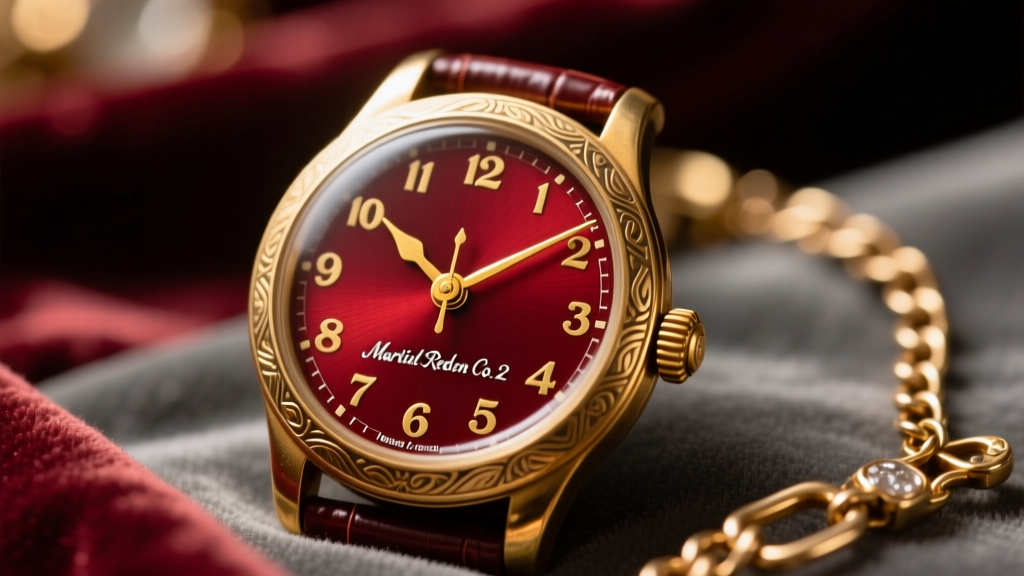
Martial Redon Co. 2: A Technical and Historical Deep Dive into a Rare French Chronograph Movement
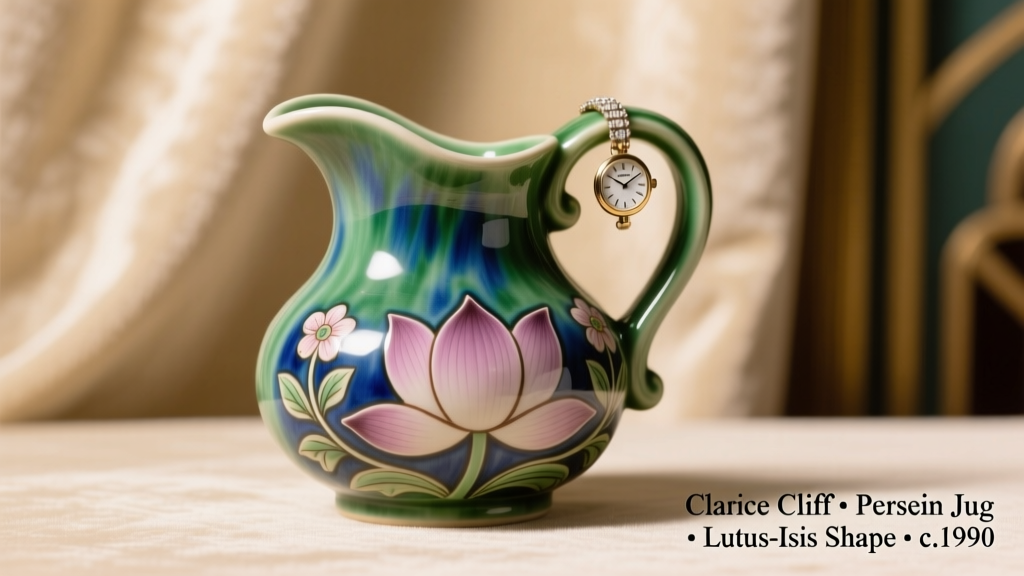
Clarice Cliff Persian Jug: The Lotus Isis Shape in Green, Blue, and Mauve — A 1930 Masterpiece at 10 Inches
Scales Jewelers Henry Troemner Glazed Case Patinated Metal Maple 16 × 17 Inch: A Technical Masterpiece of American Precision Instrumentation
Staffordshire Pitcher Bowl: Decoding the Lucerne Blue Transfer Pattern with W.P. Co. Incised Mark

Fiesta Cup and Saucer in Red No. 2: A Mid-Century American Ceramic Icon
Peachblow Vase, Wheeling Glass Company, Elongated Pear Form, Red-to-Amber Gradient, 9¼ Inches — A Technical & Historical Appraisal
Neoclassical Walnut Sofa with Fortuny Fabric: A 1930s Italian Masterpiece Measuring 36 Inches in Depth
Hall China Airflow Teapot in Canary Yellow Gold: A Mid-Century Masterpiece of Form, Function, and Ceramic Innovation
Hutschenreuther Figurine: Children Dancing in White — A Study of the 4¼-Inch Porcelain Masterpiece