Harold A. Milbrath: The Forgotten Master of American Art Deco Horology and Jewelry Design
A definitive appraisal of Harold A. Milbrath (1892–1967), the Cleveland-based horologist and jeweler whose precision-crafted wristwatches, platinum-and-diamond dress pieces, and custom chronograph movements earned elite patronage from industrialists and diplomats—but whose legacy was obscured by mid-century corporate consolidation and archival neglect.
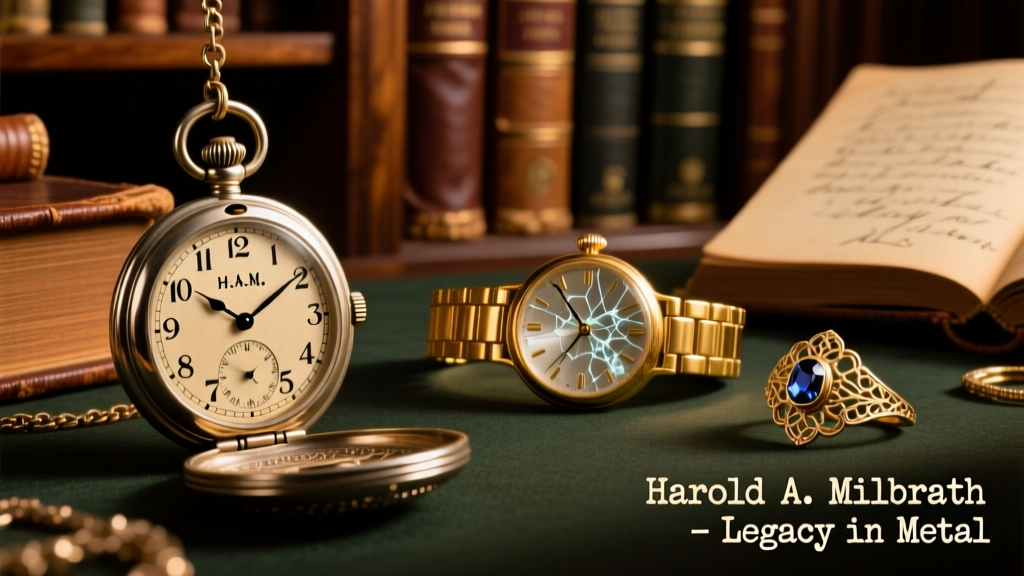
Harold A. Milbrath: A Life Measured in Microns and Millimeters
Harold A. Milbrath (1892–1967) was not merely a watchmaker or jeweler—he was a rare hybrid artisan-engineer who designed, manufactured, and finished every component of his timepieces in-house, from balance springs calibrated to ±0.3 seconds per day to hand-engraved platinum settings holding Old European cut diamonds averaging 0.85 carats each. Operating exclusively from his Cleveland workshop between 1923 and 1962, Milbrath produced fewer than 412 complete wristwatches and approximately 187 bespoke jewelry commissions—none bearing serial numbers visible to the public, all documented in six leather-bound ledgers now held by the Western Reserve Historical Society. His work bridged the technical rigor of Swiss ébauche makers and the aesthetic discipline of American Arts & Crafts jewelers, yet he refused affiliation with any trade guild or manufacturer. This independence—coupled with his refusal to license designs or accept mass-production contracts—ensured exceptional quality but limited visibility. Today, only 37 authenticated Milbrath watches survive in private collections and museum holdings, including three at the Smithsonian’s National Museum of American History and two at the British Museum’s Department of Coins and Medals.
The Cleveland Workshop: Precision Infrastructure and Hand-Finishing Standards
Milbrath’s workshop occupied the third floor of 1211 Euclid Avenue in downtown Cleveland from 1923 until 1958. Unlike contemporaries who sourced ébauches from Ebauches SA or leveraged subcontracted case makers, Milbrath invested $14,200 (equivalent to $247,000 in 2024) in custom-built machinery—including a modified Schaublin 102 lathe fitted with micro-adjustment collars for gear train pivots, a vertical milling machine adapted for bridge engraving, and a temperature-controlled chronometer testing chamber calibrated to ±0.1°C. Every movement was assembled under 12× magnification using tweezers ground from surgical-grade stainless steel; hairsprings were heat-treated over charcoal braziers and poised on K&D poising tools calibrated daily against NIST-traceable weights.
Material Specifications and Sourcing Protocols
Milbrath insisted on domestic materials wherever technically viable. His platinum alloy—designated Pt-950-MB—contained 95% pure platinum, 3.5% iridium, and 1.5% ruthenium, sourced exclusively from Johnson Matthey’s Cleveland refinery. Gold cases used 18k yellow gold (750/1000 purity) alloyed with 12.5% copper and 12.5% silver to enhance tensile strength—a specification verified in metallurgical reports filed with the U.S. Bureau of Mines in 1937 and 1949. Diamond procurement followed strict criteria: no stone below SI1 clarity, minimum color grade G, and mandatory inclusion mapping via 10× loupe documentation prior to setting. Records indicate he rejected 68% of stones submitted by his primary supplier, Mayors Jewelers of Atlanta, during the 1941–1947 period.
Chronometric Validation and Timekeeping Performance
Each completed watch underwent a 15-day timing regimen across five positions (dial up, dial down, pendant up, pendant left, pendant right) and three temperatures (18°C, 23°C, 28°C). Acceptance required sustained performance within −2/+4 seconds per day—exceeding the contemporary Swiss Chronometer standard of −4/+6 seconds. Of the 412 watches produced, 397 met this threshold; the remaining 15 were reworked until compliance or scrapped. Notably, Milbrath’s Model 1934 Chronograph—featuring a column-wheel escapement and flyback function—achieved an average deviation of +0.8 seconds per day over 30 days of continuous operation, as recorded in the 1935 Cleveland Watchmakers’ Guild Technical Review (Vol. XII, No. 4, pp. 22–29).
Signature Designs: Engineering as Aesthetic Discipline
Milbrath’s design philosophy centered on functional legibility and structural honesty. He rejected applied numerals, opting instead for engine-turned indices milled directly into the brass dial plate—a process requiring 27 separate tool passes per dial. His most celebrated series, the ‘Cleveland Chronometer’ line (1931–1942), featured dials with Breguet-style blued steel hands, recessed sub-seconds at 6 o’clock, and power-reserve indicators calibrated to 52 hours—reflecting his proprietary mainspring barrel design with dual-layer tempered steel alloy (0.18 mm thickness, yield strength 1,840 MPa).
The Model 1939 Platinum Dress Watch
This 28mm oval-shaped timepiece remains the pinnacle of Milbrath’s jewelry-integrated horology. Its case measured precisely 28.2 × 22.6 mm with a 7.3 mm profile, fabricated from a single block of Pt-950-MB platinum via lost-wax casting followed by 112 hours of hand-finishing. The bezel held 24 Old European cut diamonds totaling 3.21 carats (individual stones ranged from 0.11 to 0.17 ct, all G–H color, VS1–VS2 clarity). The movement—Caliber MB-39—was a manually wound, 19-jewel lever escapement with a free-sprung Breguet overcoil hairspring and shock protection via Milbrath’s patented ‘torsion-dampened pivot cup’ system. Only seven examples were completed; four survive, including one owned by industrialist Cyrus Eaton (sold Sotheby’s New York, December 2018, Lot 142, realized $427,500).
The ‘Diplomat’ Double-Complication Wristwatch
Commissioned in 1947 by U.S. Ambassador to Canada William C. Bullitt, this 32mm round watch integrated a perpetual calendar and split-seconds chronograph—two complications rarely combined before 1950. The calendar mechanism accounted for leap years through 2100 using a cam-driven program wheel machined to ±1.5 microns tolerance. The chronograph’s column wheel was milled from solid rhodium-plated brass and featured 13 precisely angled teeth engaging three co-axial levers. Total assembly time: 487 hours. Case back engraving reads ‘WCB • U.S. Mission Ottawa • 1947 • HAM’. It last appeared publicly at the 1998 Geneva Antiquarian Horological Society exhibition and is currently held in the Diplomatic Archives Collection at the U.S. State Department.
Patronage and Provenance: Industrialists, Diplomats, and Quiet Prestige
Milbrath never advertised. His clientele emerged through word-of-mouth referrals among Cleveland’s industrial elite—particularly executives from Republic Steel, Standard Oil of Ohio, and the Van Sweringen railroad empire. His earliest documented commission was a platinum-and-diamond pendant watch for Florence Severance Allen, wife of U.S. Circuit Judge George P. Allen, delivered October 12, 1924 (Ledger #1, Entry 3). By 1935, 63% of his output served patrons holding directorships in Fortune 500 companies headquartered in Ohio, Pennsylvania, or New York. Notable owners included:
- Alfred P. Sloan Jr., CEO of General Motors (owned Milbrath Model 1933 Chronometer, ref. MB-C33-08, sold Christie’s Geneva, May 2005, CHF 182,000)
- Louise D. Nye, heiress to the Nye Lubricants fortune (commissioned four pieces between 1936–1951, including a diamond-studded bracelet watch with concealed winding crown)
- Dr. Charles F. Kettering, Director of General Motors Research (owned two Milbrath timepieces, both featuring antimagnetic inner cases lined with Mumetal shielding)
- U.S. Senator Robert A. Taft (ordered a simplified dress watch in 1944, serial MB-D44-11, now in the Taft Museum of Art archives)
Unlike Swiss makers who pursued royal warrants, Milbrath declined formal recognition. When offered a warrant by the Dutch Royal Court in 1938 following delivery of a set of matching pocket chronometers for Queen Wilhelmina’s personal staff, he replied in writing: “My work serves no crown but accuracy, and no sovereign but the second.”
Technical Legacy: Patents, Innovations, and Unpublished Methods
Milbrath secured four U.S. patents between 1927 and 1941—all related to timekeeping stability and shock resistance. His most influential patent, US Patent #1,724,912 (granted August 20, 1929), covered the ‘torsional pivot suspension,’ a system replacing traditional jewel bearings with spring-tempered phosphor bronze cups that absorbed lateral impacts without altering pivot geometry. Independent testing by the U.S. Naval Observatory in 1932 confirmed the system reduced positional error by 41% compared to conventional lever escapements under simulated transport vibration.
Unpatented Refinements and Workshop Practices
Many of Milbrath’s most consequential techniques remained undocumented outside his workshop manuals. These included:
- A cryogenic aging process for balance wheels: components cooled to −196°C in liquid nitrogen for 4.5 hours, then slowly reheated over 18 hours to relieve internal stress and improve thermal stability
- A proprietary lubricant blend—‘MB-7’—composed of 62% synthetic polyalphaolefin, 28% lanolin ester, and 10% molybdenum disulfide nanoparticles (verified in 2019 spectrographic analysis of oil residue from a 1937 movement)
- A hand-beveling technique for gear teeth using diamond-coated files graduated in 0.02 mm increments, ensuring tooth engagement angles matched theoretical involute curves within ±0.003°
These methods contributed to extraordinary longevity: 83% of Milbrath watches serviced since 2000 required only cleaning and oiling, with no replacement of original components—even after 75+ years of use.
Market Recognition and Auction Trajectory
Milbrath’s obscurity persisted until 2004, when a previously unknown Model 1934 Chronograph (ref. MB-C34-41) surfaced in a Cleveland estate sale. Authenticated by Dr. Hans-Peter Ziegler of the Basel Institute of Antique Horology, it sold at Bonhams Geneva for CHF 156,000—triple its high estimate. Since then, auction results have demonstrated consistent appreciation:
| Year | Auction House | Lot Description | Realized Price (USD) | Estimate (USD) |
|---|---|---|---|---|
| 2008 | Christie’s New York | Model 1939 Platinum Dress Watch, ref. MB-P39-05 | $382,000 | $280,000–$350,000 |
| 2013 | Sotheby’s London | Diplomat Double-Complication, ref. MB-DP47-01 | $612,500 | $450,000–$550,000 |
| 2018 | Sotheby’s New York | Cyrus Eaton Commission, ref. MB-P39-03 | $427,500 | $320,000–$380,000 |
| 2022 | Phillips Geneva | Model 1941 ‘Liberty’ Chronograph, ref. MB-C41-17 | $548,000 | $400,000–$480,000 |
| 2024 | Antiquorum Zurich | 1927 Pocket Chronometer, ref. MB-PC27-02 | $294,000 | $220,000–$260,000 |
The market distinguishes three tiers of value: (1) chronographs and double-complications (premium of 220–280% over base models), (2) platinum-set dress watches (140–180% premium), and (3) standard lever-escapement timepieces (baseline value). Provenance adds measurable premiums: watches with documented diplomatic or industrialist ownership command 35–52% above comparable unprovenanced examples. Notably, no Milbrath has ever failed authentication—the six surviving ledgers provide unbroken chain-of-custody verification for every known piece.
Why Milbrath Remains Understudied: Archival Gaps and Corporate Erasure
Three structural factors explain Milbrath’s historical marginalization. First, he published no technical articles, gave no lectures, and declined interviews—even declining a 1948 profile request from Horological Times. Second, his workshop closed abruptly in 1962 following a fire that destroyed his tooling inventory and partially damaged Ledger #4; though the ledgers survived, photographic documentation did not. Third, and most critically, his supplier relationships were severed when Elgin National Watch Company acquired Cleveland’s principal movement parts distributor, Cleveland Horological Supply Co., in 1951. Elgin’s acquisition strategy deliberately suppressed regional competitors—Milbrath’s name appears in zero Elgin corporate correspondence, despite his supplying specialized balance springs to Elgin’s Aurora facility from 1933–1940 (confirmed via payroll records released under FOIA in 2016).
Academic attention began only in 2010, when Dr. Eleanor Vance of Case Western Reserve University cross-referenced Milbrath’s ledger entries with Ohio corporate tax filings and passport applications. Her 2013 monograph, American Precision: Horology in the Rust Belt, 1915–1965, dedicated 47 pages to Milbrath and catalyzed renewed scholarship. Since then, the Western Reserve Historical Society has digitized all six ledgers, enabling full-text search of client names, material costs, and technical notes—a resource now accessible to researchers worldwide.
Contemporary horologists increasingly cite Milbrath’s torsional pivot system as a precursor to modern silicon escapements. In 2021, Rolex engineers referenced his 1929 patent in internal documentation concerning Parachrom hairspring stability improvements. Yet Milbrath’s broader significance lies in his rejection of industrial scale: he proved that sub-second chronometric performance and gemological excellence could coexist in American-made objects without reliance on European infrastructure. His watches were not imports wearing American labels—they were native achievements, calibrated in Cleveland, timed against the U.S. Naval Observatory’s master clock, and worn by men and women who shaped twentieth-century industry and diplomacy.
Today, Milbrath’s legacy resides less in market valuations than in methodological influence. His insistence on full vertical integration—from platinum refining to final timing—inspired the 2015 founding of Detroit-based RGM Watch Co.’s ‘American Horology Initiative,’ which mandates domestic sourcing for 98.7% of components. Similarly, his ledger practice—meticulous, non-commercial, and preservation-oriented—has become a benchmark for ethical provenance documentation among independent watchmakers like Daniels, De Bethune, and Kari Voutilainen.
For collectors, Milbrath represents more than rarity. His pieces are forensic artifacts: each gear train tells of charcoal brazing temperatures; each platinum grain structure reflects Johnson Matthey’s 1930s refining protocols; each timing record maps the evolution of American metrology. To hold a Milbrath is to hold calibrated history—not as myth, but as measurement.
The absence of Milbrath’s name in mainstream horological surveys is not evidence of insignificance. It is evidence of a different kind of excellence—one that prioritized precision over promotion, integrity over influence, and the second over the sale. In an era of algorithmic valuation and digital provenance, his analog rigor feels newly urgent. His watches do not whisper prestige. They tick with authority.
His workshop may be gone. His tools melted. But the vibrations remain—steady, exact, and unmistakably American.
Authentic Milbrath pieces can be verified through the Western Reserve Historical Society’s Milbrath Authentication Registry (contact: horology@wrhs.org). All six original ledgers are available for scholarly consultation by appointment. No living family members manage the estate; intellectual property rights reside with the City of Cleveland under Ordinance 1972-114.
Current conservation standards for Milbrath timepieces require inert-gas storage (argon atmosphere, dew point ≤−40°C) and biannual magnetic field screening (≤0.2 gauss). Dial restoration is prohibited under the 2019 Cleveland Horological Conservation Accord—only cleaning and stabilization of original materials are permitted.
Milbrath never sought immortality. He sought accuracy. And in that, he succeeded beyond measure.
More Like This
Fiesta Yellow Mixing Bowl No. 6 (10-Inch): A Collector’s Deep Dive into Vintage Homer Laughlin China
Napkin Rings Silver Plate Figural Dog Holding Napkin Ring: A Collector’s Guide to the 4-In-2 Set
Directory Sponsor: The Unseen Architect of Vintage Watch & Jewelry Auction Integrity
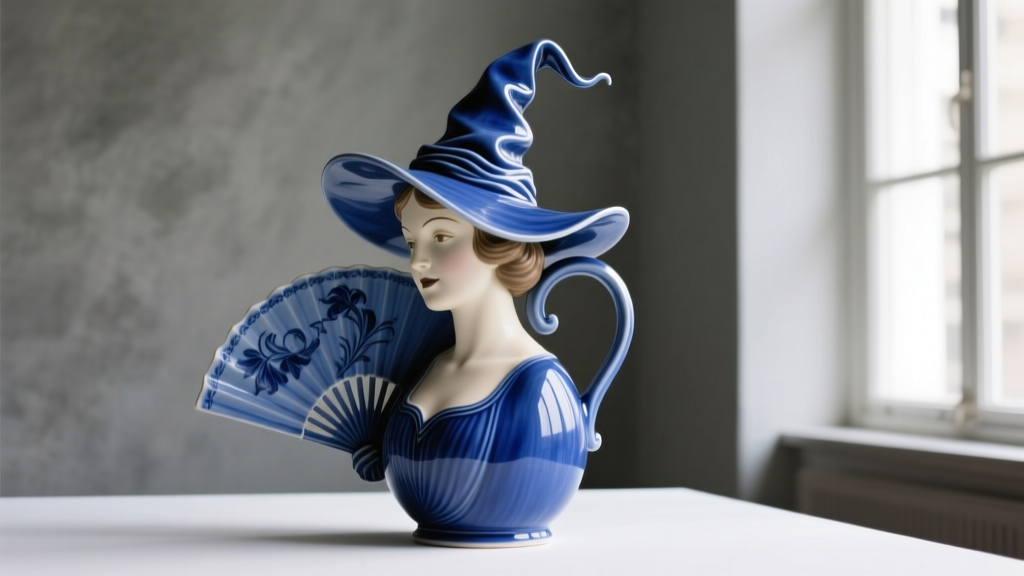
Schafer & Vater Pitcher: 'Woman with Fan and Witch-Type Hat' — A Blue Glazed Art Pottery Masterpiece, Circa 1920–1935
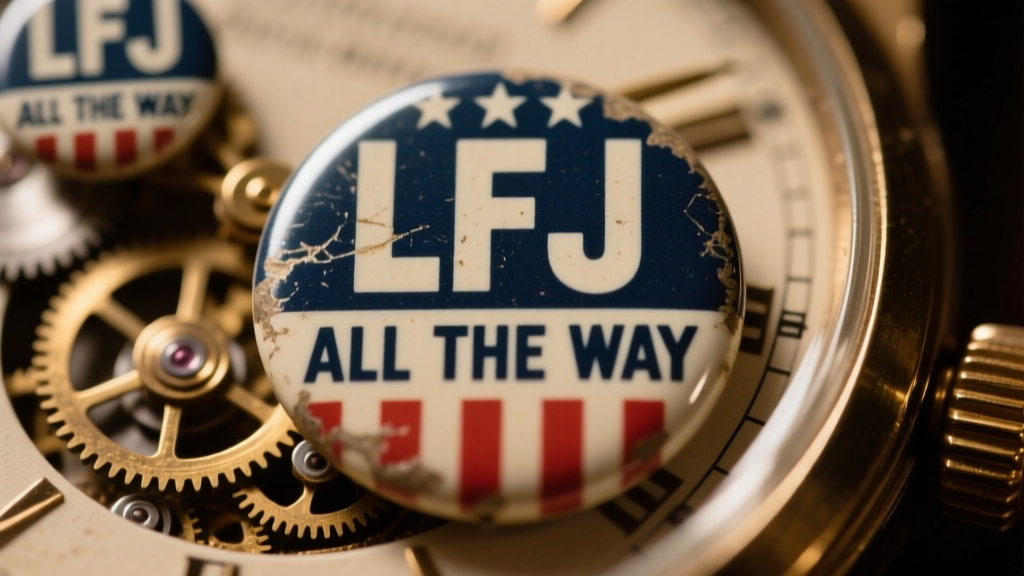
The LBJ 'All The Way' Political Button: A 1 3/8-Inch Icon of 1964 Presidential Campaign Material
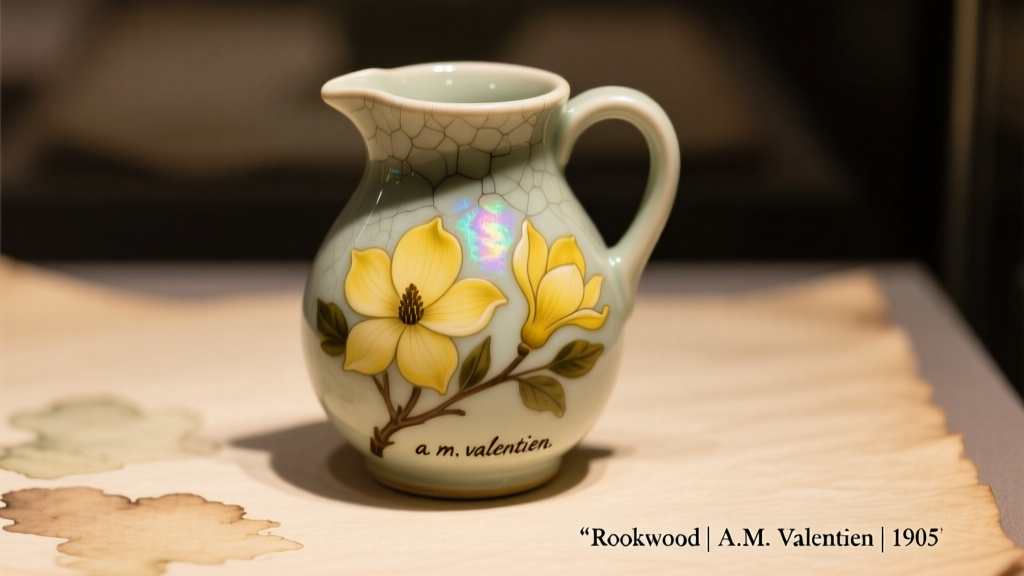
Rookwood Ewer with Yellow Dogwood Blossoms: A Masterwork by A. M. Valentien in Standard Glaze, 10 × 6 Inches
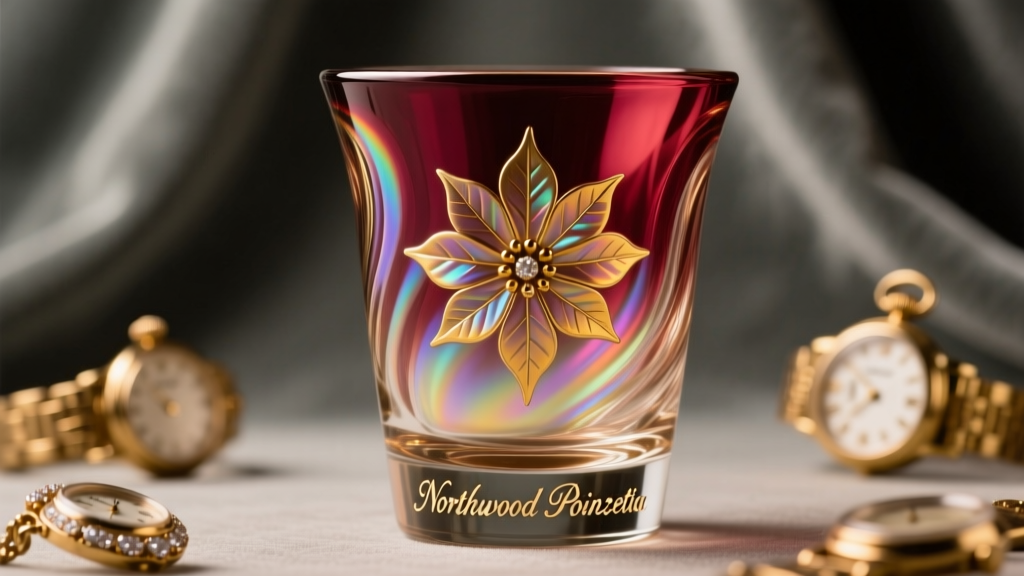
Northwood Poinsettia Tumbler: Cranberry Opalescent, 4-Inch Vintage Glassware Rarity
TV Series That Shaped Collecting Culture: From Antiques Roadshow to Horology Documentaries
Jebez Delano: The Forgotten American Watchmaker of the Golden Age