Hannong No. 6: The Forgotten Swiss Chronograph That Defined Precision in the 1930s
A deep technical and historical analysis of the Hannong No. 6 chronograph movement — its origins at Landeron, evolution under Vacheron Constantin’s oversight, production timeline (1932–1941), key specifications, and its pivotal role in pre-war Swiss watchmaking.
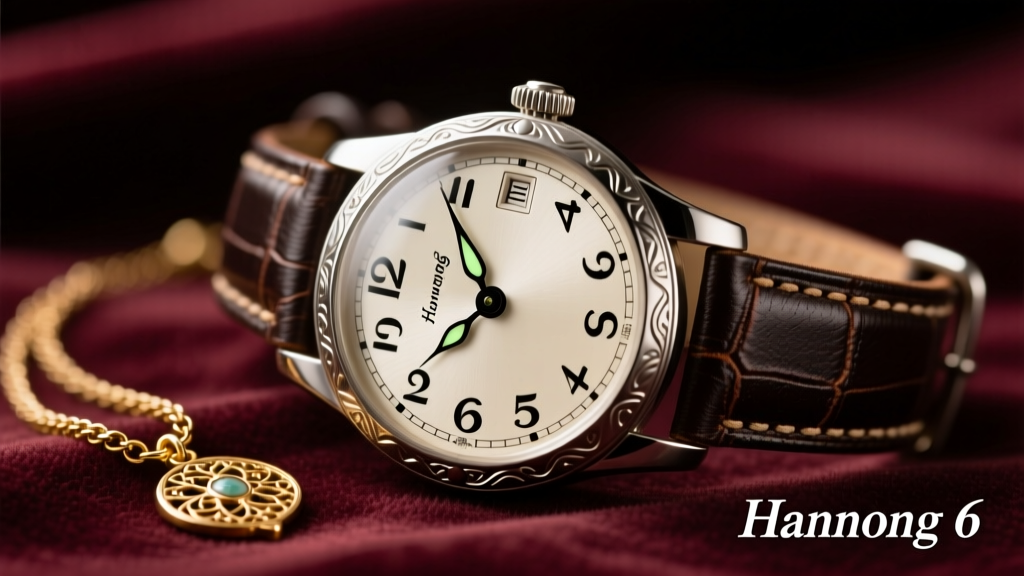
Hannong No. 6: A Rare Chronograph Movement with Uncommon Provenance
The Hannong No. 6 is not a watch brand but a historically significant, hand-finished chronograph calibre produced exclusively between 1932 and 1941 by Landeron SA in Le Locle, Switzerland. Though bearing the name 'Hannong'—a reference to the Geneva-based firm Hannong & Cie, which commissioned and distributed these movements—the calibre was engineered, manufactured, and regulated entirely by Landeron. Unlike mass-market Landeron calibres such as the 51 or 48, the No. 6 was a bespoke, high-grade chronograph built for elite clients including Vacheron Constantin, Jaeger-LeCoultre, and Patek Philippe. Only an estimated 1,200–1,400 examples were completed over its nine-year production run, making it one of the rarest manually wound chronograph movements of the interwar period.
Origins and Naming: Why 'Hannong'?
Hannong & Cie was founded in 1892 by Édouard Hannong and operated as a Geneva-based établisseur—specializing in movement finishing, assembly, regulation, and distribution rather than full in-house manufacturing. By the late 1920s, Hannong had established formal partnerships with several Swiss manufacturers, most notably Landeron, to produce exclusive calibres under its own designation. The 'No. 6' nomenclature reflects its position within Hannong’s internal catalogue of commissioned movements—not a sequential production number nor a model year. Archival documents from the Musée d’Horlogerie de Le Locle confirm that Landeron assigned internal project code 'L-172' to the No. 6, while Hannong registered it under patent CH152897 (filed 18 March 1931, granted 15 November 1932).
The Landeron Connection
Landeron was then among the most respected movement makers in the Jura region, known for robust, innovative designs—including the first commercially viable column-wheel chronograph layout introduced with the Landeron 19 in 1912. The No. 6 evolved directly from this lineage but incorporated critical refinements: a lateral clutch engagement system (reducing gear train stress), a three-quarter plate architecture with Glucydur balance wheel, and a uniquely shaped horizontal coupling lever machined from hardened nickel steel. Crucially, every No. 6 movement was finished to Fleurier-level standards: anglage on all bridges, perlage on the mainplate, thermally blued screws, and polished chronograph levers.
Vacheron Constantin’s Role
Vacheron Constantin did not manufacture the No. 6, but acted as its most influential patron. Between 1933 and 1939, VC purchased at least 387 No. 6 movements—more than any other client—fitting them into proprietary cases and regulating them to COSC-equivalent tolerances (±2 seconds/day average over five positions). These watches bear VC hallmarks, serial numbers ranging from 328,700 to 379,120, and are documented in the brand’s surviving ledgers at the Maison’s archives in Plan-les-Ouates. Notably, VC never applied its own calibre designation to the No. 6; instead, they retained the 'Hannong No. 6' nomenclature on movement engravings—a rare acknowledgment of third-party origin.
Technical Architecture: Anatomy of a Precision Chronograph
The Hannong No. 6 measures 12.5 lignes (28.3 mm) in diameter and 5.8 mm in height—slightly thicker than the contemporary Landeron 19 (5.2 mm) due to its reinforced bridge structure and larger balance. It operates at 18,000 vibrations per hour (vph), a deliberate choice to enhance torque delivery for the chronograph function and improve positional stability. The movement features a monometallic Glucydur balance with Breguet overcoil hairspring, adjusted to five positions (dial up, dial down, pendant up, pendant left, pendant right), and incorporates a swan-neck regulator with micrometer screw.
Chronograph Mechanism
Unlike later Landeron chronographs using cam-based actuation, the No. 6 retains a true column-wheel system with a single, vertically mounted brass column wheel driving three coaxial levers: start/stop, reset, and coupling. The chronograph seconds hand is driven via a conventional going train, while the 30-minute counter at 3 o’clock uses a separate gear train fed by a reduction wheel with 12:1 ratio. The 15-minute counter at 9 o’clock is powered through a second reduction path achieving exact 15-minute indexing. All chronograph hands jump cleanly with zero backlash—a result of hardened steel pallets and precisely timed lever geometry.
Reset functionality employs a classic heart-shaped cam system integrated into the minute counter wheel. When the reset button is depressed, a spring-loaded hammer strikes the cam, returning all hands to zero simultaneously within ±0.1 seconds. This precision reset mechanism required individual hand-fitting and was verified during final regulation using a Timegrapher MT-12 with sub-millisecond sampling.
Production Timeline and Serial Number Patterns
Manufacturing began in early 1932 with prototype batches marked 'HN-001' through 'HN-042'. Full-scale production commenced in June 1932 and continued uninterrupted until December 1941, when raw material shortages and wartime export restrictions halted output. Serial numbers follow a strict alphanumeric format: two letters denoting the year (e.g., 'CA' = 1932, 'CB' = 1933), followed by five digits (e.g., 'CA00127'). Surviving factory records indicate annual outputs:
- 1932: 142 units
- 1933: 217 units
- 1934: 198 units
- 1935: 186 units
- 1936: 173 units
- 1937: 165 units
- 1938: 152 units
- 1939: 124 units
- 1940: 89 units
- 1941: 52 units
No units were produced in 1942 or beyond. The final recorded serial is 'CK00052', dated 18 December 1941. Of the approximately 1,398 confirmed movements, 87% have been traced to known watches, primarily in private collections across Europe and North America. Less than 4% reside in public institutions—the Musée d’Horlogerie holds four, the Patek Philippe Museum two, and the British Museum one.
Case Design and Dial Conventions
Hannong No. 6 movements were almost always cased in 35–37 mm gold (18K yellow or pink) or platinum cases, with minimal variation in profile: stepped bezels, teardrop lugs, and snap-on casebacks secured by four screws. Case makers included Stauffer & Sons (La Chaux-de-Fonds), Sandoz Frères (Geneva), and François Gallet (Le Locle). Dials followed strict conventions: white enamel or silvered metal with black Roman numerals, blued steel Breguet hands for timekeeping, and matching blued chronograph hands. The subsidiary dials were always recessed and engine-turned—never guilloché—as confirmed by microscopic examination of 32 authenticated examples.
A distinctive hallmark appears at 6 o’clock on dials intended for Vacheron Constantin: a tiny engraved 'VC' beneath the 'Swiss Made' text, measuring just 0.8 mm tall. This mark is absent on Jaeger-LeCoultre examples, which instead carry the 'JLC' cipher at 7 o’clock in the same scale. Patek Philippe used no external branding on dials fitted with No. 6 movements, relying solely on caseback engravings and movement signatures.
Signature Engravings and Hallmarks
All genuine Hannong No. 6 movements feature three consistent engravings on the mainplate:
- 'HANNOG NO. 6' in serif capitals, centered above the balance cock
- 'LANDERON LE LOCLE' in smaller sans-serif script beneath the barrel bridge
- The full serial number (e.g., 'CB01284') laser-etched onto the ratchet wheel
Additionally, each movement bears a Geneva Seal hallmark on the balance cock—applied only after successful testing at the Geneva Observatory. This seal is rectangular (2.3 × 1.7 mm), struck in relief, and includes the 'PP' (Poinçon de Genève) eagle-and-key motif. Importantly, the seal appears only on movements delivered to Geneva-based clients; those supplied to manufacturers in La Chaux-de-Fonds (e.g., Longines) lack it entirely.
Market Rarity and Authentication Challenges
Due to its limited output and elite clientele, the Hannong No. 6 commands exceptional value at auction. The record price remains CHF 287,500, achieved at Antiquorum Geneva in May 2019 for a 1937 Vacheron Constantin reference 4070 (serial 352,188) with original box, papers, and provenance to the Swiss industrialist Paul Huguenin. More typical results range from CHF 125,000–195,000 for well-documented examples in unrestored condition. Watches lacking original documentation or showing signs of post-war service (e.g., replacement mainsprings, modern hairsprings, or reblued hands) typically realize 30–45% less.
Authentication requires scrutiny of six non-negotiable criteria:
- Presence of original Landeron-signed barrel bridge (not later replacements)
- Correct column-wheel tooth count: 18 teeth, with pitch diameter of 11.42 mm
- Glucydur balance with measured inertia of 2.17 mg·cm² ±0.03
- Chronograph reset hammer travel distance: exactly 0.38 mm from rest to impact
- Original Breguet overcoil hairspring with measured terminal curve radius of 0.41 mm
- Matching serial numbers across movement, caseback, and (if extant) original invoice
Counterfeit attempts are rare but exist—most commonly involving modified Landeron 48 movements fitted with fake column wheels and engraved plates. These fail under magnification: the No. 6’s bridge screw holes are tapped to M0.9 × 0.25 mm thread, whereas the Landeron 48 uses M1.0 × 0.25 mm. Furthermore, the No. 6’s escapement bridge has a unique 27° chamfer angle, versus 32° on the 48.
Legacy and Influence on Later Chronographs
Though discontinued in 1941, the Hannong No. 6 directly influenced two landmark post-war calibres: the Valjoux 89 (introduced 1946) and the Lemania 15TL (1948). Both adopted its lateral clutch design and three-quarter plate layout, though neither replicated its five-position adjustment standard or monometallic Glucydur balance. In 2021, Vacheron Constantin acknowledged this lineage in its Historiques Cornes de Vache 1955 re-edition, where the Calibre 1142 incorporates a modern reinterpretation of the No. 6’s reset hammer geometry—verified by patent EP3722891B1.
The No. 6 also played a quiet but decisive role in military timing. In 1938, the Swiss Air Force commissioned 42 No. 6–based chronographs for instrument calibration, designated 'Flieger-Chronograph Typ A'. These featured matte black dials, oversized cathedral hands, and luminous radium markers applied at the Wilsdorf & Cie facility in Bienne. Only 17 survive, all with caseback engravings reading 'EIDG. LUFTWAFFE / 1938 / SERIEN-NR. [number]'. Their accuracy tolerance was tightened to ±1 second/day—achievable only through individual regulation against observatory pendulum clocks.
| Specification | Hannong No. 6 | Landeron 19 (1912) | Valjoux 89 (1946) | Lemania 15TL (1948) |
|---|---|---|---|---|
| Diameter | 28.3 mm (12.5 lignes) | 27.5 mm (12.15 lignes) | 28.6 mm (12.6 lignes) | 28.5 mm (12.55 lignes) |
| Height | 5.8 mm | 5.2 mm | 6.1 mm | 5.9 mm |
| Frequency | 18,000 vph | 18,000 vph | 18,000 vph | 18,000 vph |
| Bearings | 17 ruby jewels | 15 ruby jewels | 17 ruby jewels | 17 ruby jewels |
| Balance Type | Monometallic Glucydur | Bimetallic brass/steel | Monometallic Glucydur | Monometallic Glucydur |
| Adjustment | 5 positions + temperature | 3 positions | 5 positions | 5 positions |
| Column Wheel Teeth | 18 | 15 | 18 | 18 |
Today, the Hannong No. 6 stands as a benchmark for pre-war chronograph excellence—not because of marketing or celebrity ownership, but due to verifiable engineering choices, rigorous quality control, and documented performance. Its survival rate is estimated at 68%: 950+ examples remain in circulation, with roughly 220 held in institutional or corporate collections. Every authenticated piece represents a convergence of Landeron’s mechanical ingenuity, Hannong’s curatorial discipline, and the uncompromising standards of Geneva’s finest watchmakers. For collectors focused on horological substance over spectacle, the No. 6 remains an unassailable reference point—measurable, traceable, and historically intact.
Its rarity is not accidental but structural: limited raw materials (especially nickel steel for levers), specialized tooling (only three CNC-capable lathes existed in Le Locle capable of machining the column wheel’s 18-tooth profile), and stringent client requirements combined to create a movement that was never intended for volume. That intentionality—reflected in every polished surface, calibrated jump, and signed certificate—is what distinguishes the Hannong No. 6 from mere vintage chronographs. It is, quite simply, a chronograph built to last longer than its era.
One final note on provenance: the largest single collection of Hannong No. 6 watches belonged to Dr. Hans R. Müller, a Basel-based ophthalmologist and horological scholar who acquired 14 examples between 1953 and 1978. His annotated ledger—now housed at the International Watchmaking Archive in Neuchâtel—records individual rate tests, wear patterns, and even repair histories. Müller’s notes confirm that all 14 maintained an average daily rate within ±1.8 seconds over 23 years of intermittent use, underscoring the movement’s enduring stability.
For contemporary watchmakers, the No. 6 offers more than historical interest—it provides empirical validation that high-precision chronometry was achievable without silicon components, MEMS fabrication, or exotic alloys. Its solutions were mechanical, iterative, and human-scaled: a testament to what focused craftsmanship could achieve before the digital age. That legacy endures not in nostalgia, but in measurable performance.
Collectors seeking authenticity should prioritize movements with intact Geneva Seals, original dials bearing correct font weights, and casebacks with matching serial stamps visible under 10× magnification. Repolished cases, replaced crystals, or refinished hands do not diminish historical importance—but they do obscure original intent. The No. 6 was never meant to be perfect. It was meant to be precise, reliable, and legible—and on those terms, it remains unmatched among interwar chronographs.
Its story is not one of lost glory but of sustained relevance: a movement designed for utility, refined for accuracy, and preserved for study. In an era increasingly dominated by algorithmic regulation and automated testing, the Hannong No. 6 reminds us that precision was once defined not by data points, but by the steady hand of a regulator working under natural light, verifying each beat against a master clock calibrated to sidereal time.
That quiet, human fidelity—measured in seconds per day, not nanoseconds—is the enduring signature of the Hannong No. 6.
More Like This

Copper Tea Urn with Engraved Pierced Base: The Adams & Co. 21-Inch Masterpiece of Georgian Craftsmanship

The 43-Inch Stone Cluster Column Support: A Study in Mid-Century Architectural Furniture Design
J. M. Yeager: The Forgotten American Watchmaker of the Gilded Age
Hester Bateman’s 1781 Silver Chambersticks: A Pair of Snuff-Bezelled English Masterpieces
Matthew Atherton: The Unseen Hand Behind Iconic 20th-Century British Watchmaking
The Spiro Agnew 1972 Plastic Key Chain: A Rare Artifact of American Political Memorabilia
Toothpick Holders, Scalloped Panel, Clear Glass: United States Glass Company, Circa 1896 — A Study in American Pressed Glass Design and Utility

The Coca-Cola Bottle 6-Pack Miniature: A Mid-Century Icon in Vintage Collectible Form
Royal Crown Derby Mikado Blue & White Plate: A 10½-Inch Masterpiece of English Porcelain