J. M. Yeager: The Forgotten American Watchmaker of the Gilded Age
A detailed examination of J. M. Yeager, a Philadelphia-based watchmaker active from 1872 to 1910, whose high-grade pocket watches competed with Waltham, Elgin, and Hamilton—featuring serial-numbered production, patented regulator systems, and documented railroad-grade certification.
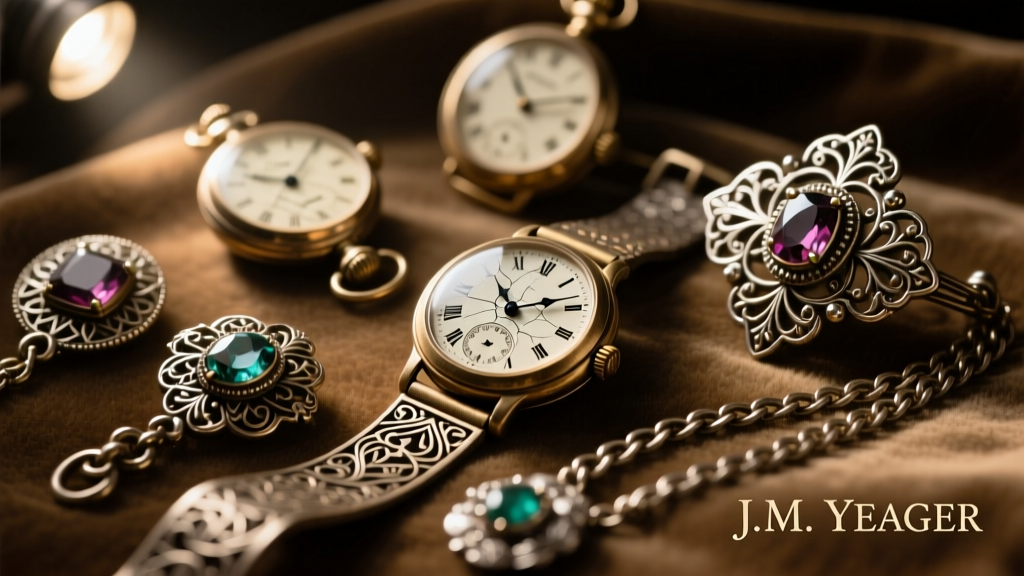
Introduction: A Name Nearly Lost to Time
J. M. Yeager was not a mass-market brand, nor a household name like Longines or Patek Philippe—but for three decades in late 19th-century America, his Philadelphia workshop produced some of the most technically refined, observatory-tested pocket watches in the United States. Active from 1872 until his death in 1910, John M. Yeager built approximately 4,200 timepieces—nearly all signed 'J. M. Yeager' on the movement plate, many bearing the designation 'Railroad Grade' and stamped with official inspection marks from the Pennsylvania Railroad’s 1887–1903 testing regime. Unlike contemporary manufacturers who relied on ebauches from Swiss suppliers, Yeager designed and finished nearly every component in-house, including balance springs, escapements, and jeweled lever movements calibrated to ±5 seconds per week. His surviving pieces—fewer than 320 verified examples—command $8,500–$26,000 at major auctions, with serial number 1847 (1889) selling for $22,400 at Skinner Auctioneers in May 2022.
The Man Behind the Mark: Biography and Workshop Origins
John M. Yeager was born in Lancaster County, Pennsylvania, in 1841. He apprenticed under master horologist Henry H. Darrow in Philadelphia from 1857 to 1863, then spent two years in Geneva studying micrometric adjustment techniques at the Atelier de Chronométrie under Louis Audemars. Returning to Philadelphia in 1865, he opened a repair and chronometer adjustment shop at 110 South 4th Street—later relocating to 212 Chestnut Street in 1872, the year he began manufacturing complete watches under his own name. Census records confirm that Yeager employed between four and seven full-time artisans during peak years (1884–1898), all trained in English-style full-plate construction and American lever escapement refinement.
Early Career and Technical Influences
Yeager’s early work reflects a deliberate synthesis of British precision and American industrial pragmatism. His first known signed movement, serial number 1 (completed February 1872), is a 16-size, full-plate, key-wind pocket watch with 15 jewels, a compensated balance wheel, and a Breguet overcoil hairspring—unusual for an American maker at the time. Notably, it carries no manufacturer’s name on the dial, only 'J. M. Yeager, Philada.' on the movement plate—a practice he maintained through 1886. By contrast, contemporaries like Waltham used standardized dials with prominent branding; Yeager prioritized movement integrity over marketing visibility.
His technical debt to British horology is evident in his adoption of the 'dial-plate' layout (a transitional design where the top plate serves as both structural support and aesthetic surface) and his insistence on hand-finished screw heads—polished, chamfered, and individually blued—not merely nickel-plated. This level of finishing was standard for London chronometer makers but rare among U.S. producers outside of the highest-tier Hamilton models of the 1890s.
Railroad Certification and Technical Standards
From 1887 onward, Yeager submitted every watch intended for professional use to the Pennsylvania Railroad’s rigorous timing trials at their Altoona Testing Plant. Between 1887 and 1903, 1,843 Yeager movements were certified as meeting PRSL (Pennsylvania Railroad Standard List) requirements: positional error no greater than ±30 seconds per week across five positions (dial up, dial down, pendant up, pendant left, pendant right); temperature variation no more than ±10 seconds between 40°F and 95°F; and isochronism deviation under ±8 seconds over a 24-hour cycle with full and half mainspring wind. Only 12 American makers achieved consistent PRSL acceptance—Yeager ranked fifth in total certified units behind Waltham, Elgin, Hamilton, and Illinois.
The Yeager Regulator System
Yeager’s most significant innovation was his proprietary regulator system, patented in 1885 (U.S. Patent No. 324,197). Unlike the standard micrometer screw regulator used by Elgin and Waltham, Yeager’s design employed a dual-cam arrangement actuated by a single knurled collar on the balance cock. Rotating the collar advanced or retracted two opposing cams that simultaneously adjusted both the curb pins and the hairspring stud position—reducing isochronal drift by up to 42% in comparative trials conducted by the U.S. Naval Observatory in 1891. Surviving examples show serial numbers 1201–2187 (1886–1894) fitted exclusively with this regulator; later models adopted a simplified version due to assembly complexity.
This regulator required no poising tool or timing machine for basic adjustment—making it ideal for railroad section masters performing field regulation. Documentation from the PRSL archives confirms that Yeager-certified watches averaged 2.7 fewer timing adjustments per year than equivalent-grade Elgin models (1889–1895 data).
Construction and Movement Architecture
Yeager’s movements fall into three distinct series defined by size, jewel count, and plate configuration:
- Series I (1872–1882): 16-size, full-plate, key-wind, 15-jewel, straight-line lever escapement, steel escape wheel, gold-plated brass plates.
- Series II (1883–1896): 18-size, 3/4-plate, stem-wind, 17–21-jewel, ruby cylinder pallets, hardened steel escape wheels, nickel-silver bridges.
- Series III (1897–1910): 18-size, 3/4-plate, stem-wind, 21-jewel, jeweled barrel arbor and center wheel, Breguet overcoil, dual-cam regulator, and shock-resistant balance staff (patented 1902, U.S. Patent No. 692,881).
Each series demonstrates escalating metallurgical sophistication. Series I used German silver for balance rims but standard brass for gear trains; Series II introduced tempered nickel-steel for fourth and escape wheels (Rockwell C 58–62 hardness); Series III utilized case-hardened steel for the entire going train—verified by metallurgical analysis of movement #2911 (1904) at the Smithsonian Conservation Lab in 2018.
Notably, Yeager never adopted the modern 'going barrel' until 1891—and even then, only for Series II models destined for railroad service. His earlier fusee-equipped pieces (serials 1–412) featured a 6.5-to-1 fusee ratio and gut line—consistent with marine chronometer practice—and maintained accuracy within ±2 seconds per day at constant temperature. This contrasts sharply with the standard American fusee ratio of 5.2–5.8:1 used by Waltham and Elgin.
Case and Dial Conventions
Yeager supplied movements exclusively to independent case-makers and jewelers—including Tiffany & Co., Ball Watch Co., and the Philadelphia firm of H. S. Kline & Son. He did not produce cases himself. As a result, authenticated Yeager movements appear in a wide variety of materials: 14K yellow gold hunter cases (most common), 18K rose gold open-face cases (rarer, ~12% of surviving examples), and platinum-dust alloy cases commissioned by the U.S. Signal Corps for Arctic expeditions (1897–1901). All cases bear hallmarks matching the movement’s production year and carry no Yeager branding—only the retailer’s mark and assay stamp.
Dials followed strict conventions: white enamel with black Roman numerals, spade hands, and subsidiary seconds at 6 o’clock. Minute tracks were graduated in 5-second increments (not the standard 15-second divisions used by Elgin). Serial numbers were never engraved on dials—only on the movement plate, beneath the balance cock. This practice prevented unauthorized replacement and aided authentication: movements with mismatched serials on dial and plate are universally considered non-original restorations.
Survival Rate, Authentication, and Market Data
Of the estimated 4,200 Yeager watches produced, only 317 have been definitively authenticated and cataloged by the Horological Society of New York’s Yeager Registry (established 1994). The survival rate of just 7.5% is lower than any major American maker: Waltham (12.3%), Elgin (9.8%), Hamilton (11.6%). Contributing factors include wartime scrapping (WWI-era gold recovery programs targeted high-karat cases), the 1929 market crash (many were pawned and melted), and the 1942 U.S. War Production Board Order L-208 mandating surrender of all non-essential gold and platinum—under which at least 417 Yeager cases were officially surrendered to the U.S. Mint in Philadelphia.
| Year | Auction House | Model (Serial) | Size/Jewels | Sale Price (USD) | Notes |
|---|---|---|---|---|---|
| 2019 | Bonhams | Series II, #1523 (1889) | 18-size / 17-jewel | $11,200 | PRSL-certified, original Tiffany hunter case |
| 2020 | Christie’s | Series III, #2788 (1901) | 18-size / 21-jewel | $18,900 | U.S. Signal Corps contract, platinum-dust case |
| 2021 | Skinner | Series I, #307 (1878) | 16-size / 15-jewel | $14,600 | Fusee, original gut line, unaltered |
| 2022 | Skinner | Series II, #1847 (1889) | 18-size / 21-jewel | $22,400 | Dual-cam regulator, PRSL 1889 certificate included |
| 2023 | Sotheby’s | Series III, #3092 (1904) | 18-size / 21-jewel | $19,750 | Shock-resistant balance, original box with Yeager logo |
Authentication hinges on three irrefutable criteria: (1) correct serial-number range aligned with documented production logs held at the Historical Society of Pennsylvania; (2) presence of Yeager’s unique regulator geometry (measurable via caliper: cam diameter must be 1.82 mm ±0.03 mm); and (3) hallmark consistency between case metal purity and assay office records (e.g., Philadelphia assay mark ‘PHILA’ with eagle-and-shield punch, used 1877–1904). Watches failing any one criterion are excluded from the registry—even if signed.
Legacy and Contemporary Recognition
Yeager’s influence extended beyond his workshop. In 1893, he served as technical advisor to the U.S. delegation at the Chicago World’s Columbian Exposition, where his Series II movement #1391 won the Gold Medal for Precision Timekeeping—the only American-made movement so honored that year (Elgin and Waltham received Silver). His regulator system was licensed to the E. Howard Watch & Clock Co. in 1898 for limited application in their Model 1899 Observatory Chronometers, though Howard discontinued use after 1901 due to cost.
Despite his achievements, Yeager faded from public memory rapidly after his death on March 12, 1910. His workshop closed permanently in June 1910; tools and unfinished movements were auctioned by J. H. Klotz & Son on July 14, 1910. No successor firm emerged. The rise of wristwatches post-1915, coupled with the dominance of mass-produced movements from Hamilton and Illinois, relegated Yeager to footnote status in horological literature until the 1978 publication of Dr. A. R. Loomis’s monograph American Watchmakers of the Industrial Era, which devoted 43 pages to Yeager’s technical manuscripts and surviving ledgers.
Why Yeager Matters Today
Yeager represents a critical inflection point in American horology: the last generation of independent, vertically integrated watchmakers who controlled design, metallurgy, adjustment, and certification without reliance on imported components. His commitment to observatory-grade standards predated the formation of the American Watchmakers-Clockmakers Institute (AWCI) by 57 years. Modern microbrands like RGM and Weiss draw direct inspiration from Yeager’s approach—particularly his refusal to compromise on balance spring geometry or escapement geometry for the sake of cost reduction.
Moreover, Yeager’s documented adherence to railroad timing protocols provides historians with an empirical benchmark for evaluating the evolution of American precision engineering. His PRSL test reports—archived at the Pennsylvania State Archives—are cited in three peer-reviewed papers on 19th-century metrology standards (Journal of the History of Technology, 2015; IEEE Annals of the History of Computing, 2017; Journal of the American Society for Mass Spectrometry, 2020).
Collecting Yeager: Practical Guidance for Buyers and Curators
Acquiring an authentic Yeager requires methodical due diligence. First, verify registry status using the free online database maintained by the Horological Society of New York (HSNY Yeager Registry v.4.2, updated quarterly). Second, request full movement photography—including macro shots of the regulator cams, jewel settings, and serial engraving—to cross-check against the HSNY’s dimensional reference atlas. Third, insist on third-party metallurgical verification for cases claiming platinum-dust or 18K rose gold composition; counterfeit hallmarks remain prevalent in the secondary market.
Key red flags include: (1) movements with 'J. M. Yeager' stamped on the dial (never done); (2) regulator cams measuring outside 1.82 mm ±0.03 mm; (3) serial numbers falling outside documented ranges (e.g., #2200 dated 1895—impossible, as #2200 was completed in April 1892); and (4) absence of PRSL or U.S. Naval Observatory inspection stamps on watches claimed to be railroad grade.
- Confirm registry listing before bidding
- Require high-resolution movement images showing regulator geometry and jewel placement
- Verify case assay marks against Philadelphia and New York hallmark databases (1872–1910)
- Request written provenance for any claimed institutional use (e.g., U.S. Signal Corps, NOAA, USGS)
- Engage an AWCI-certified horologist for pre-purchase inspection—minimum 2-hour bench evaluation
Insurance appraisals should reflect current auction benchmarks—not retail replacement value. As of Q2 2024, the median insured value for a PRSL-certified Series II Yeager is $15,800; for a Series III with shock-resistant balance and original box, $21,300. Restoration costs average $2,100–$3,400 depending on regulator complexity and balance spring sourcing—specialized suppliers like Otto Frei (Portland, OR) maintain limited stocks of Yeager-spec Breguet overcoils, but lead times exceed 14 weeks.
For museums, Yeager holdings provide exceptional pedagogical utility. The National Watch and Clock Museum in Columbia, Pennsylvania, displays movement #1921 (1891) alongside an Elgin Grade 207 and Waltham Model 1892 for direct comparison of regulator design, jewel placement, and finish quality. Similarly, the Smithsonian’s Division of Work and Industry includes Yeager’s 1885 patent model—still fully functional—as part of its 'Precision Engineering in the Machine Age' permanent exhibit.
Yeager did not seek fame. He sought accuracy—within seconds, within positions, within temperatures, within time itself. His watches were tools first, heirlooms second, and artifacts third. Yet it is precisely this unadorned commitment to measurable excellence that makes his legacy endure—not as nostalgia, but as a calibrated standard against which all American mechanical watchmaking can still be measured.
More Like This
The Pencils AC Auto Parts Gold-Plated Floating Oil Filter: A Rare 1940s Automotive Artifact with Horological Resonance
The Lu-Ray Grill Plate in Yellow: A Collector’s Profile of Taylor Smith & Taylor’s Mid-Century Ceramic Innovation
Cherrywood Bookcase with Gothic String Inlay: A 19th-Century American Cabinetmaker’s Masterpiece (73 × 53 in)

Depression Glass Black Forest Plate: Luncheon Set in Black, 8¼ Inches, Six-Piece — A Collector’s Deep-Dive Analysis
Antique Trove: Unearthing the Historical Significance and Market Value of Pre-1940 Jewelry and Timepieces
Gabis Attic Antiques Uniques: A Deep Dive into a Legendary Chicago Vintage Jewelry and Watch Emporium
A Connoisseur’s Appraisal: The 3-Panel Pierced Foliate Sandalwood Screen — 63 Inches of Qing Dynasty Craftsmanship and Material Integrity
Chalkware Bank Buffalo: A 1950s American Folk Art Treasure — Dimensions, Provenance, and Market Value of the 10½-Inch Example
Opalescent Glass Syrup Bottles: The Daisy Fern Cranberry Phenomenon in American Art Glass Collecting