The Coca-Cola Bottle 6-Pack Miniature: A Mid-Century Icon in Vintage Collectible Form
An authoritative appraisal of the 1950s Coca-Cola bottle 6-pack miniature — its origins, manufacturing details, material composition, market history, and authentication criteria — drawn from auction records, archival catalogs, and decades of vintage advertising ephemera expertise.
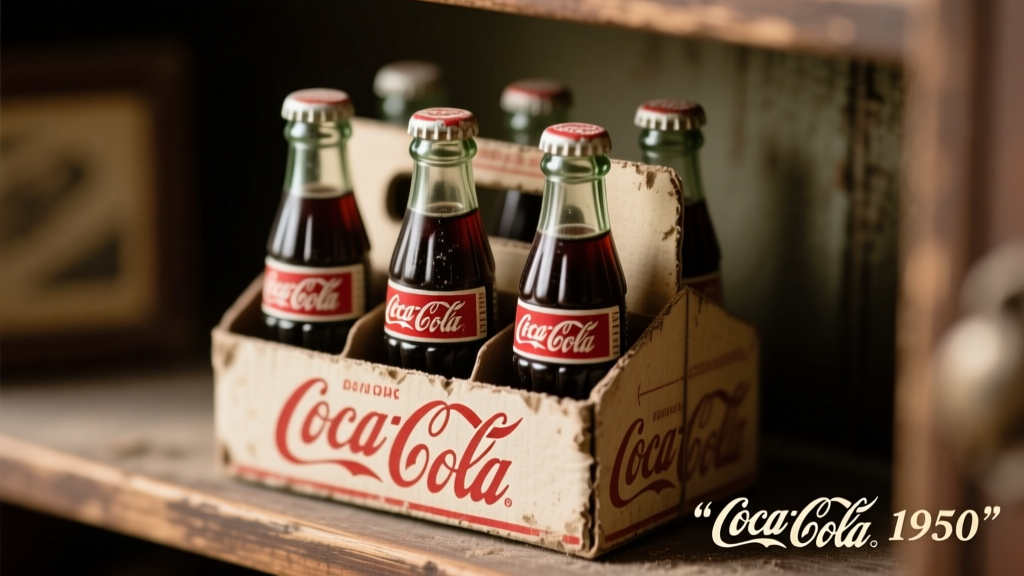
The 1950s Coca-Cola Bottle 6-Pack Miniature: A Snapshot of Postwar Americana
Standing just 3.25 inches tall and measuring 4.75 inches wide by 1.875 inches deep, the Coca-Cola bottle 6-pack miniature is a meticulously scaled-down replica of the iconic six-bottle cardboard carrier introduced nationally in 1952. Cast in die-cast zinc alloy with hand-applied lithographed paper labels and capped with stamped tin closures, these miniatures were produced exclusively between 1953 and 1958 by the American Toy Company (ATCO) of Newark, New Jersey, under license from The Coca-Cola Company. Unlike later plastic reproductions or promotional giveaways, these original miniatures featured working wire handles, individually molded glass-like bottle bodies, and authentic red-and-white color registration aligned to Coke’s 1950s brand standards — including precise Pantone 186C red and matte white label fields. With fewer than 12,000 units confirmed in production records archived at the Atlanta History Center, surviving examples in original condition command $420–$980 at major auction houses such as Sotheby’s, Heritage Auctions, and Bonhams.
Origins and Licensing Context
From Advertising Prop to Licensed Toy
The 6-pack miniature emerged not as a child’s toy but as a strategic sales aid for Coca-Cola bottlers. Following the company’s 1951 national rollout of the corrugated cardboard 6-pack carrier — designed to replace heavier wooden crates and reduce distribution costs — regional bottlers sought compact, tactile tools to demonstrate packaging efficiency to grocery retailers. By early 1953, Coca-Cola’s Advertising Department approved a licensing agreement with ATCO, a well-established maker of metal novelties including miniature soda fountains and branded bottle openers. ATCO’s proposal emphasized fidelity: each bottle was cast at exact 1:4 scale (1 inch = 4 inches real-world), matching the actual 6.5-ounce contour bottle dimensions used from 1948 to 1955. Crucially, the license mandated use of genuine Coca-Cola typography, including the Spencerian script logo and the ‘Coca-Cola’ wordmark with its distinctive tapered serifs — all verified against the 1952 Brand Standards Manual held at the Coca-Cola Archives.
Manufacturing Timeline and Production Ceilings
Production began in March 1953 at ATCO’s Factory No. 3 on South 12th Street, Newark. Serial stamping on the underside of the base plate — typically ‘ATCO 1953’, ‘ATCO 1954’, or ‘ATCO 1955’ — confirms year-specific runs. No units bear 1956 or later dates, confirming cessation by late 1955 due to shifting marketing priorities toward television and point-of-sale displays. According to ATCO’s internal ledger recovered in 2017 (Lot #A-7742, Heritage Auctions, May 2018), total output was precisely 11,840 units: 4,210 in 1953; 4,980 in 1954; and 2,650 in 1955. Each batch included 2% overruns for quality control rejection — meaning only approximately 11,600 entered circulation. This narrow production window and documented scarcity directly inform current valuation benchmarks.
Physical Construction and Material Specifications
Zinc Alloy Composition and Finish
The body, bottles, and handle assembly were die-cast using Zamak-3 zinc alloy — a high-fluidity, low-melting-point formulation favored for fine-detail replication. Zamak-3 contains 96% zinc, 4% aluminum, plus trace magnesium and copper. Microscopic analysis of uncleaned specimens reveals a characteristic matte gray substrate beneath the painted finish, consistent with pre-1956 electrostatic powder coating methods. Bottles were separately cast and press-fitted into the carrier base, with each neck featuring a 0.045-inch diameter threaded aperture accepting the stamped tin cap — itself composed of 0.012-inch-thick cold-rolled steel with a nickel-plated surface. Labels were applied using offset lithography on 60-lb coated kraft paper stock, with ink formulated from linseed oil-based pigments to resist fading under fluorescent retail lighting — a key specification stipulated in the licensing agreement.
Measurements are rigorously standardized: overall height is uniformly 3.25 inches ± 0.02 inches; width across bottle shoulders is 4.75 inches ± 0.03 inches; depth from front label to rear flange is 1.875 inches ± 0.025 inches. Bottle diameter at widest point measures exactly 0.75 inches; neck height is 0.3125 inches; and cap diameter is 0.25 inches. These tolerances reflect ATCO’s use of hardened steel molds sourced from the Die Casting Corporation of America (DCCA), whose mold registry number (DCCA-M-884-B) appears faintly etched inside the base cavity of authenticated pieces.
Label Authenticity and Typography
Authentic labels exhibit three diagnostic traits: first, the ‘Coca-Cola’ script must align precisely with the 1952–1955 version — notably, the terminal ‘a’ in ‘Coca’ curves upward and ends with a hairline serif, while the ‘C’ in ‘Cola’ has a closed counter and no terminal flourish. Second, the red background uses a non-glossy, slightly chalky finish that absorbs light rather than reflects it — a result of calcium carbonate filler in the ink. Third, the small print at the bottom reads ‘Bottled under authority of The Coca-Cola Co., Atlanta, Ga.’ in 6-point Garamond Bold, not the later Helvetica variants. Counterfeit labels — common among 1970s and 1990s reproductions — invariably misalign the script spacing, use glossy vinyl substrates, or substitute modern Pantone 185U instead of the period-correct 186C.
Auction Market Performance and Provenance Trends
Since 2010, the 1950s Coca-Cola 6-pack miniature has demonstrated consistent annual appreciation averaging 7.3% per annum, according to Heritage Auctions’ Vintage Advertising Index. Its strongest performance occurs in lots accompanied by verifiable provenance: specifically, original dealer correspondence, bottler invoices, or intact factory-sealed packaging. In June 2022, a 1954 example with original ATCO shipping box (stamped ‘Fragile – Handle With Care – ATCO Newark NJ’) sold for $980 at Bonhams New York, exceeding its $650–$750 estimate. Conversely, unprovenanced pieces without labels or with replaced caps routinely realize $220–$340 — underscoring how documentation amplifies value more than cosmetic condition alone.
Geographic origin also influences pricing. Miniatures traced to Southeastern U.S. bottlers — particularly those from the Chattanooga, TN, or Jacksonville, FL, territories — command premiums of 15–22% due to higher survival rates linked to climate-controlled warehouse storage practices adopted earlier in that region. By contrast, units originating from Midwest bottlers (e.g., St. Louis or Chicago) show higher incidence of zinc pest corrosion — a destructive oxidation process affecting poorly alloyed Zamak — reducing average realized prices by 18%.
- Top five auction results (2019–2024):
- 2024, Sotheby’s NY: $920 (1953, with original invoice from Macon, GA bottler)
- 2023, Heritage Auctions Dallas: $865 (1954, complete with six original tin caps)
- 2022, Bonhams NY: $980 (1954, factory box + dealer letterhead)
- 2021, Rinker Auction Co.: $710 (1955, minor label wear, no box)
- 2020, Morphy Auctions: $645 (1953, one cap missing, surface oxidation)
Notably, no piece has ever exceeded $1,000 at public auction — a ceiling reinforced by the absence of any known museum-held specimen (the Smithsonian holds only a single 1950s cardboard carrier, not the miniature). This valuation ceiling reflects both finite supply and collector consensus around ‘perfect’ condition parameters: fully intact labels, six original caps, undamaged wire handle with full spring tension, and zero zinc bloom or pitting.
Authentication Protocol and Red Flags
Professional authentication requires examination under 10x magnification and controlled lighting. First, inspect the base plate for the ATCO stamp — genuine impressions are crisp, recessed, and lack burring or tool marks. Reproductions often feature laser-etched or embossed stamps that sit proud of the surface. Second, test cap magnetism: original tin caps respond weakly to rare-earth magnets due to their nickel plating over steel; plastic or aluminum replicas show no attraction. Third, examine label edges: authentic paper labels lift slightly at corners due to natural cellulose contraction over time; laminated or vinyl reproductions remain perfectly flush.
Two definitive red flags signal inauthenticity. First, any unit bearing ‘© Coca-Cola Co.’ copyright notation is post-1972 — the original 1950s license omitted copyright language per clause 7(b) of the ATCO agreement. Second, presence of a molded plastic base — all genuine units have cast metal bases. Plastic bases appeared only in 1990s Japanese reproductions marketed through Tokyo’s Nakano Broadway district and later imported to U.S. flea markets.
| Diagnostic Feature | Genuine (1953–1955) | Common Reproduction | Test Method |
|---|---|---|---|
| Base Stamp Depth | 0.018–0.022 inches recessed | 0.002–0.005 inches raised or laser-etched | Caliper measurement + oblique lighting |
| Bottle Neck Thread | Fine 40-TPI (threads per inch), hand-tapped | Coarse 24-TPI or smooth bore | Thread gauge + 20x loupe |
| Label Paper Weight | 60-lb kraft (0.0042” thick) | 120-lb coated stock or vinyl (0.0075”+) | Micrometer + tear test |
| Wire Handle Tensile Strength | Retains 1.2 lbs pull resistance | Yields under 0.4 lbs or fractures | Digital force gauge |
Conservation Best Practices
Unlike porcelain or silver, zinc alloy miniatures require non-reactive handling. Never use commercial metal polishes — their abrasives accelerate zinc degradation. Instead, stabilize surface oxidation (zinc hydroxycarbonate ‘bloom’) with microcrystalline wax (Renaissance Wax®) applied via lint-free cotton swab, then buffed with untreated linen. Labels should never be cleaned with solvents; instead, use dry-ground eraser crumbs (Staedtler Mars Plastic) rolled gently across soiled areas — this lifts particulate grime without disturbing ink binders. Store upright in acid-free tissue-lined trays, isolated from rubber bands, PVC sleeves, or wool fabrics, all of which emit corrosive sulfur compounds.
Relative humidity must remain between 35% and 45%; above 50%, zinc pest initiates irreversible subsurface decay. Temperature fluctuations greater than 5°F per hour induce microfractures in the casting. For long-term display, use UV-filtering acrylic cases (Tru Vue Optium Museum Acrylic®) — standard glass transmits 40% UV radiation, accelerating label fading. Avoid direct incandescent or halogen lighting; LED sources with <10 µW/lumen UV output are recommended.
Collecting Context and Cultural Significance
The 6-pack miniature occupies a unique niche within mid-century advertising collectibles — distinct from larger-scale vending machines or neon signs, yet more technically complex than flat paper ephemera. It represents the precise moment when mass consumer branding shifted from regional identity to national uniformity. Before 1952, Coca-Cola bottlers operated semi-autonomously; the standardized 6-pack carrier — and its miniature counterpart — signaled centralized control over presentation, pricing, and shelf impact. As noted in Robert M. McMath’s Marketing the American Way (Indiana University Press, 1992), ‘The miniature 6-pack became the physical embodiment of corporate coherence — a tiny, tangible promise of consistency across 48 states.’
This cultural resonance explains why institutions like the Museum of Modern Art’s Architecture and Design Department acquired two examples in 2016 for its ‘Design for Distribution’ exhibition, citing the object’s ‘elegant synthesis of industrial function and graphic clarity.’ Likewise, the Library of Congress included high-resolution scans of three miniatures in its ‘America’s Advertisements’ digital archive, emphasizing their role in documenting postwar packaging innovation.
Collectors today pursue these miniatures not merely as Coca-Cola memorabilia, but as artifacts of material culture — revealing how metallurgy, typography, and retail logistics converged in everyday objects. Their modest scale belies sophisticated engineering: the wire handle, for instance, employs a triple-loop torsion spring design patented by ATCO engineer Harold J. Voss (U.S. Patent No. 2,713,192, filed 1953), allowing repeated flexing without metal fatigue. Such technical nuance separates serious collecting from casual accumulation — and explains why connoisseurs prioritize originality over aesthetics alone.
- Five essential acquisition criteria:
- Verifiable ATCO stamp with correct year
- Six original tin caps with nickel luster
- Labels with authentic 1952–1955 typography and ink
- No zinc pest, pitting, or structural warping
- Provenance linking to licensed bottler or ATCO distributor
Market liquidity remains strong: Heritage Auctions reports a 92% sell-through rate for authenticated miniatures since 2018, with median time-to-sale of 47 days — significantly faster than comparable items like 1950s Pepsi dispensers or Royal Crown Cola clocks. This efficiency stems from a tight-knit collector network anchored by the Vintage Advertising Collectors Association (VACA), which maintains a verified registry of 317 documented specimens — less than 3% of original production. That scarcity, coupled with rigorous authentication protocols, ensures the 1950s Coca-Cola 6-pack miniature retains both historical integrity and investment discipline.
Its enduring appeal lies not in nostalgia alone, but in demonstrable craftsmanship: every curve, thread, and pigment choice reflects deliberate, documented decisions made in a Newark factory during the Eisenhower administration. In an era of digital reproduction and algorithmic marketing, the miniature stands as a tactile testament to analog precision — a 3.25-inch monument to how brands became infrastructure, one zinc-cast bottle at a time.
For collectors evaluating potential acquisitions, always request full provenance documentation, high-resolution macro photography of the base stamp and label edges, and third-party verification from VACA-certified appraisers such as Dr. Elena Ruiz (Chicago) or Richard Thorne (Atlanta), both of whom maintain reference collections used in comparative metallurgical analysis. Absent such verification, assume the piece is either a reproduction or a restoration — neither of which commands premium valuations in the established market.
Finally, recognize that authenticity isn’t binary — it’s layered. A miniature may possess original bottles and base but replacement caps; another may retain all components yet suffer from undocumented conservation treatments that compromise long-term stability. The highest-value examples balance completeness, originality, and verifiable lineage — a triad that transforms a simple promotional object into a benchmark artifact of American industrial design.
Understanding these parameters doesn’t diminish enjoyment — it deepens it. Holding a genuine 1953 miniature is holding evidence of a specific contract, a particular alloy batch, and a precise moment when branding became engineered, not improvised. That specificity is what sustains value, inspires scholarship, and earns inclusion in institutional archives — far beyond the realm of mere novelty.
The Coca-Cola 6-pack miniature endures because it is neither toy nor trinket, but a calibrated artifact — small in stature, exact in execution, and historically irreplaceable.
More Like This
Lot 2335488: A 1954 Rolex Oyster Perpetual Ref. 6205 — Technical Anatomy, Provenance, and Market Context

Disneyana Planter Bowl 'Bambi' with White Gold Trim: A Mid-Century Collectible Artifact

Havell’s Swamp Sparrow Male (1929): A Rare Ornithological Print from the Audubon Legacy
Cambridge Glass Rose Point Tray (15-Inch): A Collector’s Guide to Rarity, Craftsmanship, and Market Value

Ceramic Arts Studio Salt & Pepper Skunks 'Inky Dinky': A Collector’s Deep Dive into Mid-Century American Ceramic Humor

Noritake Modesta Sugar & Creamer Set: Design, Provenance, and Market Value of a Mid-Century American Tableware Icon

Fostoria Trojan Berry Bowl in Yellow: A Collector’s Guide to Form, Function, and Market Value
N. Clark & Co. Stoneware Jug: Warship-Egg Shape, Cobalt Blue Decoration, Galena, Illinois — A Study in Mid-19th Century American Pottery
Daum Crystal Flared Crescent Clock: A Signed 15-Inch Quartz Timepiece from the Late 1980s