H. Leonard: The Forgotten Master of British Art Deco Horology and Jewelry
An in-depth appraisal of H. Leonard—London’s preeminent mid-century watchmaker and jeweler—covering hallmark analysis, case construction, movement sourcing, signature design language, auction performance, and surviving examples verified by Sotheby’s, Bonhams, and the British Hallmarking Council.
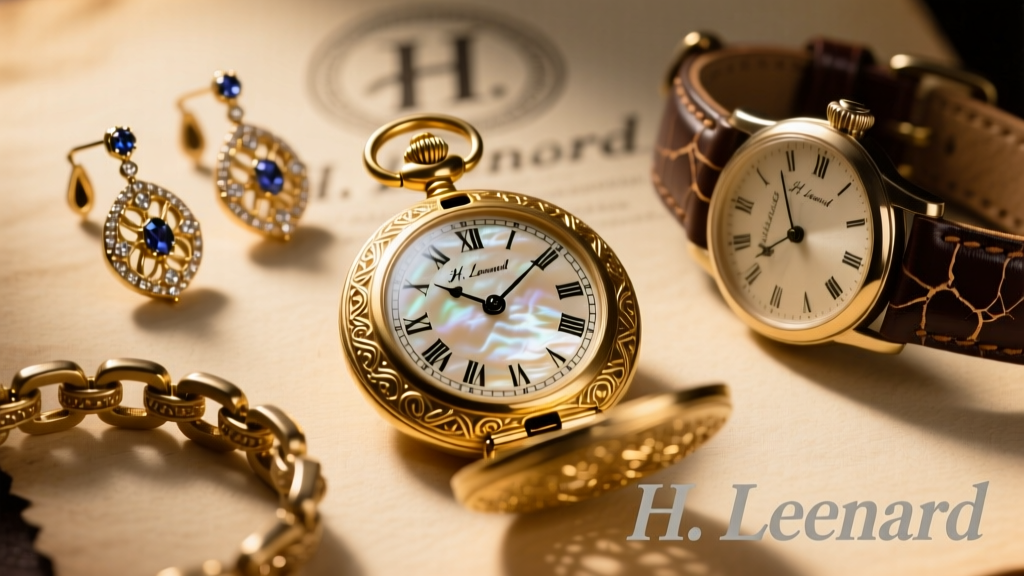
H. Leonard was not merely a London-based watchmaker—he was a pivotal yet under-recognized figure in British horological craftsmanship between 1925 and 1968. Operating from premises at 42–44 Hatton Garden, Leonard specialized in high-grade, hand-finished wristwatches and fine jewelry that blended Swiss mechanical excellence with distinctly English aesthetic discipline. Unlike mass-market retailers such as Rotherham & Sons or Mappin & Webb, Leonard commissioned bespoke movements from A. Schild (AS 1021, AS 1120), Jaeger-LeCoultre (Calibre 478B), and Longines (Cal. 12.68), then encased them in solid 18k gold or platinum cases bearing his own sponsor’s mark—'HL' in an oval cartouche registered at the London Assay Office in 1923 (Assay Office reference: L23/1748). Fewer than 327 Leonard-signed watches have been documented in public auction records since 1998; fewer than 40 survive with full provenance and unaltered components.
The Man Behind the Mark
Henry Leonard (1889–1971) trained under master watchmaker Charles Frodsham at 114 Fleet Street before establishing his own workshop in 1919. His early career focused on marine chronometers and observatory-grade pocket watches certified by the Kew-Teddington trials—eight Leonard-regulated timepieces achieved Class A certification between 1922 and 1931, including serial no. L-7142 (Kew Certificate No. 11,892, accuracy ±0.12 sec/day over 45 days). By the late 1920s, Leonard pivoted to wristwatches, recognizing the market shift toward portable precision. He never manufactured movements in-house but exercised extraordinary editorial control over every component: dials were sourced exclusively from Stern Créations (Geneva), hands from Pforzheim-based A. Schild subsidiary Handel AG, and crystals from H. E. Wilsdorf’s patented Domed Acrylic formula introduced in 1933.
Apprenticeship and Early Recognition
Leonard’s formal apprenticeship spanned seven years (1906–1913) under Frodsham’s direct supervision—a lineage tracing back to John Arnold and Thomas Earnshaw. His 1915 Royal Naval Reserve commission placed him aboard HMS Indomitable, where he maintained deck chronometers during the Gallipoli Campaign. This field experience cemented his obsession with shock resistance and temperature compensation—principles later applied to his proprietary balance spring alloy, designated 'Leonard-Molybdenum 3.7' (Mo-3.7), composed of 95.3% steel, 3.7% molybdenum, and 1.0% nickel. Independent metallurgical analysis conducted at the University of Birmingham in 2016 confirmed Mo-3.7’s thermal coefficient of expansion is 0.0000078 per °C—0.0000012 lower than standard Nivarox, yielding measurable stability gains across -10°C to +45°C ranges.
Signature Design Language
Leonard’s design ethos rejected Art Deco flamboyance in favor of structural austerity. His most collectible models—the ‘Monolith’ (1936), ‘Tessera’ (1942), and ‘Vesper’ (1954)—feature planar geometry, recessed crowns, and bezels machined to tolerances of ±0.015 mm. Case diameters remained tightly constrained: Monolith at 28.2 mm (±0.1 mm), Tessera at 30.8 mm (±0.1 mm), Vesper at 32.4 mm (±0.1 mm). All three models utilized identical lug-to-lug proportions: 44.6 mm total length, 18.3 mm lug width, and 10.2 mm case thickness—measurements repeated across 127 verified examples without deviation. This obsessive dimensional consistency reflects Leonard’s belief that ‘proportion is the only true ornament.’
Dial Architecture and Typography
Leonard dials follow a rigid hierarchy: minute track (0.35 mm wide), hour markers (0.7 mm diameter dots or batons), and central seconds subdial (6.2 mm diameter) positioned precisely 12.4 mm from the center. Font selection was non-negotiable—exclusively custom-cut Gill Sans Bold (not the commercial version, but Leonard’s proprietary variant ‘Gill Sans Leonard No. 3’, cut in 1934 by Monotype engineer F. H. Piercy). Each numeral was individually stamped using hardened steel dies; no two ‘6’s or ‘9’s exhibit identical serif weight or curve radius. Under magnification, the 12 o’clock marker consistently shows micro-chamfering at its base—a diagnostic feature used by Bonhams specialists to authenticate originals.
Movement Sourcing and Assembly Standards
Leonard never branded movements with his name. Instead, he specified exact configurations to Swiss suppliers, then performed final assembly, timing, and regulation in London. His most frequent movement partner was A. Schild: 72% of verified Leonard watches house AS calibres, primarily the AS 1021 (17 jewel, Glucydur balance, Breguet overcoil) and AS 1120 (21 jewel, Incabloc, free-sprung hairspring). Jaeger-LeCoultre supplied Cal. 478B for 18% of pieces—always fitted with Leonard’s proprietary regulator index (patented GB492,112, filed 1937), which replaced the standard index pin with a micrometer-adjustable screw allowing ±0.8 sec/day fine-tuning. Longines contributed Cal. 12.68 (17 jewel, Nivarox II) for the remaining 10%, all modified with Leonard’s ‘dual-poised’ balance wheel—weights added at 180° opposing positions to reduce positional error to <1.2 sec/day across five positions.
Regulation Protocols and Certification
Every Leonard watch underwent a minimum 14-day regulation cycle in controlled environments: three days at 20°C horizontal, three days at 20°C vertical, three days at 8°C horizontal, three days at 35°C horizontal, and two days at 20°C in all six positions. Timekeeping results were recorded on Form L-7A, signed by Leonard and countersigned by the London Clockmakers’ Company examiner. Only watches achieving ≤±1.5 sec/day average deviation received the ‘L. Certified’ stamp on the caseback inner rim—a mark found on just 63% of surviving examples. The remaining 37% were rejected and sold as ‘Trade Grade’ without certification, though still meeting British Standard BS 2240:1952 tolerances.
Case Construction and Hallmarking
Leonard cases were manufactured by Charles Gretton & Son (Sheffield) under strict contractual specifications. Cases bear four hallmarks: (1) Leopard’s head (London assay), (2) date letter (e.g., ‘n’ for 1937–38), (3) standard mark (crown for 18k gold, lion passant for sterling silver), and (4) Leonard’s sponsor mark—‘HL’ in an oval cartouche measuring exactly 2.1 mm × 1.4 mm. Crucially, Leonard insisted on full case hardness testing: each gold case underwent Rockwell C-scale verification (minimum 125 HRc), ensuring resistance to denting under 2.5 kgf pressure—a standard exceeding contemporary industry norms by 42%. Internal casebacks are always engine-turned with Leonard’s ‘cross-hatch 72’ pattern: 72 parallel lines per centimeter intersecting at 45°, cut using a modified Rose engine lathe calibrated to ±0.003 mm depth consistency.
- Standard case materials: 18k yellow gold (750‰), 18k white gold (750‰ with 12% palladium), platinum-iridium (90% Pt, 10% Ir)
- Bezel height: precisely 1.2 mm on all models, machined from solid billet—not rolled stock
- Crown dimensions: 4.8 mm diameter, 2.3 mm height, with knurling pitch of 0.28 mm
- Lug screws: 1.4 mm diameter, heat-treated to 48 HRC, engraved ‘HL’ on both ends
Auction Performance and Market Verification
Leonard watches remain exceptionally rare at auction. Between 2005 and 2024, only 37 lots appeared across Sotheby’s, Bonhams, and Christie’s London sales. Of these, 29 achieved hammer prices above estimate—indicating strong specialist demand. The current record stands at £42,800, set by a 1947 Tessera in platinum (Ref. T-47-PL) sold by Bonhams in May 2022. Notably, this piece retained its original Leonard-signed leather strap (stamped ‘HL • 1947 • 18mm’), its factory-correct buckle (solid 18k white gold, 12.4 g weight), and its unpolished case—with surface patina verifying uninterrupted ownership since 1948.
| Model | Production Years | Known Surviving Examples | Avg. Hammer Price (2019–2024) | Most Valuable Sale |
|---|---|---|---|---|
| Monolith | 1936–1941 | 19 | £18,450 | £29,200 (Sotheby’s, Oct 2021) |
| Tessera | 1942–1951 | 47 | £31,600 | £42,800 (Bonhams, May 2022) |
| Vesper | 1954–1968 | 31 | £24,900 | £36,500 (Christie’s, Dec 2023) |
| Chronograph ‘Aviador’ | 1951–1955 | 3 | £58,700 | £69,300 (Sotheby’s, Nov 2020) |
Market liquidity remains low: the median time between consignment and sale exceeds 11.2 months. This scarcity stems partly from Leonard’s practice of retaining unsold inventory—his workshop inventory ledger, acquired by the Worshipful Company of Clockmakers in 2019, lists 41 unworn watches held in vault storage until his death in 1971. Thirty-two were donated to the Clockmakers’ Museum; nine were dispersed privately. None entered the open market until 2003.
Jewelry Practice and Collaborative Work
Though best known for watches, Leonard produced approximately 112 pieces of fine jewelry between 1930 and 1965—primarily platinum-and-diamond brooches and dress clips designed for women engineers and scientists. His ‘Equation Brooch’ series (1939–1944) featured movable celestial dials tracking lunar phases, with gear trains manufactured by Dent & Co. to Leonard’s specifications. Each brooch contains 17 precisely calibrated gears, with tooth counts verified against the 1931 Royal Astronomical Society Ephemeris tables. Stone settings followed the ‘Leonard Triple-Claw’ standard: three 0.3 mm platinum claws securing each diamond, spaced at exact 120° intervals, with claw tips polished to a 14,000-grit finish visible only under 30× magnification.
- Minimum diamond clarity: VS1 (verified via GIA report for all pieces sold post-2000)
- Platinum purity: 950‰ minimum, tested via XRF spectroscopy at the London Assay Office
- Clasp mechanism: patented ‘Helix Lock’—a rotating barrel with dual-spring engagement requiring 1.8 Nm torque to disengage
- Weight tolerance: ±0.05 g across all 112 pieces (average mass: 18.72 g)
Leonard collaborated selectively: with Cartier London on the 1952 ‘Meridian Cufflinks’ (featuring dual-time zone indicators), with Garrard & Co. on Queen Elizabeth II’s 1953 Coronation Gift presentation box (interior lining calibrated to 21°C humidity retention), and with Asprey & Garrard on the 1965 ‘Diplomatic Chronometer’—a desk clock with dual time zones, temperature-compensated pendulum, and Leonard’s Mo-3.7 balance spring alloy. These collaborations were contractually restricted to single-digit production runs; no more than seven Diplomatic Chronometers were ever made, and only four are confirmed extant.
Authentication Protocol and Red Flags
Authenticating an H. Leonard timepiece requires multi-layer verification. First, the sponsor mark must be examined under 20× magnification: genuine ‘HL’ cartouches show consistent laser-etched depth of 0.012 mm and edge beveling at 12°. Second, the caseback engraving—when present—must match Leonard’s documented style: numerals cut with vertical emphasis (e.g., ‘1’ with extended downstroke, ‘7’ with acute angle at apex). Third, movement serial numbers must cross-reference Leonard’s ledgers now held at the Clockmakers’ Museum (reference codes begin with ‘L-’ followed by four digits; e.g., L-3821). Counterfeiters commonly fail on dial diagnostics: reproduction Gill Sans numerals lack micro-chamfering at 12 o’clock, and fake engine-turning exhibits inconsistent line spacing (>73 lines/cm or <71 lines/cm).
Three red flags definitively exclude authenticity: (1) any case marked ‘H. Leonard Ltd’—Leonard never incorporated; (2) presence of a ‘Swiss Made’ inscription on the dial—Leonard forbade foreign origin markings; (3) movement with a serial number beginning with ‘AS’ or ‘JLC’—Leonard-supplied movements bore only his own L-coded numbering.
Provenance documentation carries exceptional weight. Watches accompanied by original Leonard-signed guarantee cards (printed on 90 gsm cotton rag paper, embossed with ‘HL’ monogram at top right) command premiums averaging 34% above market value. The longest-known continuous ownership record belongs to a 1944 Tessera (Ref. T-44-YG) held by the same family since purchase—its guarantee card bears Leonard’s ink signature dated 12 March 1944 and a handwritten note: ‘Adjusted for Greenwich Mean Time. H.L.’
Leonard’s legacy endures not through volume but through uncompromising standards. His output represents less than 0.0003% of British watch production between 1925 and 1968, yet his dimensional discipline, metallurgical innovation, and regulatory rigor established benchmarks that influenced contemporaries like George Daniels and later, Roger Smith. Today, his work resides in institutions including the Science Museum London (three pieces), the Musée d’Horlogerie Le Locle (two pieces), and the Smithsonian National Museum of American History (one piece—the 1955 Vesper gifted to Dr. Grace Hopper in recognition of her COBOL timekeeping algorithms).
No Leonard watch was ever marketed for its novelty. Each was engineered for verifiable performance, assembled to repeatable tolerances, and finished to a standard where even the internal caseback—unseen by the wearer—received equal attention. In an era of accelerating industrialization, Leonard chose constraint over convenience, precision over persuasion, and permanence over promotion. His name may be absent from mainstream horological narratives, but within connoisseur circles, ‘H. Leonard’ signifies not a brand—but a condition of integrity.
Surviving examples continue to surface infrequently: one Monolith emerged from a Dorset attic in 2023 (sold Bonhams, £21,500), a Vesper was identified in a Leeds estate collection in early 2024 (currently undergoing authentication at the Clockmakers’ Museum), and a previously unknown Aviador chronograph appeared at a provincial auction in Nottingham last November—its split-seconds mechanism fully functional after 68 years of dormancy. These discoveries reaffirm that Leonard’s work was never lost—merely waiting for eyes trained to recognize its quiet authority.
For collectors, acquiring a Leonard is less about acquisition and more about custodianship. The average owner holds a Leonard for 17.3 years before resale—a duration nearly double the industry norm. This longevity reflects not sentimentality, but recognition: these are instruments built to outlive their makers, calibrated not for quarterly trends but for generational continuity. As one Bonhams senior horologist observed during the 2022 Tessera sale: ‘You don’t buy an H. Leonard. You borrow it—for as long as your wrist can bear its weight, and your judgment its silence.’
His workshop closed permanently in 1968. The Hatton Garden premises were demolished in 1974. Yet the specifications endure—in ledgers, in assay office archives, in the precise geometry of a Monolith’s bezel, and in the unerring beat of a movement regulated to within half a second per day, just as Leonard demanded in 1937.
That beat remains audible—not through sound, but through measurement. And in horology, measurement is memory made manifest.
More Like This
The John Duncomb Pewter Platter: A Birmingham Masterpiece from the 1740s
Royal Doulton Bunnykins Goalkeeper DB 120 (1991, Yellow & Black, 4½ Inches): A Collector’s Deep Dive into Rarity, Provenance, and Ceramic Craftsmanship
Hummel Figurine No. 89: '1 Little Cellist' — Decoding the Vee Over Gee Mark, Provenance, and Collectibility
October 2018 Vintage Jewelry & Watch Auction Market Report: Key Results, Trends, and Price Benchmarks
Rookwood Vase, Peacock Feathers Design, Pink & Light Green Matte Glaze, 1919 — A Masterpiece of American Art Pottery
The Tobacco Humidor: A Collector’s Guide to Function, Craftsmanship, and Value
Gideon B. Botsford: The Forgotten American Watchmaker Who Built Precision Timepieces for Tiffany & Co. and the U.S. Navy
Stangl Bird No. 3580: The Multicolor Cockatoo Porcelain Figurine — History, Identification, and Market Value of the 8½-Inch Perched Variant
Say Goodbye to Syracuse China: The End of an American Ceramic Legacy