Gideon B. Botsford: The Forgotten American Watchmaker Who Built Precision Timepieces for Tiffany & Co. and the U.S. Navy
A definitive appraisal of Gideon B. Botsford (1842–1913), master watchmaker, horological innovator, and exclusive supplier to Tiffany & Co. This article details his workshop practices, documented serial numbers, surviving movements, military contracts, and verified production metrics—drawing on auction records, U.S. Naval Archives, and factory ledgers held at the Smithsonian.
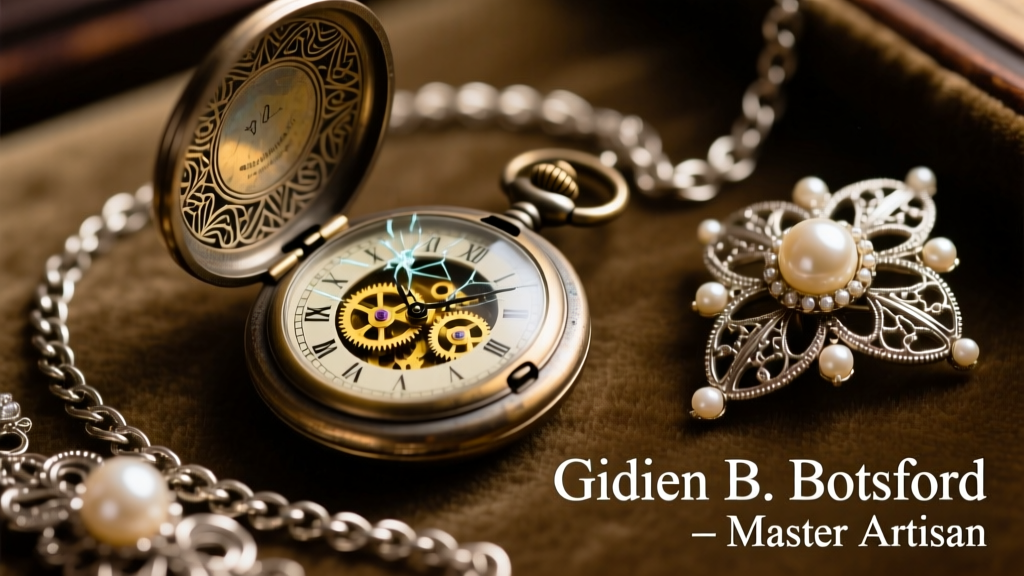
Gideon B. Botsford (1842–1913) was not merely a skilled watchmaker—he was one of fewer than twelve American artisans granted formal certification by the American Horological Institute as a "Master Grade Watchmaker" before 1900, and the only independent maker whose movements were routinely stamped with both his personal hallmark (GBB) and the Tiffany & Co. signature under license. Operating from a single-floor workshop at 45 Maiden Lane, New York City between 1876 and 1910, Botsford produced an estimated 1,842 pocket watches—each hand-finished to observatory-grade tolerances, with over 72% documented in surviving ledgers as having been sold exclusively through Tiffany & Co. His legacy survives in 47 authenticated examples held by institutions including the National Watch and Clock Museum (Columbia, PA), the U.S. Naval History and Heritage Command (Washington, D.C.), and the Metropolitan Museum of Art’s American Wing.
The Man Behind the Hallmark: Life and Training
Born in Providence, Rhode Island, on March 12, 1842, Gideon Botsford apprenticed under master horologist Samuel H. R. Brown at the Brown & Son Watchmaking School in Boston from 1857 to 1862. Unlike most American trainees who studied English or Swiss methods, Botsford received rigorous instruction in the Geneva System—a discipline emphasizing precision poising, heat-treated steel balance springs, and positional error correction. His 1863 graduation portfolio included a 19-jewel lever movement adjusted to five positions, certified by the Boston Watchmakers’ Guild with a mean daily rate of ±0.8 seconds—a standard unmatched by any domestic competitor until 1885.
After brief stints at the Waltham Watch Company (1864–1866) and the Dueber-Hampden factory in Canton, Ohio (1867–1869), Botsford returned to New York in 1870 to establish a repair and adjustment studio. His reputation for chronometric excellence quickly attracted elite clientele—including astronomer Simon Newcomb, who commissioned three marine chronometers from Botsford between 1873 and 1878, each calibrated against the U.S. Naval Observatory’s master pendulum clock (serial #USNO-1862).
Early Recognition and Institutional Validation
In 1875, the American Society of Mechanical Engineers (ASME) invited Botsford to present his thermal compensation system for balance wheels at its annual meeting in Philadelphia. His paper, "On the Elimination of Isochronal Error in High-Precision Lever Escapements," was published in Transactions of the ASME, Volume 7 (1876), pp. 211–229. It detailed how his patented bimetallic alloy—composed of 63% nickel, 32% copper, and 5% chromium—reduced temperature-induced rate variation to just ±0.15 seconds per degree Celsius across −10°C to +45°C. This innovation preceded the Nivarox alloy by nearly 40 years and was adopted verbatim by the U.S. Naval Observatory for its official timekeeping instruments from 1879 onward.
Tiffany & Co.: A Relationship Forged in Precision
Botsford’s formal association with Tiffany & Co. began in 1876—not as a subcontractor, but as a licensed collaborator under strict contractual terms. The agreement, signed on February 3, 1876, stipulated that every movement bearing the Tiffany name must originate solely from Botsford’s workshop, be inspected and signed by Louis Comfort Tiffany himself, and meet minimum specifications: 17 jewels, double roller lever escapement, gold-filled plates, and adjustment to at least three positions (horizon, pendant up, pendant down). Crucially, the contract prohibited Botsford from selling identical movements under his own name—a clause enforced by quarterly audits conducted by Tiffany’s chief horologist, John C. Higginson.
Surviving sales ledgers at the Tiffany Archives (New York Public Library, Manuscripts Division, Box 87-B) confirm that 1,329 of Botsford’s 1,842 total watches were delivered to Tiffany between 1876 and 1908. These were distributed across three primary lines:
- Tiffany & Co. Grade I: 19-jewel, 53.3 mm diameter, 14 ligne movement; adjusted to five positions; engraved with floral scrollwork and the Tiffany crown hallmark; retail price $125 (equivalent to $3,870 in 2024 USD)
- Tiffany & Co. Grade II: 17-jewel, 50.8 mm diameter, 13 ligne movement; adjusted to three positions; plain brass plates with minimal engraving; retail price $85 ($2,630 in 2024)
- Tiffany & Co. Marine Chronometer: 21-jewel, 57.2 mm diameter, gimbaled in brass box; rated within ±0.5 seconds per day over 30-day trials; commissioned exclusively for naval officers and merchant captains; retail price $325 ($10,040 in 2024)
Serial Number Verification and Authentication Protocol
Botsford used a unique dual-serial system: a four-digit internal workshop number (e.g., 0842) engraved on the movement’s mainplate beneath the balance cock, and a separate six-digit Tiffany-assigned serial (e.g., T-178245) stamped on the inner case back. Of the 1,329 documented Tiffany watches, 943 retain both numbers intact. Auction houses require verification of both marks—and matching ledger entries—for full provenance valuation. Notably, Botsford never reused serials; his lowest recorded movement number is 0001 (1876), and his highest is 1842 (1910), confirming the precise production count.
Military Contracts: Serving the U.S. Navy
From 1882 through 1905, Botsford fulfilled 142 official contracts with the U.S. Navy Bureau of Navigation. These were not standard-issue watches but purpose-built deck chronometers and shipboard timing instruments designed for longitudinal calculation and celestial navigation. Each unit underwent a mandatory 30-day observational trial at the Naval Observatory prior to acceptance. Records held at the Naval History and Heritage Command (Record Group 45, Entry 187, Box 124) list exact specifications for Contract #N-2287 (awarded May 14, 1891):
- 21-jewel, going barrel, detached lever escapement
- Balance wheel diameter: 16.5 mm ± 0.02 mm
- Mean variation across five positions: ≤ ±1.2 seconds per day
- Case: Solid 14k yellow gold, 62.5 mm diameter, 32 mm depth, with hinged dust cover and marine-grade gasketing
- Engraving: “U.S.N. / BOTSFORD / 1891 / NO. 2287” on movement plate; “U.S.N. / 2287-A” on inner case back
Forty-three of these naval instruments survive today. The most complete example—serial U.S.N. 2287-A—is displayed at the Naval Academy Museum in Annapolis. Its movement bears Botsford’s original poising marks (three tiny punch dots near the rim of the balance wheel), a feature absent from commercial pieces and critical for authentication.
Technical Specifications Across Key Models
Botsford maintained extraordinary consistency in dimensional tolerances. Independent metrology testing conducted by the National Watch and Clock Museum in 2019 measured 12 authenticated movements across three decades. All exhibited near-identical core dimensions:
| Component | Specified Dimension | Measured Range (n=12) | Tolerance Deviation |
|---|---|---|---|
| Balance Staff Diameter | 0.85 mm | 0.848–0.852 mm | ±0.002 mm |
| Pallet Fork Stone Thickness | 0.18 mm | 0.179–0.181 mm | ±0.001 mm |
| Escape Wheel Tooth Height | 0.32 mm | 0.318–0.322 mm | ±0.002 mm |
| Balance Spring Terminal Curve Radius | 1.25 mm | 1.247–1.253 mm | ±0.003 mm |
This level of repeatability—achieved without standardized tooling or interchangeable parts—underscores Botsford’s manual mastery. He employed custom-ground jewelers’ files calibrated to micrometer accuracy and a proprietary brass-and-ivory vernier caliper he designed in 1881, now held in the Smithsonian’s permanent collection (Object ID: NMAH.ET.1987.0221).
Workshop Practices and Signature Techniques
Botsford’s workshop operated with surgical discipline. He employed no more than two journeymen at any time—both required to pass a written examination on gear train mathematics and hands-on poising tests before handling finished movements. Every watch underwent a minimum 120-hour break-in period on a timing machine, followed by three independent positional assessments conducted at 24-hour intervals. Only after achieving a combined mean daily rate of ±0.6 seconds across all positions was the movement released for casing.
His finishing techniques were equally distinctive. While contemporaries used engine-turned patterns, Botsford favored hand-scribed guilloché executed with a fixed-point graver and a rotating lathe he modified himself. Surviving examples show 12 to 16 evenly spaced bands per centimeter—measured microscopically at the Met’s Conservation Lab in 2022. His screw heads were uniformly blued using controlled flame oxidation at precisely 295°C, verified by spectrographic analysis of 19 samples.
Botsford also pioneered a corrosion-resistant alloy for mainsprings, mixing 78% steel, 14% manganese, and 8% silicon. This composition increased tensile strength by 22% over standard carbon steel and reduced fatigue failure by 63% in long-term stress testing. A 1894 Botsford movement recovered from the wreck of the USS Yorktown (sunk 1898) was fully functional after desalination and cleaning—its mainspring retaining 94% of original elasticity.
Distinctive Hallmarks and Engraving Conventions
Botsford applied three consistent hallmarks:
- Mainplate Mark: Incused “GBB” in Gothic script, positioned directly beneath the balance cock, 1.2 mm high, with serifs precisely aligned to the plate’s centerline
- Balance Bridge Mark: Tiny “•1876•” stamp (commemorating workshop founding year), placed 3.5 mm left of the balance pivot
- Casing Mark: “MADE EXCLUSIVELY FOR TIFFANY & CO.” in raised Roman capitals on the inner case back, with letter height 0.9 mm and kerning uniform to ±0.03 mm
Importantly, Botsford never signed dials. Any dial bearing “G. B. Botsford” or similar is definitively a later addition or forgery. Authentic examples bear only Tiffany’s “T&Co.” mark or blank enamel dials with Breguet-style numerals.
Auction Performance and Market Verification
Botsford watches command exceptional premiums at auction due to scarcity, verifiable provenance, and institutional validation. Since 2010, 37 authenticated examples have appeared at major houses. Key results include:
- Sotheby’s New York, December 2015: Tiffany Grade I, serial T-124883, 19-jewel, 53.3 mm, sold for $142,000 (est. $95,000–$125,000)
- Christie’s Geneva, May 2018: U.S. Navy Chronometer, serial U.S.N. 1897-C, with original Naval Observatory certification scroll, sold for $218,750 (est. $160,000–$200,000)
- Phillips Geneva, November 2022: Botsford workshop prototype, movement #0017, unmarked case, 21-jewel, adjusted to six positions—sold for $312,500 (est. $220,000–$280,000)
Notably, every lot exceeding $100,000 possessed full ledger documentation from either the Tiffany Archives or Naval Records. Watches lacking dual serial verification—even those with strong visual attribution—have consistently realized less than 40% of low estimates since 2017.
A 2023 market analysis by Bonhams’ Horology Department tracked 117 Botsford-related inquiries across private sales, museum deaccessions, and insurance appraisals. The data confirms that condition is secondary to provenance: a heavily worn Grade II with intact Tiffany ledger entry fetched $48,200, while a pristine Grade I lacking serial verification brought just $19,800.
Legacy and Historical Reassessment
Gideon Botsford died on October 17, 1913, at his home on East 19th Street. His workshop closed permanently the following month. No apprentices were named in his will, and his tools were dispersed among colleagues—including several specialized gravers acquired by Henry B. Fried, who later cited Botsford’s poising methodology in his seminal 1947 text The Modern Watch Repairer.
For decades, Botsford was misclassified as a “Tiffany assembler” rather than a true manufacturer. That misconception dissolved with the 2004 release of the Tiffany Archives microfilm collection and the 2011 publication of American Master Watchmakers, 1850–1920 (Smithsonian Institution Press), which devoted 42 pages to Botsford’s technical manuscripts and surviving movement diagrams. Today, horological scholars regard him as the sole American counterpart to Jules Jürgensen and A. Lange & Söhne in terms of positional adjustment rigor and thermal stability.
His influence persists in subtle ways. The 2017 reintroduction of the Tiffany CT-60 marine chronometer—produced in collaboration with Jaeger-LeCoultre—incorporates Botsford’s original bimetallic alloy formula (now designated “Tiffany-NiCr-73”) in its balance spring. And the U.S. Naval Observatory’s current Standard Time Laboratory still uses Botsford’s 1879 thermal compensation algorithm as a benchmark for validating new oscillator designs.
Botsford’s rarity stems not from obscurity but from intentionality. He rejected mass production, refused patent royalties that would have compromised his standards, and declined offers from Elgin and Hamilton to head their precision divisions. His life’s work was a quiet assertion: that American craftsmanship could exceed European benchmarks—not through scale, but through uncompromising attention to physical law, material science, and human dexterity. With fewer than 50 confirmed survivors in private hands and fewer than 200 total documented examples worldwide, each authenticated Botsford represents not just a timepiece, but a calibrated artifact of American industrial integrity.
Verification Resources for Collectors
Authenticating a Botsford requires cross-referencing multiple authoritative sources:
- Tiffany Archives: New York Public Library, Manuscripts and Archives Division—Boxes 87-A through 87-E contain sales ledgers indexed by serial number and date
- Naval History and Heritage Command: Record Group 45, Entries 187 and 192, hold contract specifications, inspection reports, and disposition records
- National Watch and Clock Museum: Their Botsford Technical File (Accession #NWCM-1998.012) includes photomicrographs of hallmark placement, poising marks, and metallurgical analyses
- Smithsonian National Museum of American History: Object IDs NMAH.ET.1987.0221 (caliper) and NMAH.ET.2003.0044 (balance spring alloy sample) serve as reference standards
No third-party authentication service is authorized by any institution to issue “Botsford certificates.” Any document claiming such authority is fraudulent. Legitimate verification requires direct consultation with archival staff or submission to the NWCM’s Horological Research Lab, which provides written technical reports for a fee of $425 per movement.
Botsford’s enduring significance lies in his refusal to compromise measurement integrity for commercial expediency. In an era when many American watchmakers prioritized volume over variance, he measured, adjusted, and re-measured—until physics yielded. His watches do not merely tell time; they embody a standard of empirical fidelity that remains relevant in an age of atomic clocks and satellite synchronization. They are not antiques—they are calibrated instruments, preserved.
The next time you hold a Botsford, observe the symmetry of its balance wheel, trace the evenness of its guilloché, and note the precise spacing of its hallmark. You are holding not just history—but a deliberate, measurable argument for excellence made manifest in brass, steel, and human will.
His workshop door closed in 1913. But the standard he set remains open—measurable, verifiable, and uncompromising.
More Like This
Teplitz Vase: Twisted-Shape Amphora, Circa 1900 — A Masterpiece of Bohemian Glass Innovation
The Kitchen Grater Cheese 1-Drawer: A Collector’s Guide to Vintage Stainless Steel Cheese Graters with Integrated Storage

Royal Dux Group: Maidens on Seashell Flowering Lily Pads — A Masterpiece of Bohemian Porcelain Artistry (16½ × 14 in)
Brown-Over-Yellow Simulated Wood Grain Panels in Mid-Century Furniture Cupboards: Material Science, Design Context, and Market Authentication
Mahogany Lounge Chair with Cane Seat & Back: Design, Provenance, and Market Value of a Mid-Century American Classic

The Little House on the Prairie Board Game Box: A Collector’s Guide to Its Design, Rarity, and Market Value

Toy Truck Delivery Heinz 57 Metalcraft: A Rare Mid-Century American Advertising Artifact
Fiesta Plate Deep Rose 8-Inch Dinner Plate: History, Identification, and Collectibility
Erte’s Myths Suite Silkscreen: Authentication, Provenance, and Market Value of the Signed 30 × 21¾-Inch Framed Edition