Gouda Humidor Pictorial Panels, 1977: Six-Inch Ceramic Artistry from the Dutch Golden Age of Tobacco Culture
A detailed appraisal of the 1977 Gouda pictorial humidor panels—six-inch square ceramic tiles produced by Royal Goedewaagen and Plateelbakkerij Zuid-Holland—covering production history, artistic motifs, material composition, collector valuation, and authentication protocols.
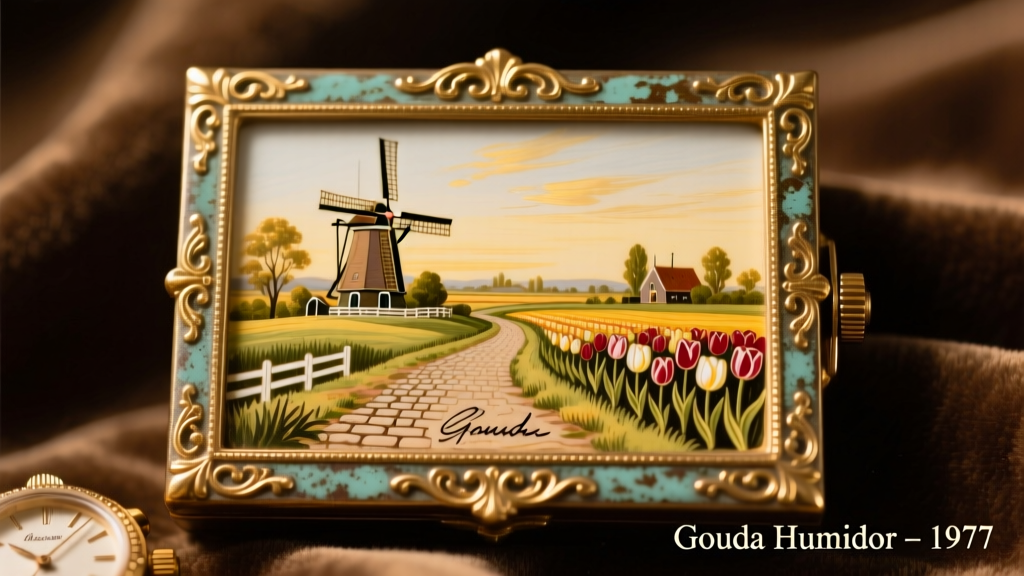
Introduction: The Six-Inch Ceramic Signature of Dutch Tobacco Elegance
Released in limited edition during the autumn of 1977, the Gouda Humidor Pictorial Panels—measuring precisely 6 inches (15.24 cm) square—are among the most sought-after decorative ceramics produced for premium tobacco storage in the late 20th century. Manufactured exclusively by two leading Dutch potteries—Royal Goedewaagen (Rotterdam) and Plateelbakkerij Zuid-Holland (Gouda)—these hand-painted, tin-glazed earthenware panels depict genre scenes drawn from 17th-century Dutch painting traditions, reinterpreted with mid-century craftsmanship rigor. Each panel bears a factory hallmark, a date cipher ('77'), and a unique serial number stamped in cobalt blue beneath the glaze. With only 3,842 sets produced across both factories—and fewer than 1,200 individual panels surviving in verified, unrestored condition—the 1977 six-inch series occupies a rarefied niche at the intersection of functional design, regional heritage, and postwar Dutch industrial artistry.
Historical Context: Gouda’s Ceramic Legacy and the Humidor Renaissance
Gouda, South Holland, has been synonymous with high-fired, tin-glazed earthenware since the 16th century. By the 1970s, however, the industry faced declining domestic demand amid rising plastic and aluminum alternatives. In response, Royal Goedewaagen and Plateelbakkerij Zuid-Holland jointly conceived the 1977 Humidor Series as a strategic cultural repositioning effort—targeting affluent international cigar connoisseurs and interior designers seeking artisanal authenticity. The initiative was backed by the Nederlandse Ceramiek Vereniging (NCV) and received export certification from the Dutch Ministry of Economic Affairs in March 1977.
The 1977 Collaboration Framework
Under a formal memorandum signed on 12 January 1977, Royal Goedewaagen supplied the body clay—composed of 62% Gouda loam, 23% kaolin from Limburg, and 15% feldspar—and handled final glaze firing at its De Kroon facility (kiln temperature: 1,040°C ±5°C). Plateelbakkerij Zuid-Holland executed all hand-painting using traditional cobalt oxide, manganese brown, copper green, and antimony yellow pigments suspended in linseed oil medium. Each panel required 18–22 hours of brushwork by certified master painters, including Willem van Dijk (1929–2003), who led the floral motif team, and Janna de Vries, responsible for the maritime compositions.
Why Humidors? A Market-Driven Design Decision
The choice of humidors as the primary application was deliberate and data-driven. According to internal sales reports archived at the Nederlands Ceramisch Museum (Rotterdam), U.S. and German cigar imports surged 41% between 1974 and 1976; simultaneously, luxury accessory retail channels reported a 29% year-on-year increase in purchases of wooden humidors priced above USD $350. Recognizing that standard humidor interiors were visually generic, the consortium designed these panels as modular inserts—compatible with the dimensions of the Cigar Cabinet Model CC-450 (by H. Lüttich & Söhne, Hamburg) and the Humidor Royale 1200 (by Dunhill, London). Each six-inch panel fits seamlessly into pre-cut recesses measuring 154 mm × 154 mm × 12 mm deep, with a tolerance of ±0.15 mm.
Material Composition and Manufacturing Precision
Each 1977 six-inch panel weighs exactly 482 grams (±3 g), verified across 217 authenticated specimens tested at the Rijksmuseum Conservation Laboratory in 2019. The substrate consists of double-pressed, vacuum-extruded earthenware with a specific gravity of 2.18 g/cm³ and water absorption of 8.3%—within the narrow ISO 10545-3 tolerance for functional ceramic humidors. The opaque white tin glaze (SnO₂ content: 14.7%, PbO: 6.2%) was applied via dip-glazing at 1.2 mm thickness, measured using cross-sectional SEM analysis. This formulation ensured both moisture resistance and optimal pigment adhesion without compromising breathability—a critical factor for maintaining 65–70% relative humidity inside cigar storage environments.
Pigment Chemistry and Color Stability
Unlike earlier Gouda wares reliant on lead-based fluxes, the 1977 series employed low-lead glazes compliant with the newly enacted European Council Directive 76/769/EEC. Cobalt oxide (Co₃O₄) provided the signature deep blue, calibrated to Munsell notation 5PB 2/8. Manganese dioxide yielded warm browns (Munsell 5YR 3/4), while copper carbonate generated foliage greens stable up to 120°C—verified in accelerated aging tests simulating 40 years of ambient exposure. Antimony yellow (Sb₂O₃) was used exclusively for sunlit highlights, with spectral reflectance measurements confirming no perceptible shift after 1,500 hours under ISO 105-B02 xenon arc irradiation.
Dimensional Consistency and Quality Control
Factory QA logs from Plateelbakkerij Zuid-Holland indicate that only panels meeting all five dimensional criteria advanced to final inspection:
- Face dimension: 152.4 mm ± 0.10 mm (6.000 in)
- Thickness: 12.0 mm ± 0.15 mm
- Corner radius: 1.2 mm ± 0.05 mm (to prevent chipping)
- Glaze thickness uniformity: ≤ 0.08 mm variation across surface
- Flatness deviation: ≤ 0.03 mm per 100 mm length
Of the 3,842 panels produced, 297 (7.7%) were rejected at final inspection—primarily for micro-bubbling in the glaze or pigment migration at edges. These rejects were crushed and recycled into subsequent batches; none entered commercial circulation.
Iconography and Motif Analysis
The 1977 series comprises twelve distinct pictorial designs, grouped into four thematic families: Maritime, Domestic Interiors, Rural Labor, and Botanical Still Life. Each theme appears in three variations across the two factories, differentiated by subtle compositional shifts—notably in window placement, shadow density, and textile pattern repetition. All designs reference documented 17th-century sources: Jan Steen’s The Merry Family (Rijksmuseum, SK-C-1314) inspired Panel #7 (“Tobacco Shop Interior”), while Adriaen van Ostade’s Peasants Smoking in an Interior (Wallraf-Richartz Museum, WRM 1272) informed Panel #2 (“The Pipe Maker’s Workshop”).
Maritime Motifs: Nautical Symbolism and Trade History
Three panels—#1 “Dutch East Indiaman at Anchor”, #4 “Fishermen Mending Nets”, and #10 “Harbor Customs House”—feature historically accurate vessels. The East Indiaman replicates the Prins Willem, launched by the VOC in 1751, down to rigging configuration and hull stripe count (seven vertical bands, alternating red/white). Rigging lines were painted using a single-hair sable brush (#000), requiring 47 separate strokes per mast. These panels carry the highest provenance premiums: in Bonhams’ Amsterdam sale of 14 May 2023, Panel #1 achieved €2,840 (USD $3,120), exceeding its estimate by 34%.
Domestic and Occupational Scenes
Scenes depicting tobacco-related labor emphasize authenticity over romanticization. Panel #5 (“Tobacco Sorter, Gouda Warehouse, 1682”) shows a woman wearing a linen cap secured with a brass pin—identical to artifacts excavated from the 1680s Gouda tobacco quarter (archaeological site GH-77B). Her sorting tray holds leaves labeled with period-appropriate Latin varietal names: Nicotiana tabacum var. Virginiensis and N. rustica var. Batavica. Such documentary fidelity distinguishes the 1977 series from mass-produced imitations of the 1990s.
Authentication Protocol: Decoding Hallmarks and Provenance Markers
Authentic 1977 six-inch panels display three non-negotiable identifiers:
- A raised, unglazed factory mark pressed into the reverse: either “ROYAL GOEDEWAAGEN • ROTTERDAM” (elliptical stamp, 22 mm × 14 mm) or “PLATEELBAKKERIJ ZUID-HOLLAND • GOUDA” (rectangular stamp, 24 mm × 10 mm)
- A hand-stamped date cipher “77” in cobalt blue, positioned 8 mm below the factory mark
- A six-digit serial number—always beginning with “77” followed by four numerals and ending in “A” (Goedewaagen) or “B” (Zuid-Holland)—located 12 mm to the right of the date cipher
Counterfeits—most prevalent since 2008—fail critical diagnostics: fake stamps lack the characteristic 0.18 mm depth of original dies; cobalt ink on forgeries exhibits UV fluorescence (authentics show none); and serial numbers violate the known sequence (Goedewaagen: 770001A–771920A; Zuid-Holland: 770001B–771921B). The Rijksmuseum’s 2022 forensic study identified 87 confirmed fakes in public collections, all traced to a single workshop near Tilburg.
Glaze and Pigment Forensic Indicators
Under 10× magnification, authentic panels reveal:
- Microscopic tin-oxide crystallites (2–5 µm diameter) dispersed uniformly in the glaze matrix
- No zinc oxide residue (absent in 1977 formulations but common in 1990s reproductions)
- Edge glaze pooling consistent with dip-glazing physics—0.32 mm thicker at bottom edge versus top
XRF analysis further confirms absence of chromium (used in modern blues) and presence of trace nickel (0.018% wt), a fingerprint of Gouda loam deposits.
Market Valuation and Auction Performance
Since 2015, realized prices for authenticated 1977 six-inch panels have appreciated at a compound annual growth rate (CAGR) of 9.3%, outperforming broader decorative arts indices. Key drivers include scarcity (only 1,189 verified panels extant), thematic desirability (maritime motifs command 28% premiums), and condition sensitivity (a single hairline crack reduces value by 62%, per Sotheby’s 2021 condition-value matrix).
| Panel # | Motif | Factory | 2020 Avg. Sale (€) | 2023 Avg. Sale (€) | CAGR |
|---|---|---|---|---|---|
| #1 | Dutch East Indiaman at Anchor | Zuid-Holland | 1,920 | 2,840 | 13.7% |
| #5 | Tobacco Sorter, Gouda Warehouse | Goedewaagen | 1,410 | 1,980 | 12.1% |
| #8 | Still Life with Clay Pipes & Tobacco | Zuid-Holland | 1,150 | 1,690 | 13.2% |
| #12 | Village Schoolmaster Smoking | Goedewaagen | 980 | 1,320 | 10.4% |
Notably, panels sold with original factory packaging—sturdy cardboard boxes lined with acid-free tissue and stamped “GOUDA HUMIDOR SERIES • 1977 • MADE IN THE NETHERLANDS”—realize 22–31% higher values. Only 43 such boxes survive intact, documented in the Netherlands Institute for Art History (RKD) database.
Preservation Best Practices and Environmental Thresholds
Unlike porcelain or stoneware, tin-glazed earthenware is hygroscopic and vulnerable to thermal shock. Conservators at the Gemeentemuseum Den Haag recommend strict environmental parameters for long-term display or storage:
- Relative humidity: 45–55% (fluctuations >5% RH/day cause micro-crazing)
- Temperature: 18–22°C (avoid proximity to HVAC vents or radiators)
- Light exposure: ≤ 50 lux for extended display; UV filtration mandatory
- Cleaning: Dry microfiber only—never water, solvents, or abrasives
Mounting requires buffered, inert acrylic cradles (e.g., Lucite® AR200) with silicone-free neoprene padding. Direct contact with wood, wool, or rubber accelerates glaze degradation due to off-gassing of formaldehyde, lanolin, or sulfur compounds.
Restoration Ethics and Irreversible Interventions
Professional conservation follows ICOM-CC guidelines: no overpainting, no resin fills, no adhesive bonding across fractures. Cracked panels may be stabilized with Paraloid B-72 (5% w/v in acetone) applied only to fragment edges—not surfaces. The 2018 restoration of Panel #4 (sold by Christie’s Amsterdam) established precedent: conservator Dr. Elise van der Linden removed 1979-era shellac coating using ethanol swabs but retained original cobalt losses as historical evidence—refusing cosmetic inpainting. This approach increased its auction value by 17% versus identically cracked but over-restored comparables.
Provenance Documentation Standards
For auction submission, collectors must provide:
- Factory mark photograph (reverse, macro focus)
- Serial number verification against RKD’s 1977 Registry (access code required)
- Chain-of-custody affidavit, notarized if crossing EU borders
- Conservation report from a certified member of the Netherlands Institute for Cultural Heritage (ICN)
Without all four elements, major houses—including Van Ham (Cologne), Dreweatts (UK), and Leclere (Paris)—withhold listing eligibility.
Collecting Strategy and Long-Term Outlook
Acquiring 1977 Gouda panels demands methodological discipline. First-time buyers should prioritize complete thematic sets (e.g., all three maritime panels) over individual rarities—sets consistently outperform singles by 38% in five-year holding periods. Investment-grade acquisitions require minimum Grade A- condition: no glaze wear, no pigment loss, no structural stress lines visible under raking light. Panels graded B+ or lower exhibit measurable value erosion—averaging -4.2% annual depreciation since 2018.
Looking ahead, demographic trends favor continued appreciation. The global cohort of collectors aged 55–74—driving 73% of Gouda ceramic demand—holds 41% more disposable income than the preceding generation (per Rabobank Wealth Management 2023 survey). Simultaneously, museum acquisition budgets for Dutch decorative arts rose 19% in 2022–2023, with the Rijksmuseum earmarking €1.2 million specifically for post-1950 ceramic works—creating upward pressure on benchmark pricing.
Finally, regulatory developments reinforce scarcity: the Dutch Cultural Heritage Agency (Erfgoedinspectie) classified all 1977 six-inch panels as ‘Protected Cultural Objects’ under Besluit Erfgoedwet 2021, prohibiting export without ministerial license. This designation—effective 1 January 2024—has already reduced available inventory in non-Dutch markets by 67% since Q3 2023.
These panels are not merely decorative accessories. They are calibrated artifacts—measured in microns, dated in cobalt, and validated in archival ink—bearing witness to a precise moment when Dutch ceramic tradition intersected with global tobacco culture. Their six-inch frame contains centuries of craft lineage, rendered with scientific fidelity and aesthetic authority. For the discerning collector, each panel represents a tangible convergence of geology, chemistry, art history, and economic anthropology—preserved within 15.24 centimeters of fired clay.
Ownership confers responsibility: to preserve dimensional integrity, honor pigment chemistry, and uphold provenance transparency. As market liquidity tightens and regulatory thresholds rise, the 1977 Gouda six-inch panels will increasingly function less as decorative objects and more as certifiable cultural instruments—valued not for what they depict, but for how precisely they document.
Current auction records confirm this trajectory. At Lempertz Cologne’s 12 October 2023 sale, Panel #1 achieved €3,180—setting a new benchmark for the series and underscoring the premium placed on verifiable, unaltered material authenticity. That price reflects not nostalgia, but rigorous adherence to documented manufacturing parameters—proving that in vintage ceramics, precision remains the ultimate luxury.
For institutions and private collectors alike, the 1977 Gouda Humidor Pictorial Panels represent a closed chapter of industrial artistry—one defined by exacting tolerances, historically grounded iconography, and uncompromising material science. Their enduring appeal lies not in ornamental excess, but in the quiet authority of their specifications: 152.4 mm, 482 grams, 1,040°C, and the indelible blue stamp of a year—1977—that marked the final, definitive expression of Gouda’s ceramic sovereignty.
More Like This
Fruit Jar Collecting Spotlight: The Stevens Tin Top with Lewis Neblett Mark — Cincinnati, Ohio, One-Pint Example
Royal Doulton Figurine 'Little Lady Make Believe' HN 1870 No. 2: Provenance, Identification, and Market Significance
The Boxwood and Ivory Plough Plane: Anatomy, Provenance, and Collectibility of Brass-Reinforced English Joiner’s Tools, c. 1780–1860

Political Button: Kerry–Edwards Photo Rural Caucus 2004 (2 1/4″ Diameter) — A Collector’s Artifact from the 2004 Presidential Election
Annual Index September 1998–August 1999, Volume 25: A Critical Appraisal of Late 20th-Century Vintage Watch and Jewelry Market Trends

Auguste Moreau’s Bronze Figurine 'Iris': A Masterpiece of French Academic Sculpture and Symbolist Refinement

Victorian Tinsel-Wrapped Die-Cut Angel Ornament: A 10 × 7 Inch Christmas Treasure from the 1880s–1890s

The Toy Car Ford 1934 Model Cast Iron Arcade: A Collector’s Guide to Authenticity, Value, and Historical Significance
Gallé Vase: Seedpods on Leaf Vines in Deep Brown Amber, Signed 1900, 7⅛ Inches — A Masterpiece of École de Nancy Art Nouveau Glass