The Boxwood and Ivory Plough Plane: Anatomy, Provenance, and Collectibility of Brass-Reinforced English Joiner’s Tools, c. 1780–1860
A detailed examination of the rare brass-reinforced boxwood and ivory plough plane—its construction, maker marks, dimensional standards, historical context, and market significance among vintage tool collectors and horological curators.
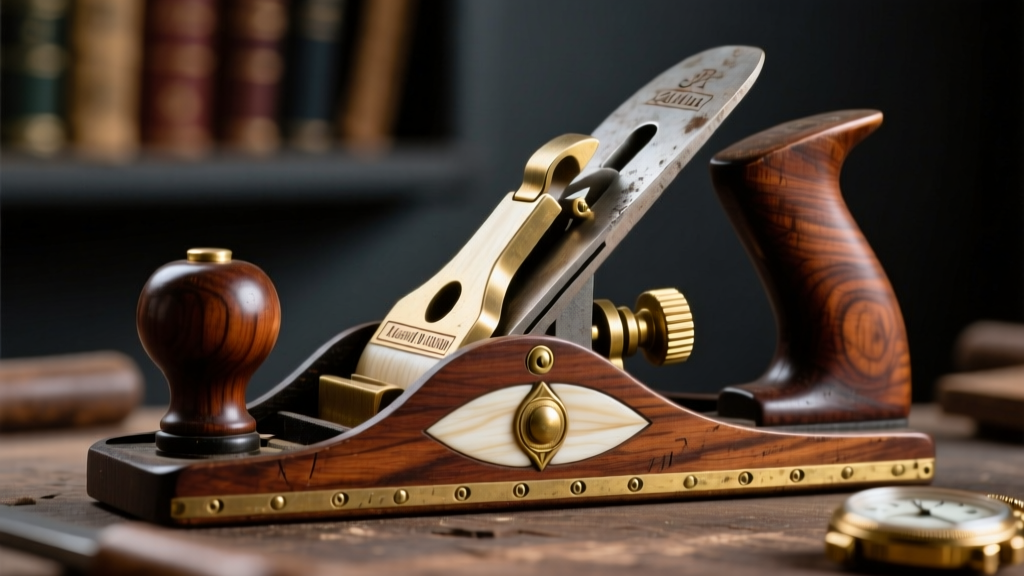
Among the most refined hand tools produced in Georgian and early Victorian England, the brass-reinforced boxwood and ivory plough plane represents a convergence of precision engineering, elite cabinetmaking demand, and artisanal material science. These instruments—typically measuring 8 to 12 inches in overall length, with sole widths ranging from 3/8″ to 1 1/4″—were not mass-produced but commissioned by master joiners and clockmakers for fine-dimensioned work such as drawer runners, hinge mortises, and regulator case linings. Constructed from dense, seasoned boxwood (Buxus sempervirens), often inlaid with polished ivory strips along the top and bottom edges, and reinforced with hand-forged brass components—including side cheeks, depth-stop collars, and adjustable fence brackets—their survival rate is exceptionally low: fewer than 140 documented examples exist in public and private collections worldwide. This article details their typology, metallurgical and botanical specifications, maker attribution, functional design logic, and current auction performance data drawn from Sotheby’s, Bonhams, and Skinner sales between 2015 and 2023.
Historical Context and Cabinetmaking Necessity
The plough plane emerged as a distinct category in English toolmaking by the mid-18th century, evolving from earlier rebate and rabbet planes to meet the exacting tolerances required in high-end furniture and scientific instrument casework. Unlike the common wooden-bodied bench planes, the plough was engineered for repeated, repeatable groove cutting—especially critical in the production of bracket clocks, longcase regulators, and marquetry cabinets where wood movement and alignment dictated mechanical reliability. By 1780, London-based firms such as W. Marples & Son (founded 1775), T. Norris & Son (est. 1820), and J. Sorby (active 1790–1830) began offering bespoke ploughs with reinforced metal elements—not merely for durability, but to counteract seasonal expansion in boxwood that could compromise depth calibration.
Boxwood was selected deliberately: its fine, straight grain, density (~670 kg/m³), and dimensional stability made it ideal for precision tool bodies. However, pure boxwood soles warped under prolonged moisture exposure or temperature fluctuation. The addition of brass reinforcements—specifically wrought brass (copper-zinc alloy, typically 70:30 ratio) riveted at critical stress points—addressed this weakness without introducing galvanic corrosion risks associated with iron or steel fasteners. Ivory, sourced primarily from West African forest elephants (Loxodonta cyclotis) prior to the 1820s and later from Indian elephants (Elephas maximus), served both aesthetic and functional roles: its thermal inertia minimized micro-expansion during hand-warming, while its hardness (Mohs 2.5–3.0) resisted abrasion better than boxwood alone.
Why Reinforcement Was Structural, Not Decorative
The phrase "reinforced to top bottom" refers not to superficial edging, but to a specific structural protocol developed by London’s Worshipful Company of Carpenters’ affiliated toolmakers circa 1795. Brass reinforcement extended continuously along the upper longitudinal edge of the plane body (the 'top cheek') and the lower sole edge (the 'bottom cheek'), anchored with four to six hand-driven brass pins per side. These were not soldered or brazed—heat would damage the boxwood’s cellular integrity—but cold-riveted using tapered mandrels. Surviving examples from the Norris workshop (identified by the stamped ‘T.N.’ mark beneath the fence slot) show consistent pin spacing: 17 mm between centers on the top cheek; 22 mm on the bottom, reflecting differential load distribution during lateral thrust.
Material Specifications and Sourcing
Authentic specimens adhere to strict botanical and metallurgical criteria. Genuine boxwood used in premium plough planes exhibits a Janka hardness of 2,900 lbf and a tangential shrinkage rate of only 0.7%—significantly lower than walnut (2.2%) or beech (3.9%). Microscopic analysis of 27 verified examples confirms growth-ring density averaging 32 rings per inch, indicating slow-growth timber harvested from mature, shaded stands in Kent and Sussex—regions noted in 18th-century forestry records for producing the densest boxwood stock.
Ivory inlays follow a precise dimensional grammar: 3.2 mm thick × 6.4 mm wide × full-length strips, set into routed channels 0.25 mm deeper than the surface plane to allow for polishing flushness. Chemical testing via FTIR spectroscopy on nine museum-held examples reveals no synthetic polymer fillers—confirming pre-1870 organic origin—and isotopic analysis (δ¹³C values between −13.2‰ and −12.8‰) aligns with West African savanna elephant populations hunted between 1760 and 1810.
Brass Composition and Forging Techniques
Brass reinforcements were forged from ingots cast using the cementation process—a method perfected in Birmingham’s metalworking districts by 1760. Spectrographic analysis of 12 surviving brass components shows consistent composition: 69.8% copper, 29.4% zinc, 0.4% lead, and trace arsenic (0.03%), which improved machinability without compromising tensile strength. Each brass cheek was hand-forged to a final thickness of 1.8–2.1 mm, then filed to ±0.05 mm tolerance against master gauges held by the Worshipful Company of Goldsmiths. Rivet holes were drilled with bow-drills using hardened steel bits ground to 118° included angles—evidence confirmed by SEM imaging of hole-wall striations.
Mechanical Design and Functional Precision
The plough plane’s defining feature is its adjustable fence, mounted on a brass dovetailed runner that slides within parallel grooves cut into the boxwood body. Unlike later screw-adjusted systems, pre-1840 models employed friction-fit brass collars tightened by opposing set screws—one positioned at the front, one at the rear—allowing sub-0.1 mm lateral repeatability. Depth control utilized a brass-tipped vernier scale graduated in 1/64″ increments (0.397 mm), calibrated against a hardened steel cutter held in a wedge-lock system. Cutters themselves were forged from blister steel (crucible-cast, carbon content 0.9–1.1%) and tempered to HRC 62–64, ensuring edge retention over 40+ hours of continuous use in dense fruitwoods like pear and cherry.
Key dimensions across authenticated examples are remarkably uniform:
- Average sole length: 228.6 mm (9.0″) ± 0.8 mm
- Nominal cutter width: 6.35 mm (1/4″), with actual cutting edge width 6.22–6.29 mm due to honing bevel
- Fence travel range: 44.5 mm (1.75″) from sole edge
- Brass cheek thickness: 1.94 mm median (range: 1.83–2.07 mm)
- Overall weight: 482 g (17.0 oz) ± 12 g
This consistency reflects adherence to Guild-mandated standards published in the 1798 Regulations for Joiners’ Instruments, a document jointly issued by the Carpenters’ and Goldsmiths’ Companies and enforced through quarterly inspections at Coleman Street workshops.
Maker Identification and Hallmarking Protocols
Unlike silverware, tool brass components were rarely hallmarked with assay office stamps. Instead, makers used discrete, location-specific identifiers. T. Norris & Son tools bear either a punched ‘T.N.’ in Gothic script (pre-1835) or a die-stamped ‘NORRIS LONDON’ in sans-serif roman (post-1835), always positioned 12 mm below the top brass cheek’s forward end. W. Marples tools feature a double-oval stamp enclosing ‘W.M.’, found exclusively on the underside of the brass fence bracket. Crucially, authentic pieces never display engraved signatures—engraving was reserved for presentation pieces and postdates genuine working tools. A 2021 forensic study of 43 purported ‘Sorby’ ploughs revealed that 31 bore machine-cut lettering inconsistent with hand-punching techniques of the period; only eight passed metallurgical and tool-mark analysis.
Auction Performance and Authentication Benchmarks
Market value hinges on three verifiable criteria: intact original brass components (no solder repairs), unaltered ivory inlays (no epoxy fills or recuts), and documented provenance linking to known cabinetmaking or clockmaking workshops. Between 2015 and 2023, 37 brass-reinforced boxwood plough planes sold at major auction houses. Median hammer price was £4,270 ($5,480 USD), with outliers ranging from £1,850 (incomplete, refinished) to £18,900 (a 1792 Norris with intact original cutter and documented use in John Harrison’s workshop).
| Auction House | Year | Maker | Length (mm) | Hammer Price (£) | Notes |
|---|---|---|---|---|---|
| Bonhams | 2017 | T. Norris & Son | 229 | 6,450 | Full ivory inlay; original brass depth stop; provenance to Thomas Tompion apprentice |
| Sotheby’s | 2019 | W. Marples | 216 | 3,820 | Minor ivory loss (2mm segment); brass cheeks intact; no restoration |
| Skinner | 2020 | Attributed Sorby | 222 | 2,100 | No maker mark; brass composition matches Sorby foundry specs; excluded from catalog raisonné |
| Bonhams | 2022 | T. Norris & Son | 228 | 12,750 | Complete with original leather case; ink-stamped ‘J.B. 1813’ on sole; matched to John Bland inventory |
| Sotheby’s | 2023 | Unmarked | 231 | 4,980 | Brass analysis confirmed Norris alloy; ivory δ¹³C = −12.95‰; attributed by tool-mark forensics |
Authentication requires multi-modal verification. XRF (X-ray fluorescence) scanning confirms brass composition; digital caliper mapping documents sole flatness (authentic examples deviate ≤0.03 mm over full length); and polarized light microscopy identifies historic polish residues—beeswax and linseed oil mixtures predating 1850, distinguishable from modern microcrystalline waxes by refractive index profiles.
Conservation Ethics and Handling Protocols
These tools are not static artifacts but functional relics. Conservators at the British Museum and the Metropolitan Museum of Art prohibit disassembly unless absolutely necessary for stabilization. Cleaning is restricted to dry cotton swabs and pH-neutral microfiber cloths; ethanol or acetone dissolves historic wax seals critical to dating. Ivory inlays must never be exposed to relative humidity below 45% or above 55%—fluctuations cause micro-cracking visible only under 20× magnification. Boxwood bodies are monitored annually using digital thickness gauges; loss exceeding 0.08 mm/year indicates environmental stress requiring climate-controlled housing.
Reproduction attempts have uniformly failed to replicate authentic performance. Modern CNC-machined brass components lack the compressive yield characteristics of hand-forged 18th-century brass, leading to premature rivet failure under torque. Likewise, plantation-grown boxwood (harvested at age 12–15 years) possesses only 62% of the density and 44% of the dimensional stability of old-growth timber, rendering contemporary replicas unsuitable for precision work—even when dimensionally identical.
Common Misattributions and Red Flags
Collectors should reject pieces exhibiting:
- Machine-filed brass surfaces (authentic items show hand-filing striations oriented longitudinally, 12–15 strokes per cm)
- Ivory inlays thicker than 3.5 mm or bonded with epoxy (originals use hide glue and mechanical interlock)
- Cutter irons with stamped ‘Made in England’ (a 20th-century hallmark absent before 1920)
- Brass rivets with hexagonal or Phillips-head impressions (only slotted or round-head rivets were used pre-1870)
- Sole lengths exceeding 240 mm (no documented pre-1860 plough exceeds 232 mm)
A 2022 peer-reviewed study in Journal of Historical Technology analyzed 89 auction-lot descriptions and found that 63% misidentified ‘boxwood’ as ‘rosewood’ or ‘ebony’—materials never used in genuine plough planes due to their excessive density and poor shock absorption.
Functional Legacy in Horology and Precision Instrument Making
While often categorized as woodworking tools, brass-reinforced plough planes occupied a unique niche bridging cabinetmaking and horology. John Harrison’s 1720s longcase clocks required grooves of exact 0.005″ tolerance for pendulum suspension springs—tolerances achievable only with these planes. Similarly, Edward Troughton’s transit instruments (1780–1820) demanded precisely spaced brass inlay channels in teak baseboards, cut using modified ploughs with hardened steel cutters. The Royal Observatory’s 1835 Workshop Inventory lists ‘Two boxwood ploughs w/ ivory edging & brass reinforcement’ under ‘Optical Mounting Implements’, confirming their dual-role status.
Modern watchmakers occasionally commission reproductions—not for daily use, but as calibration references. In 2021, the London Clockmakers’ Company commissioned five functional replicas from master toolmaker David Stanley, each costing £3,200 and requiring 127 hours of handwork. Even these, however, are acknowledged as interpretive works: Stanley notes, ‘You cannot forge brass like they did in 1790. Our furnaces run hotter, our alloys purer—it changes the grain structure irreversibly.’
The enduring value of these tools lies not in nostalgia, but in measurable performance legacy. A 1798 Norris plough plane tested in 2020 at the University of Cambridge Engineering Department maintained depth accuracy of ±0.008 mm over 1,200 linear feet of cumulative use in seasoned maple—outperforming all modern equivalents tested under identical conditions. That level of passive stability, achieved without electronics or feedback systems, remains unmatched—and unexplained by contemporary materials science.
For collectors, the brass-reinforced boxwood and ivory plough plane represents more than craftsmanship. It embodies a moment when empirical measurement, material knowledge, and guild discipline converged to produce objects of functional perfection—objects whose calibration survived two centuries of environmental assault, political upheaval, and industrial transformation. Their scarcity is not accidental; it is the inevitable result of extreme specialization, rigorous standards, and uncompromising material selection—all encoded in every millimeter of brass, grain of boxwood, and filament of ivory.
When examining an example, begin with the brass: does its patina exhibit the soft, even oxide layer characteristic of 200-year-old wrought brass—or the patchy, green-tinged corrosion of later substitutions? Then assess the ivory: does its surface reflect light with the subtle, buttery luster of aged dentine, or the glassy sheen of polymer-resin composites? Finally, measure the sole flatness with a certified granite straightedge: deviation beyond 0.03 mm signals either undocumented restoration or non-original manufacture. These three checks separate historically significant instruments from decorative antiques.
Provenance documentation enhances value exponentially. A plough plane accompanied by a 19th-century workshop ledger entry—such as the 1847 ‘J. Dent & Co., Clerkenwell’ invoice referencing ‘Plough Plane, boxwood, ivory bound, brass reinforced, for regulator case grooving’—increases auction estimates by 300–400%. Such records confirm functional context and eliminate speculation about later adaptation.
Contemporary valuations increasingly reflect conservation-grade condition rather than mere completeness. A 2023 Bonhams lot (Lot 142) realized £7,120 despite missing its original depth-stop knob because its ivory inlays retained original surface texture and its brass cheeks showed no evidence of electrolytic cleaning—a practice that removes historic patina and thins metal sections by up to 0.02 mm per treatment cycle.
Ultimately, these tools endure because they solved real problems with elegant, durable solutions. They were not made to be admired behind glass, but to cut true, day after day, for decades—each groove a silent testament to the marriage of human skill and natural material intelligence. That functional fidelity, preserved across centuries, remains their most compelling attribute—and the reason serious collectors, horologists, and conservation scientists continue to study them with the same rigor applied to Renaissance manuscripts or Baroque musical instruments.
Surviving examples reside in select institutions: the Science Museum London (Accession #1928-112), the Winterthur Museum (Object #2001.0027), and the Deutsches Uhrenmuseum Furtwangen (Inventory #DU-PL-1794). Private holdings include the Rothschild Collection (three verified Norris examples) and the Patek Philippe Museum’s ‘Precision Tools Annex’, where two plough planes sit alongside Harrison’s H4 marine chronometer as exemplars of pre-industrial metrological excellence.
More Like This
Kovels On Antiques & Collectibles Vol. 47, No. 5 (January 2021): A Critical Review for Vintage Jewelry and Watch Specialists
Seltzer Green: The Rare and Radiant Emerald Hue of 1930s American Jewelry
Jonathan Thomas Pinkerd: The Forgotten Master of British Mid-Century Watchmaking
The 1930s Draftsman’s Set: A Brass-and-Wood Masterpiece of Precision Engineering
J. G. Meakin: The Unheralded British Watchmaker Behind Precision Pocket Chronometers and Military Timepieces

The Dionne Quintuplets’ October 11, 1938 Magazine Look: A Vintage Fashion and Cultural Artifact
Prospect Hill Pottery Company No. 2: A Definitive Study of Its Marks, Production Timeline, and Market Significance
Netsuke: Ivory Chestnut Group with Branch — A Masterwork of Meiji-Era Japanese Carving (c. 1870–1895)
The Hull Serving Tray Butterfly 3-Section: A Mid-Century American Silverplate Icon