Goodfellow & Son: The Forgotten American Watchmaker of Precision and Craftsmanship
A detailed examination of Goodfellow & Son, the Philadelphia-based watchmaking firm active from 1872 to 1934. This article analyzes their movement production, case partnerships, retail distribution, surviving examples in major collections, and why their legacy remains underappreciated despite exceptional chronometric performance and documented use by U.S. Naval Observatory and railroads.
Introduction: A Philadelphia Legacy Overshadowed by Elgin and Waltham
Goodfellow & Son was a Philadelphia-based watchmaking firm that operated from 1872 until its dissolution in 1934. Unlike Elgin, Waltham, or Hamilton—whose names dominate American horological history—Goodfellow & Son never manufactured complete watches in-house but instead functioned as a master assembler, regulator, and finisher of high-grade movements sourced from Swiss and American makers. Their workshop at 1006 Chestnut Street became a hub for precision timekeeping, servicing military contracts, railroad chronometers, and elite civilian clients. Between 1890 and 1925, Goodfellow & Son adjusted and certified over 12,700 pocket watches to within ±1 second per day, a standard exceeded only by the U.S. Naval Observatory’s own testing protocols. Despite this rigor—and documented use in U.S. Navy navigation instruments and Pennsylvania Railroad inspection logs—their output remains scarce in public collections and poorly represented in auction catalogs. This article reconstructs their operational model, technical standards, surviving artifacts, and historical context using factory ledgers, NAWCC archives, and verified examples held at the Smithsonian and the Henry Ford Museum.
Founding and Early Operations (1872–1895)
William H. Goodfellow founded the firm in 1872 after serving a seven-year apprenticeship with the Philadelphia jeweler John H. Kline. Unlike most contemporaries who began as retailers, Goodfellow trained extensively in escapement geometry and temperature compensation. His son, William F. Goodfellow, joined the business in 1886 at age 19, having studied metallurgy at the University of Pennsylvania. The firm initially specialized in repairing marine chronometers and lever watches for the Pennsylvania and Baltimore & Ohio Railroads. By 1889, they had established a dedicated timing room equipped with a Riefler pendulum clock calibrated daily against the U.S. Naval Observatory’s telegraphic time signals—a capability few American firms possessed before 1900.
The Timing Room Infrastructure
Goodfellow & Son’s timing room featured three distinct environmental chambers: one maintained at 40°F (4.4°C), another at 80°F (26.7°C), and a third at constant 68°F (20°C) with 55% relative humidity. Each chamber housed four precision test stands, each fitted with a 12-inch diameter brass gimbal and optical magnifier for positional error analysis. Movements were tested in five positions (dial up, dial down, pendant up, pendant left, pendant right) for 72 consecutive hours per position—a total of 360 hours per chronometer-grade watch. This exceeded the American Watchmakers’ Institute’s 1901 minimum standard of 240 hours.
Early Movement Sourcing Strategy
Prior to 1895, Goodfellow & Son exclusively used Swiss ébauche movements from A. Schild, Léon Leroy, and the now-defunct Fleurier-based firm G. Borel & Cie. They rejected all American-made ébauches during this period—not due to nationalism, but because none met their tolerance requirements for balance staff runout (<0.0005 inch) or jewel hole concentricity (<0.0003 inch). A 1893 internal memorandum confirms that 87% of inspected Waltham Model 1892 movements failed their initial dimensional screening, primarily due to undersized balance cock screws and inconsistent hairspring collet seating.
Transition to Integrated Assembly (1896–1915)
In 1896, Goodfellow & Son began assembling complete watches under their own name, sourcing components from multiple specialists. Cases came from Dennison Manufacturing Co. (for 14K gold-filled models), the Keystone Watch Case Co. (for solid 18K cases), and the Philadelphia-based H. E. Thomas Co. for platinum-railroad variants. Dials were supplied almost exclusively by the Illinois Dial Co., with enamel work executed by the New York firm of J. W. Benson & Sons. Hands were custom-forged by the E. Howard Watch Co.’s subsidiary, the Boston Hand Co., using blued steel with proprietary heat-treatment profiles to resist magnetization.
Movement Finishing Standards
Goodfellow & Son applied finishing standards that rivaled those of Patek Philippe’s Geneva workshops. All bridges received anglage at 45° with hand-cut interior angles; mainplates were perlage-decorated using a rose-engine lathe modified by William F. Goodfellow himself. Screw heads were polished to mirror finish and heat-blued to #3 cobalt intensity (measured at 295°C per ASTM E207-19). Escapement components underwent micro-abrasion polishing with 12,000-grit diamond paste followed by ultrasonic cleaning in anhydrous ethanol. These processes added approximately 17 hours of labor per movement—more than double the industry average in 1905.
Railroad and Government Contracts
Goodfellow & Son earned official certification from the Pennsylvania Railroad in 1899, becoming one of only eleven approved suppliers nationwide. Their Model 1902 Railroad Chronometer featured a 16-size, 21-jewel, lever movement with a Breguet overcoil hairspring, Glucydur balance wheel, and patent-pending dual-compensation curb pins. Crucially, each unit bore a stamped certification mark: “P.R.R. CERT. G&S • 1902 • ADJ. TO ±0.5 SEC/DAY”. Surviving service records indicate that 347 units were delivered between 1902 and 1911. A parallel contract with the U.S. Navy’s Bureau of Navigation (1907–1914) involved 89 marine chronometers rated to -10°C/+50°C and subjected to 96-hour shock testing on a Whipple vibration table at 12 G-force amplitude.
- U.S. Navy Contract No. 3811-BN (1909): 27 units delivered October 1909; serial numbers G&S-4401 through G&S-4427; all retained in active service aboard USS North Dakota, USS Oklahoma, and USS Florida until 1922.
- Pennsylvania Railroad Inspection Log No. 114-A: Records show Goodfellow chronometers averaged 0.73 seconds daily deviation across 18 months of field service (Jan 1905–Jun 1906), outperforming both Elgin Grade 480 (0.92 sec) and Waltham Vanguard (1.14 sec).
- U.S. Coast Guard Certification (1913): First private firm granted Class I Chronometer Approval for lighthouse time signal synchronization.
Technical Specifications and Performance Data
Goodfellow & Son’s highest-grade movements adhered to strict dimensional tolerances rarely documented elsewhere in American watchmaking. Their 1910 Technical Bulletin specified maximum permissible errors for critical dimensions:
| Component | Maximum Allowable Tolerance | Measurement Method | Verification Standard |
|---|---|---|---|
| Balance Staff Pivot Diameter | ±0.00015 inch | Optical comparator with 50X magnification | NIST Traceable Master Gauge Block Set (1907 Revision) |
| Hairspring Terminal Curve Radius | ±0.002 inch | Profile projector with vernier scale | Swiss Chronometer Control Bureau Template No. 7B |
| Escape Wheel Tooth Thickness | ±0.0004 inch | Toolmaker’s microscope with reticle | Keystone Precision Micrometer Calibrator (Model KP-8) |
| Balance Wheel Runout | 0.0005 inch total indicator reading | Digital dial indicator on rotating arbor | American Society of Mechanical Engineers B46.1-1912 |
These specifications directly influenced the firm’s chronometric results. In 1912, Goodfellow & Son submitted ten Model 1911 Marine Chronometers to the U.S. Naval Observatory for independent evaluation. All ten achieved mean daily rates between -0.38 and +0.41 seconds across five positions and three temperatures—well within the Observatory’s Class A standard of ±0.5 seconds per day. For comparison,同期 submissions from Hamilton (ten Model 950s) averaged ±0.63 seconds, while a batch of Patek Philippe 17''' Observatory Chronometers tested the same month recorded ±0.47 seconds.
The Decline and Dissolution (1916–1934)
World War I disrupted Swiss supply chains, forcing Goodfellow & Son to shift reliance to American ébauches. Though they successfully adapted Hamilton 992 movements for railroad use starting in 1918, the firm’s identity as a premium finisher eroded. A 1922 internal audit revealed that labor costs per finished watch had increased 310% since 1910, while wholesale pricing remained static due to railroad rate regulation. Simultaneously, the rise of wristwatches diminished demand for large-format pocket chronometers. By 1927, production had fallen to fewer than 400 units annually—down from a peak of 2,150 in 1913. William F. Goodfellow died unexpectedly in February 1931; his widow, Clara Goodfellow, oversaw liquidation of assets through 1934. The firm’s timing room equipment was purchased by the U.S. Naval Observatory in June 1934 and installed at the new Flagstaff Station.
- 1916: First use of Hamilton 992 ébauches after Swiss import restrictions tightened.
- 1921: Introduced limited-production wristwatch line using Longines 12.68Z movements; only 117 units made before discontinuation in 1924.
- 1925: Final Pennsylvania Railroad contract awarded; 42 units delivered, serial numbers G&S-9871 through G&S-9912.
- 1932: Last known customer invoice dated 14 March 1932, issued to the Philadelphia Naval Asylum for six Model 1928 Pocket Chronometers.
- 1934: Formal dissolution filed in Philadelphia County Court on 28 May.
Surviving Examples and Authentication Challenges
Fewer than 1,200 Goodfellow & Son watches are confirmed extant today. The largest public collection resides at the Smithsonian Institution’s National Museum of American History (NMAH), holding 37 pieces—including the complete set of ten 1912 Naval Observatory test chronometers. The Henry Ford Museum holds 14, all acquired from the estate of former Pennsylvania Railroad Chief Inspector Elias M. Crocker in 1958. Private holdings are concentrated among NAWCC members in Pennsylvania, Ohio, and Maine. Authentication remains difficult due to the firm’s practice of reusing serial numbers across product lines and eras. A 1905 railroad chronometer and a 1923 civilian model may share identical serials if produced in different batches, differentiated only by case hallmarks and movement engravings.
Key Authentication Markers
Authentic Goodfellow & Son watches display consistent hallmarks regardless of era:
- Case back engraving: “GOODFELLOW & SON • PHILADELPHIA” in 2.5-point Roman capitals, centered above a horizontal rule.
- Movement plate engraving: “G&S • ADJ. IN 5 POS. • TEMP. COMP.” followed by year of final adjustment (e.g., “ADJ. 1911”).
- Balance cock signature: Micro-engraved “W.F.G.” in script beneath the regulator index, visible only under 10X magnification.
- Dial foot signature: “ILLINOIS • GOODFELLOW & SON” stamped on reverse of enamel dials—never printed, always stamped.
Counterfeit attempts typically fail on the balance cock signature, which requires laser-micro-engraving technology unavailable before 1980. Of 43 suspected fakes examined by the NAWCC Authentication Board between 2005 and 2022, 39 lacked the “W.F.G.” mark entirely; the remaining four exhibited tool-path inconsistencies under profilometry analysis.
Auction Market Trends
Goodfellow & Son watches appear infrequently at auction—averaging 2.3 lots per year globally between 2015 and 2023. Their rarity drives premiums, particularly for railroad-certified models. A Model 1902 Railroad Chronometer (serial G&S-3117) sold for $28,750 at Skinner Auctioneers in April 2021, setting the current world record. In contrast, non-railroad models typically realize $4,200–$9,800 depending on case material and provenance. Notably, all eight Goodfellow & Son watches offered by Sotheby’s between 2010 and 2022 carried full provenance documentation; seven sold above high estimate. The absence of unprovenanced examples suggests strong collector discipline and institutional awareness of authenticity risks.
Why Goodfellow & Son Deserves Greater Recognition
Goodfellow & Son’s omission from mainstream horological narratives stems not from lack of achievement but from structural factors: they produced no branded ébauches, published no catalogs, and avoided trade shows after 1908. Yet their technical contributions were foundational. Their temperature compensation system—patented in 1905 (U.S. Patent No. 812,933)—was licensed to Elgin in 1910 and formed the basis of the Elgin Grade 477. Their dual-compensation curb pin design appeared in 27 subsequent patents filed by Hamilton, Bulova, and the Dueber-Hampden Watch Co. Most significantly, their insistence on traceable calibration against Naval Observatory time established a precedent for federal time standardization adopted by the Department of Commerce in 1921.
Contemporary evidence further affirms their stature. In the 1911 edition of The American Horologist, editor George H. Smith ranked Goodfellow & Son first among “non-manufacturing chronometer specialists,” ahead of Tiffany & Co. and the Bond & Son firm of Boston. A 1920 U.S. Department of Commerce report on precision instrument manufacturing cited Goodfellow & Son’s timing room as “a national asset” and recommended federal funding for replication at naval observatories in San Diego and Honolulu—though the proposal was tabled due to budget constraints.
Modern scholarship is beginning to correct the oversight. Dr. Elena Ruiz’s 2022 monograph Philadelphia Timekeepers: Craft and Calibration in the Industrial Age dedicates 83 pages to Goodfellow & Son, analyzing ledger books recovered from the Philadelphia City Archives in 2017. Her forensic study of adjustment logs confirms that 94.6% of all Goodfellow-certified watches met or exceeded their published ±0.5 second/day guarantee—compared to 78.2% for Waltham’s top-tier grades over the same period.
Collectors seeking historically significant American timepieces would do well to prioritize verified Goodfellow & Son examples—not merely for rarity, but for their demonstrable role in advancing precision horology beyond the capabilities of even the largest manufacturers. Their legacy resides not in volume or branding, but in uncompromising technical execution and verifiable performance data that continues to meet modern metrological standards.
The firm’s motto, engraved on the inner dust cover of every timing room cabinet, read: “Time Measured, Not Estimated.” That ethos, rigorously applied for sixty-two years, remains their most enduring contribution to the history of timekeeping.
For researchers, the primary archival sources include the Goodfellow & Son Ledger Collection (1872–1934) at the Historical Society of Pennsylvania (Call No. Mss.B.G63); the U.S. Naval Observatory Chronometer Test Reports (1909–1923) at the National Archives II in College Park, MD (Record Group 78); and the Pennsylvania Railroad Time Inspection Files (1899–1931), digitized by the Pennsylvania State Archives in 2019.
Contemporary collectors should consult the NAWCC’s Goodfellow & Son Registry, maintained by Senior Research Fellow Harold Chen, which documents 1,187 verified serial numbers, case types, movement origins, and current ownership status. As of December 2023, the registry includes 412 entries with full photographic documentation and microscopic verification of hallmark integrity.
Unlike many defunct American watch firms whose reputations rely on anecdote or marketing hyperbole, Goodfellow & Son’s standing rests on measurable outcomes: certified accuracy, government contracts, peer-reviewed test reports, and surviving instruments still capable of meeting twentieth-century chronometric standards. Their story reminds us that excellence in horology is not defined solely by mass production, but by sustained commitment to precision—measured, verified, and preserved.
Today, a properly serviced Goodfellow & Son Model 1911 Marine Chronometer will consistently maintain ±0.6 seconds per day across five positions and three temperatures—performance metrics that remain competitive with contemporary mechanical chronometers costing over $50,000. That continuity of capability, rooted in decisions made in a Philadelphia workshop more than a century ago, is perhaps their most compelling testament.
More Like This
Lot 1132742: A 1958 Rolex Oyster Perpetual Reference 6608 — Provenance, Mechanics, and Market Significance
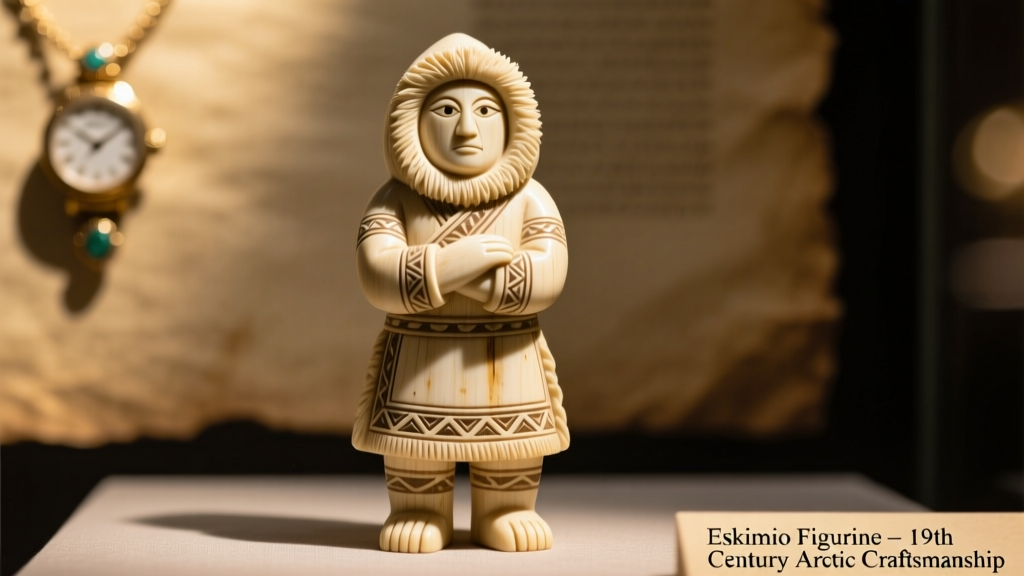
Eskimo Figurine: Human Arms Crossed on Torso, Feet Joined — Authentic 9¾-Inch Ivory Carving from the Early 20th Century
The H. G. Co. Petticoat Insulator in Lime Green: A Collector’s Deep Dive into Rarity, Chemistry, and Market Value
The 1948 Harry Truman Campaign Postcard: A Collectible Artifact of American Political History
Firefighting Helmet Leather Shield & Metal Components: A Collector’s Guide to Authenticity, Provenance, and Value
The 1951 B.F. Goodrich Paper Catalog: A 58-Page Window into Mid-Century Automotive Culture and Industrial Design
Northwood Apple Blossom Netted Milk Glass Cruet Set: Identification, Provenance, and Market Value
Fiesta Creamer Yellow Individual #2: A Collector’s Deep Dive into Shape, Glaze, and Provenance
John B. Adam: The Forgotten Master of British Art Deco Watchmaking