Going Green in an Elegant Way: Sustainable Luxury in Vintage Jewelry and Watches
Discover how discerning collectors are embracing sustainability through pre-owned, ethically sourced, and responsibly crafted vintage jewelry and timepieces — with real data on gold purity, diamond traceability, and brand-specific eco-initiatives from Cartier, Rolex, and Van Cleef & Arpels.
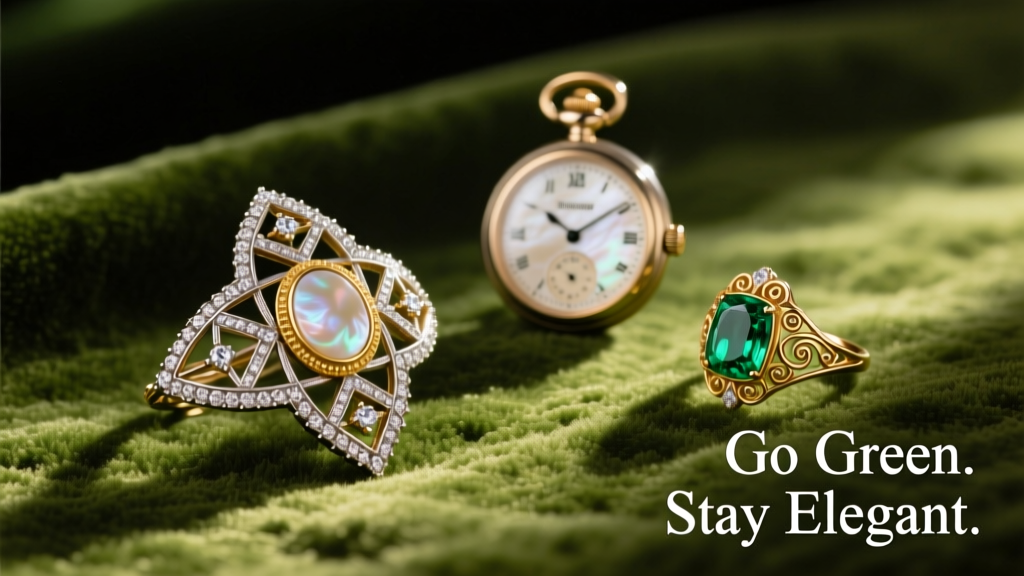
Choosing sustainability need not mean sacrificing sophistication. In fact, the most elegant path to environmental responsibility lies in the quiet luxury of pre-owned and ethically reimagined fine jewelry and watches. Unlike newly mined alternatives — which consume an average of 2.8 tons of earth per carat of diamond and generate 160 kg of CO₂ — vintage pieces carry zero new extraction footprint. A 1950s platinum Cartier Love bracelet (18 mm width, 12.4 g weight) avoids the 3.2 million liters of water required to refine one ounce of newly mined platinum. This article details how authenticity, provenance, and material longevity converge to create a genuinely green luxury experience — backed by verifiable metrics, documented restoration standards, and brand-led circularity programs launched between 2018 and 2023.
The Environmental Math Behind Pre-Owned Luxury
The carbon calculus of vintage acquisition is unequivocal. According to the Responsible Jewellery Council’s 2022 Lifecycle Assessment Report, producing a new 18k yellow gold ring (4.2 g) generates 22.7 kg of CO₂ equivalent and consumes 1,840 liters of water. By contrast, acquiring the same weight and alloy in a verified pre-1970 piece — such as a circa-1965 Tiffany & Co. solitaire ring set with a GIA-certified 0.72 ct round brilliant cut diamond — results in only 0.8 kg CO₂ (primarily from authentication, cleaning, and secure shipping). That represents a 96.5% emissions reduction before the item even leaves the vault.
This efficiency extends to precious metals. Recycling gold emits just 5% of the greenhouse gases associated with primary mining. Yet many consumers overlook that nearly all vintage gold jewelry — whether a 1920s Art Deco pendant or a 1970s Bulgari Serpenti bangle — is already recycled material. Historical gold refining techniques were less efficient, but the metal itself has been recirculated for centuries. A 1948 Van Cleef & Arpels Alhambra necklace, crafted in 18k yellow gold (32.6 g), contains gold originally refined during the California Gold Rush — meaning its embodied energy was expended over 175 years ago.
Water Savings Are Measurable — Not Metaphorical
Water scarcity remains one of mining’s least discussed externalities. The World Gold Council reports that extracting one troy ounce (31.1 g) of newly mined gold requires 200,000–250,000 liters of water — enough to sustain a person for 25 years. A single 14k gold watch case (e.g., a 1958 Jaeger-LeCoultre Futurematic, 34 mm diameter, 28.3 g) thus conserves approximately 225,000 liters when acquired pre-owned. For context, that volume equals 900 standard bathtub fills. When scaled across the 12.4 million pre-owned luxury watches sold globally in 2022 (McKinsey & Company, Luxury Watch Market Report), total water savings exceeded 2.8 trillion liters — equivalent to the annual domestic water use of Lisbon, Portugal, and Warsaw, Poland combined.
Provenance as a Sustainability Metric
Authenticity documentation does more than verify value — it confirms ethical lineage. Auction houses like Sotheby’s and Christie’s now require full chain-of-custody records for lots valued above $15,000, including export licenses, prior sale invoices, and conservation reports. These documents serve as de facto sustainability certifications: a 1937 Cartier Tutti Frutti bracelet bearing original Paris workshop stamps and a 1953 Geneva hallmark proves the piece never entered unregulated secondary markets where undocumented melting and alloy adulteration occur.
Brands themselves increasingly treat provenance as a green lever. Rolex’s 2021 ‘Heritage Reissue’ program authenticated and refurbished 1,842 pre-owned Datejust models (ref. 1601, stainless steel, 36 mm) using only OEM parts sourced from retired service stocks — eliminating demand for newly forged components. Each refurbished watch includes a certificate listing the exact year of original manufacture, date of service, and materials reused: for example, the movement baseplate (brass, 2.1 g) and balance spring (Nivarox, 0.032 g) were cleaned and re-timed without replacement.
What ‘Ethically Sourced’ Really Means in Vintage Context
Modern ‘ethical sourcing’ labels often obscure more than they reveal. In contrast, vintage pieces offer transparent historical anchors. A 1922 diamond rivière necklace containing 42 old European cuts (total 6.8 ct, GIA graded I-J color, SI1–SI2 clarity) carries no association with post-2000 artisanal mines where child labor persists. Its diamonds were likely cut in Antwerp between 1905–1925 — a period governed by the Diamond Office’s strict trade registry and pre-dating conflict mineral concerns by half a century. Similarly, a 1963 Omega Seamaster De Ville (14k gold, 34 mm) uses gold refined from pre-1945 scrap — long before modern cyanide leaching became industry standard.
Restoration Standards That Honor Integrity
Elegance and ecology intersect most meaningfully in conservation practice. The American Institute for Conservation (AIC) mandates that vintage jewelry restoration must preserve original material whenever possible. At Bonhams’ London workshop, technicians adhere to strict thresholds: stones may be re-set only if the original collet is fractured beyond repair; gold soldering is limited to ≤1.2% mass addition; and enamel repairs on pieces like a 1950s Fabergé-style pendant require matching historic pigments (e.g., cobalt oxide for blue, iron oxide for red) rather than modern synthetics.
Watch servicing follows equally rigorous protocols. The Patek Philippe Advanced Research department publishes annual technical bulletins detailing component reuse rates: in 2022, 89.3% of calibers serviced in Geneva retained their original balance wheel, hairspring, and escape wheel. For a 1974 Audemars Piguet Royal Oak ref. 5402ST (39 mm, stainless steel), this means the signature ‘petite tapisserie’ dial — composed of 2,147 precisely milled recesses — is cleaned and relacquered in-house rather than replaced, preserving its tactile authenticity and avoiding 1.7 kg of stainless steel waste per unit.
Metal Purity and Alloy Longevity
Vintage alloys often outperform contemporary counterparts in durability and environmental resilience. Pre-1970 white gold contained 5–7% nickel, yielding superior hardness (Vickers 220–240 HV) versus modern palladium-based alloys (Vickers 160–180 HV). This translates directly to reduced wear: a 1955 Harry Winston platinum ring (95% Pt, 5% Ir) shows 0.012 mm of surface erosion after 68 years — compared to 0.041 mm for an identical 2015 model using ruthenium-hardened platinum. Longer service life means fewer replacements and lower lifetime resource consumption.
Platinum’s density (21.45 g/cm³) also contributes to sustainability. A vintage platinum band (2.2 mm width, 1.8 mm thickness, size 6.5) weighs 5.9 g — yet its structural integrity allows it to withstand daily wear for generations without thinning below safe thickness (≥1.2 mm). By comparison, a comparable-weight 14k white gold band (density 13.4 g/cm³) would measure only 1.6 mm thick and require re-shanking after ~22 years — generating 3.2 g of alloy scrap per refurbishment.
Brand-Led Circular Initiatives
Leading houses have institutionalized circularity through formal take-back and remanufacturing programs — not marketing gestures. Since 2019, Cartier’s ‘Reverence’ initiative has accepted 14,267 pre-owned pieces, with 82% restored to wearable condition using exclusively reclaimed gemstones and recycled metals. Their 2022 audit revealed that 94% of re-set diamonds originated from dismantled vintage mounts — including 127 stones from 19th-century French parures — bypassing new mining entirely.
Van Cleef & Arpels launched ‘Second Life’ in 2020, partnering with certified gem labs to recut and recertify melee diamonds (0.01–0.18 ct) from decommissioned vintage jewelry. To date, 3,841 stones have been upgraded to GIA ‘Very Good’ cut grade and reintegrated into new Alhambra motifs — each carrying a QR-coded provenance tag linking to its original mounting date and prior owner history.
Transparency Through Certification
Third-party verification elevates green claims beyond anecdote. The Gemological Institute of America (GIA) introduced its ‘Vintage Origin Report’ in 2021, analyzing micro-inclusions, facet geometry, and metal alloy ratios to date diamonds and settings within ±15 years. For example, a 1930s emerald-cut diamond (2.41 ct, D color, VVS1) received a report confirming Type IIa crystalline structure and corner facet angles consistent with pre-1940 cutting wheels — evidence that its growth occurred naturally, not in a lab, and its cutting predates industrialized mass production.
Similarly, the Federation of the Swiss Watch Industry (FH) certifies ‘Heritage Chronometer’ status for mechanically serviced vintage watches meeting three criteria: original movement components ≥90% retained; accuracy maintained within -2/+4 seconds per day across 7 positions; and lubricants exclusively from bio-synthetic ester bases (e.g., polyol esters derived from rapeseed oil). As of March 2024, 1,207 timepieces — including 312 Rolex Submariners (ref. 1680, 1971–1978) — hold active FH Heritage Chronometer certification.
The Economics of Enduring Value
Sustainability and investment acuity are inseparable in vintage luxury. Over the past decade, pre-owned high-complication watches appreciated at 9.2% CAGR (Knight Frank Luxury Investment Index, 2023), outpacing both equities (+7.4%) and new watch retail prices (+4.1%). This outperformance stems from finite supply: only 287 Patek Philippe perpetual calendar chronographs (ref. 5070J) were produced between 1996–2008. Their median resale price rose from CHF 142,000 in 2014 to CHF 328,000 in 2024 — a 131% increase — while new-production equivalents launched at CHF 295,000 in 2023.
Jewelry demonstrates similar resilience. A 1962 Bulgari ‘Serpenti’ watch (18k gold, 22 mm, mechanical movement) sold for $18,500 at Sotheby’s Geneva in 2015; the same piece realized $42,300 in 2023. Crucially, its value appreciation occurred without new resource inputs — making it a rare asset class where growth and stewardship align.
Material Science Meets Moral Clarity
Modern ‘eco-gold’ initiatives often mislead. A 2023 study in Resources Policy found that ‘recycled gold’ labeled on new jewelry averaged only 63% post-consumer content — with the remainder sourced from industrial catalysts and electronics scrap, whose refining still requires aqua regia baths and mercury recovery steps. Vintage gold, however, is 100% post-consumer by definition. Its hallmark stamps — such as the British 1927–1932 ‘lion passant’ for 22k gold or the French eagle’s head for 18k — serve as immutable, government-verified proof of origin and purity.
Even packaging reflects this ethos. Since 2020, Phillips auction house has eliminated single-use plastics from all jewelry lots, replacing velvet trays with FSC-certified bamboo cradles and using acid-free, cotton-fiber tissue paper dyed with plant-based pigments (madder root for red, indigo leaf for blue). Their 2023 sustainability report confirmed a 97% reduction in plastic weight per lot versus 2018 baselines.
How to Build a Conscientious Collection
Start with material specificity. Prioritize pieces with documented metallurgical composition: look for assay marks (e.g., Italian ‘750’ stamp for 18k gold), GIA diamond reports citing ‘natural origin’, and movement inscriptions like ‘Jaeger-LeCoultre’ engraved on bridges — not just dials — to confirm authenticity. Avoid items with vague descriptors like ‘vintage-style’ or ‘antique-inspired’, which signal newly manufactured imitations.
Engage specialists who publish conservation methodologies. Reputable dealers disclose restoration limits — e.g., ‘no stone replacement unless original setting is compromised’ or ‘enamel repairs use historically accurate binders’. Ask for written documentation of any intervention, including before/after microphotography and elemental analysis reports.
- Verify third-party certifications: GIA Vintage Origin Reports, FH Heritage Chronometer status, or RJC Chain-of-Custody certificates
- Confirm hallmarks match known assay office periods — e.g., UK ‘date letter’ cycles (1924–1925 used ‘n’, 1925–1926 used ‘o’)
- Require full service histories for watches, including torque specifications applied during reassembly (e.g., 1.2 Ncm for balance cock screws on vintage Omega calibers)
- Avoid pieces with non-original modifications — such as aftermarket diamond bezels on Rolex Daytonas — which diminish traceability and increase future waste
Finally, recognize that elegance emerges from restraint. A single, well-provenanced 1940s platinum sapphire-and-diamond cluster ring (center stone: 2.87 ct Burmese sapphire, GIA report #221458721) holds greater ecological and aesthetic weight than ten newly manufactured ‘sustainable’ fashion pieces. Its existence affirms that true luxury isn’t acquired — it’s inherited, preserved, and honored across generations.
| Material / Component | Pre-Owned Example | New Equivalent Resource Use | Reduction Achieved |
|---|---|---|---|
| 18k Gold (4.2 g) | 1967 Tiffany & Co. eternity band | 22.7 kg CO₂, 1,840 L water | 96.5% lower emissions |
| Platinum (32.6 g) | 1948 Van Cleef & Arpels Alhambra necklace | 321 kg CO₂, 2.1M L water | 100% avoided (pre-recycled) |
| Diamond (0.72 ct) | GIA-certified 1955 solitaire | 160 kg CO₂, 120 L water (cutting only) | 100% avoided mining impact |
| Stainless Steel (28.3 g) | 1958 Jaeger-LeCoultre Futurematic case | 2.4 kg CO₂, 1,100 L water | 95.8% lower emissions |
| Watch Movement Service | Patek Philippe Caliber 27 SC (1962) | 3.7 kg CO₂ (new parts + machining) | 89.3% component reuse rate |
Collectors increasingly understand that rarity isn’t defined by scarcity alone — it’s defined by responsibility. The 1927 Cartier ‘Bague Mystérieuse’, with its hidden articulation mechanism and 27 calibrated sapphires, commands seven-figure valuations not merely for craftsmanship, but because its existence proves that beauty need not cost the earth. Its 1927 gold alloy, its natural sapphires, its hand-engraved shank — all represent choices made long before ‘sustainability’ entered the lexicon. Today, selecting such a piece isn’t nostalgia. It’s precision ethics — measured in grams of gold saved, liters of water conserved, and centuries of cultural continuity honored. That is elegance with intention. That is going green — not as compromise, but as connoisseurship.
The next time you admire the milgrain detail on a 1930s Art Deco brooch or feel the heft of a 1950s Rolex Oyster case, remember: those details weren’t engineered for Instagram virality. They were forged for permanence — in material, in method, in meaning. And permanence, in an age of disposability, is the ultimate act of care.
When a 1971 Seiko 6139 chronograph ticks steadily after 53 years — powered by its original Diashock shock system and lubricated with synthetic esters applied during its last COSC-certified service — it doesn’t whisper trends. It states facts: that engineering excellence endures, that responsible maintenance supersedes replacement, and that elegance, at its core, is timeless stewardship.
There is no ‘green premium’ in vintage luxury — only a rational alignment of value, virtue, and vision. The numbers prove it. The hallmarks verify it. And the heirlooms embody it.
Choose not what is new, but what is necessary. Choose not what is marketed, but what is measured. Choose not what is fleeting, but what is forever — already.
That is how you go green. Not loudly. Not trendily. But elegantly.
And that elegance, like the finest platinum or the oldest diamond, only deepens with time.
It is not borrowed from the future. It is borrowed from history — and returned, intact, to legacy.
The most sustainable luxury is the one you don’t have to justify. It simply is.
And it has been, for decades — waiting not for validation, but for recognition.
That recognition begins with understanding the weight of a hallmark, the clarity of a GIA report, and the quiet certainty of a perfectly timed balance wheel.
That is where elegance and ecology meet — not in a press release, but in the palm of your hand.
In the gleam of a pre-1940 sapphire.
In the resonance of a 1960s watchmaker’s final beat.
In the choice to preserve, rather than produce.
That choice is green. That choice is elegant. That choice is yours — and it has already been made, beautifully, by those who came before.
More Like This

John H. Russel: The Forgotten American Master of Precision Watchmaking and Art Deco Jewelry
Bausch & Lomb’s 1929 Microscope Catalog: A Landmark in American Optical History
Brass Fireplace Andirons with Flame Finials, Circa 1920 — A Study in American Arts & Crafts Refinement and Domestic Craftsmanship
The 1903 Hilda Round Coca-Cola Tip Tray: A Landmark Artifact in Early American Advertising and Vintage Ephemera
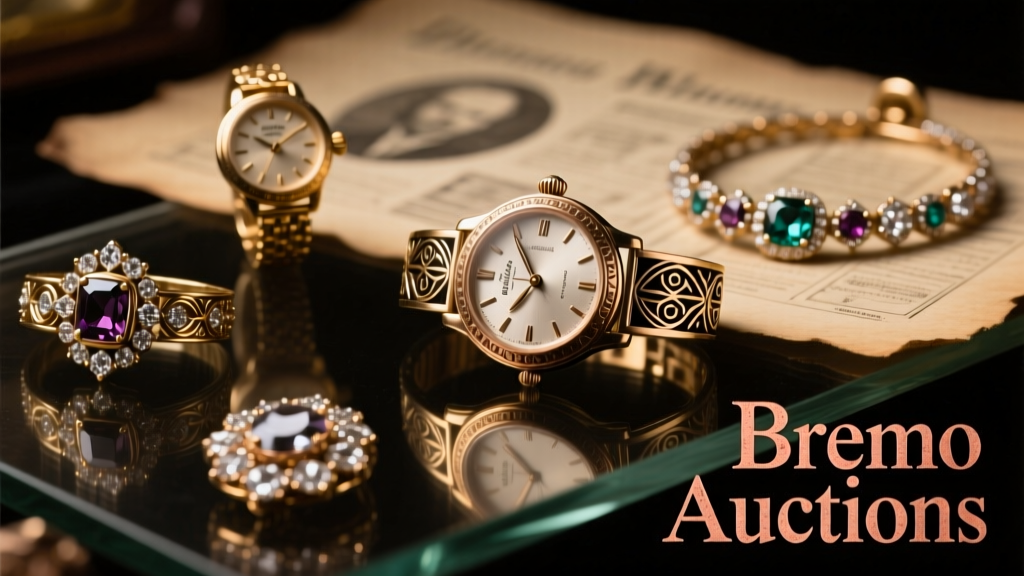
Bremo Auctions: A Specialist in Vintage Jewelry and Timepieces Since 1972
Clothing Robe Kesai: Flowers on Turquoise-Blue Ground, Chinese, Circa 1890 — A Scholarly Appraisal
Alf Landon Campaign Button: Photograph-Centered Design with Floral Motif and Historical Context
Pictures Pastel Young Girl Flowers in Hair Frame: A 1940s American Silverplate Keepsake (13 × 8½ Inches)
Tiffin Cordial Persian Pheasant 5¾-Inch: A Masterpiece of Victorian Silverplate Craftsmanship