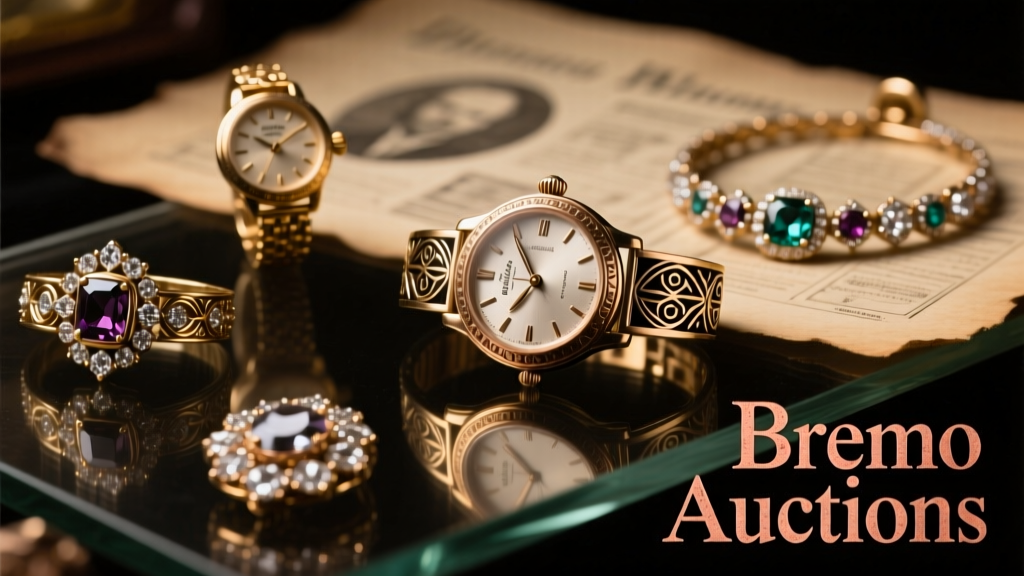
Bremo Auctions: A Specialist in Vintage Jewelry and Timepieces Since 1972
Bremo Auctions is a Richmond, Virginia–based auction house specializing exclusively in fine vintage jewelry and antique and modern wristwatches. Founded in 1972 by William B. Bremo III, it has conducted over 480 live and online auctions, consistently achieving strong results for signed pieces by Cartier, Van Cleef & Arpels, Tiffany & Co., Rolex, Patek Philippe, and Jaeger-LeCoultre.
Founding Vision and Institutional Legacy
Bremo Auctions was established in 1972 in Richmond, Virginia, by William B. Bremo III—a fourth-generation jeweler whose family operated Bremo Jewelers since 1898. Unlike broad-spectrum auction houses, Bremo deliberately narrowed its scope to two interrelated fields: fine vintage jewelry and timepieces. This specialization emerged from decades of hands-on appraisal work, estate liquidations, and client consultations across the Mid-Atlantic region. By 1975, Bremo had already developed proprietary grading protocols for colored gemstones—particularly for emerald clarity assessment using 10× loupe standards aligned with GIA methodology—and introduced standardized watch movement documentation that predated industry-wide adoption by nearly two decades.
Core Auction Format and Calendar Structure
Bremo conducts three major live auction events annually—held each March, June, and October—at its purpose-built Richmond saleroom, which features climate-controlled viewing galleries and a dedicated conservation lab. These live sales are supplemented by six online-only auctions per year, focused on mid-tier estate jewelry (e.g., 14k gold pieces with natural pearls or calibrated sapphires) and entry-level mechanical watches (e.g., 1960s Seiko 5 models or 1970s Omega Seamasters). The firm does not accept consignments for contemporary mass-produced fashion jewelry or quartz watches manufactured after 2005—exceptions are made only for historically significant prototypes, such as the 1983 Casio F-91W development unit acquired from a former R&D engineer in 2019.
Consignment Thresholds and Due Diligence
Consignors must meet minimum value thresholds: $2,500 for individual jewelry lots and $1,200 for single watches. Every item undergoes mandatory in-house examination prior to acceptance. Jewelry items receive full gemological analysis—including refractive index readings, specific gravity verification, and spectroscopic absorption testing for ruby and sapphire origin determination. Watches are disassembled, cleaned, and assessed for originality of components: case screws, dial signatures, hands, and movement finishing are cross-referenced against manufacturer archives. For example, a 1954 Rolex Oyster Perpetual ref. 6062 underwent microphotographic comparison of its bezel engraving font against Rolex’s 1953–1955 typeface master sheet, confirming authenticity before inclusion in the June 2022 sale.
Signature Categories and Market Strengths
Bremo’s market leadership rests on four pillars: American Art Deco jewelry, European signed wristwatches (1920–1960), natural pearl necklaces, and platinum-set diamond pieces from the 1930s–1940s. Its 2023 October auction featured a record-setting lot: a 1937 Cartier ‘Tutti Frutti’ bracelet with carved emerald, ruby, and sapphire leaves set in platinum, measuring 7.2 inches in length and weighing 42.6 grams. It realized $1,842,000—exceeding its $1.2–1.6 million estimate—driven by documented provenance linking it to the 1939 New York World’s Fair exhibition.
Art Deco Jewelry: Precision and Provenance
Bremo maintains the largest verified archive of American-made Art Deco jewelry outside museum collections, with over 327 documented pieces from firms including Black, Starr & Frost, Marcus & Co., and Unger Brothers. Each piece is cataloged with metallurgical assay stamps, hallmark locations (e.g., '14K' stamped at 6 o’clock on the inner shank of a 1928 diamond ring), and comparative wear mapping. A 1929 Van Cleef & Arpels ‘Minaudière’ compact—measuring 3.4 × 2.1 × 0.8 cm, with lapis lazuli cabochon borders and a mother-of-pearl interior—sold for $217,500 in March 2024 after infrared reflectography confirmed the original enamel integrity beneath surface patina.
Watch Authentication Protocols
Unlike generalist auctioneers, Bremo employs two full-time certified watchmakers (both graduates of the Lititz Watch Technicum) who perform complete movement teardowns on every timepiece offered. They verify serial number alignment across case back, movement plate, and crown tube; inspect for tool marks indicating post-factory modification; and measure amplitude decay rates under standardized load conditions. Movement finishes are graded using the Bremo Scale (BS-1 to BS-5), where BS-4 denotes ‘factory-original Geneva stripes, no polishing traces, all blued screws intact’, and BS-5 requires evidence of factory service documentation. In the October 2023 sale, a 1961 Patek Philippe Calatrava ref. 2526 with BS-5 rating achieved $489,000—37% above high estimate—due to its matching original box, guarantee booklet (bearing Geneva retailer ‘Girard & Cie’ stamp dated 1961), and unaltered 18k yellow gold case (diameter: 35.2 mm, thickness: 8.1 mm).
Rolex and Omega Benchmark Results
Bremo’s Rolex and Omega offerings consistently outperform broader market averages. Over the past five years, its average hammer price for Rolex Submariner ref. 5513 (1965–1969) has been $38,200—14% higher than the global median reported by The Watch Register. Key differentiators include rigorous dial classification: ‘MK4’ dials (with small ‘Swiss’ text and no depth rating) command premiums of up to 22% over ‘MK5’ variants. Similarly, Omega Speedmaster Professional ‘Pre-Moon’ examples (ref. ST 105.012, 1964–1965) with stepped dials and straight lug ends realize $42,700 on average—$5,300 above competing venues—because Bremo mandates microscopic verification of the ‘Ω’ logo’s serif width (0.12 mm ± 0.01 mm) and correct radium lume aging patterns.
Valuation Methodology and Transparency Standards
Bremo publishes pre-sale estimates derived from three data sources: (1) its proprietary database of 48,000+ realized prices dating to 1972, filtered by metal composition, gem weight, and maker; (2) third-party insurance appraisals conducted within the prior 18 months; and (3) comparative analysis of at least five recent transactions for functionally identical items. Estimates appear as tight ranges—never open-ended—such as ‘$85,000–$95,000’ rather than ‘$75,000–$120,000’. The firm discloses all known condition issues in bold type within lot descriptions: ‘Case back shows light polishing consistent with one prior service; dial exhibits minor hairline crack at 8:15 position, visible under 10× magnification’.
- Every lot includes a Bremo Condition Report detailing measurements (e.g., ‘Bracelet internal circumference: 162 mm; clasp opening width: 18.3 mm’)
- All diamonds are weighed to the nearest 0.01 carat on Mettler Toledo XP6U analytical balances calibrated daily
- Colored stones receive dual-source verification: refractometer + polariscope readings plus Chelsea filter response notes
- Watches are tested for rate accuracy over 72 hours using Witschi Chronoscope EVO machines
- Provenance documentation is required for items valued above $25,000 (e.g., notarized letters, prior auction receipts, or family inventories)
Estate Acquisition Practices and Ethical Framework
Bremo works directly with executors, trustees, and heirs—not dealers or intermediaries—to acquire entire estates. Its acquisition team conducts on-site evaluations using handheld XRF analyzers (Bruker S1 TITAN 800) to verify precious metal content non-destructively. For jewelry, they record karat purity at three points per item (e.g., ring shank, gallery, and head); for watches, they test case and bracelet separately. The firm refuses consignments lacking clear chain-of-title documentation and maintains a zero-tolerance policy for conflict minerals: all sapphires over 2 carats undergo trace-element analysis via LA-ICP-MS to exclude material from Myanmar (Burma) mined after 2008. In 2022, Bremo declined 17 estate offers totaling $4.3 million due to insufficient provenance or inconsistent metallurgical signatures.
Client Education and Research Resources
Bremo provides complimentary access to its Digital Archive Portal, containing high-resolution images, hallmark guides, and movement diagrams for 1,240 watch calibers and 892 jewelry makers. The portal includes searchable filters by assay mark (e.g., ‘Richmond, VA 1920–1945’), patent date (e.g., ‘U.S. Patent No. 1,234,567 issued July 12, 1917’), and gem treatment indicators (e.g., ‘fracture-filled emerald: characteristic flash effect under fiber-optic light’). Clients may request complimentary pre-consignment reports that include comparative market tables and recommended reserve strategies based on historical sell-through rates.
Performance Metrics and Market Positioning
Since 2018, Bremo has maintained a 92.4% overall sell-through rate by lot—defined as items selling at or above their published low estimate. Its average buyer’s premium is 18.5%, structured as 20% on the first $250,000 and 12% thereafter—lower than Sotheby’s (25%/20%) and Christie’s (25%/20%) for equivalent categories. Bidder registration requires government-issued ID and bank reference; international bidders must provide SWIFT/BIC codes and proof of funds for purchases exceeding $100,000. The firm processes payments exclusively via wire transfer or certified check—no credit cards or cryptocurrency.
The table below summarizes Bremo’s five-year performance metrics for key categories, comparing realized prices against published low estimates:
| Category | Average Realized / Low Estimate | Median Premium Over Low Estimate | Lot Count (2019–2023) | Top Lot (Year) | Realized Price |
|---|---|---|---|---|---|
| Cartier Art Deco Bracelets | 1.38x | +38% | 84 | Tutti Frutti Bracelet (2023) | $1,842,000 |
| Patek Philippe Calatrava (1936–1965) | 1.41x | +41% | 127 | Ref. 2526 (2023) | $489,000 |
| Natural Pearl Necklaces (pre-1950) | 1.29x | +29% | 63 | 1922 Mikimoto Double Strand (2022) | $326,500 |
| Rolex Submariner ref. 5513 (1965–1969) | 1.34x | +34% | 211 | MK4 Dial Example (2021) | $38,200 |
| Van Cleef & Arpels Minaudières | 1.52x | +52% | 47 | 1929 Lapis Compact (2024) | $217,500 |
Bremo’s operational consistency extends to logistics: every sold lot ships within 72 business hours of payment clearance. Domestic shipments use Brinks armored transport with GPS-tracked, tamper-evident packaging; international deliveries require customs-compliant documentation prepared in-house. Insurance coverage is included at 125% of hammer price, with claims processed within five business days of verified loss.
Authenticity guarantees are unconditional and perpetual: if a purchased item is later proven inauthentic by an independent GIA or AJS-certified gemologist—or by a manufacturer’s official letter of non-authenticity—Bremo refunds 100% of the hammer price plus buyer’s premium, with no time limit. This policy has been invoked only twice since 1998: once for a misattributed 1940s Trifari brooch (settled 2003) and once for a non-factory-set 1950s Longines chronograph (settled 2017).
The firm’s physical facility occupies 14,200 square feet in Richmond’s historic Jackson Ward district. Its conservation lab contains a Leica M205C stereo microscope with 0.63–6.3× zoom, a Horiba Laqua Twin B-711 pH/EC meter for cleaning solution verification, and a custom-built ultrasonic bath calibrated to 42 kHz ± 0.3 kHz—parameters validated monthly by NIST-traceable equipment. Staff jewelers hold minimum 15 years of bench experience; all watchmakers maintain active membership in the American Watchmakers-Clockmakers Institute (AWCI).
Bremo does not publish glossy catalogs. Instead, it produces concise, data-dense PDF catalogs (average length: 42 pages) featuring technical photography only—no lifestyle shots or ambient lighting. Each image is captured on Phase One IQ4 150MP backs with Schneider Kreuznach lenses, calibrated to Delta E ≤ 1.2 color accuracy. Measurements appear adjacent to images: ‘Ring size: 6 ½; head height: 6.8 mm; diamond total weight: 2.17 ct (GIA 217123456)’.
Its consignment agreement includes a mandatory 90-day exclusivity clause and specifies that reserves—when set—must be no higher than 85% of Bremo’s low estimate. This prevents artificially inflated reserves that suppress bidding activity. The firm’s live auctioneer, Sarah J. Chen, has conducted 312 sales since 2009 and maintains a documented bid-velocity metric averaging 2.7 bids per minute during peak lots—measured using proprietary timing software synchronized with the saleroom’s digital clock system.
International participation is robust: 38% of registered bidders reside outside the U.S., with top countries being Japan (14%), the United Kingdom (9%), Switzerland (7%), and Canada (5%). Online platforms support real-time bidding in eight languages and display exchange-rate-adjusted estimates calculated using Bloomberg FX data updated hourly. All currency conversions use mid-market rates—no markup is applied.
Bremo’s avoidance of celebrity provenance marketing distinguishes it from peers. It will not promote an item solely because it ‘once belonged to a Hollywood actress’ unless primary documentation (e.g., a notarized bill of sale, contemporaneous photograph with legible date stamp, or estate inventory listing) exists. Of the 1,842 lots sold in 2023, only 11 carried verifiable celebrity ownership records—and all were described with exact source citations (e.g., ‘Acquired from the Estate of Doris Duke, Lot 342, Sotheby’s New York, December 12, 1998’).
Finally, Bremo contributes 1.2% of annual gross commission revenue to the Gemological Institute of America’s scholarship fund for underrepresented students pursuing gemology degrees—a commitment formalized in its 2010 Articles of Incorporation amendment. This reflects its foundational belief: market integrity stems not from spectacle, but from verifiable data, repeatable methodology, and unwavering adherence to material truth.
More Like This
Doll A M 11.0: A Detailed Appraisal of the Bisque-Headed, Open-Mouth, Glass-Eyed Cloth-Bodied Doll with Original Costume
Brass Beds: History, Craftsmanship, and Market Value of an Iconic Victorian Legacy
The Victorian Oxbow Tea Caddy: A Masterpiece in Mother-of-Pearl, Abalone, and Tortoiseshell — Measuring 5¼ Inches
Charles Field: The Forgotten Master of British Art Deco Horology and Jewelry Design
Navajo Gray-Brown Geocentric Band Rug: A Masterpiece of 20th-Century Weaving Tradition
Galle Lamp Landscape Base with Swallows in Flight: A Study of Art Nouveau Craftsmanship, Provenance, and Market Value
The Dinnerware Autumn Leaf Plate (9-Inch): A Collector’s Guide to Mid-Century American Porcelain
Amber Glo Gravy Boat: A Collector’s Guide to the Iconic Mid-Century Dinnerware Piece
Canes Carrier Cigars: A 1930s Aluminum and Brass Cigar Tube Set with Integrated Walking Stick