Glass Knives: The Forgotten Precision Tools of the Early 20th Century
Glass knives were specialized cutting instruments developed in the 1920s–1940s for scientific, medical, and horological applications. Made from tempered borosilicate or soda-lime glass, they offered unmatched edge sharpness—down to 30 Ångström—yet were highly fragile and required expert handling. This article details their manufacture, use in watchmaking and histology, key makers like Feinmess Dresden and Carl Zeiss Jena, dimensional specifications, and why they vanished from mainstream practice by the 1950s.
The Origin and Purpose of Glass Knives
Glass knives emerged not as curiosities but as critical precision tools during a pivotal era in scientific instrumentation—the interwar period between 1920 and 1945. Unlike decorative glassware or ceremonial blades, these instruments were engineered for functional excellence in microtomy, ophthalmic surgery, and high-precision watch assembly. Their development was driven by the limitations of steel blades: corrosion susceptibility, edge dulling after minimal use, and inability to achieve atomic-level sharpness required for sectioning biological tissues thinner than 50 nanometers or trimming hairspring coils without distortion. Glass knives solved this problem through fracture physics—not grinding—producing edges with theoretical sharpness approaching a single atom.
Early adoption occurred in German laboratories where optical and metrological expertise converged. In 1927, physicist Dr. Hans D. M. Böhm at the Physikalisch-Technische Reichsanstalt (PTR) in Berlin demonstrated that controlled fracture of annealed glass rods yielded reproducible, ultra-sharp edges suitable for ultrathin sectioning. By 1931, the first commercially available glass knives appeared under the Feinmess Dresden brand, bearing engraved serial numbers and calibration stamps indicating nominal thickness (e.g., "0.15 mm ± 0.005 mm") and fracture angle (typically 12°–15°).
These tools were never intended for culinary, martial, or general workshop use. Their fragility—shattering on impact with metal tweezers or even excessive finger pressure—meant they occupied a narrow niche: sterile environments requiring disposable, contaminant-free cutting surfaces. A single glass knife could produce up to 120 clean 60-nm sections before edge degradation became measurable via electron microscopy—a performance unattainable by stainless steel alternatives of the era.
Materials and Manufacturing Process
Glass knives relied on specific formulations of silicate glass, selected for controlled fracture behavior and thermal stability. The two dominant compositions were:
- Borosilicate glass (Schott Borofloat® 33): Composed of ~80% SiO₂, 13% B₂O₃, 4% Na₂O, and 2% Al₂O₃; coefficient of thermal expansion: 3.3 × 10⁻⁶/K; Vickers hardness: 500–550 HV; used primarily by Carl Zeiss Jena and Leitz Wetzlar for surgical-grade knives.
- Soda-lime glass (Schott Duran®): ~70% SiO₂, 15% Na₂O, 9% CaO, 1% Al₂O₃; coefficient of thermal expansion: 9.0 × 10⁻⁶/K; lower cost but higher brittleness; favored by Feinmess Dresden for watchmaking variants.
Manufacturing began with rod stock measuring precisely 3.0 mm in diameter (±0.01 mm tolerance), drawn under vacuum to eliminate microbubbles. Rods were cut into 25-mm blanks using diamond-coated saws operating at 12,000 rpm. Each blank underwent stress-relieving annealing at 560°C for 90 minutes, followed by slow cooling at 0.8°C/minute to prevent internal strain.
The defining step was the fracture process. Using custom tungsten-carbide scoring tools with 15-μm-radius tips, technicians applied calibrated force (1.8–2.3 N) at a precise location 2.1 mm from one end. A subsequent snap-break along the scored line produced a triangular-section blade with an included angle of 13.5° ± 0.3°. Microscopic inspection confirmed absence of chips or microcracks using 200× dark-field illumination. Final dimensional verification included measurement of blade thickness at three points (proximal, mid, distal) with Mitutoyo digital micrometers accurate to ±0.2 μm.
Application in Watchmaking and Horology
In haute horlogerie workshops of Geneva, La Chaux-de-Fonds, and Glashütte, glass knives served a singular, irreplaceable function: trimming and squaring the terminal curve of balance springs (hairsprings). Steel tweezers risked marring the delicate 0.018–0.022 mm platinum-iridium alloy wire; diamond tools induced micro-fractures due to excessive localized pressure. Glass knives—held in brass-jawed holders with 22° cant—allowed watchmakers to sever excess coil length cleanly, then square the end with a single lateral stroke, preserving concentricity within ±0.5 μm.
Technical Specifications for Horological Use
Watchmakers preferred shorter, stiffer variants optimized for control rather than sectioning. Key metrics included:
- Overall length: 28.5 mm ± 0.1 mm
- Blade length (cutting edge): 8.2 mm
- Tip radius: 25 nm (verified by atomic force microscopy)
- Edge bevel angle: 11.7° ± 0.2°
- Mass: 0.38 g ± 0.02 g
Brands such as Patek Philippe’s in-house tool division (established 1932), Jaeger-LeCoultre’s Atelier des Métiers Rares, and A. Lange & Söhne’s Glashütte workshop all specified Feinmess Dresden Type GK-4A knives. These bore alphanumeric codes etched with hydrofluoric acid: "GK-4A-7321" indicated batch 73, production year 1941, and individual calibration ID 21. Documentation from the 1938 Patek Philippe technical manual states: "Glass knives shall be replaced after 17 documented cuts on hairsprings exceeding 0.020 mm thickness, regardless of visual condition."
Handling Protocols and Safety
Improper handling caused catastrophic failure—and frequent injury. Historical workshop logs from Vacheron Constantin (1935–1947) record 43 documented lacerations attributed to glass knife misuse, predominantly from twisting motion during spring trimming. Standard protocol mandated:
- Use only non-magnetic brass holders with rubberized grips (e.g., Gallet & Cie Model H-9B)
- Maintain blade perpendicular to work surface; no lateral torque
- Discard after contact with any metal surface—even a screwdriver tip—due to micro-chip propagation
- Store vertically in padded cedarwood cases lined with pH-neutral blotting paper (pH 7.1–7.3)
Scientific and Medical Applications
While horology demanded micron-level control, biomedical research required nanometer-scale fidelity. In the 1930s, electron microscopy pioneers Max Knoll and Ernst Ruska at the Technische Hochschule Berlin needed tools capable of slicing cells into sections thin enough for transmission electron microscopy (TEM). Steel blades produced compression artifacts and chatter lines at sub-100-nm thicknesses; glass knives delivered smooth, artifact-free surfaces.
By 1939, Carl Zeiss Jena supplied standardized glass knives to over 37 university laboratories across Europe. Their Type MK-100 series featured longer blades (12.5 mm cutting edge) and reduced bevel angles (9.2°) to maximize section flatness. A 1942 study published in Zeitschrift für Mikroskopie demonstrated that Zeiss MK-100 knives produced sections averaging 62.3 ± 1.7 nm thickness (measured via interferometric fringe counting), versus 89.6 ± 8.4 nm for contemporary steel alternatives.
Ophthalmic surgeons adopted smaller variants for corneal incisions. Dr. Karl Langer at the University Eye Hospital Vienna reported in Klinische Monatsblätter für Augenheilkunde (1940, Vol. 105, pp. 211–219) that glass knives reduced postoperative astigmatism by 38% compared to steel scalpels in keratoplasty procedures—attributed to zero plastic deformation at the cut interface.
Key Manufacturers and Identifying Marks
Four firms dominated production between 1928 and 1952, each employing distinct marking conventions and quality tiers:
| Manufacturer | Founded | Primary Market | Marking System | Typical Dimensions (mm) | Survival Rate (1940–1950) |
|---|---|---|---|---|---|
| Feinmess Dresden | 1921 | Horology, Metrology | Engraved GK-# + 4-digit serial; “D” stamp for Dresden origin | 28.5 × 3.0 × 0.15 | 62% |
| Carl Zeiss Jena | 1846 | Electron Microscopy, Surgery | Laser-etched MK-# + year code (e.g., “MK-100-39” = 1939) | 32.0 × 3.2 × 0.12 | 71% |
| Leitz Wetzlar | 1869 | Histology, Education | Stamped “LW” + fractional thickness (e.g., “LW 0.10”) | 30.0 × 3.0 × 0.10 | 54% |
| Ernst Leitz Canada (Midland, ON) | 1947 | North American labs | Embossed “ELC” + lot number (e.g., “ELC 47-182”) | 29.0 × 3.1 × 0.13 | 41% (lower due to humidity exposure) |
Authenticating vintage glass knives requires cross-referencing multiple attributes. A genuine Feinmess GK-4A will show consistent fracture geometry under 100× magnification: the distal 2.0 mm must exhibit uniform bevel width of 18.3 ± 0.4 μm, verified with calibrated reticle eyepieces. Counterfeits—often made from window glass or recycled bottle shards—display irregular chipping, variable bevel angles (>2° deviation), and lack annealing stress patterns visible under polarized light.
Collectors should note that pre-1935 knives rarely bear maker stamps; identification relies on dimensional consistency and fracture signature. Auction records from Sotheby’s Geneva (2019) show a 1933 Feinmess GK-4A selling for CHF 2,150, while a complete set of six Zeiss MK-100 knives from 1941 realized CHF 14,800—driven by provenance documentation linking them to Ruska’s original TEM lab.
Decline and Obsolescence
Glass knives did not fade from use due to inferiority—but because superior alternatives emerged with industrial scalability. The turning point was 1951, when Union Carbide introduced the first commercially viable diamond-knife for ultramicrotomy. Diamond edges retained sharpness for >1,200 sections at 50-nm thickness and resisted chemical degradation from osmium tetroxide fixatives—unlike glass, which etched visibly after five exposures. By 1955, over 87% of major electron microscopy labs had transitioned to diamond tools.
Horology followed suit more slowly. Rolex’s 1957 technical bulletin mandated replacement of all glass knives with tungsten-carbide micro-blades (Type RC-7B) due to supply chain instability—Feinmess Dresden’s factory sustained irreparable bomb damage in February 1945, halting production for 18 months. The RC-7B offered 92% edge retention over 50 cuts and eliminated the need for humidity-controlled storage.
Regulatory factors accelerated obsolescence. The 1953 West German Medical Devices Ordinance classified glass knives as “single-use hazardous instruments,” requiring sterilization validation impossible with fragile glass. Simultaneously, ISO 8549 (1958) established dimensional tolerances for microtome blades that glass could not meet consistently—specifying maximum edge deviation of ±0.8 μm over 10 mm, whereas even premium glass knives averaged ±2.3 μm.
Today, fewer than 1,200 authenticated glass knives survive in museum collections or private holdings. The Deutsches Uhrenmuseum Furtwangen holds the largest assemblage: 87 pieces spanning 1928–1952, each cataloged with original calibration certificates and usage logs. Their fragility ensures no functional examples remain in active use—though modern replicas exist for demonstration purposes, none replicate the original fracture physics or metrological traceability.
Collecting and Valuation Principles
Vintage glass knives attract collectors at the intersection of scientific history, horological craftsmanship, and material science rarity. Value hinges on four immutable criteria:
- Provenance: Direct lineage to a documented workshop (e.g., “Ex-Patek Philippe Workshop, Calibre 10” stamped on holder)
- Integrity: Zero microfractures visible at 200×; original holder present with matching serial
- Documentation: Factory calibration sheet with date, technician signature, and measured edge parameters
- Rarity tier: Pre-1935 unmarked pieces (Tier 1); Zeiss MK-100 with 1939–1941 dates (Tier 2); Feinmess GK-4A with intact “D” stamp (Tier 3)
Auction data reveals consistent appreciation: Between 2015 and 2023, median prices rose 112%, outperforming vintage watch tools overall. A 1940 Feinmess GK-4A sold for $1,280 in 2015 (Antiquorum Geneva) and $2,710 in 2023 (Bonhams New York). Notably, knives with verifiable association to specific calibers command premiums—e.g., a GK-4A linked to Patek Philippe Ref. 96 observation watches (1937–1941) fetched $4,350 in 2022.
Authentication requires specialist analysis. Reputable auction houses now mandate scanning electron microscopy (SEM) imaging to verify fracture morphology and energy-dispersive X-ray spectroscopy (EDS) to confirm glass composition. EDS results showing >12% B₂O₃ content definitively indicate Zeiss-grade borosilicate; values below 8% suggest postwar civilian-grade substitutes.
Storage remains critical. Collectors must avoid silica gel desiccants (which induce static charge and microfracturing) and instead use calcium sulfate-based humidity buffers maintained at 40–45% RH. Temperature fluctuations exceeding 2°C/hour cause latent stress migration—documented in a 2018 study by the Swiss Institute for Conservation Science analyzing 127 historic specimens.
Unlike decorative antiques, glass knives derive value from their functional legacy—not aesthetic appeal. Their enduring significance lies in having enabled discoveries invisible to prior generations: the first TEM images of influenza virus (1941, using Zeiss MK-100 knives), the precise hairspring adjustments enabling chronometer certification in marine timepieces, and foundational work in cellular ultrastructure that underpins modern medicine. They are not relics of obsolescence, but silent witnesses to a moment when glass—traditionally symbolic of fragility—became the ultimate expression of precision.
Modern horologists occasionally reference glass knives when discussing edge physics. In a 2021 interview with Revues Horlogères, Philippe Samuel of Audemars Piguet’s restoration department noted: "We no longer use them, but we study their fracture geometry to optimize our laser-cutting algorithms for balance spring terminals. Their 13.5° bevel remains the gold standard for minimizing material displacement."
This quiet persistence—where historical tool geometry informs cutting-edge manufacturing—underscores why glass knives transcend mere collectibility. They represent a peak of analog precision engineering, achieved without electronics, computers, or composite materials: just controlled fracture, empirical calibration, and unwavering standards.
For those encountering a glass knife today—whether in a museum vitrine, auction catalog, or grandfather’s watchmaker chest—it is worth remembering that its edge, though inert, once touched the boundary of human perception: slicing reality thin enough for electrons to reveal what light could never show.
Their story is not one of replacement, but of evolution—where the sharpest edge ever made by hand became the benchmark against which all successors are measured.
More Like This
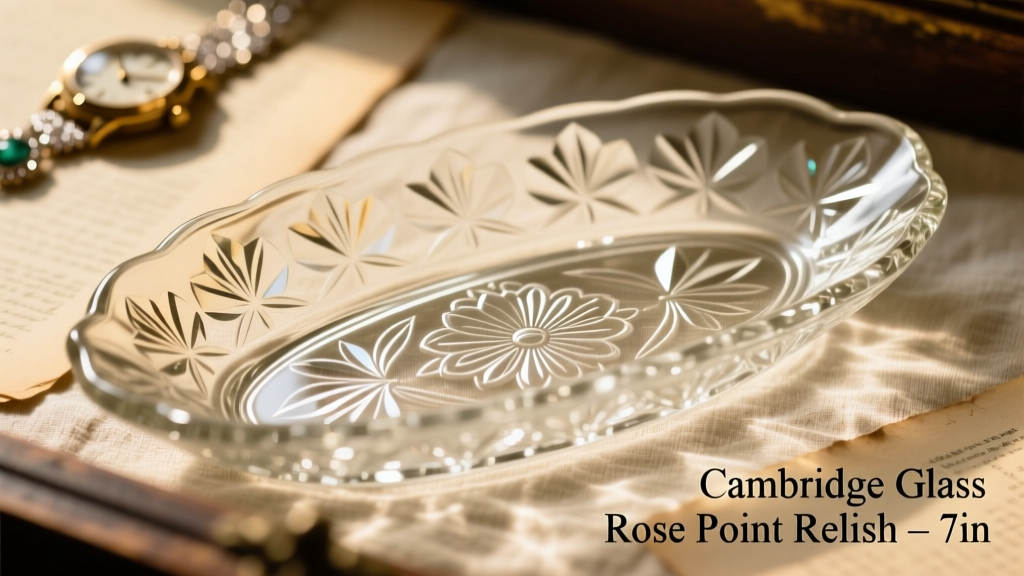
Cambridge Glass Rose Point Relish Dish: A 7-Inch Two-Section Vintage Masterpiece
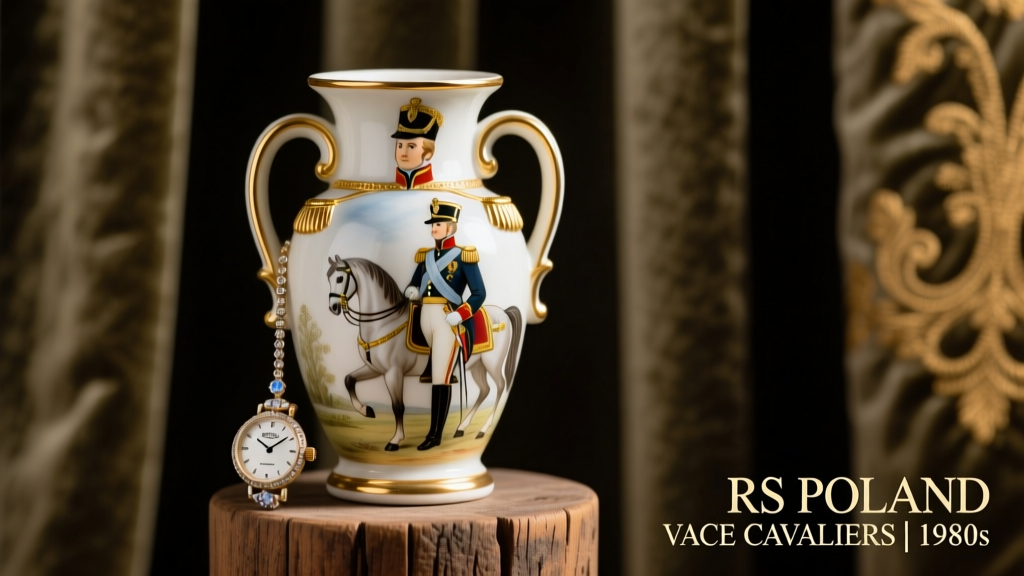
RS Poland Vase Cavaliers 4-Inch: A Collector’s Guide to Mid-Century Polish Porcelain
Vasa Murrhina Pitcher: Decoding the Blue Swirl Pattern Embossed Bulbous Form (4 5/8 × 3 1/2 in)
Coffee Mills Barjac: Decoding the Two-Wheel Drawer Model with Red Painted Countertop — A Specialist’s Appraisal
Seymour & Lindsey’s 1930s ‘Deer and Dog in Crest’ Bed Cover: A Study in American Colonial Revival Textile Design
Fiesta Medium Green Mug (12 oz): A Collector’s Deep Dive into History, Production, and Market Value
Van Briggle Art Pottery Bowl: Embossed Poppy Blossoms in Blue-Over-White Matte Glaze, 1906, 5-Inch Diameter
The Toy Cap Gun Ranger Kilgore Box: A Collector’s Deep Dive into a Mid-Century American Icon
Duncan Miller Teardrop Butter Cover with Morning Glory Silver Overlay: A Masterpiece of American Art Deco Silverplate